
Thermal adhesive TDS interpretation is often treated as a quick comparison exercise, but in real sourcing and engineering work, a technical data sheet only becomes useful when you connect the numbers to bond-line thickness, substrate type, curing conditions, assembly stress, and long-term reliability. A thermal adhesive that looks impressive because of one W/m·K value may still be a poor fit if its viscosity cannot hold the target gap, its cure profile disrupts production rhythm, or its mechanical behavior creates stress on fragile components during thermal cycling.
If your project involves heat dissipation, bonded assembly strength, or reliable gap filling across electronics, LED modules, battery parts, or power devices, it helps to review thermally conductive adhesive solutions for heat-control projects with a practical application lens rather than as a simple catalog exercise. At ZDS, we usually support customers by matching thermal conductivity targets with realistic bond-line control, substrate compatibility, cure behavior, electrical insulation needs, and sample validation planning so the selected material fits both the product and the production process.
Why buyers should not select a thermal adhesive from one number alone
Many buyers begin by scanning thermal conductivity first. That is understandable, because heat transfer is usually the reason the material is being considered. But from our manufacturing perspective, a thermal adhesive is never defined by conductivity alone. It is a combined system of filler loading, resin chemistry, flow behavior, cure mechanism, adhesion profile, mechanical modulus, and process stability.
A high conductivity formulation may become difficult to dispense, may require stricter mixing control, or may lose real-world thermal efficiency if the adhesive traps air or creates an uneven bond line. A lower conductivity product can sometimes perform better in the finished assembly because it wets the surfaces more effectively, maintains thinner contact, and cures with lower internal stress.
For procurement teams comparing suppliers, this is an important mindset shift: the TDS is not a ranking sheet. It is a decision tool that must be read together with the application drawing, process route, substrate list, and reliability expectations.
What a thermal adhesive TDS usually includes and why it can be misleading

Most thermal adhesive technical data sheets include a familiar set of values: appearance, chemistry type, mix ratio if two-part, viscosity, density, pot life or working time, cure schedule, hardness, lap shear, elongation, thermal conductivity, volume resistivity, dielectric strength, and operating temperature range. Some also list flame rating, coefficient of thermal expansion, glass transition behavior, or thermal shock resistance.
The problem is not that these data points are wrong. The problem is that many buyers compare them as if they were generated under identical conditions across all suppliers. In practice, values can reflect different test methods, different substrate pairs, different curing states, different sample geometries, and different laboratory assumptions.
For example, one TDS may report viscosity at 25°C after mixing, while another reports each component separately. One supplier may give hardness after 24 hours at room temperature, another after a heat cure. One lap shear value may be measured on aluminum, another on steel. One thermal conductivity number may represent a calculated bulk property rather than effective in-joint performance.
This is why we encourage engineers and sourcing teams to annotate each TDS line item with three questions: how was it tested, under what condition, and how close is that condition to our real use case?
Thermal adhesive TDS interpretation for heat-transfer data
The most misunderstood field on a thermal adhesive data sheet is usually thermal conductivity, shown in W/m·K. It matters, but it does not tell the whole thermal story. In a bonded assembly, the actual heat path depends on more than bulk conductivity. You also need to think about bond-line thickness, interfacial contact quality, void content, substrate flatness, dispensing consistency, and whether the adhesive is used as a thin bond line or as a gap-filling material.
In simple terms, W/m·K tells you how readily heat can move through the material itself. But the finished assembly experiences thermal resistance, which is influenced by both the material and the geometry of the bond. A thicker layer of a higher-conductivity adhesive may still transfer heat less efficiently than a thinner, better-wetted layer of a moderate-conductivity adhesive.
That is why thermal interface selection should ask:
- What bond-line thickness will the process actually produce?
- Is the adhesive intended for bonding, gap filling, potting, or thermal interface use?
- Will the surfaces remain flat and fully contacted during cure?
- Can the dispensing process minimize trapped air?
- Does the assembly require electrical insulation as well as heat transfer?
For electronics assemblies where the material must both hold parts and conduct heat, a product such as ZDS-929 thermal conductive adhesive for electronics is usually evaluated not just on conductivity, but on wetting behavior, controlled cure, and compatibility with delicate substrates and components.
Thermal conductivity versus thermal resistance
When reading a TDS, buyers should separate material property from assembly outcome. Thermal conductivity is the material property. Thermal resistance is the assembly outcome. The first is useful for formulation comparison; the second is more useful for real product design.
| TDS item | What it tells you | Common buyer mistake | Better interpretation |
|---|---|---|---|
| Thermal conductivity (W/m·K) | Bulk ability of the adhesive to conduct heat | Treating it as direct proof of final device cooling | Use it together with bond-line thickness and contact quality |
| Thermal resistance | Heat-transfer opposition in a defined setup | Ignoring test geometry and thickness | Compare only when specimen conditions are similar |
| Operating temperature | General service range claim | Assuming full strength and adhesion across the entire range | Check property retention near the upper temperature limit |
| Specific gravity or density | Clue about filler loading and formulation character | Ignoring its influence on flow and dispensing | Use it to anticipate pumpability and settling control needs |
Bond-line thickness, contact quality, and application method
From an adhesive manufacturing standpoint, bond-line thickness is one of the strongest hidden variables behind thermal performance. A TDS may show strong conductivity, but if the product is too viscous to spread evenly, or too fluid to maintain the intended gap, real heat transfer can fall short.
Thin bond lines generally support lower thermal resistance, provided the adhesive can wet both substrates and avoid dry spots. Gap-filling designs need a different balance. In those cases, the adhesive must retain body, suspend fillers uniformly, and cure without excessive shrinkage or cracking.
Application method directly affects that outcome:
- Needle dispensing favors controlled placement but may require lower viscosity and stable anti-settling behavior.
- Screen printing favors repeatability on flatter parts but needs carefully tuned rheology.
- Meter-mix-dispense systems suit two-part products but require mix accuracy and pot life planning.
- Manual mixing can work for sampling, but increases air entrapment and ratio variation risk.
For assemblies that also need structural holding power, buyers often compare conductivity with bond integrity. In these situations, ZDS-5118 high-strength thermal conductive adhesive type materials are reviewed not only for thermal transfer, but for their ability to maintain joint stability under vibration, handling, and repeated heating cycles.
Lap shear, modulus, elongation, and reliability
Mechanical data often gets less attention than thermal data, yet it frequently determines whether the assembly survives in service. Lap shear is useful, but it is not a complete reliability indicator. A high lap shear result on a rigid metal coupon may look attractive while masking brittleness, poor peel resistance, or stress concentration on mixed-material assemblies.
When reviewing mechanical values, consider the interaction of four properties:
- Lap shear strength: helpful for comparing bonded joint load capacity under defined conditions.
- Modulus: indicates stiffness and how much stress the adhesive may transfer into components.
- Elongation: provides clues about flexibility and tolerance to differential thermal expansion.
- Hardness: gives a quick sense of cured body, but not the full picture of toughness.
In thermal assemblies, materials with very different coefficients of thermal expansion are common: aluminum housings, ceramic substrates, FR-4 boards, copper, plastics, and battery casings. If the adhesive is too rigid, thermal cycling may create cracking, interface failure, or component warpage. If it is too soft, the joint may creep or lose dimensional stability.
That is why the right mechanical profile depends on the application. A rigid heat sink attachment and a flexible battery pack bonding point do not need the same stress behavior.
How to read lap shear more carefully
Ask what substrates were used. Ask whether the value was measured after room-temperature cure or post-cure. Ask whether the test was run at ambient temperature or elevated temperature. And ask whether failure was cohesive, adhesive, or substrate-related. A single MPa number without that context can mislead both engineering and procurement teams.
For mixed-material assemblies requiring both conductivity and structural resilience, ZDS-PU926 thermal conductive structural adhesive for demanding assemblies reflects the kind of product category buyers evaluate when elongation, impact tolerance, and stress absorption matter as much as heat flow.
Viscosity, working time, and cure conditions
Viscosity is one of the most practical fields in thermal adhesive TDS interpretation because it strongly affects dispensing, wetting, bond-line control, and air release. Yet buyers sometimes treat it as a minor process detail. In production, it can decide whether a material runs smoothly or creates downtime.

What matters is not simply whether viscosity is high or low, but whether it matches the application:
- Low to medium viscosity may improve wetting and automated dispensing, but may slump on vertical surfaces.
- High viscosity can support gap retention, but may increase voiding, pressure demand, or mixing difficulty.
- Thixotropic behavior may help the adhesive flow under shear and then stay in place after application.
Working time, pot life, and open time should also be read carefully. A generous pot life may help manual assembly, but may slow line speed if handling strength develops too slowly. A fast cure may improve throughput, but it can reduce placement window, increase exotherm in larger masses, or stress temperature-sensitive components.
At ZDS, we usually discuss cure data with customers in terms of process rhythm: mixing time, loading time, alignment time, fixture time, transfer time, and final cure time. The TDS becomes much more useful when each cure field is mapped to the actual production sequence.
| Parameter | Why it matters in production | What to ask the supplier |
|---|---|---|
| Mixed viscosity | Affects pumpability, wetting, and bond-line consistency | Is the value measured after mixing, and at what temperature? |
| Pot life | Determines usable working window after mixing | How quickly does viscosity rise during the pot life? |
| Fixture time | Influences line takt and work-in-progress volume | What minimum condition gives handling strength? |
| Full cure | Affects final thermal and mechanical performance | Is a post-cure required to reach listed properties? |
| Cure temperature | Impacts energy use and component safety | Can the formulation be adjusted for lower-temperature cure? |
How substrate type changes the meaning of TDS data
A thermal adhesive does not behave the same on aluminum, anodized aluminum, stainless steel, copper, ceramics, FR-4, polycarbonate, or coated surfaces. Substrate energy, roughness, oxide condition, contamination, and heat sensitivity all influence wetting and adhesion.
This is a common gap in buyer evaluation. Teams compare TDS values as if the material exists independently from the surfaces it must bond. In practice, the same adhesive may show excellent adhesion on blasted aluminum, moderate adhesion on untreated stainless steel, and poor durability on certain low-surface-energy plastics without primer or formulation adjustment.
Surface preparation is therefore part of TDS interpretation. If a supplier lists strong adhesion data but does not clarify surface state, you should assume validation is still needed.
- Metals may need degreasing, abrasion, or oxide management.
- Ceramics usually require clean, dry surfaces and careful stress control.
- Plastics may need corona, plasma, primer, or a more flexible chemistry.
- Electronic assemblies may require low ionic contamination and controlled outgassing behavior.
What data matters most by application type
Different thermal applications emphasize different TDS priorities. Buyers make better decisions when they rank the data by use case instead of applying one universal checklist.
| Application | Most important TDS priorities | Common mistake |
|---|---|---|
| LED modules | Thermal conductivity, thin bond-line control, electrical insulation, color stability near heat | Choosing only by conductivity and ignoring dispensing precision |
| PCB and electronics | Controlled viscosity, low stress, electrical insulation, cure compatibility with components | Overlooking modulus and cure temperature impact on parts |
| Battery assemblies | Gap filling, flame or heat tolerance targets, vibration resistance, mixed-substrate adhesion | Using a brittle adhesive on expansion-prone structures |
| Power modules | Thermal transfer, long-term heat aging, bond integrity under cycling | Trusting ambient-property data without elevated-condition review |
| Heat sink structural bonding | Lap shear, modulus balance, bond-line thickness, conductivity, environmental durability | Ignoring assembly stress and joint design |
Where continuous heat exposure is a dominant concern, buyers often move toward higher-temperature systems such as ZDS-369AB high-temp thermal conductive adhesive, but even there, temperature resistance should be reviewed together with cure profile, crack resistance, and retention of adhesion after aging.
Common TDS pitfalls when comparing products
Most poor comparisons happen because buyers align headline numbers but not test conditions. Here are some of the most common mistakes we see:
- Comparing conductivity values measured under different methods or assumptions.
- Comparing lap shear values from different substrates.
- Ignoring whether data reflects room-temperature cure, heat cure, or post-cure.
- Using initial viscosity alone without checking viscosity rise over working time.
- Assuming operating temperature range means full performance at every point in that range.
- Ignoring storage conditions, shelf life, and filler settlement risk for highly loaded systems.
- Treating electrical insulation values as universal without checking thickness and cure state.
These issues are why sample validation remains essential even when the TDS looks favorable.
A practical review checklist for engineers and buyers
When we help customers compare thermal adhesives, we recommend a structured review that goes beyond marketing claims. A good shortlist usually begins with the following questions:
- What heat path is the adhesive expected to support, and at what bond-line thickness?
- Is the material bonding, gap filling, sealing, potting, or doing more than one job?
- What are the exact substrate pairs and their surface conditions?
- Does the assembly require electrical insulation?
- What is the real operating temperature, not just the storage or brief peak temperature?
- Will the joint experience vibration, drop, thermal cycling, or moisture exposure?
- What dispensing method and cycle time must the adhesive fit?
- What cure route is acceptable for the line and the components?
- What property retention matters after aging, not just at time zero?
- Can the supplier explain test conditions clearly and provide sample support?
How to shortlist candidates and validate before mass production
For commercial investigation buyers, the most efficient path is usually a three-stage process. First, eliminate obvious mismatches based on chemistry, cure route, viscosity range, operating environment, and substrate compatibility. Second, request 2 to 4 candidates with TDS and practical application notes. Third, run controlled comparative tests on the actual assembly or a representative coupon design.
Your validation plan should typically include:
- Dispensing or application trial
- Bond-line thickness check
- Void observation
- Handling strength timing
- Thermal performance under realistic load
- Adhesion after thermal cycling or heat aging
- Basic electrical insulation verification where relevant
- Process repeatability across more than one batch or operator
Procurement teams should add supply-side questions as well: MOQ, lead time, packaging size, storage requirements, shelf life, and batch consistency controls. A technically suitable adhesive can still be a sourcing risk if packaging does not match usage volume or if lead time creates inventory pressure.
How we help customers compare thermal adhesives more accurately
From our adhesive manufacturing perspective, the most useful supplier is not the one that provides the most impressive single number, but the one that helps translate data into process fit and long-term reliability. That often includes discussing whether epoxy, silicone, polyurethane, or another chemistry family is more appropriate; whether filler loading should be adjusted; whether a lower-stress profile is needed; and whether viscosity or cure speed should be customized for the production method.
At ZDS, we often support buyers by reviewing drawings, substrate combinations, heat-management goals, and assembly conditions before recommending a sample path. In some cases, the right answer is a standard product. In others, a modified viscosity, cure schedule, or mechanical profile reduces risk more effectively than chasing the highest conductivity value on paper.
That is especially important for private label and OEM/ODM projects, where packaging format, batch repeatability, and technical documentation matter alongside performance.
Conclusion
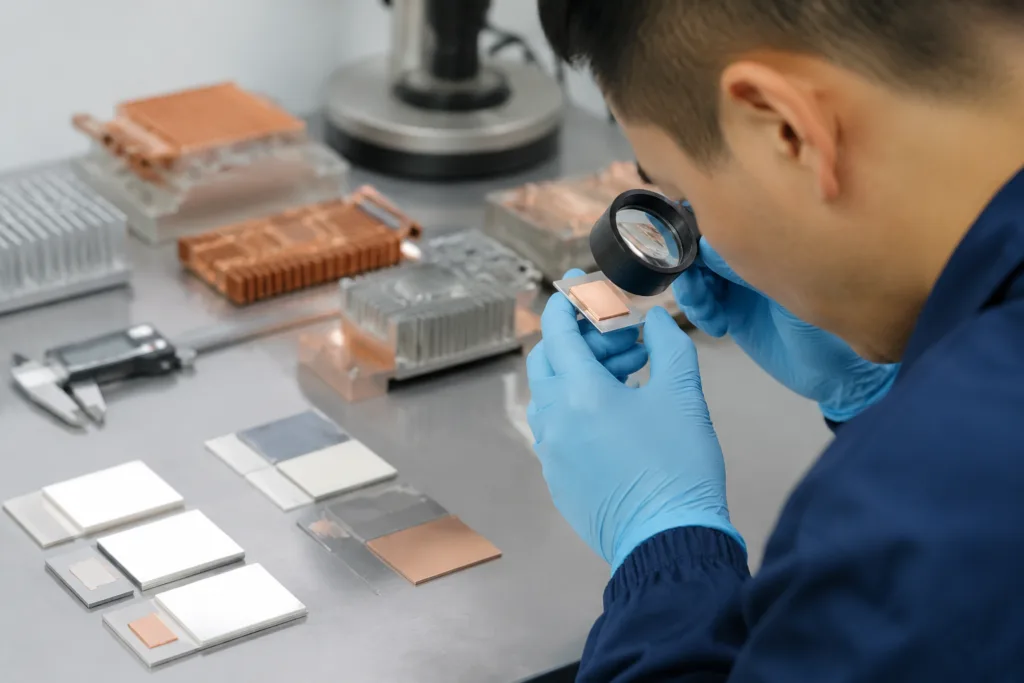
Good thermal adhesive TDS interpretation means reading the data sheet as a process-and-performance document, not as a list of isolated numbers. W/m·K matters, but so do thermal resistance, bond-line thickness, viscosity, cure route, lap shear context, modulus, elongation, substrate behavior, and validation conditions. The right thermal adhesive is the one that transfers heat effectively in the real assembly, bonds reliably over time, and fits the production environment without avoidable quality risk.
For engineers, product teams, and procurement managers, the most practical next step is to compare shortlisted materials with a consistent review checklist, then confirm the result through representative sample testing rather than relying on headline TDS claims alone.
FAQs
Is the highest W/m·K thermal adhesive always the best choice?
No. The best choice depends on actual bond-line thickness, wetting, void control, cure behavior, substrate contact, and mechanical reliability. A material with a lower conductivity number can perform better in the real assembly if it forms a thinner, more uniform bond line and fits the process more consistently.
What does lap shear tell me on a thermal adhesive TDS?
Lap shear gives a useful indication of bonded joint strength under a defined test setup, but it should not be read alone. You need to know the substrate pair, surface preparation, cure condition, test temperature, and failure mode before using that value to compare products or predict long-term assembly durability.
Why does viscosity matter so much in thermal adhesive selection?
Viscosity affects how the adhesive dispenses, wets the surface, releases air, holds the intended gap, and maintains bond-line consistency. If the viscosity does not match the equipment and assembly design, thermal and mechanical performance can both suffer even when the TDS looks strong on paper.
How should buyers compare cure data from different suppliers?
Compare cure data only after checking whether each supplier is referring to room-temperature cure, heat cure, fixture time, or full property development. A fast fixture time does not always mean fast full cure, and a listed cure schedule may require tighter temperature control than the production line can reliably provide.
Can one thermal adhesive work for metal, ceramic, and plastic in the same project?
Sometimes, but it depends on stress, surface energy, temperature exposure, and movement between the materials. Mixed-substrate projects often need a more balanced adhesive profile, especially when thermal expansion differences are large. Sample testing on the actual substrate combination is the safest way to confirm compatibility.
What should procurement teams ask besides TDS performance data?
Procurement should also ask about MOQ, lead time, packaging options, shelf life, storage conditions, batch consistency controls, and whether the supplier can support sample validation or formulation adjustment. These factors strongly affect implementation risk, especially in scaled production.
Related Reading
- Thermally conductive adhesives: how they balance heat dissipation and bonding performance
- Practical adhesive testing methods buyers should understand
- Adhesive strength simplified: peel, shear, and tensile performance decoded
- adhesive selection technical support for specification review
- adhesive sample testing support for application validation