
Choosing between a one part epoxy adhesive and a two-part epoxy is not just a chemistry decision. In real production, it affects storage, dispensing, line design, cure time, labor, consistency, and how much process control you need to get repeatable bond performance. For engineers, procurement teams, and product developers, the right choice usually comes down to how the adhesive fits the manufacturing process rather than which option sounds stronger on paper.
For teams comparing formulation paths, it can help to explore ZDS adhesive solutions as a way to frame the discussion around substrates, curing conditions, and production method before narrowing down to a specific epoxy system.
What is a one part epoxy adhesive and how it works
A one part epoxy adhesive is supplied as a ready-to-use material. The resin and curing system are pre-formulated in a single package, so the user does not need to measure or mix components before application. In most cases, curing is activated by heat, although some specialty systems may respond to other controlled conditions.
This format is attractive when process consistency matters. Because there is no manual ratio control, one-part systems reduce mixing errors, air entrapment from hand blending, and variability between operators. That makes them especially useful in automated assembly lines, repeatable bead application, and higher-volume production where each unit needs the same adhesive behavior.
At the same time, one-part epoxies often require refrigerated or controlled storage to maintain shelf life and avoid premature reaction. They also commonly depend on oven cure or another defined heat cycle, which means the process must be able to support that extra curing step.
When teams start comparing materials, it is often useful to review broader epoxy adhesive options for industrial bonding to see how one-part systems fit alongside structural, potting, and application-specific epoxy types.
What is an epoxy two part adhesive and how it works
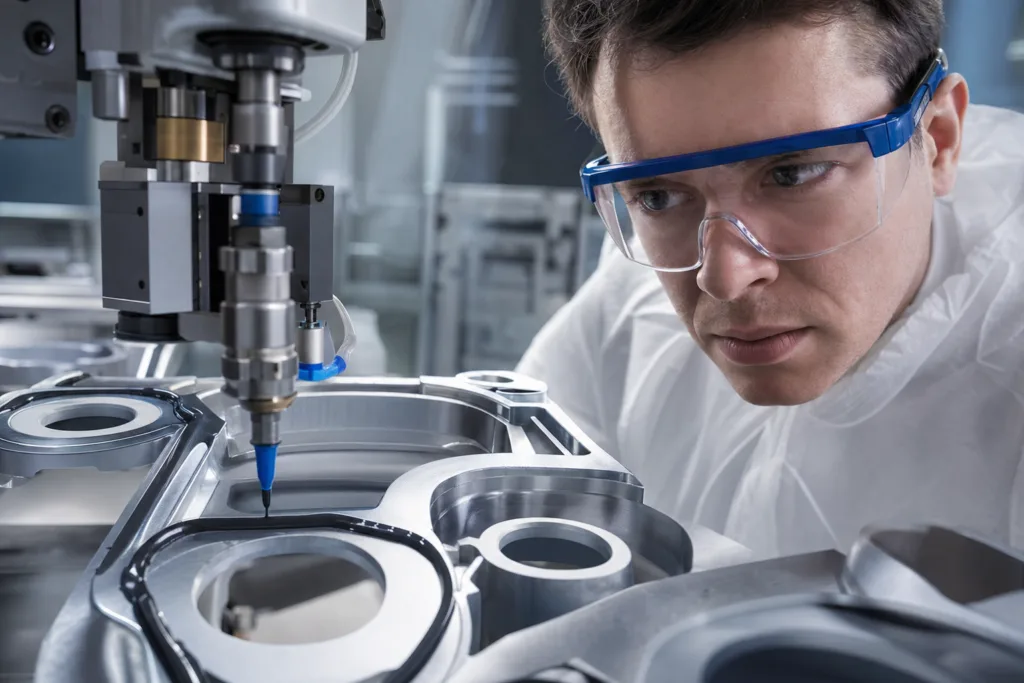
An epoxy two part adhesive consists of a resin and a hardener supplied separately. The cure begins once the two components are mixed in the required ratio. Depending on the formulation, the mixed adhesive may cure at room temperature, with moderate heat, or with a staged cure profile.
Two-part epoxies are often chosen for flexibility. They can work well in production settings where adding an oven is not practical, where larger bond gaps must be filled, or where structural assembly requires a combination of toughness, adhesion, and practical fixture time. They also allow formulation latitude across viscosity, cure speed, hardness, and service resistance.
The trade-off is that mixing accuracy matters. Incorrect ratio, poor blending, or inconsistent dispensing can lead to under-cure, soft bonds, reduced chemical resistance, or performance drift across batches. In other words, two-part systems can be highly capable, but they place more responsibility on process control at the point of use.
Key differences at a glance
| Factor | One-Part Epoxy | Two-Part Epoxy |
|---|---|---|
| Supply format | Pre-mixed single component | Separate resin and hardener |
| Mixing at use | Not required | Required |
| Typical cure trigger | Heat | Mixing, often room temperature or heat assisted |
| Pot life | Not applicable in the usual sense before dispensing | Limited after mixing |
| Storage | Often refrigerated or tightly controlled | Usually simpler before mixing |
| Automation fit | Strong for repeatable high-volume dispensing | Good with meter-mix equipment |
| Manual repair use | Less convenient if heat cure is needed | Often more convenient |
| Ratio error risk | Low | Higher if mixing is inconsistent |
| Throughput impact | Depends on oven capacity and cure schedule | Depends on fixture time and pot life |
Storage and shelf life comparison
Storage conditions can be a hidden deciding factor. A one part epoxy adhesive may simplify dispensing, but it can complicate inventory handling if cold storage is required. Teams need to account for refrigeration space, thaw time, lot rotation, and production planning so material is conditioned correctly before use.
Two-part epoxy is often easier to store before mixing because the components remain stable in separate containers under standard recommended conditions. However, once mixed, the clock starts. Pot life becomes a real operating constraint, especially in manual assembly or low-volume cells where material may sit longer than expected.
From an inventory perspective, one-part epoxy centralizes complexity in storage, while two-part epoxy shifts complexity to use-stage handling. Procurement teams should evaluate not just shelf life on paper, but also how much material is likely to be wasted due to expired conditioned stock, mixed leftovers, or stalled production runs.
Application and dispensing comparison
In manual work, two-part epoxy is often easier to adopt because it does not always require a heated cure line. Cartridge systems, dual syringes, or meter-mix equipment can make application manageable in repair, prototyping, or medium-volume assembly. The downside is operator dependence. Poor purge, incorrect ratio, or inadequate mixing can affect bond quality.
One-part epoxy is generally more process-friendly in automated dispensing environments. Since the material is already formulated as a single component, the dispenser only needs to control shot size, bead geometry, and placement. This can improve repeatability and reduce defects linked to mixing variation.
Where higher mechanical demands exist, teams sometimes compare a room-temperature or heat-assisted two-part material such as ZDS-282AB high-strength epoxy adhesive for bonding when evaluating structural assembly steps that need robust adhesion but cannot rely entirely on a heat-triggered one-part process.
Equipment planning should also include cleaning and maintenance. One-part systems avoid static mixer consumption and ratio calibration, but two-part systems may offer more flexibility for variable work cells. The practical question is whether your line is optimized for pre-mixed material handling or for in-line meter-mix dispensing.
Curing behavior comparison
Curing behavior is one of the biggest separators between the two systems. A one part epoxy adhesive usually remains stable until exposed to its activation temperature. That allows extended open handling before cure, but once heat is applied, the process depends on time-at-temperature, part mass, and oven uniformity.
Two-part epoxies begin reacting after mixing. Some reach handling strength at room temperature, while others cure faster with mild heat. This can be helpful for assemblies that are too large for ovens, field-installed components, or products sensitive to higher temperatures.
Throughput depends on the full curing system, not just nominal cure speed. A fast oven cure may still bottleneck if parts queue before heating. A room-temperature two-part may seem slower, but it can fit a flexible production flow better if parts can fixture offline without tying up central equipment. At ZDS, this process-fit question is often more important than comparing chemistry labels alone.
Performance comparison
Neither category is automatically stronger in every application. Bond strength depends on substrate, joint design, cure completeness, surface preparation, and service environment. One-part epoxy can deliver very reliable results in tightly controlled manufacturing, especially when bond line geometry and cure profile are optimized. Two-part epoxy can offer strong structural performance, gap tolerance, and broader practical use where conditions vary.
Gap filling deserves special attention. If parts have loose tolerances or uneven mating surfaces, a two-part system may be easier to tune for viscosity and sag control while still developing a durable bond. For electronics, potting, or encapsulation scenarios, formulation goals may shift toward thermal stability, dielectric protection, or transparency rather than only lap shear strength.
That is why application-specific materials matter. For elevated temperature filling or protective encapsulation, teams may compare products like ZDS-368AB high-temperature potting epoxy adhesive when the process requires epoxy performance beyond a simple adhesive joint.
Process efficiency comparison
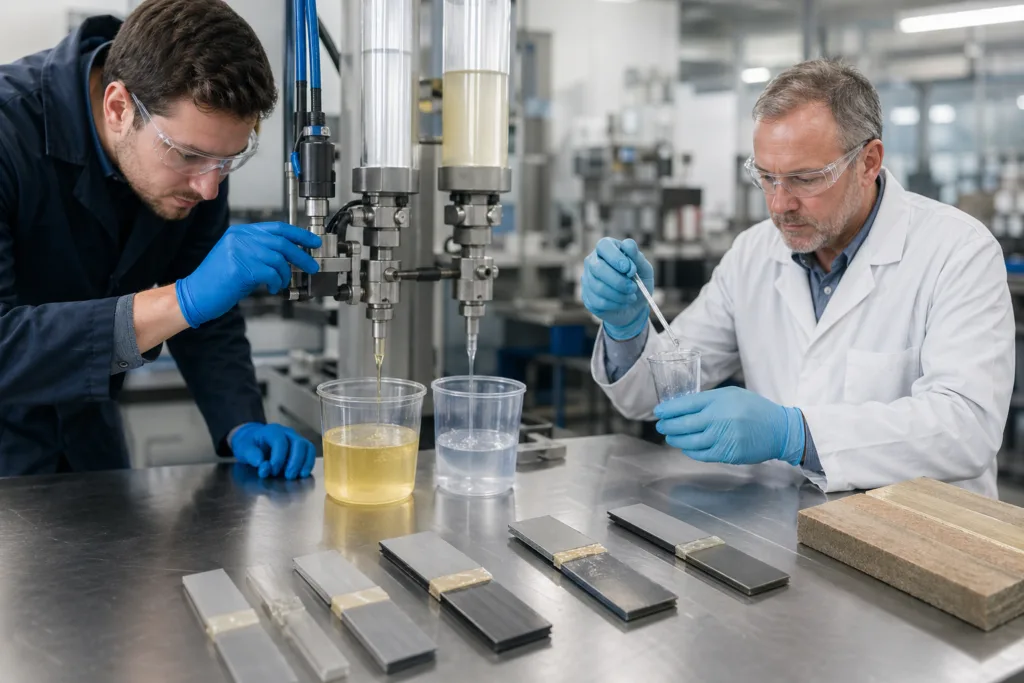
Process efficiency is where many selection mistakes happen. A one-part epoxy adhesive may reduce labor by eliminating mixing and lowering operator variability. It can support cleaner automation, better shot-to-shot consistency, and less rework linked to ratio error. But those gains can disappear if refrigerated handling, thaw control, or oven capacity are not managed well.
Two-part epoxy can be highly efficient in lower-volume or mixed-model production because it does not force all parts through the same thermal cure step. It also supports rework-friendly workflows in some cases, since operators can mix smaller amounts as needed. However, scrap risk can rise if mixed material exceeds pot life or if inconsistent blending causes cure defects that are only discovered later.
The most efficient option is usually the one that removes the biggest source of variation in your actual plant. For some lines that is mixing. For others it is heat cure logistics.
Where one part epoxy adhesive is the better fit
One-part epoxy is often the better fit when the process includes controlled heating and repeatable, high-volume assembly. Typical examples include automated component bonding, appliance subassembly, metal-to-metal joining with fixed cure windows, and electronics manufacturing steps where precise dispensing matters more than field flexibility.
It is especially attractive when you want to reduce operator influence. If the same bond geometry is applied thousands of times, eliminating mix ratio errors can improve consistency. One-part systems also make sense when the line already has ovens or thermal stations, so cure activation does not add major process burden.
In electronics protection workflows, a preselected material family still has to match viscosity, transparency, thermal exposure, and encapsulation depth. For that reason, some teams evaluating sensitive assemblies also review options such as ZDS-168 transparent epoxy potting adhesive for electronics to compare whether the application is really a bonding job, a potting job, or a combined protection requirement.
Where epoxy two part adhesive is the better fit
Two-part epoxy is often the better choice when production needs flexibility. It suits large parts, room-temperature assembly, repair operations, lower-volume manufacturing, and structural joints that benefit from tailored cure speed or broader gap-filling capability.
It can also be the more practical option when parts cannot tolerate the heat needed by many one-part systems. For mixed-material assemblies, prototypes, maintenance work, or installations outside a fixed production line, two-part epoxy often gives the user more freedom to adapt the process.
That said, flexibility should not be confused with simplicity. Good meter-mix control, disciplined cartridge handling, and proper operator training still matter if you want consistent cure and reliable long-term performance.
How to choose based on your process
The best selection method is to map adhesive behavior against your real process constraints. Start with the substrate pair, required bond line, production volume, cure window, and service environment. Then compare what each epoxy type demands from storage, dispensing, and quality control.
- Substrate compatibility: Metals, composites, plastics, ceramics, and electronic components may each need different adhesion and cure profiles.
- Line speed: Fast takt times may favor pre-mixed dispensing, but only if curing can keep pace.
- Fixture time: If parts must be moved quickly without ovens, a suitable two-part system may fit better.
- Thermal limits: Heat-sensitive parts can rule out many one-part options.
- Joint geometry: Thin bond lines and tight tolerances often support one-part use; wider gaps may favor two-part formulations.
- Environment: Moisture, chemicals, heat, and vibration can shift the decision toward tougher or more specialized systems.
- Quality risk: Ask whether your bigger risk is mixing variation or curing logistics.
If the process is stable, high-volume, and heat-capable, one-part epoxy often becomes a strong candidate. If the process is variable, field-based, room-temperature dependent, or structurally diverse, two-part epoxy frequently offers the better operational fit.
Common mistakes when selecting epoxy adhesive resin
One common mistake is choosing based on advertised strength alone. A strong epoxy that does not cure fully in the real process will underperform a better-matched product with lower headline numbers. Another frequent mistake is ignoring storage behavior. Refrigerated one-part material can create planning issues if the line is not set up for controlled conditioning.
Teams also sometimes assume room-temperature cure is always easier. In reality, two-part systems can create hidden variation through ratio drift, incomplete mixing, or expired mixed material. On the other side, some users overestimate the simplicity of one-part epoxy without accounting for oven capacity, thermal mass, or cure shadowing in complex assemblies.
A final mistake is failing to separate bonding from potting, sealing, or encapsulation needs. Many epoxy projects involve more than one function, and the right answer may depend on whether adhesion, dielectric protection, thermal resistance, or gap filling is the primary requirement.
Selection checklist before choosing one-part or two-part epoxy
- What substrates are being joined or protected?
- Can the assembly tolerate the heat needed for cure?
- Is manual mixing acceptable, or must variation be minimized?
- What fixture time is acceptable before moving the part?
- Does the joint need gap filling or only a thin bond line?
- Will production run at high volume, mixed model, or intermittent batches?
- Do storage conditions support refrigerated materials if needed?
- Is the application truly bonding, or also potting or encapsulation?
- What service conditions will the cured epoxy face?
- Which failure mode is more costly: mixing error, slow cure, or handling waste?
Conclusion
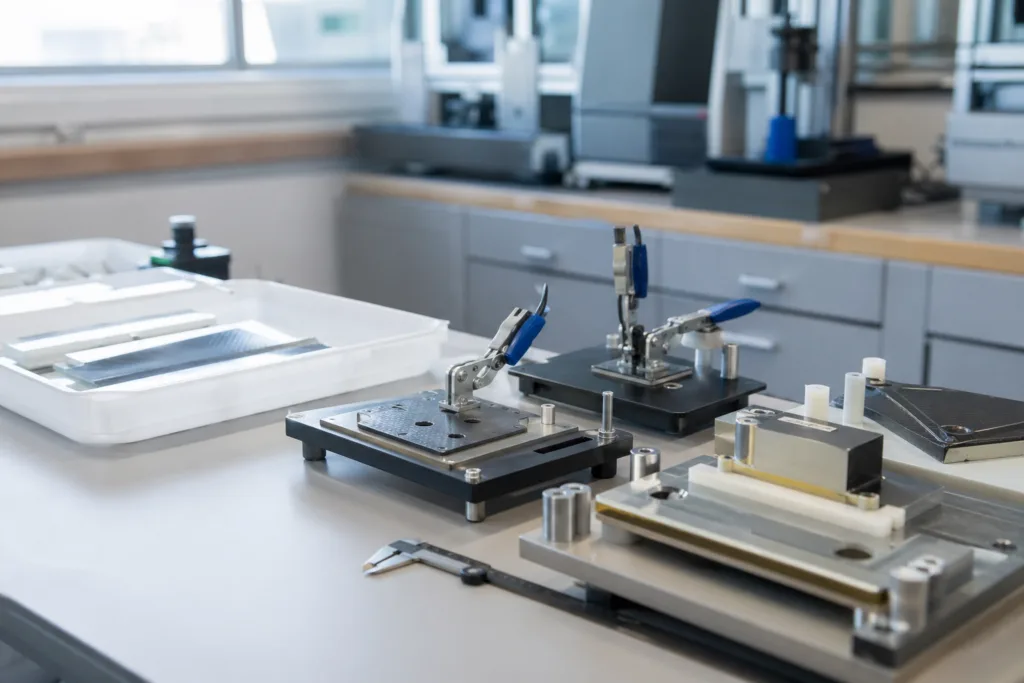
There is no universal winner between one-part and two-part epoxy. A one part epoxy adhesive usually makes the most sense when you want dispensing consistency, reduced operator variation, and controlled heat cure in a repeatable production environment. Two-part epoxy is often the better fit when you need room-temperature flexibility, adaptable fixture time, structural gap filling, or less dependence on centralized thermal equipment.
The practical choice comes from matching chemistry to process reality. When substrate type, cure path, line speed, and service conditions are evaluated together, the selection becomes much clearer and the risk of expensive rework drops significantly.
FAQ
Is one part epoxy adhesive stronger than two-part epoxy?
Not necessarily. Final strength depends on substrate, joint design, cure completeness, and service conditions more than the one-part or two-part label alone.
Does one part epoxy adhesive always require heat to cure?
Many one-part epoxy systems are heat activated, so users should confirm the cure schedule and whether their process can deliver the required temperature consistently.
When is two-part epoxy easier to use in production?
Two-part epoxy is often easier when parts are large, heat sensitive, repaired manually, or assembled in flexible cells where room-temperature curing is more practical than oven curing.
What is the main process risk with two-part epoxy?
The main risk is inconsistent mixing or ratio control, which can lead to incomplete cure, variable strength, and wasted material after pot life is exceeded.
What is the main process risk with one-part epoxy?
The main risk is treating it as simple without planning for storage control, material conditioning, and enough curing capacity to keep production moving.
How should engineers choose between one-part and two-part epoxy?
They should compare substrate compatibility, cure method, line speed, fixture time, heat limits, bond line requirements, and storage logistics against the real manufacturing process.