
Choosing a glass adhesive for glass and acrylic bonding is not the same as choosing a general-purpose adhesive. These assemblies are often judged by what people see first: clarity, clean edges, low haze, and a neat finished appearance. At the same time, the bond still needs to survive stress, handling, temperature changes, moisture, and long-term aging. That means adhesive selection has to balance visual quality with mechanical reliability.
explore ZDS adhesive solutions if you are comparing different bonding chemistries for transparent assemblies and want a clearer view of how formulation, curing method, and flexibility affect final bond quality.
Glass and acrylic can also behave very differently in service. Glass is hard, rigid, and dimensionally stable. Acrylic is lighter and easier to machine, but it expands more with temperature and can be more sensitive to chemical attack or stress cracking. When these materials are bonded together, the adhesive layer becomes the interface that must manage both appearance and movement.
Why glass and acrylic bonding is different
Ordinary structural bonding often focuses on strength first. Transparent assemblies add another set of requirements. A bond line that is strong but cloudy, yellow, bubbly, or visible at the edge may still be considered a failure. In many products, the adhesive must support load while remaining visually unobtrusive.
Another difference is stress management. Glass and acrylic do not expand and contract at the same rate. If the adhesive is too rigid, internal stress can build up around the bond line, especially during temperature cycling. If the adhesive is too soft, it may not hold alignment or edge integrity well enough. Good selection starts with understanding which performance trade-off matters most in the actual application.
Main bonding goals for clear assemblies
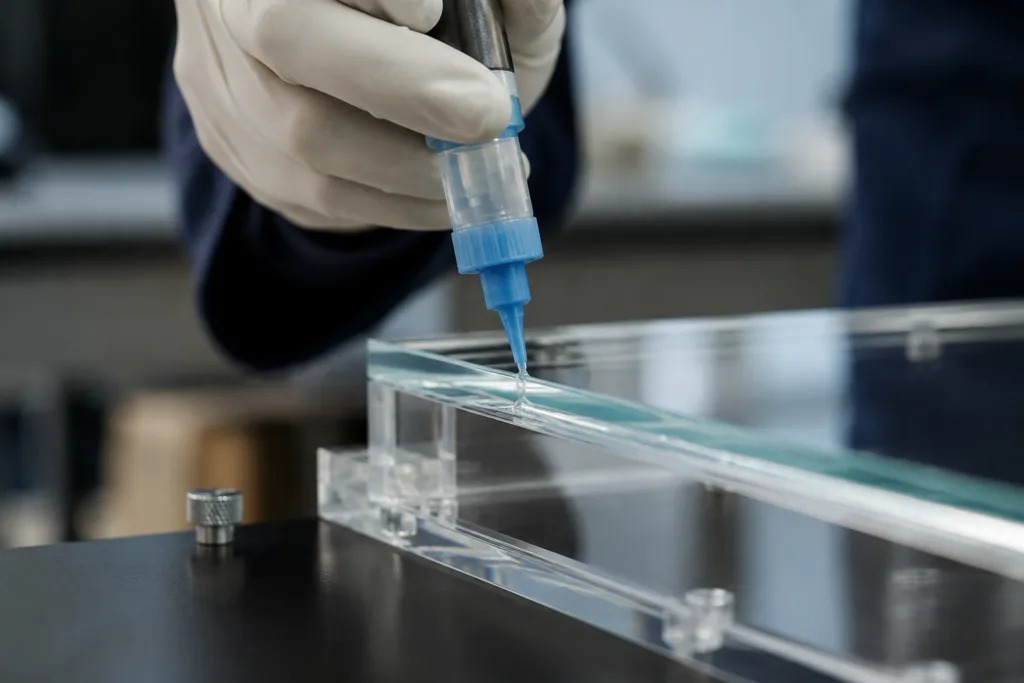
Clarity and low visual distortion
For display panels, covers, viewing windows, and decorative assemblies, optical appearance can be a primary requirement. In these cases, the adhesive should resist haze, bubbles, and discoloration. Refractive match, bond-line uniformity, and cure cleanliness all matter.
Reliable adhesion
The adhesive must wet both surfaces well and maintain adhesion over time. A bond that initially looks clear can still fail later if it has weak surface contact, incomplete cure, or poor environmental resistance.
Durability in service
Moisture, UV exposure, cleaning chemicals, outdoor conditions, and thermal cycling all affect long-term performance. The right glass adhesive is not only clear on day one but also stable after months or years of use.
Clean processing
Application method strongly affects results. Trapped air, contamination, inconsistent gap control, and poor cure access can all reduce bond quality. In practice, process fit is just as important as chemistry.
Key material challenges that affect adhesive choice
Transparency requirements
When the bond line is visible, even minor defects stand out. Small bubbles, uneven adhesive spread, cure shrinkage patterns, or edge yellowing may be unacceptable. This is why highly clear chemistries are often preferred for display-like assemblies.
Stress cracking risk in acrylic
Acrylic can be vulnerable to environmental stress cracking, especially if it has residual forming stress or is exposed to aggressive chemicals. Some adhesives, primers, or cleaning solvents can worsen this problem. Adhesive compatibility with acrylic should always be checked before full-scale production.
Thermal expansion mismatch
Acrylic typically moves more than glass as temperature changes. A rigid adhesive may create concentrated stress at edges or corners. Flexible or high-elongation systems can help absorb movement and reduce cracking or edge lift.
Long-term exposure
Indoor and outdoor conditions are very different. Sunlight, humidity, and cleaning cycles can gradually change adhesive appearance and performance. For applications exposed to light or weather, resistance to yellowing and moisture ingress becomes much more important.
How to choose the right adhesive by application requirement
A practical way to select adhesive is to rank the job by its dominant requirement. If appearance is the highest priority, optical clarity and low haze come first. If the bonded parts will move, expand, or vibrate, flexibility becomes more important. If cure speed matters for throughput, a UV-curing system may be attractive, provided the joint design allows light access.
In manufacturer-side evaluation work at ZDS, selection usually starts with a few basic questions: Are both substrates transparent enough for UV cure? Is the bond line visible? Will the assembly see outdoor aging? How much movement must the joint tolerate? Those answers narrow the field much faster than looking at generic strength claims alone.
| Priority | Usually preferred adhesive direction | Key reason |
|---|---|---|
| Maximum visual clarity | Optical-grade UV or clear optical adhesive | Low haze and cleaner bond appearance |
| Fast cure in transparent parts | UV-curing adhesive | Rapid fixture and process efficiency |
| Movement and stress relief | Flexible adhesive | Better accommodation of expansion mismatch |
| Glass to metal durability | Toughened or flexible structural UV system | Improved stress handling at dissimilar interfaces |
| Outdoor exposure | Weather-resistant clear adhesive | Better long-term appearance retention |
UV-curing adhesives for clear glass-to-acrylic bonds
UV-curing adhesives are often a strong fit when both parts allow sufficient light transmission to the bond area. They can provide fast handling strength, neat processing, and very clear bond lines when the formulation matches the substrates and joint geometry.
They work especially well for small to medium transparent assemblies where cure access is straightforward. If the adhesive layer is too thick, if shadowed areas are present, or if one substrate blocks UV light, cure reliability becomes harder to control. In those cases, a different chemistry or a secondary cure mechanism may be needed.
When evaluating UV curable adhesive options, focus on more than cure speed. Check viscosity for gap filling, final hardness, expected shrinkage, adhesion to both glass and acrylic, and visual stability under light exposure. A fast cure is helpful, but not if it increases stress, bubbles, or edge defects.
Optical adhesives for maximum transparency
Optical adhesives are used where the bond line is part of the visible surface experience. Typical examples include display layers, viewing windows, cover lens assemblies, and applications where reduced reflection or improved visual uniformity matters. In these jobs, clarity is not just about being transparent. It also involves low haze, smooth wet-out, and consistent appearance across the bonded area.
For assemblies where optical quality is central, a product such as ZDS-3702A optical bonding adhesive represents the type of solution often considered when high transparency and controlled visual finish are more important than simple gap filling. The key is to confirm that the adhesive suits the actual substrate pair, thickness range, and curing setup.
Optical systems usually demand tighter process control than general assembly adhesives. Dust, poor dispensing, uneven pressure, or incomplete cure can create visible defects quickly. If the part is cosmetic or display-facing, trial work should include appearance checks under real lighting conditions, not just bench inspection.
Flexible adhesives when movement matters more than rigidity
Not every clear bond should be rigid. If the assembly will see thermal cycling, impact, vibration, or slight differential movement between bonded parts, a flexible adhesive can reduce stress concentration. This is often important for larger panels, mixed-material assemblies, or designs with thin edges and corners.
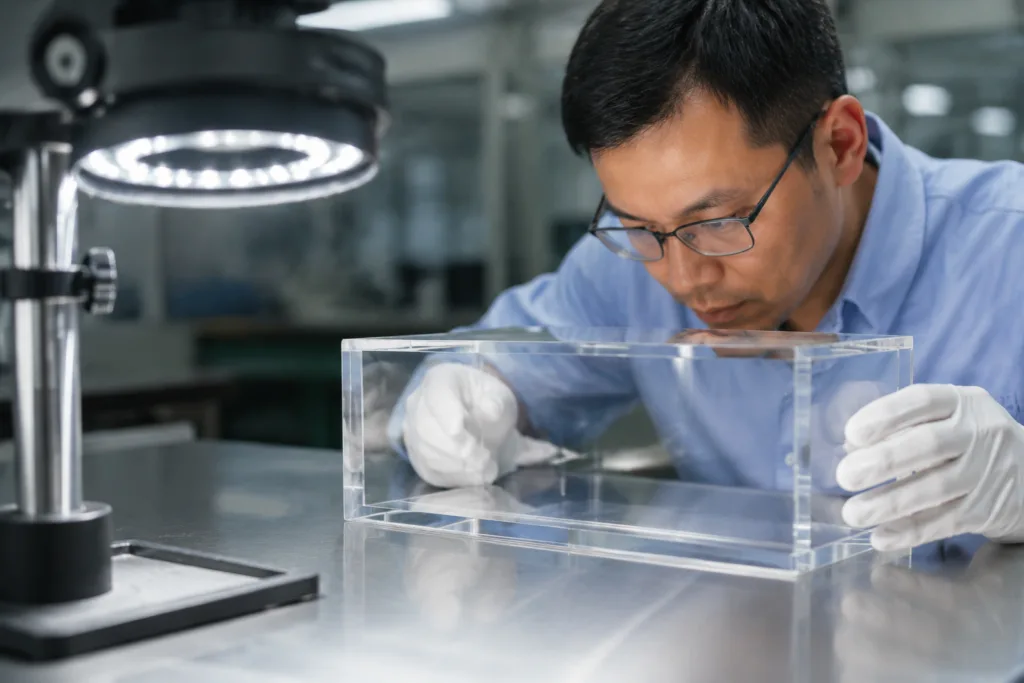
A more flexible system may slightly reduce absolute rigidity, but it can improve real-world reliability by absorbing strain that would otherwise transfer directly into the glass, acrylic, or interface. This trade-off is often worthwhile when crack prevention and edge stability matter more than maximum stiffness.
In applications that need stress relief between transparent or semi-transparent materials, ZDS-3612 flexible glass and plastic sealant illustrates the kind of material considered when flexibility, clean sealing behavior, and substrate movement tolerance are more important than a hard structural bond line.
When glass-to-metal or glass-to-plastic changes the selection logic
Once one side of the bond is metal or another plastic, the selection process changes. Metals bring different surface energies, different stiffness, and sometimes greater thermal conductivity. Plastics vary widely in polarity, surface activity, and sensitivity to stress. A formulation that performs well on glass-to-glass may not perform the same way on glass-to-metal or glass-to-plastic.
For glass bonded to metal frames, brackets, or inserts, flexibility and adhesion durability often become more critical because the joint must handle stronger stiffness mismatch. Systems such as ZDS-3127 high-flexibility glass and metal UV adhesive reflect the kind of chemistry that may better manage differential movement while still curing cleanly in suitable joint designs.
Glass-to-plastic bonding also requires caution around plastic stress cracking, plasticizer interaction, and cure compatibility. The adhesive should be tested on the exact grade of plastic rather than assuming all plastics behave similarly.
Surface preparation and process factors that affect bond quality
Even a well-chosen adhesive can fail if the surfaces are poorly prepared. Dust, mold release, oils, fingerprints, polishing residue, and cleaning solvent remnants can all reduce wetting and create visible bond defects. Glass generally benefits from thorough cleaning, while acrylic requires extra care to avoid cleaners that may attack the surface.
Uniform bond-line control is also important. Too little adhesive can leave voids or poor edge coverage. Too much can trap bubbles, increase shrink stress, or create overflow that harms appearance. Dispensing method, assembly pressure, fixture alignment, and cure timing all influence final results.
- Clean substrates with compatible methods and verify no residue remains.
- Check that acrylic parts are not carrying high residual stress from machining or forming.
- Use a viscosity that matches the gap and wetting requirement.
- Minimize air entrapment during dispensing and part placement.
- Confirm full cure in the actual joint, not only on exposed sample drops.
Common bonding failures and what usually causes them
Haze or cloudiness
This often comes from poor wetting, microbubbles, surface contamination, or an adhesive not suited for optical clarity. It can also result from cure imbalance or moisture effects.
Yellowing over time
Yellowing may be linked to UV exposure, heat aging, or the wrong chemistry for the environment. It matters most in visible joints and outdoor-facing applications.
Poor adhesion
Weak adhesion is commonly caused by contaminated surfaces, incompatible chemistry, under-cure, or a mismatch between adhesive rigidity and service stress.
Cracking or crazing in acrylic
This can be caused by residual stress in the acrylic, aggressive cleaners, incompatible adhesive ingredients, or a bond line that transfers too much stress into the plastic.
Bubbles and voids
Air entrapment during dispensing, poor assembly technique, high viscosity in thin gaps, or cure shrinkage effects can all contribute to bubbles.
Edge lift
Edge lift often points to movement stress, moisture ingress, insufficient wetting at the perimeter, or an adhesive that is too rigid for the assembly.
How to match adhesive type to real-world use cases
| Use case | Main need | Likely adhesive direction |
|---|---|---|
| Display cover or viewing panel | High clarity and low haze | Optical-grade clear adhesive |
| Small transparent fixture | Fast cure and neat appearance | UV-curing glass adhesive |
| Large glass-acrylic assembly | Stress relief during temperature change | Flexible clear adhesive |
| Glass bonded to metal trim | Differential expansion management | Flexible or toughened structural UV adhesive |
| Sealing edge around transparent part | Movement tolerance and clean edge behavior | Flexible sealant-style adhesive |
If the part is highly cosmetic, start with appearance-driven screening. If the part is more functional, start with durability and process reliability. In both cases, narrow candidates by testing on the real substrates, at the real bond line, under the real cure conditions.
Selection checklist for choosing a glass adhesive
- What are the exact substrates: glass to acrylic, glass to metal, or glass to another plastic?
- Is the bond line visible, partially visible, or hidden?
- How important are clarity, low haze, and color stability?
- Can UV light reach the full bond area reliably?
- Will the assembly see temperature swings, vibration, or impact?
- Is flexibility needed to handle expansion mismatch?
- What gap size and viscosity range fit the process?
- Will the bonded part face moisture, sunlight, or cleaning chemicals?
- How much cure speed is required for production flow?
- What failure mode is least acceptable: haze, crack, edge lift, or bond loss?
Conclusion
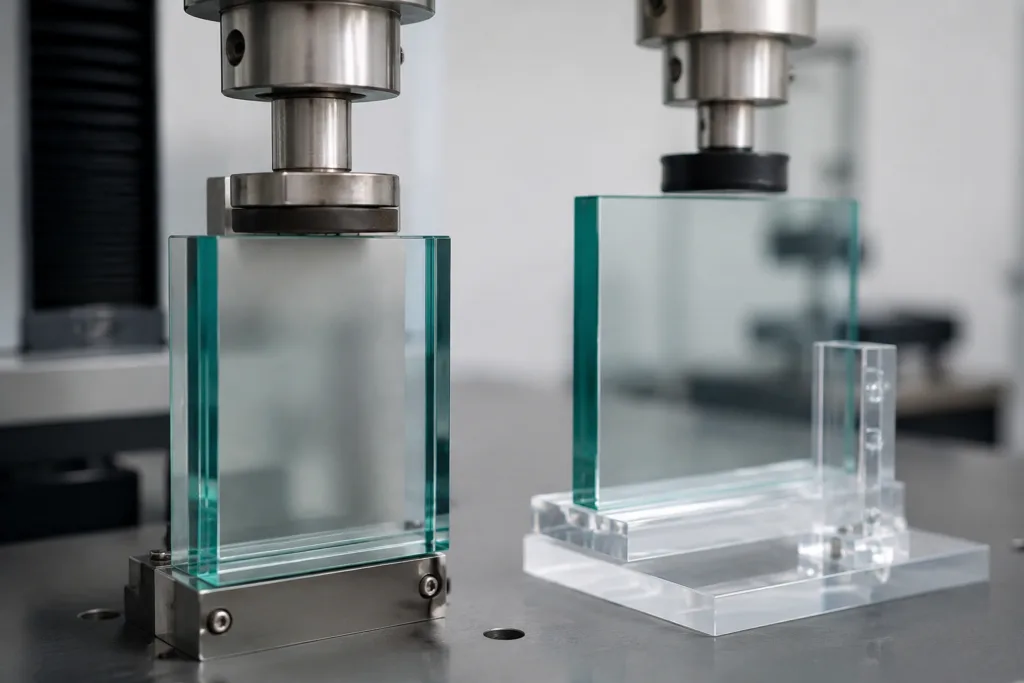
The right glass adhesive is rarely chosen by strength alone. For glass and acrylic bonding, the decision usually comes down to a balance of clarity, stress management, cure method, substrate compatibility, and long-term environmental resistance. UV-curing systems can be highly effective where light access is good and clean processing matters. Optical adhesives are preferred when visual quality is central. Flexible systems are often the safer choice when movement, thermal mismatch, or mixed materials increase stress on the joint.
A practical decision framework is simple: define the appearance requirement, define the service environment, define the movement in the assembly, then confirm the adhesive with realistic testing. That approach helps avoid attractive short-term bonds that fail later through haze, cracking, yellowing, or edge separation.
FAQ
What is the best type of glass adhesive for bonding glass to acrylic?
The best type depends on whether clarity, flexibility, or cure speed matters most. UV-curing and optical adhesives are often chosen for clear visible bonds, while flexible systems are better when thermal movement or stress relief is important.
Can UV adhesive bond glass to acrylic reliably?
Yes, UV adhesive can work very well if both substrates allow enough light to reach the bond area and the formulation is compatible with acrylic. Cure depth, gap size, and stress on the plastic should be checked carefully.
Why does acrylic sometimes crack after bonding?
Acrylic may crack because of residual internal stress, incompatible cleaners, aggressive adhesive chemistry, or a bond line that is too rigid for the amount of movement in service. Testing on the exact acrylic grade is important.
How do I keep a glass adhesive bond line clear?
Use an adhesive designed for transparent assemblies, prepare surfaces carefully, control bubbles during dispensing, and make sure the cure is complete and even. Clean process control is usually the biggest factor in bond appearance.
Is a flexible adhesive better than a rigid adhesive for glass and acrylic?
A flexible adhesive is often better when the assembly will experience thermal expansion mismatch, vibration, or impact. A rigid adhesive may suit smaller or more static parts, but it can increase stress in mixed-material joints.
What surface preparation matters most before bonding glass and acrylic?
Remove dust, oils, fingerprints, and residue without damaging the acrylic surface. The goal is a clean, compatible surface that allows good wetting, strong adhesion, and a defect-free visible bond line.