
UV adhesive is a liquid bonding material that cures when exposed to ultraviolet light, allowing very fast fixture times and precise placement in applications where process control matters. For engineers, buyers, and product teams, the real value is not just speed. It is the combination of fast handling strength, neat bond lines, optical clarity in many formulations, and compatibility with high-throughput assembly. That said, UV curing is not universal. It works best when the light can reach the adhesive and when the substrate, bond geometry, and production setup are aligned with the curing mechanism.
explore the full adhesive portfolio if you are comparing UV systems with other bonding, sealing, potting, or assembly technologies and want a broader view of where each adhesive family fits.
What UV curable adhesives are and how UV adhesive curing works
UV curable adhesives are typically one-part materials formulated with reactive oligomers, monomers, additives, and photoinitiators. When UV light of the right wavelength reaches the adhesive, the photoinitiators absorb that energy and trigger a polymerization reaction. In simple terms, the liquid starts converting into a solid network very quickly.
Unlike two-part systems that begin reacting after mixing, UV adhesive usually stays liquid until light exposure starts the cure. This gives users more open time for alignment and dispensing, followed by rapid on-demand curing once the assembly is positioned correctly. In production, that can reduce waiting time between bonding and downstream handling.
The cure behavior depends on several factors:
- Light wavelength matching the adhesive chemistry
- Light intensity or irradiance
- Exposure time
- Distance between lamp and bond line
- Substrate transparency or light access
- Bond line thickness
- Surface cleanliness and fit-up
Some UV formulations are designed for rigid structural holding, while others emphasize flexibility, removability, optical clarity, or lower shrinkage. This is why a UV adhesive should be selected by application logic rather than by cure speed alone.
Why UV glue cures so quickly
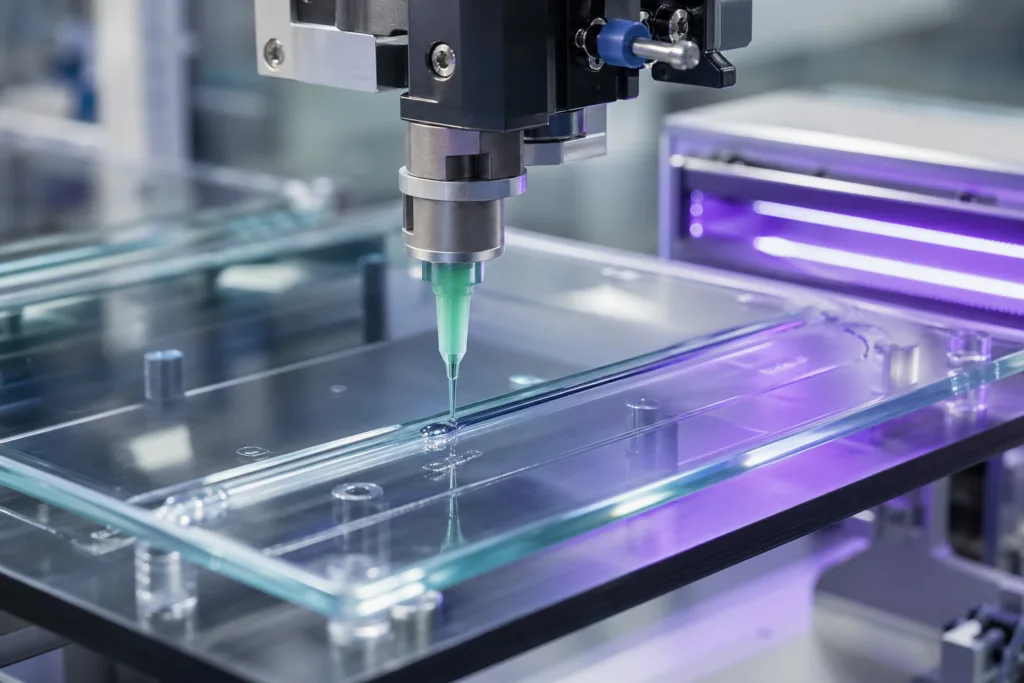
The main reason UV glue cures so fast is that the reaction starts almost immediately when enough UV energy reaches the photoinitiator package. There is no need for moisture diffusion, heat soak, or long solvent evaporation. The material changes state because of light-initiated polymerization, not because it is simply drying out.
This creates several practical benefits on the line. A precisely dispensed bead can remain stable before cure, then lock into place in seconds when exposed to UV. Assemblies can often be moved, inspected, or processed sooner than with slower ambient-cure systems. That is especially useful for glass, electronics, display parts, and small precision components where alignment matters.
Still, fast surface cure does not always mean complete cure through the full bond line. If the adhesive layer is too thick or the light path is blocked, the outer region may cure faster than deeper zones. That is one reason process validation matters as much as the chemistry itself.
Where UV adhesive excels in real production
UV adhesive is often chosen because it supports both performance and process efficiency. When the design fits the technology, it can simplify assembly without adding complex mixing steps or long curing delays.
Fast throughput
On-demand curing can shorten fixture time dramatically. Instead of waiting minutes or hours for handling strength, operators can often cure parts in seconds under controlled light. For high-volume lines, this can improve work-in-progress flow and reduce bottlenecks.
Clean bonding and precision dispensing
One-part UV systems are commonly used in fine dispensing processes because they can be applied in narrow beads, dots, or thin bond lines. This makes them useful for compact devices, display assemblies, and parts where overflow must be minimized. In manufacturing evaluations, teams often compare UV adhesive solutions for different production needs based on viscosity, cure window, optical appearance, and rework expectations.
Strong visual aesthetics
Many UV formulations are valued for clear bond lines and neat appearance, especially in transparent or semi-transparent assemblies. This matters in consumer-facing parts, optical components, decorative bonding, and display-related products where haze, yellowing, or visible overflow can affect perceived quality.
Good fit for automated lines
UV curing can pair well with automated dispensing, vision alignment, and controlled exposure stations. Since the cure can be triggered at a defined step, it supports consistent takt time when the process is properly engineered.
Main limitations and risks to understand early
UV adhesive is highly effective in the right conditions, but several limitations should be identified before qualification. Many project delays happen because the curing method is treated as a minor detail instead of a core design constraint.
Shadowed areas and blocked light paths
If UV light cannot reach the adhesive, cure may be incomplete or absent in those zones. Opaque housings, metal overlap areas, deep cavities, and undercut geometries are common risk points. In such cases, a different adhesive family or a dual-cure approach may be more appropriate.
Transparency requirements
Many UV applications require at least one substrate to transmit the relevant light wavelength, or require direct access to the bond line from an exposed side. Clear glass and some clear plastics can work well, but not all transparent-looking materials transmit UV equally. Pigments, coatings, and UV-blocking additives can interfere with cure.
Bond line thickness limits
Very thick sections may cure unevenly because the light energy attenuates as it passes through the adhesive. Thin, controlled bond lines are usually easier to cure consistently. If your design requires filling deep gaps or large volumes, UV may not be the best first option.
Heat and substrate sensitivity
Although UV adhesives avoid oven curing in many cases, the exposure source can still generate heat, and some formulations shrink or harden in ways that stress sensitive plastics or delicate assemblies. Evaluating stress on thin glass, display layers, and brittle substrates is important. For display-related assemblies, application-specific products such as ZDS-2109011 high-intensity UV acrylic adhesive for LED screens illustrate how formulation choices can be aligned with more demanding optical or processing requirements.
Equipment dependence
UV bonding performance depends on lamp condition, wavelength fit, exposure geometry, maintenance, and quality checks. A strong adhesive formula can still fail in production if the curing equipment is poorly matched or inconsistently monitored.
Best application scenarios for UV adhesive
UV adhesive tends to perform best when the bond line is accessible to light, the substrates are dimensionally well controlled, and the assembly benefits from fast, precise curing.
Glass bonding and clear assemblies
Glass-to-glass and glass-to-metal applications are among the classic uses of UV adhesive, particularly where transparent bond lines and neat appearance are important. Fixtures, decorative components, sensors, and display assemblies often fit this profile.
Transparent plastics
Some clear plastics bond well with UV systems, but compatibility must be checked carefully. Stress cracking, haze, surface energy issues, and UV transmission can vary widely across acrylic, polycarbonate, PET, and other materials.
Electronics and display assembly
Small parts, camera modules, display layers, touch components, and precision electronic subassemblies often benefit from controlled dispense patterns and rapid cure. In these environments, clarity, low overflow, and repeatability can matter more than maximum bulk strength.
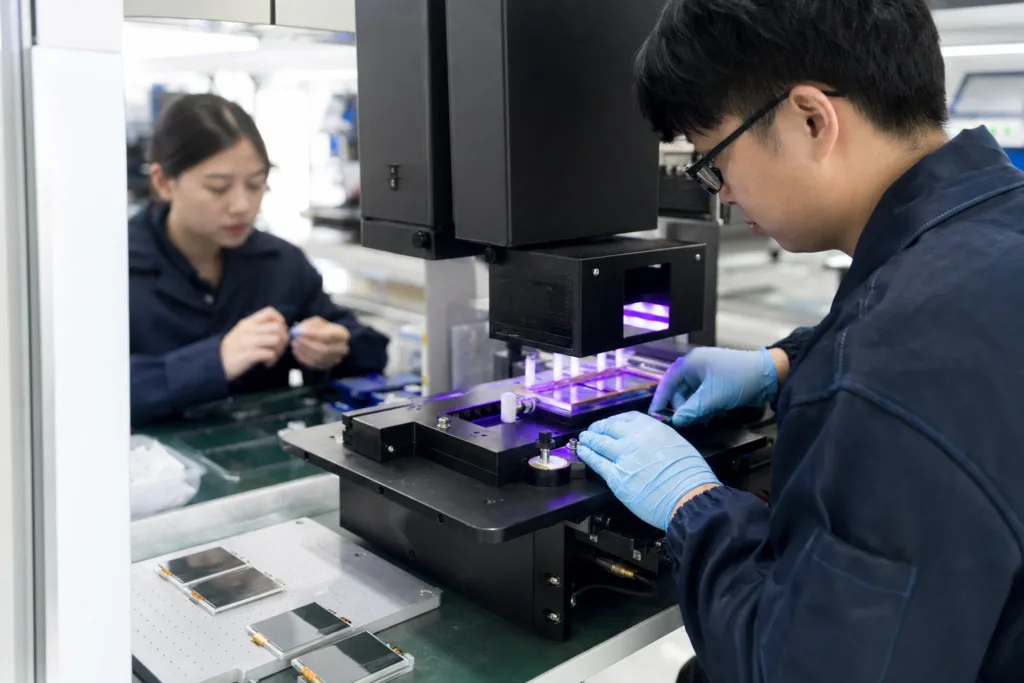
Optical components and precision parts
Optical assemblies typically demand low haze, controlled refractive appearance, and stable bond geometry. Small precision parts also benefit from the ability to align first and cure afterward. When evaluating clear display-oriented bonding, teams may review options like ZDS-3658B high-strength transparent UV adhesive for LCD glass to understand how transparency, strength, and process fit can be balanced.
Process and equipment requirements that affect curing quality
Successful UV bonding depends on more than choosing the right bottle. The production setup has a direct effect on cure consistency, appearance, and long-term reliability.
Wavelength and irradiance
The lamp output must match the adhesive’s photoinitiator response. If the wavelength is wrong, cure can be slow or incomplete even if the lamp appears bright. Irradiance also matters because low intensity may require longer exposure or may fail to cure through the intended depth.
Exposure time and fixture design
Time, distance, angle, and fixture geometry all influence how much usable energy reaches the bond line. A part that cures well on a lab bench may behave differently in a nested production fixture if shadows are introduced or the lamp distance changes.
Substrate preparation
Oil, mold release, dust, fingerprints, and poor surface energy can reduce adhesion even when cure looks visually complete. This is one reason ZDS and other manufacturers typically view surface condition as a core part of qualification, not a separate housekeeping issue.
Curing quality control
Validation should include more than visual inspection. Useful checks may include tack-free confirmation, handling strength, bond line appearance, destructive testing, exposure verification, and aging trials relevant to the environment. If the application requires later disassembly or temporary holding rather than permanent structural fixation, a more specialized option such as ZDS-2201061 UV adhesive for transparent removable bonding may be worth assessing during trials.
How to choose the right formula
Choosing a UV adhesive should start with the assembly and process, not with a generic product category. The right formula is the one that cures reliably in your geometry and meets your mechanical, visual, and environmental requirements at production speed.
Check substrate compatibility first
Identify every bonded material, including coatings, inks, films, and surface treatments. A UV adhesive that bonds glass well may perform differently on polycarbonate or treated metal. The substrate pair matters as much as the adhesive itself.
Match cure depth to bond geometry
Thin bond lines with clear light access are usually the easiest case. If the design includes gaps, overlap zones, or shaded edges, verify that the cure reaches the full bond area. Do not assume a fast surface cure means full crosslinking throughout.
Balance flexibility and rigidity
Rigid formulas may provide dimensional stability and cleaner part positioning, but they can transfer more stress to brittle or dissimilar materials. Flexible formulas may better absorb thermal expansion mismatch, shock, or peel stress. This trade-off is often more important than headline strength.
Consider optical clarity and appearance
For visible bond lines, displays, lenses, or clear housings, assess clarity, color, haze, and long-term appearance. A technically strong bond may still be rejected if it affects the visual finish.
Review environmental resistance
Think about service exposure to humidity, cleaning chemicals, heat cycling, UV exposure, and mechanical load. The right lab result is not enough if the bonded assembly sees harsher conditions in use.
Fit the formula to production speed
Some formulations cure extremely fast under powerful lamps, while others need longer exposure for complete conversion or better adhesion. The best process fit is the one that meets quality targets without creating a narrow operating window.
Common selection mistakes and when UV adhesive is not the best choice
A common mistake is selecting UV adhesive mainly for cure speed, then discovering too late that the bond area is shaded or the substrate blocks the required wavelength. Another is overlooking the importance of lamp consistency, especially when moving from lab samples to volume production.
Other avoidable issues include:
- Using UV adhesive for deep gap filling or thick-section bonding
- Ignoring plastic stress cracking risk
- Choosing a rigid formula for parts with thermal movement
- Relying on visual cure only without bond testing
- Skipping aging checks for moisture, temperature, or chemical exposure
UV adhesive may not be the best choice when the joint is fully hidden from light, when the assembly requires large-volume filling, when substrates are highly opaque, or when service conditions demand a chemistry optimized for heat, impact, or chemical resistance beyond what a candidate UV system can provide. In those cases, moisture-cure, two-part, heat-cure, acrylic, epoxy, silicone, or hybrid systems may offer a better process-performance balance.
Practical checklist for evaluating a UV adhesive supplier or product sample
When reviewing a product sample or supplier recommendation, use a structured checklist instead of relying on one or two promising test results.
- What exact substrates, coatings, and surface conditions were tested?
- What lamp wavelength and irradiance were used?
- What bond line thickness and joint geometry were validated?
- Is the formula intended for rigid, flexible, removable, or optical use?
- How sensitive is the process window to exposure time variation?
- What environmental conditions should be checked during qualification?
- Is the target appearance clear, low-haze, low-overflow, or non-yellowing?
- What level of rework, if any, is required?
- Can the adhesive support the intended dispensing method?
- Does the sample behavior in the lab translate to production equipment?
This kind of evaluation helps separate a material that cures quickly from a material that cures reliably in real manufacturing conditions.
Conclusion
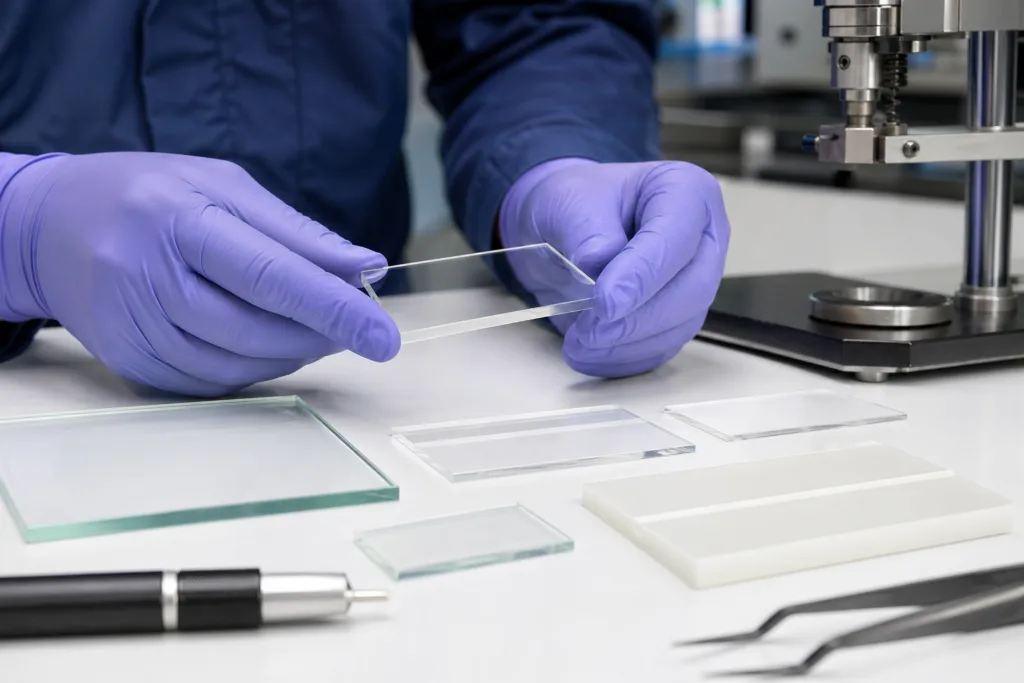
UV adhesive is a strong option when the assembly allows light access, the bond line is controlled, and the process values fast fixture, precision application, and clean appearance. It is especially useful in clear assemblies, electronics, displays, optical parts, and small precision components. But it is not a default answer for every joint design. The best results come from matching the chemistry, cure method, equipment, and substrate behavior as one system. For technical and purchasing teams, that means validating not just bond strength, but cure reliability, geometry fit, appearance, and production repeatability.
FAQ
What is a UV adhesive?
A UV adhesive is a liquid adhesive that cures when exposed to ultraviolet light, allowing fast on-demand bonding without mixing in many applications.
Does UV adhesive work on opaque materials?
It can work only if the light still reaches the bond line from an exposed side; if the joint is fully blocked from UV light, cure may be incomplete or impossible.
Why does UV adhesive cure so fast?
It cures quickly because light activates photoinitiators in the formula, starting a rapid polymerization reaction instead of relying on slow air drying or moisture absorption.
Can UV adhesive fill large gaps?
Usually it is better suited to thin, controlled bond lines, because thick sections can reduce light penetration and lead to uneven curing.
Is UV adhesive good for glass bonding?
Yes, UV adhesive is often a strong fit for glass bonding because many formulations offer clear bond lines, precise dispensing, and fast curing when light can pass through the assembly.
How should I evaluate a UV adhesive sample?
Test it on the real substrates, with the actual bond geometry and curing equipment, then check cure quality, adhesion, appearance, and durability under expected service conditions.