
Choosing the right plastic to metal adhesive is rarely as simple as picking the strongest glue on a datasheet. Plastic and metal behave very differently under load, heat, moisture, and vibration, so the adhesive has to bridge two unlike materials without losing strength or flexibility over time. For buyers, engineers, and product developers, the real question is not just which adhesive bonds these surfaces, but which one fits the application, process, and durability target.
For teams comparing chemistries, assembly methods, or custom formulations, it can help to explore our industrial adhesive solutions as part of a broader review of bonding requirements such as substrate compatibility, cure profile, and environmental resistance.
Why plastic-to-metal bonding is challenging
Plastic-to-metal joints often fail for predictable reasons. Metals are rigid, dimensionally stable, and usually easier to bond after cleaning or abrasion. Many plastics are more flexible, may have lower surface energy, and can move more with temperature changes. When those two materials are forced into one joint, the adhesive must absorb stress instead of simply acting as a thin layer between similar substrates.
One major issue is thermal expansion mismatch. Many plastics expand and contract much more than aluminum, stainless steel, or coated steel. If the bond line is too rigid, repeated heating and cooling can create internal stress that leads to cracking, edge lifting, or gradual adhesion loss.
Low surface energy is another challenge, especially with plastics such as polypropylene or polyethylene, though even engineering plastics can vary widely in bondability depending on additives, mold release residues, and surface finish. Some plastics that look clean may still resist wetting, which prevents good adhesive contact at the interface.
Stress concentration also matters. Plastic-to-metal joints often include corners, thin tabs, inserts, or small overlap areas. These designs can turn normal loads into peel or cleavage forces, which are much more destructive than pure shear. Adhesives that look strong in a simple strength number may perform poorly if the joint geometry is working against them.
Long-term durability is the final filter. Heat, humidity, oils, cleaners, UV, and vibration can slowly weaken a bond even if the initial assembly looks successful. That is why experienced selection work goes beyond one-time adhesion and focuses on service conditions across the full product life.
How to choose the right plastic to metal adhesive
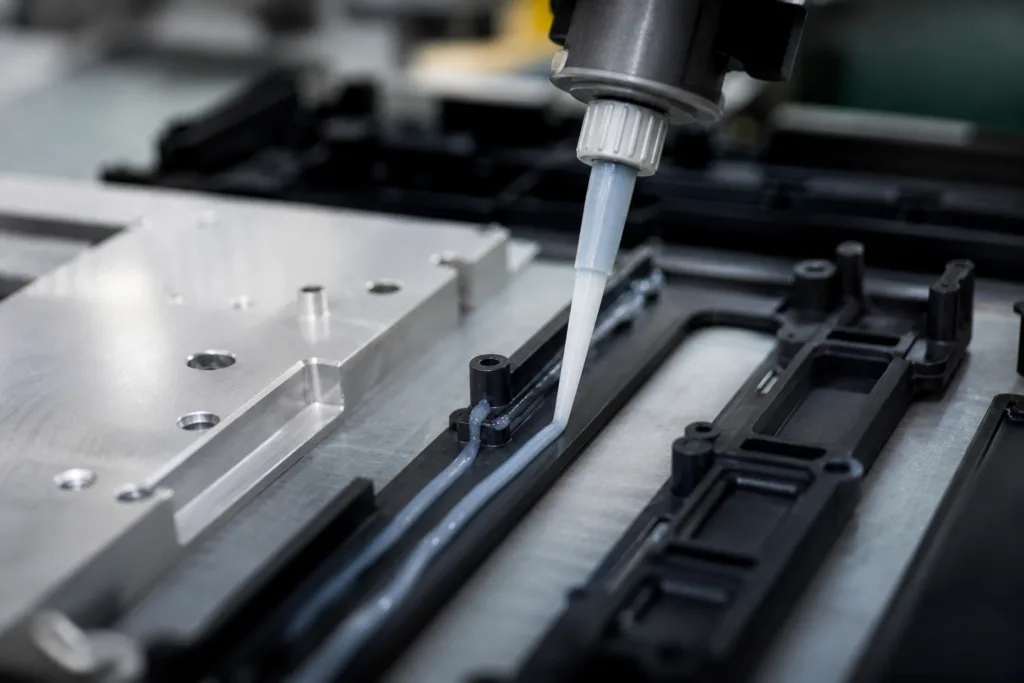
Start with the exact plastic and metal
The phrase plastic to metal adhesive covers many very different pairings. ABS to aluminum is not the same as nylon to stainless steel. Polycarbonate to painted steel is not the same as acrylic to bare aluminum. Before comparing products, identify the exact plastic grade, whether it contains fillers or flame retardants, the metal type, and whether the metal surface is bare, anodized, plated, coated, or painted.
Some plastics are naturally easier to bond, including ABS, rigid PVC, polycarbonate, and acrylic. Others may require specialized surface treatment, primers, or different adhesive chemistry. On the metal side, oxide layers, oils, passivation, and coatings can all change bond performance.
Match the adhesive to the load case
Ask whether the joint will see mostly shear, peel, impact, vibration, or repeated flexing. A rigid adhesive may perform very well in a well-designed overlap joint but fail in a joint that twists or gets dropped. A flexible adhesive may survive movement better, but it may not deliver the positional rigidity needed in a structural assembly.
If high static strength is the priority, engineers often review epoxy options for demanding plastic-to-metal bonds because epoxies can provide strong adhesion, good gap filling, and reliable load transfer when the substrates and service conditions are suitable.
Consider cure speed and process flow
Assembly speed matters just as much as final strength in production environments. Cyanoacrylates may support rapid fixture times for small parts, while two-part epoxies or acrylics may allow more working time and better gap tolerance. UV-curing systems can be attractive when at least one substrate allows light transmission and line speed is critical. The right choice depends on whether your process needs seconds, minutes, or hours of open time and whether parts can be held in place during cure.
Check flexibility and service temperature
For dissimilar materials, flexibility is often an advantage rather than a compromise. A slightly more flexible adhesive can tolerate expansion mismatch and vibration better than a very rigid one. At the same time, if the assembly sees elevated temperatures, that flexibility must remain controlled rather than turning into creep or deformation. Always compare room-temperature handling with real service temperature needs.
Review environmental exposure early
Do not wait until the final stage to think about humidity, chemicals, cleaning fluids, sunlight, or outdoor use. Plastic and metal can each respond differently to the environment, and the adhesive has to remain compatible with both. A fast assembly adhesive may not be the right long-term choice if the product sits near engines, outdoors, or in wet enclosures.
Best adhesive options for bonding plastic to metal
Epoxy adhesives
Epoxies are often shortlisted when strength, gap filling, and durable bonding are key priorities. They generally bond many metals very well and can also work effectively with common engineering plastics when the surfaces are properly prepared. They are often used where the joint must handle load, maintain position, and survive temperature or chemical exposure better than fast consumer-style glues.
The trade-off is that epoxies are usually more rigid than elastomeric systems, so they need joint designs that avoid concentrated peel stress. For assemblies with larger bond areas and structural intent, products such as ZDS-282AB high-strength epoxy for structural bonding represent the type of solution engineers review when stiffness and strength are central requirements.
Acrylic adhesives
Acrylics are often strong candidates for metal-to-plastic applications because they can balance strength, toughness, and process practicality. Compared with some rigid systems, they may offer better impact resistance and more tolerance for slight surface variation. They are especially useful when the joint needs structural performance but also some resilience against shock and differential movement.
In commercial evaluation, many teams look at products such as ZDS-3355H metal-to-plastic bonding adhesive when comparing acrylic systems for mixed-substrate assemblies where balanced performance is more important than one headline strength value.
Cyanoacrylate adhesives
Cyanoacrylates are useful for very fast bonding of small parts, close-fitting surfaces, and high-throughput assembly steps. They can work well on some plastics and metals, but they are less forgiving of larger gaps and may become brittle in demanding dynamic conditions. They are often better for small components or secondary fixation than for large structural joints exposed to impact, heat cycling, or moisture for long periods.
Polyurethane adhesives
Polyurethanes are commonly considered when flexibility, impact resistance, and movement tolerance matter. They can perform well in assemblies that expand, vibrate, or experience moderate mechanical shock. They may not always match rigid structural epoxies in stiffness, but they can be a practical choice when the joint needs to absorb stress rather than resist it with maximum hardness.
Silicone adhesives
Silicones are usually selected for flexibility, sealing, and environmental stability rather than maximum structural strength. They are useful when the bond line must tolerate wide temperature swings, outdoor exposure, or movement between plastic and metal components. If the assembly needs both sealing and bonding, silicone may be a logical option, but it is usually not the first choice for high-load structural use.
Structural hybrid adhesives
Hybrid systems are sometimes used when a project needs a middle ground between strength and flexibility. Depending on the formulation, they may offer better toughness than rigid chemistries and better load capacity than purely elastic sealant-style materials. These can be worth reviewing when standard categories do not neatly fit the application.
When each adhesive type works best
| Adhesive type | Best fit | Main advantage | Main caution |
|---|---|---|---|
| Epoxy | Structural joints, larger bond areas, gap filling | High strength and durability | Can be too rigid for high-movement joints |
| Acrylic | Metal-to-plastic assemblies needing toughness | Good balance of strength and impact resistance | Odor and handling profile may need process review |
| Cyanoacrylate | Small parts, fast fixture, close fit surfaces | Very quick bonding | Limited gap filling and lower toughness |
| Polyurethane | Flexible joints, vibration, moderate impact | Movement tolerance | Usually lower rigidity than structural epoxies |
| Silicone | Sealing plus bonding, wide temperature swings | Excellent flexibility and weathering tolerance | Lower structural strength |
| Hybrid structural | Mixed demands for strength and flexibility | Balanced performance | Must be matched carefully to the use case |
No adhesive category is automatically the strongest for every plastic-metal combination. The better question is which chemistry fits the surfaces, stress pattern, cure process, and service environment together.
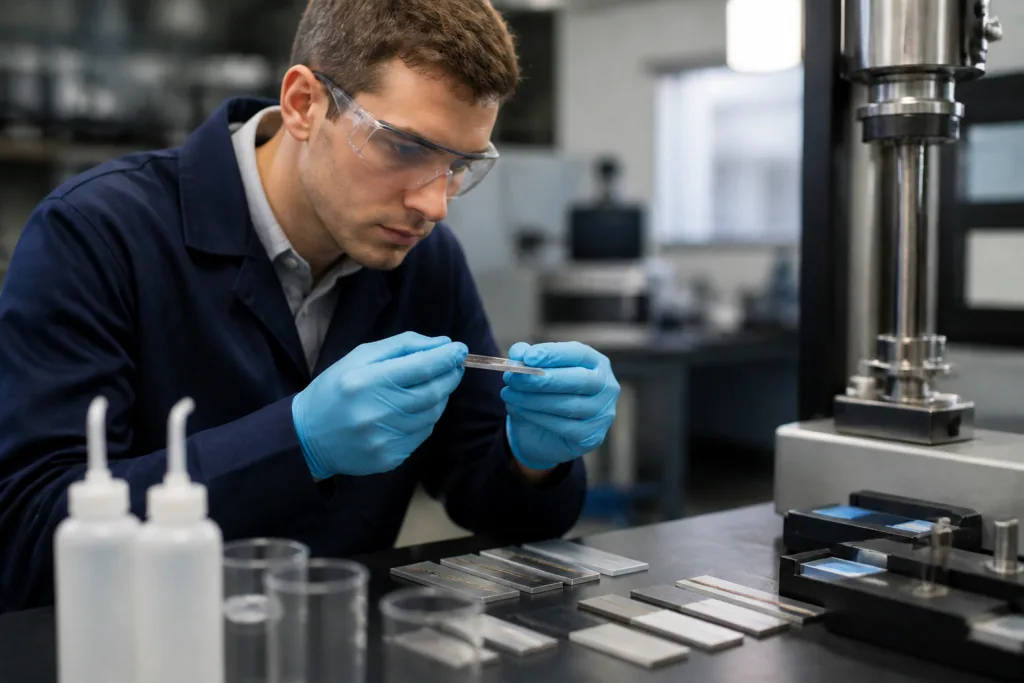
Surface preparation methods that improve bond strength
Surface preparation often determines whether a promising adhesive succeeds or fails. Even a suitable formulation can underperform if oil, release agent, dust, oxide, or fingerprints remain at the interface.
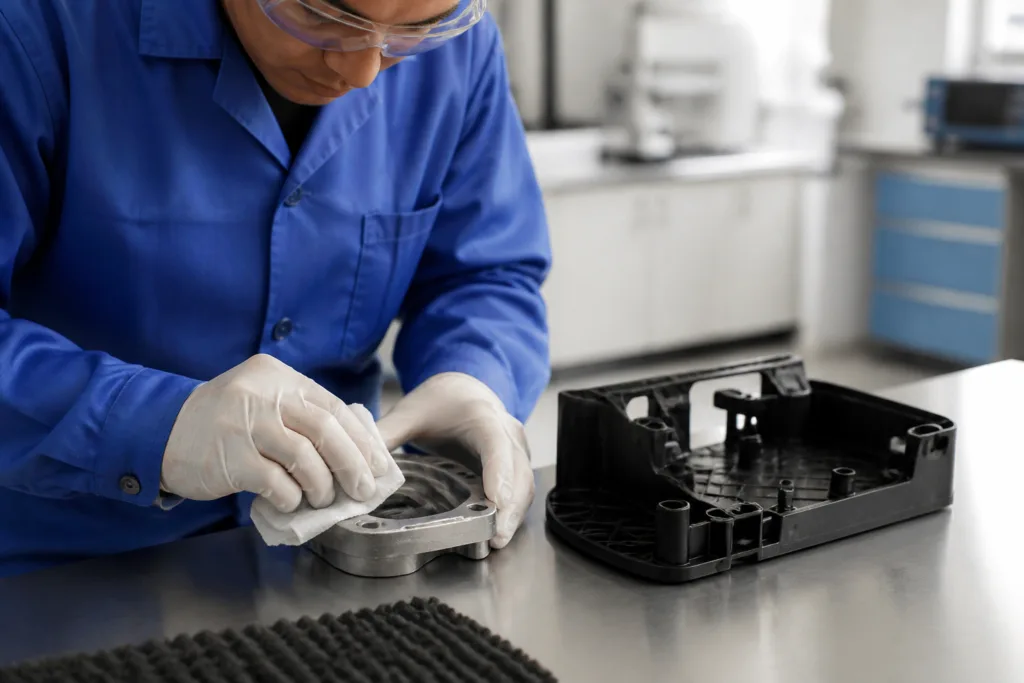
Cleaning
Remove oils, dirt, mold release residue, machining fluids, and loose contaminants before bonding. Use a cleaning method compatible with both substrates. Plastics can be sensitive to strong solvents, so chemical compatibility should be checked before wiping or immersion.
Abrasion
Light abrasion on metal can increase surface area and help remove weak boundary layers. Some rigid plastics can also benefit from controlled abrasion, but the method has to be consistent. Aggressive sanding may create debris, induce stress, or damage cosmetic surfaces.
Priming and surface activation
Some difficult plastics benefit from primers, while low-surface-energy materials may need plasma or flame treatment to improve wetting and adhesion. These methods can significantly change results, but they must be validated under real production conditions because treatment effectiveness can decay over time before bonding.
For transparent engineering plastics paired with metal, buyers may also evaluate curing method along with preparation steps. In those cases, systems such as ZDS-22072201 for PC-to-metal assemblies are the type of option considered when optical access, process speed, and substrate compatibility all shape adhesive selection.
Contamination control
Prepared parts should be bonded quickly and handled carefully. A well-cleaned surface can be re-contaminated by skin oils, shop dust, or airborne process residue. In many production settings, consistency in preparation matters just as much as the chosen adhesive chemistry.
Common plastic and metal pairings
ABS to aluminum or steel
ABS is often considered relatively bond-friendly compared with lower-energy plastics. Structural acrylics and epoxies are common starting points, especially when the assembly needs strength and dimensional stability.
Polycarbonate to stainless steel or aluminum
Polycarbonate can bond well, but care is needed with adhesive chemistry and cleaning method to avoid stress cracking. If transparency or UV curing is part of the process, the cure path and light access become important variables.
PVC to painted metal
PVC can be workable, but painted metal introduces another interface. The real bond may be limited by paint adhesion to the metal, not by the adhesive itself. Testing should include the full stack, not just the nominal substrate names.
Nylon to stainless steel
Nylon can be more difficult because moisture absorption and formulation differences affect bonding behavior. Surface condition, part conditioning, and environmental testing become especially important here.
Acrylic to aluminum
Acrylic plastics can produce clear, rigid assemblies, but brittleness and thermal movement still need attention. The right adhesive often depends on whether the priority is appearance, speed, structural load, or weathering.
Testing and validation checklist
Adhesive selection should end with validation, not with a datasheet comparison. At ZDS, selection discussions typically become much more useful once the joint design, substrates, and expected failure modes are tested together rather than judged by generic strength claims.
- Lap shear testing: useful for comparing basic load-bearing performance across candidate adhesives.
- Peel resistance: important when one substrate is flexible or the joint sees edge lifting forces.
- Temperature cycling: helps reveal stress from thermal expansion mismatch.
- Humidity exposure: screens for moisture-related adhesion loss or substrate interaction.
- Vibration testing: important for transport, appliances, electronics, and industrial equipment.
- Aging studies: check whether the bond remains reliable after time, heat, or repeated environmental stress.
Where possible, test production-prepared parts instead of ideal lab coupons. Real surfaces, real tolerances, and real cure conditions often expose issues that small-scale screening misses.
Common mistakes to avoid when gluing metal to plastic
- Choosing by strength number alone: the highest listed value may not survive your real stress pattern.
- Ignoring plastic grade: additives, fillers, and mold release can change adhesion dramatically.
- Skipping surface preparation: even minor contamination can weaken the bond line.
- Using a rigid adhesive on a moving joint: this often creates premature cracking.
- Not checking paint or coating integrity: the adhesive may bond to a weak surface layer instead of the metal.
- Validating only at room temperature: many failures show up after heat, cold, moisture, or cycling.
- Overlooking cure constraints: fixture time, shadow areas, mix ratio control, and gap size all affect outcome.
How to shortlist the right plastic to metal adhesive
A practical shortlist usually starts with five filters: exact substrates, joint geometry, required strength, service environment, and process speed. If the joint is structural and relatively rigid, epoxy or acrylic may move to the top of the list. If the joint needs flexibility or impact tolerance, polyurethane, silicone, or a hybrid system may be more appropriate. If the assembly is small and speed matters most, cyanoacrylate may still be worth considering.
From there, narrow the list by asking a few decision-oriented questions:
- Is the plastic easy or difficult to bond?
- Will the joint see peel, shock, or vibration?
- Does the adhesive need to fill gaps?
- Is fast fixture more important than ultimate strength?
- Will the assembly face moisture, heat, UV, or chemicals?
- Is the bond intended to be structural, cosmetic, sealing, or multifunctional?
The right answer is usually the adhesive that delivers adequate strength with the least risk in production and in service, not the one with the most aggressive technical description.
Conclusion
The best plastic to metal adhesive depends on the full bonding system: the plastic, the metal, the joint design, the environment, and the manufacturing process. Epoxies, acrylics, cyanoacrylates, polyurethanes, silicones, and hybrid systems all have valid roles, but they solve different problems. Strong results come from matching adhesive behavior to real application demands, preparing surfaces correctly, and validating with relevant tests before scale-up.
FAQ
Can you glue metal to plastic permanently?
Yes, permanent bonding is possible if the adhesive matches the plastic type, metal surface, joint design, and service environment, and if surface preparation and testing are handled properly.
What is the strongest adhesive for plastic to metal?
There is no single strongest option for every case, but structural epoxies and acrylics are common top candidates when high strength and durable plastic-to-metal bonding are required.
Do different plastics need different adhesives?
Yes, because plastics vary widely in surface energy, chemical resistance, flexibility, and sensitivity to stress cracking, so the same adhesive may work well on one plastic and poorly on another.
Is surface preparation really necessary for plastic to metal bonding?
In most industrial applications, yes, because cleaning, abrasion, or surface activation can greatly improve wetting, adhesion, and long-term bond consistency.
Should I choose a rigid or flexible adhesive for metal to plastic joints?
Choose based on the load and movement in the joint: rigid adhesives suit stable structural assemblies, while flexible adhesives are often better for vibration, impact, or thermal expansion mismatch.
How should plastic-to-metal adhesive performance be tested?
Use tests that reflect real service conditions, including lap shear, peel, temperature cycling, humidity exposure, vibration, and aging on production-like parts whenever possible.