
Lightweight stone panels solve a real design and installation problem: how to keep the visual impact of natural or engineered stone while reducing weight, improving handling, and expanding use in elevators, wall cladding, furniture, and architectural interiors. But the adhesive decision becomes more demanding than it is for solid stone slabs. A stone honeycomb panel adhesive has to do more than hold two surfaces together. It must distribute stress across dissimilar materials, support long-term dimensional stability, manage movement between brittle and flexible layers, and maintain bond integrity through moisture, temperature change, and fabrication variability.
If your project involves thin stone veneers laminated to aluminum honeycomb or composite backings, it helps to review adhesive options for stone composite panel bonding early in the design stage. In our manufacturing work, we see that buyers often need support beyond basic bond strength: viscosity matched to panel layup, open time suited to large-area assembly, toughness that protects brittle stone from shock loading, and packaging formats that fit OEM production or private label planning. That is where formulation adjustment, sample validation, and production consistency become as important as the nominal adhesive type.
Why lightweight stone panels need a different bonding strategy
A lightweight stone panel is a layered structure, not a simple two-substrate bond. The stone facing may be thin and brittle. The backing may be aluminum honeycomb, fiberglass-reinforced sheet, aluminum plate, or another composite support layer. Each material has different stiffness, thermal expansion behavior, surface energy, and moisture response. Under service conditions, the adhesive layer becomes the stress-management zone.
This is why selection cannot be based only on initial adhesion to stone. A suitable system also needs balanced toughness, controlled bond-line thickness, reliable wet-out over broad surface areas, and enough cohesion to avoid creep, edge lifting, or local debonding over time. In panel manufacturing, poor bonding choices usually show up later as warped appearance, hollow spots, edge separation, or reduced impact tolerance.
For manufacturers building repeatable laminated structures, laminating adhesive options for composite panel construction should be evaluated from a process and durability perspective, not only a chemistry label perspective. Large-area bonding behaves differently from small-part assembly.
What a stone honeycomb panel is and why the structure matters
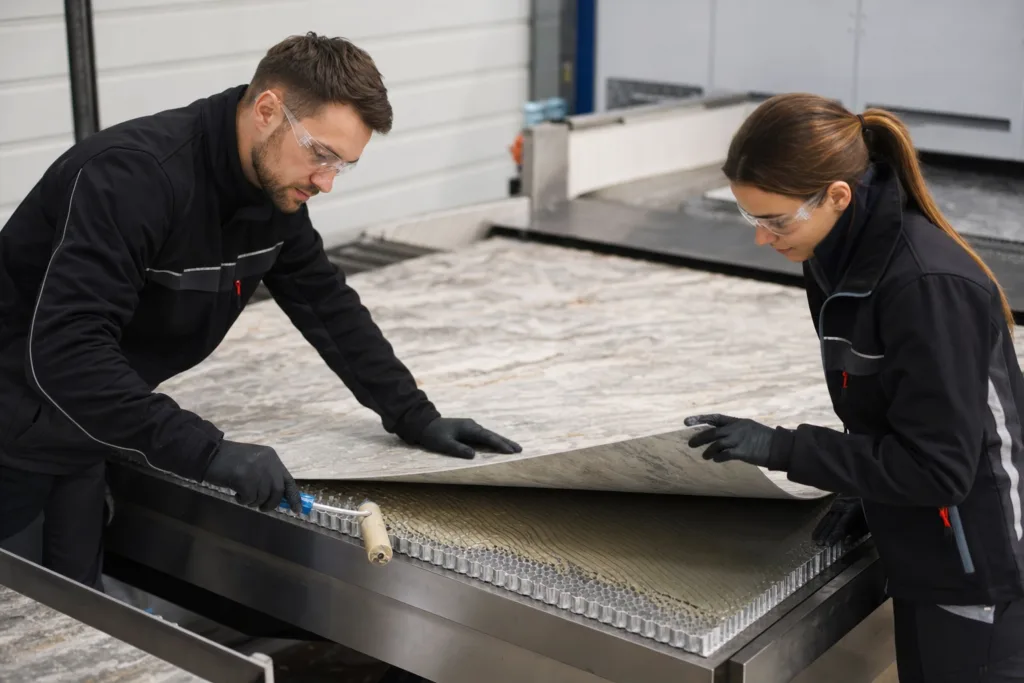
Most stone honeycomb panels combine a decorative stone face sheet with a lightweight backing structure. Typical constructions include:
- Natural stone veneer bonded to aluminum honeycomb
- Engineered stone bonded to honeycomb with an intermediate fiberglass layer
- Stone veneer bonded to aluminum or composite backing panels
- Multi-layer sandwich panels designed for wall systems, transport interiors, or furniture components
The details matter because the adhesive may contact multiple interfaces in a single panel system:
- Stone to primer or reinforcement layer
- Stone or fiberglass to aluminum sheet
- Sheet to honeycomb core
- Edge close-out or perimeter reinforcement materials
Each interface can fail in a different way. Porous stone may absorb low-viscosity material unevenly. Aluminum may require better surface cleanliness and oxide-aware preparation. Fiberglass surfaces may vary depending on resin-rich layers, release residue, or sanding condition. Composite backings may need flexibility that differs from a purely metallic sandwich panel.
How the bonding interface works in stone composite panels
In a finished panel, loads are not carried by the stone face alone. The assembly works as a sandwich structure. The face sheet takes tension or compression during bending, the core helps maintain separation and stiffness, and the adhesive transfers shear between layers. If the interface is weak, too brittle, too thick in some areas, or full of voids, the panel may lose stiffness and durability long before visible separation appears.
Core adhesion matters because localized load transfer can create stress concentrations. A well-selected adhesive spreads force more evenly, reducing the risk of crack initiation in thin stone. This is especially important around cut-outs, corners, fixing points, and panel edges where movement and stress are less uniform.
From our adhesive manufacturing perspective, the most practical way to think about bond performance is this: the adhesive should be strong enough to hold the layers together, tough enough to absorb movement, and processable enough to create a consistent bond line across the entire panel area.
Key adhesive requirements for stone honeycomb panel adhesive performance
When buyers compare products, they often start with chemistry names such as epoxy, polyurethane, or modified systems. A better starting point is performance requirements. For this application, the usual priorities are:
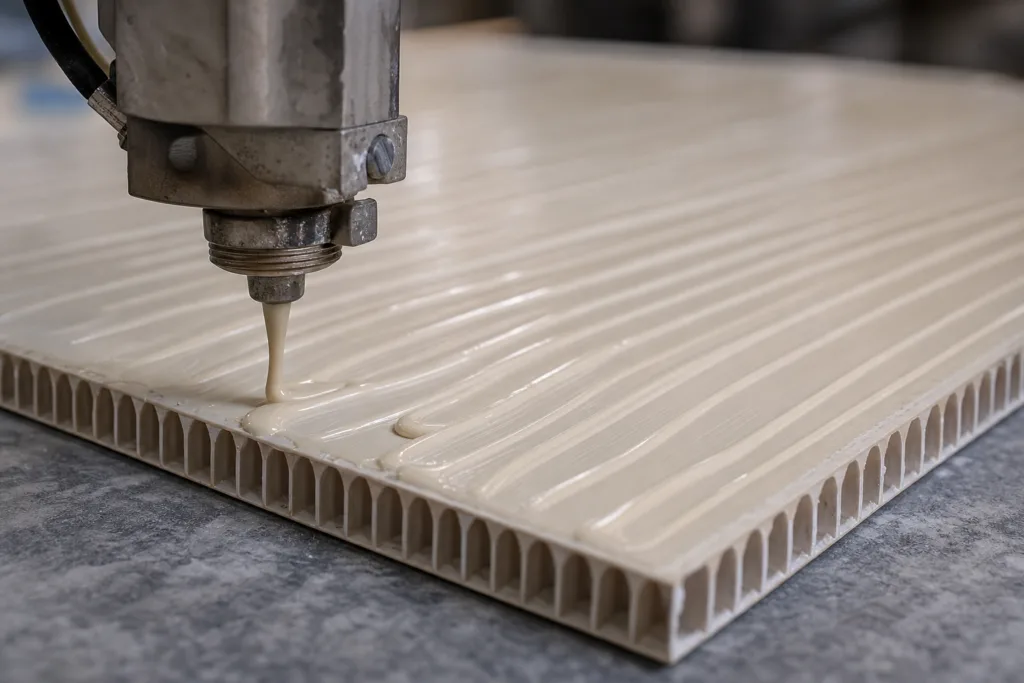
- Area coverage and wet-out: The adhesive must spread predictably over large panel surfaces without starving high points or flooding low areas.
- Toughness: Thin stone needs support against shock, vibration, and differential movement.
- Bond-line control: Excessive variation can create print-through, weak zones, or moisture-sensitive pockets.
- Low void tendency: Voids reduce effective bonding area and can become crack initiation sites.
- Environmental resistance: Humidity, condensation, cleaning agents, and temperature swings can all affect long-term performance.
- Process fit: Open time, mixing ratio, cure speed, and sag resistance must align with panel size and production rhythm.
- Compatibility with stone and backing materials: Adhesion must be stable on mineral and non-mineral surfaces within the same panel.
In honeycomb assemblies, buyers should also ask about controlled cure behavior, limited sag, and durability under heat and humidity. Standards developed for bonded honeycomb structures provide useful guidance on the kinds of properties that matter in these constructions, as reflected in this ASTM specification for honeycomb panel adhesive performance.
Choosing the right adhesive chemistry for stone and honeycomb assemblies
Epoxy systems
Epoxy adhesives are commonly considered when higher rigidity, strong structural bonding, and good adhesion to mineral and metal surfaces are required. They are often suitable when the panel design benefits from stronger cohesive properties and controlled gap filling. However, not every epoxy works well for thin stone laminates. Very rigid systems can transfer stress into brittle stone, especially under temperature cycling or impact.
That is why panel builders often evaluate epoxy adhesive solutions for structural stone panel bonding by looking beyond peak strength. The more useful questions are whether the cured system has enough toughness, whether the viscosity supports broad-area application, and whether the cure profile fits panel pressing and throughput needs.
Polyurethane systems
Polyurethane adhesives are often valued for their balance of adhesion and flexibility. In stone composite panel work, that added flexibility can help absorb thermal mismatch and service vibration. This may be beneficial where aluminum and stone are bonded together and expected to see movement or occasional impact.
Polyurethane systems also need careful review of moisture sensitivity during processing, cure control, and final hardness. If a formulation is too soft, creep or dimensional movement can become a concern. If it is too reactive for the production environment, application stability may suffer. In some projects, buyers review options such as ZDS-8001AB PU adhesive for stone bonding in demanding assemblies when they want to compare flexibility and heat-related service considerations with more rigid structural systems.
Modified structural systems
Depending on panel design, some manufacturers prefer modified epoxy or hybrid structural adhesives to balance strength and toughness. These can be useful when standard rigid epoxies are too brittle, but very flexible systems do not provide enough support. The right answer depends on stone thickness, panel size, service temperature range, and whether the application is primarily interior decorative or more mechanically demanding.
Substrate compatibility considerations
Natural stone
Natural stone varies by porosity, density, microcracking, mineral composition, and surface finish. Polished surfaces may need a different preparation approach than roughened backs. Highly absorbent stone can pull resin unevenly from the bond line. Some stones are also more sensitive to telegraphing, staining, or visible show-through if the adhesive is poorly matched.
Engineered stone
Engineered stone may contain resin phases and fillers that behave differently from natural stone. Surface contamination from cutting, polishing, or handling can reduce adhesion. We usually recommend evaluating both adhesion and cohesive behavior after conditioning, not just dry room-temperature bond strength.
Aluminum honeycomb and metallic backing layers
Aluminum surfaces can bond very well when properly prepared, but contamination, oxide condition, and surface treatment make a major difference. Cleanliness is critical. In production, inconsistent pretreatment is one of the fastest ways to create scatter in peel resistance and long-term durability.
Fiberglass and composite backing materials
Fiberglass-reinforced layers often improve crack management and impact behavior in stone panels, but they also introduce another variable. Resin-rich surfaces, release agents, and fabric print can affect wet-out. Adhesives for fiberglass-backed stone panels often need the right viscosity window to penetrate enough for mechanical engagement without flooding the structure.
Process factors that affect bond quality
A good formulation can still fail in production if the application process is not controlled. For stone composite panels, the most important process variables are usually:
| Factor | Why it matters | Typical risk if ignored |
|---|---|---|
| Viscosity | Controls spread, wet-out, and sag behavior | Dry spots, squeeze-out, or trapped air |
| Open time | Determines workable assembly window for large panels | Skinning, poor contact, incomplete transfer |
| Mix ratio | Affects cure completeness and final properties | Soft cure, brittleness, weak adhesion |
| Bond-line thickness | Influences stress distribution and durability | Voids, local weakness, movement sensitivity |
| Pressing pressure | Helps create intimate contact without starving bond line | Uneven thickness or resin starvation |
| Cure speed | Must fit panel handling and downstream operations | Warping, early handling damage, low throughput |
Bond-line thickness deserves special attention. In moisture and heat exposure, thickness variation can change how stress develops and how the interface ages. Research on why bond-line thickness matters for moisture durability is a useful reminder that durability is not just about chemistry selection; it is also about how consistently the adhesive joint is built.
Large-format stone panels often require a balance between enough adhesive to accommodate surface irregularity and not so much that cure shrinkage, trapped air, or prolonged cure becomes a problem. This is where trial panels and sectioned bond-line inspection are more valuable than relying on nominal spread-rate calculations alone.
Typical applications and what they demand from the adhesive
Wall panels and cladding interiors
These applications often prioritize flatness, dimensional stability, and long-term appearance. The adhesive must resist edge lift, thermal movement from building conditions, and occasional humidity exposure during transportation, installation, or service.
Elevator interiors
Elevator panels see vibration, repeated impact, cleaning exposure, and tight visual tolerances. Adhesive toughness and consistent bond-line control become especially important because local debonding can quickly affect appearance and acoustic feel.
Furniture and fixture components
Furniture applications may involve cut-outs, hardware integration, and localized loading. Lightweight design helps handling and support structure design, but the panel still needs resistance to edge damage and handling shock.
Architectural feature components
For shaped or custom assemblies, the production process may be less standardized. In these cases, open time, fixture method, and adhesive rheology can matter even more than ultimate strength values.
Performance risks in real use
Even when panels pass initial assembly checks, service conditions can expose hidden weaknesses. Common risks include:
- Temperature swings: Stone and aluminum do not move at the same rate, so the adhesive must absorb differential expansion.
- Moisture exposure: Humidity, condensation, or wet cleaning can gradually weaken vulnerable interfaces.
- Vibration: Transport, elevator movement, or handling shock can grow small defects into larger debonded zones.
- Impact: Brittle face materials need support from a tough adhesive layer that reduces stress concentration.
- Long-term aging: Oxidation, plasticization, hydrolysis, or interfacial degradation may reduce durability if the system is not well matched.
From a purchasing perspective, this is why short-term lap shear numbers should not be treated as the whole story. A panel adhesive must survive the combined effect of environment, structure, and process variability.
Common failures in stone honeycomb panel production
Face-sheet debonding
This may result from poor stone preparation, inadequate wet-out, insufficient toughness, or cure before full panel contact is achieved.
Local voids and hollow areas
These often come from uneven spreading, incorrect viscosity, trapped air, or non-flat substrates. They may not be obvious until tapping, cutting, or service loading reveals them.
Edge delamination
Edges experience more moisture entry and handling stress. If perimeter sealing, adhesive coverage, or local support design is weak, delamination often starts here first.
Uneven bond-line thickness
Too much adhesive in one zone and too little in another can create a mix of stiffness, cure behavior, and stress response across the panel. This inconsistency is a frequent root cause of variable quality between batches.
When troubleshooting these issues, process review matters as much as chemistry review. At ZDS, we often find that application method, substrate cleanliness, and bond-line control explain why one factory gets stable results while another struggles with the same nominal adhesive type.
How to test and validate a stone honeycomb panel adhesive before full production
Pre-production validation should mimic the real panel structure, not just a simplified coupon. A practical qualification plan usually includes:
- Adhesion checks on actual stone, backing, and reinforcement materials
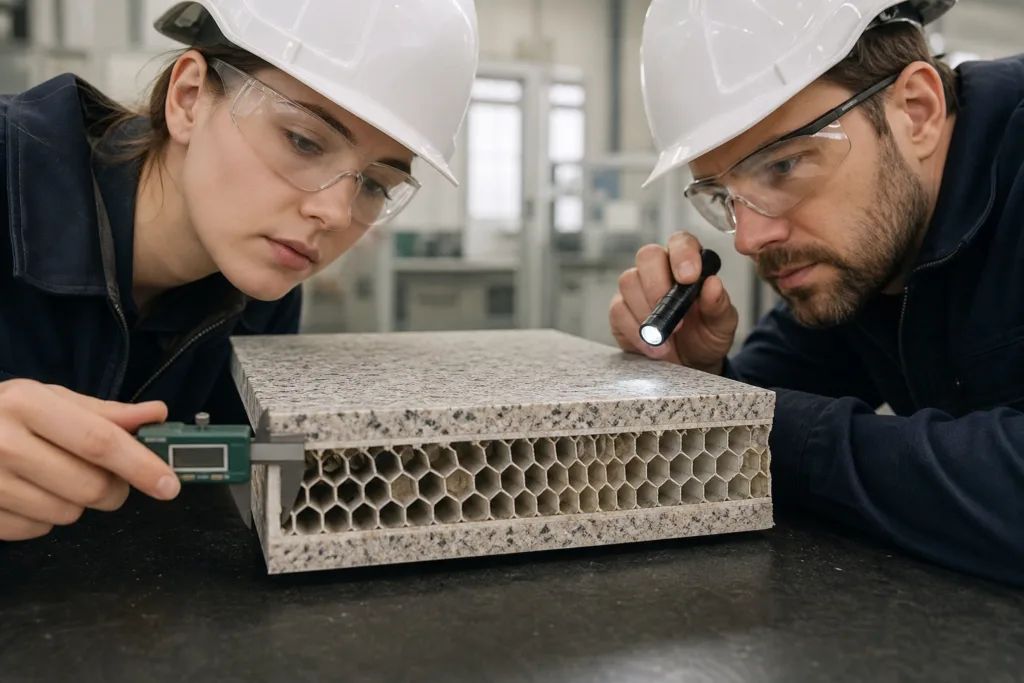
- Bond-line thickness measurement across the panel area
- Cut-section inspection for voids and adhesive distribution
- Conditioned testing after heat, humidity, or wet-dry exposure
- Impact or handling simulation for thin stone durability
- Flatness and warpage observation after cure
- Process window trials for different open times and press conditions
For sandwich structures, recognized methods such as core shear testing for bonded sandwich panels can help compare systems more consistently, especially when you want to understand how adhesive thickness, void content, and environmental conditioning influence structural behavior.
We generally suggest evaluating not only average results, but also variation between operators, panel sizes, and production days. Procurement teams may focus on price per kilogram, but production stability often has a larger cost impact than resin price alone.
How we approach selection and customization for stone composite panels
In our formulation and production work, we start with the structure rather than the label. We ask what the stone is, how thick it is, what backing is used, whether fiberglass or another intermediate layer is present, how the adhesive will be applied, and what service environment the panel will face. We also review whether the customer needs room-temperature cure, heat-assisted cure, long open time for manual layup, or faster handling for continuous production.
That is why many manufacturers benefit from adhesive selection technical support for stone composite projects before fixing a specification. Small adjustments in viscosity, pot life, thixotropy, or cured toughness can make a major difference in panel quality, especially when a product will be produced under OEM or ODM conditions across multiple batches.
Customization may include:
- Viscosity tuning for roller, trowel, bead, or metered mixing application
- Open time adjustment for panel size and assembly sequence
- Toughness balance for brittle stone with metallic cores
- Packaging changes for manual shops or automated production
- Sample support for side-by-side validation against current materials
- QC alignment for consistent mixing, cure, and batch release
Checklist for specifying a stone aluminum honeycomb bonding adhesive
Before approving a material for production, we recommend that buyers document the following:
- Stone type, thickness, and backside condition
- Honeycomb or backing material and surface preparation method
- Target bond-line thickness range
- Required open time and fixture or press window
- Room-temperature or heat-assisted cure conditions
- Minimum toughness and durability expectations
- Humidity, temperature, and cleaning exposure in service
- Panel size and flatness tolerance
- Void acceptance criteria and inspection method
- Packaging format, batch size, and shelf-life requirements
- Need for OEM customization or private label supply planning
A clear specification reduces confusion between engineering, production, and procurement. It also makes supplier comparison more meaningful because not every structural adhesive is designed for the same panel architecture.
Conclusion
Choosing a stone honeycomb panel adhesive is really an exercise in balancing structure, process, and durability. The right product must bond dissimilar materials over large areas, support thin and brittle stone, maintain a controlled bond line, and stay reliable under environmental change. For most manufacturers, the best decision comes from testing the complete panel system, not just comparing chemistry names or headline strength values. When the adhesive is matched to the stone, core, backing, and production method, lightweight panel design becomes more durable, more consistent, and easier to scale.
FAQs
What is the most important property in a stone honeycomb panel adhesive?
The most important property is usually balanced performance rather than a single number. For these panels, we look for a combination of adhesion to mineral and backing materials, enough toughness to protect thin stone, consistent bond-line control, and durability under moisture and temperature change. A very strong but brittle adhesive can still create service problems if it cannot manage movement between layers.
Can the same adhesive work for natural stone and engineered stone panels?
Sometimes yes, but it should not be assumed without testing. Natural stone and engineered stone can differ in porosity, surface chemistry, resin content, and contamination risk from processing. We usually recommend substrate-specific trials because the same adhesive may wet, cure, and age differently depending on the panel construction and backside surface condition.
How should manufacturers control bond-line thickness in large panel lamination?
Bond-line thickness can be managed through adhesive viscosity, application method, spread rate, panel flatness, and pressing conditions. In practice, manufacturers should verify cross-sections from trial panels instead of relying only on theoretical consumption. Consistent thickness reduces voids, supports better stress distribution, and improves long-term durability under heat and humidity.
What causes edge delamination in stone composite panels?
Edge delamination is commonly linked to incomplete adhesive coverage, poor local support, moisture entry, or excessive stress concentration at the panel perimeter. It can also result from uneven cure or contamination near the edge during fabrication. Because edges experience more handling and environmental exposure, they should be reviewed carefully during design validation and production QC.
Is sample testing necessary before switching adhesive suppliers or formulations?
Yes, sample testing is strongly recommended. Even when two products appear similar on a data sheet, their viscosity profile, cure behavior, toughness, and substrate interaction may differ in ways that affect panel quality. A controlled comparison using actual stone, backing materials, and process conditions is the safest way to evaluate whether a change will improve or disrupt production stability.
What should procurement teams ask an adhesive manufacturer before approval?
Procurement teams should ask about substrate compatibility, recommended surface preparation, working time, cure schedule, packaging options, shelf life, batch consistency, and whether formulation adjustment is available for their panel process. It is also useful to confirm how the supplier supports sampling, technical troubleshooting, and scale-up, because the lowest unit price does not always produce the lowest manufacturing cost.