
Solar equipment operates in one of the most demanding bonding environments in industry. A solar energy adhesive may need to hold dissimilar materials together, seal against moisture, tolerate constant UV exposure, and survive years of thermal expansion and contraction without losing integrity. That is why adhesive selection for solar applications should be based on long-term durability and validation logic, not only on initial bond strength or short-term lab results.
explore industrial adhesive solutions when comparing how different chemistries are used for bonding, sealing, potting, and protective assembly work in outdoor systems where service life matters as much as processing convenience.
Why solar applications demand more from adhesives
Solar assemblies are exposed to multiple stress factors at the same time. Unlike many indoor products, they face sunlight, heat, rain, humidity, dust, freeze-thaw conditions, and daily temperature swings for long periods. In practice, this means a solar energy adhesive must do more than simply stick two parts together. It must maintain adhesion, cohesion, flexibility, and sealing performance while the surrounding materials move and age.
Another challenge is mixed-material construction. Solar assemblies often combine glass, aluminum, coated metals, engineering plastics, cable materials, ceramics, and electronic components. Each substrate expands differently with temperature. If the adhesive is too rigid, too brittle, or poorly matched to the substrates, stress can build up over time and cause cracking, delamination, or water ingress.
What makes solar bonding different from ordinary industrial bonding
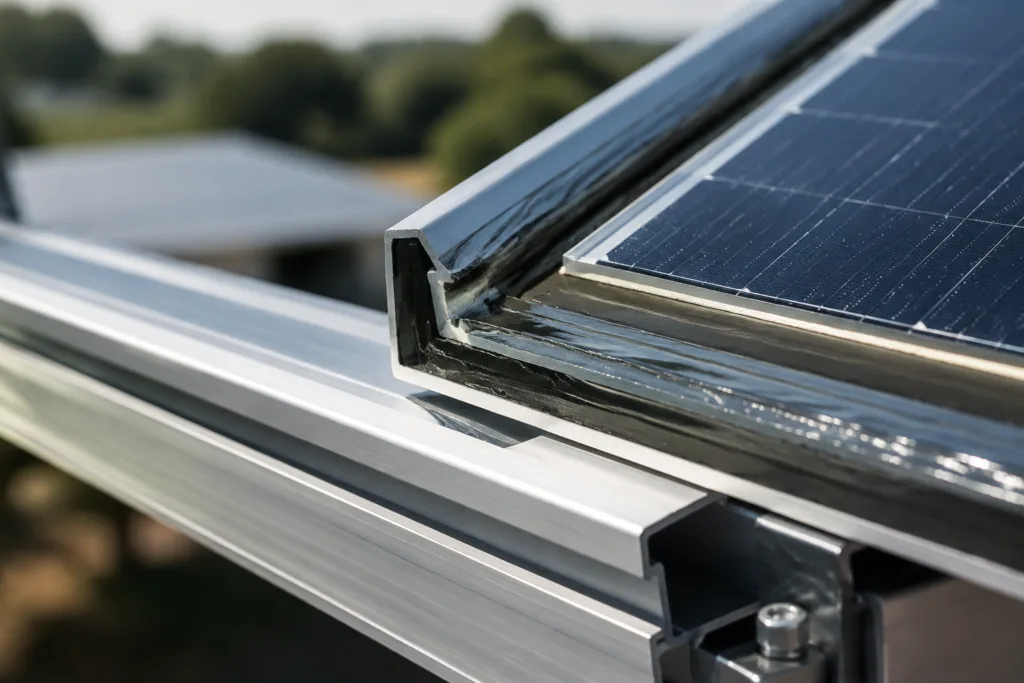
In many general industrial applications, an adhesive mainly deals with static loads or moderate indoor exposure. Solar systems are different because the environment continuously tests the bond line. UV radiation can break down some polymers. Moisture can migrate into weak interfaces. Heat cycling can fatigue rigid adhesive layers. Even a bond that looks strong on day one may become unreliable after repeated outdoor exposure.
Processing constraints also matter. Some solar-related assemblies require narrow bond lines, controlled dispensing, low-stress curing, electrical insulation, or compatibility with sensitive components. In these cases, adhesive performance has to be evaluated as a combination of material properties, cure behavior, assembly method, and real service environment.
The most important performance factors for a solar energy adhesive
UV resistance
Long-term sunlight exposure is one of the most important reasons outdoor adhesives fail. UV energy can cause discoloration, embrittlement, surface cracking, and gradual loss of mechanical properties. For solar assemblies, UV resistance is especially important in exposed sealing areas, cable exits, junction-related protection zones, and any bond line that may receive direct or reflected sunlight.
A UV-resistant material should not be judged only by whether it remains visually clear or intact at first glance. The more important question is whether it still maintains adhesion and flexibility after aging. In adjacent protective electronics zones, coatings such as ZDS-3661B UV-resistant PCB conformal coating illustrate the kind of UV durability thinking often needed when sensitive circuitry also requires environmental protection.
Weather resistance
Rain, humidity, condensation, and airborne contaminants all affect bond durability. Moisture does not only attack the adhesive itself; it can also penetrate weak interfaces between the adhesive and substrate. Once that happens, adhesion loss may spread gradually even if the part still appears bonded from the outside.
For this reason, weather-resistant adhesives are typically selected with attention to water resistance, flexibility retention, and interface stability over time. Outdoor assemblies also benefit from designs that reduce standing water, sharp stress points, and poorly sealed edges.
Temperature cycling resistance
Solar installations heat up in sunlight and cool down at night, repeating the cycle over years. Different materials expand and contract at different rates, so the adhesive layer must absorb stress without cracking or peeling away. This is where flexibility, elongation, and modulus become important. A very hard adhesive may provide high initial strength, but if it cannot accommodate movement, it can become the weak point in the assembly.
Where elevated temperature exposure or thermally stressed encapsulated areas are involved, materials such as ZDS-368AB high-temperature potting epoxy adhesive represent the type of option engineers may compare when heat resistance and structural stability are both relevant.
Long-term aging stability
One of the most common selection mistakes is prioritizing fast cure or high initial strength over aging resistance. Solar equipment is a long-service application. The better question is not “How strong is the bond today?” but “How stable is the bonded system after years of UV, moisture, and thermal stress?” A balanced adhesive should retain enough adhesion, elasticity, and environmental resistance to remain functional beyond the early life of the assembly.
Common bonding and sealing scenarios in solar applications
Module assembly and component bonding
Solar-related assemblies may require bonding of brackets, cable retention elements, protective covers, small housings, or support components. These joints often involve dissimilar materials and outdoor exposure. In such cases, the adhesive must be chosen not just for bond strength, but also for substrate compatibility, movement tolerance, and weather durability.
Engineers should also consider whether the joint is structural, semi-structural, or mainly positional. A material suitable for holding a lightweight protective part may not be suitable for a load-bearing mount. Clear role definition helps avoid over-specifying or under-specifying the adhesive.
Frame, junction box, and edge sealing applications
Sealing functions are critical because small leakage paths can lead to corrosion, electrical reliability issues, or progressive assembly damage. In frame and edge-related zones, the adhesive or sealant may need to tolerate expansion, remain elastic, and resist prolonged wet conditions. Junction-related areas also require attention to electrical protection and thermal stress.
For outdoor sealing and moisture defense, products comparable in function to ZDS-999 silicone waterproof adhesive for outdoor use are often evaluated where flexibility and water resistance are more important than rigid structural strength.
Mounting support, potting, and protective sealing
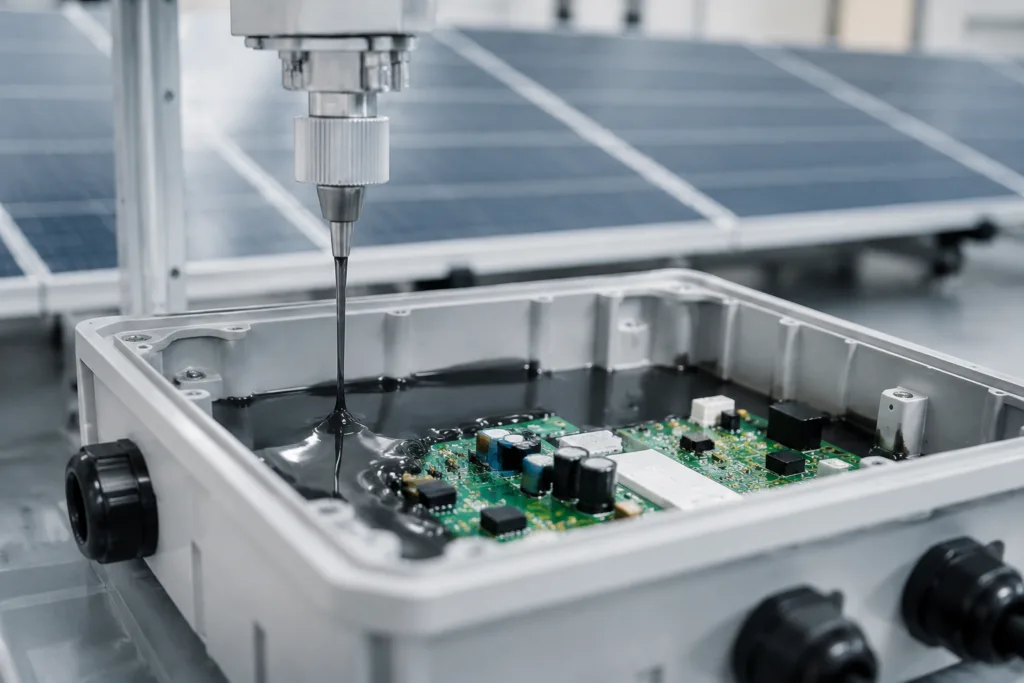
Some solar subsystems include electronics, drivers, connectors, sensors, or control elements that need potting or encapsulation support. Here the adhesive may serve multiple roles at once: environmental sealing, vibration damping, insulation, and sometimes heat management. Potting materials must be judged carefully because excessive hardness can transfer stress into delicate components, while insufficient cohesion may reduce long-term protection.
In outdoor electronics protection scenarios, ZDS-2680 silicone potting adhesive for outdoor protection reflects the kind of flexible, weather-focused material category that buyers often compare for exposed assemblies needing reliable sealing around sensitive internal parts.
How to evaluate whether an adhesive is suitable for solar use
A practical evaluation starts with the real use case rather than the product claim. Ask what the adhesive must actually do: bond, seal, pot, insulate, protect, or absorb stress. Then define the service environment: direct sunlight or shaded, high humidity or intermittent wetting, static or moving joint, high temperature peaks or moderate outdoor exposure. This process usually narrows the chemistry options faster than generic performance language.
From a manufacturer perspective, ZDS typically evaluates adhesive fit by connecting substrate pairings, cure conditions, stress profile, and environmental exposure instead of relying on a single headline property. That approach is useful for buyers because a strong datasheet claim in one area does not automatically translate into long-term solar reliability.
Key test conditions to look for
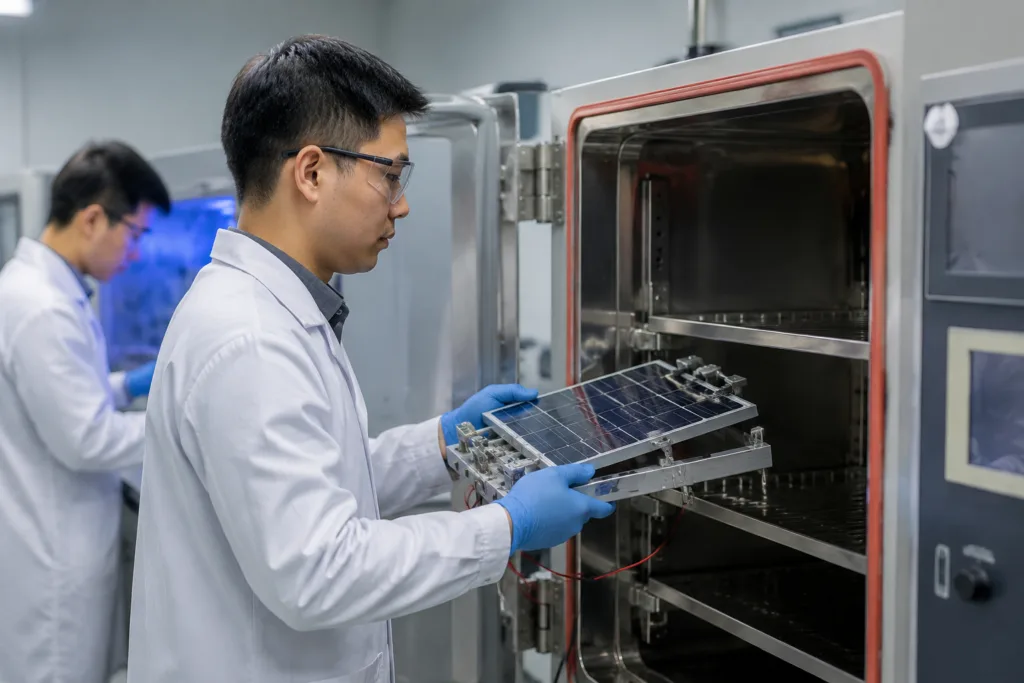
When validating a solar energy adhesive, useful test categories often include UV aging, thermal cycling, damp heat exposure, and combined weather simulation. The purpose is not just to see whether the adhesive survives, but how much performance changes after exposure.
- UV aging: checks resistance to sunlight-driven degradation such as embrittlement or adhesion loss.
- Thermal cycling: evaluates whether repeated expansion and contraction create cracks, delamination, or stress failure.
- Damp heat: helps reveal moisture-related softening, interface failure, or insulation concerns in protected assemblies.
- Outdoor exposure simulation: gives a broader picture of how multiple stress factors combine over time.
Ideally, testing should be done on the actual substrate combination and joint design, not only on generic coupons. Real geometry can change stress distribution significantly.
How to compare adhesive options without relying on generic claims
Terms such as weatherproof, durable, or outdoor grade are not enough by themselves. A better comparison method is to review the adhesive against a short set of engineering questions:
- Is it compatible with all intended substrates, including coatings and surface treatments?
- Does its flexibility or hardness match the expected movement in the joint?
- Can it handle the highest and lowest service temperatures without failure?
- Is the curing method practical for the production process?
- Will the bond line geometry support the adhesive’s strengths?
- Can the material maintain performance after UV and moisture aging?
This kind of comparison often shows why one adhesive can outperform another even when their initial bond values appear similar.
Material compatibility, application method, and curing considerations
Substrate preparation is often as important as adhesive choice. Surface contamination, release agents, oxidation, and low-surface-energy plastics can reduce adhesion even when the chemistry looks suitable on paper. Testing should therefore include realistic cleaning and preparation steps that production teams can repeat consistently.
Application method also matters. Dispensing behavior, sag resistance, gap-filling ability, open time, and cure speed affect both assembly efficiency and final quality. A low-viscosity material may wet surfaces well but run out of vertical joints. A very fast cure may help throughput but reduce positioning time. Moisture-cure, heat-cure, UV-cure, and two-part systems each bring different trade-offs for solar assemblies.
| Selection factor | Why it matters in solar use |
|---|---|
| UV resistance | Helps reduce degradation under long-term sunlight exposure |
| Moisture resistance | Supports sealing reliability in rain, humidity, and condensation |
| Flexibility | Absorbs movement from thermal expansion mismatch |
| Heat resistance | Maintains performance during elevated daytime temperatures |
| Adhesion to mixed substrates | Improves reliability across glass, metal, plastic, and coated surfaces |
| Cure suitability | Ensures the adhesive fits actual production and maintenance conditions |
Typical mistakes that lead to adhesive failure in solar environments
- Choosing based only on initial bond strength instead of aging performance.
- Using a rigid adhesive in a joint that experiences large thermal movement.
- Ignoring UV exposure for partially exposed bond lines or seal edges.
- Assuming water resistance alone is enough without checking adhesion retention after damp heat.
- Testing on ideal lab coupons rather than real substrates and actual joint geometry.
- Overlooking cure limitations caused by shadowed areas, part thickness, or process timing.
- Neglecting surface preparation consistency in production.
Many outdoor failures are not caused by one dramatic issue. They result from several small mismatches between material behavior, environment, and process conditions.
A practical validation checklist for solar adhesive selection
Before approving a solar energy adhesive, it helps to run through a structured checklist:
- Define whether the application is bonding, sealing, potting, or a combination.
- List all substrates, coatings, and expected surface conditions.
- Map the environmental stresses: UV, rain, humidity, temperature peaks, and cycling.
- Decide whether flexibility or rigidity is more appropriate for the joint.
- Confirm the curing method fits production speed and part geometry.
- Review aging-related test data rather than only initial strength data.
- Test on real assemblies or representative mockups.
- Inspect for adhesion loss, cracking, seal failure, and property change after exposure.
- Check whether the material supports serviceability or rework requirements where relevant.
- Balance performance against process efficiency and total system risk.
This checklist is especially useful when screening a UV resistant adhesive and weather resistant adhesive for outdoor solar-related systems where failure tends to develop gradually rather than immediately.
Choosing based on real durability
The right solar adhesive is rarely the one with the most impressive standalone claim. It is the one that matches the substrates, joint design, cure process, and full outdoor stress profile of the application. In solar environments, long-term reliability depends on how well the adhesive resists UV exposure, moisture, thermal cycling, and aging while continuing to bond and seal as intended.
For engineers and buyers, the most reliable path is a validation-based approach: start with the actual use case, compare realistic material trade-offs, and test for the conditions the assembly will truly face. That is how adhesive selection moves from a simple product choice to a durable design decision.
FAQ
What is the most important property in a solar energy adhesive?
The most important property depends on the job, but long-term environmental durability is usually more important than initial bond strength because solar assemblies face UV, moisture, and temperature cycling for extended periods.
Can a strong indoor adhesive be used for solar applications?
Not reliably in many cases, because an adhesive that performs well indoors may degrade quickly outdoors if it lacks UV resistance, weather resistance, or flexibility for thermal movement.
Why does thermal cycling cause adhesive failure?
Thermal cycling repeatedly expands and contracts the bonded materials, and if the adhesive cannot absorb that movement, stress can build up until cracking, delamination, or seal loss occurs.
Is waterproof performance enough for outdoor solar sealing?
No, because a material also needs good adhesion retention, UV stability, and aging resistance, otherwise it may still fail at the interface even if the cured material itself resists water.
Should solar adhesive validation be done on real parts?
Yes, whenever possible, because actual substrates, coatings, joint shapes, and bond-line thicknesses can behave differently from simple lab coupons and may reveal failure modes that basic tests miss.
What is a common mistake when selecting a solar energy adhesive?
A common mistake is choosing the adhesive mainly for fast cure or high initial strength without checking how it performs after UV aging, damp heat exposure, and long-term thermal cycling.