
Metal assemblies rarely fail because of strength alone. In many real production environments, they fail because the joint sees heat cycling, differential expansion, outdoor weather, vibration, moisture, oils, or a coated surface that behaves differently from bare metal. That is why a silicone adhesive for metal is often considered when the design goal is not just bond strength, but long-term flexibility, stress relief, sealing performance, and durability across changing service conditions.
If your application needs a bond line that can accommodate movement while also sealing against moisture and contamination, it helps to review silicone adhesive options for flexible bonding and sealing early in the design stage. From our manufacturing perspective, this is especially relevant for aluminum housings, stainless assemblies, painted metal panels, HVAC parts, lighting enclosures, transport components, and electronics-related metal interfaces where viscosity, cure chemistry, corrosion sensitivity, and packaging format all affect production success. We often help buyers compare standard grades with customized formulations, evaluate sample performance on their own substrates, and align cure behavior with dispensing, assembly speed, and bulk supply planning.
For industrial buyers, engineers, and sourcing teams, the real question is not whether silicone can bond metal. It can. The more useful question is which silicone system fits the actual metal surface, operating environment, and production process without creating corrosion risk, cure delays, or field failures. This guide focuses on that decision logic.
Why silicone is chosen for metal assemblies that move or heat-cycle
Silicone adhesives are commonly selected for metal assemblies when the joint must tolerate expansion and contraction, vibration, and weather exposure better than rigid adhesive systems. Metals expand at different rates, and the mismatch becomes more noticeable in assemblies that combine metal with glass, plastics, ceramics, powder-coated parts, or electronics components. A rigid bond may hold well at first but can transfer too much stress to the interface over time.
Silicone reduces that stress by remaining elastomeric after cure. In practical terms, that means the adhesive layer can move with the assembly instead of fighting the movement. For enclosures, trim parts, external housings, rail components, vehicle subassemblies, LED fixtures, and outdoor devices, this flexibility often matters as much as initial adhesion.
This is also why teams comparing options for choosing the best adhesive for industrial metal assembly often keep silicone in the shortlist when the bond line also serves as a seal, gasket, or movement-tolerant interface rather than a purely rigid structural joint.
What makes a silicone adhesive for metal different from rigid bonding systems
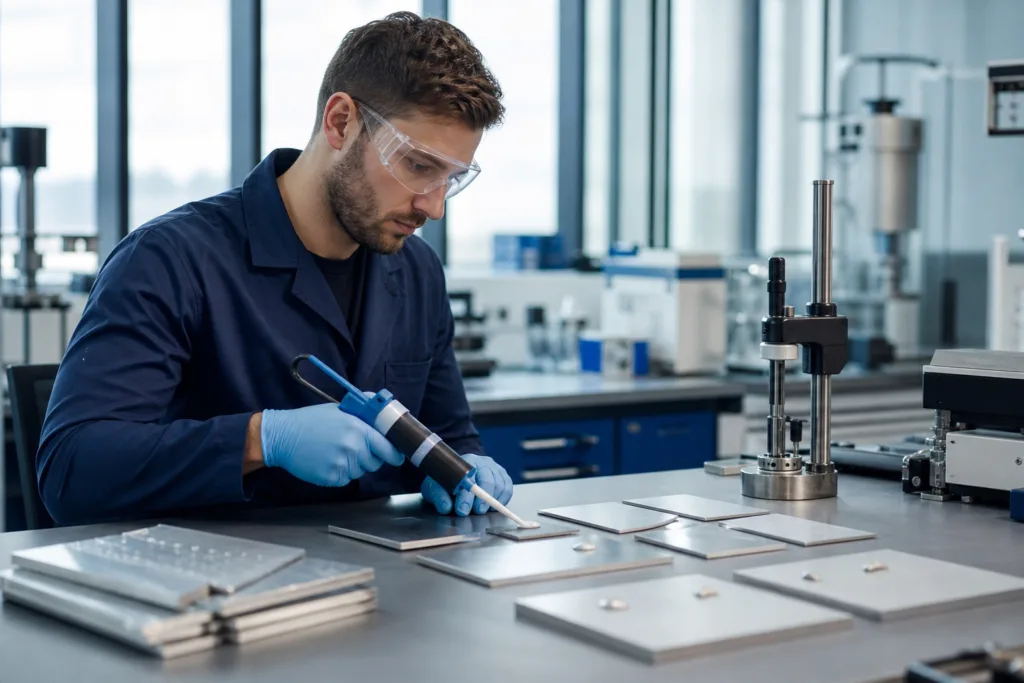
A silicone adhesive for metal behaves differently from epoxy, acrylic, and many polyurethane systems in several important ways:
- Higher flexibility after cure: better for differential thermal movement and vibration.
- Better weathering stability: useful for outdoor and UV-exposed assemblies.
- Good temperature tolerance: often suitable for elevated and cycling temperatures where some other chemistries harden, crack, or degrade faster.
- Sealing capability: the bond line can also block moisture, dust, and air leakage.
- Lower modulus: helps distribute stress, but may not match rigid systems for load-bearing structural design.
The trade-off is important. Silicone is not automatically the right answer when very high structural shear strength, paintability, very fast fixture under all conditions, or thin rigid metal-to-metal load transfer is the top priority. In those cases, another chemistry may be better. The right decision starts with the function of the joint, not the popularity of the adhesive family.
| Requirement | Why Silicone May Fit | When to Review Alternatives |
|---|---|---|
| Heat cycling | Flexible bond line reduces stress from expansion mismatch | If the joint must carry high rigid structural loads |
| Outdoor exposure | Strong UV and weathering resistance | If paintability is critical after cure |
| Sealing plus bonding | Can bond and seal in one material | If very fast high-strength fixturing is required |
| Vibration | Elastomeric cure helps absorb movement | If a hard, machinable bond line is needed |
| Corrosion-sensitive interface | Neutral cure options can reduce risk | If process controls cannot support proper cure conditions |
Aluminum, stainless steel, coated metals, and painted surfaces: compatibility considerations
“Metal” is too broad a category for adhesive selection. In our formulation and application work, we treat aluminum, stainless steel, galvanized steel, painted panels, anodized parts, and powder-coated components as separate bonding situations because they present different surface energies, oxide behavior, contamination risks, and corrosion sensitivities.
Aluminum
Aluminum is common in housings, frames, heat sinks, transport assemblies, and fabricated enclosures. Silicone can work well on aluminum, especially where movement and outdoor durability matter. However, performance depends heavily on whether the aluminum is bare, anodized, oily from fabrication, or carrying conversion coatings. Thin oils left from stamping or machining are a common reason lab samples look good while production bonds fail.
Stainless steel
Stainless steel can be a good bonding substrate, but passive surface films and process residues must be respected. Fingerprints, polishing compounds, cutting fluids, and protective films are common issues. Silicone glue for stainless steel usually performs better when the cleaning process is consistent and the supplier has checked adhesion on the exact stainless finish rather than assuming all grades behave the same.
Coated and painted metals
Many failures on “metal” are actually failures on the coating. Powder coat, e-coat, paint, and primer layers may have lower cohesion than the silicone itself. Before approving the adhesive, test whether failure occurs at the metal, within the coating, or between coating layers. If coating cohesion is weak, a stronger adhesive may simply tear the coating away.
Galvanized and zinc-containing metals
These interfaces require extra attention to cure chemistry. Acid-releasing systems can create corrosion concerns around sensitive metal surfaces, especially where the joint traps moisture or the environment is aggressive. This is one of the strongest reasons neutral cure systems are often preferred.
Surface preparation for reliable metal bonding
Even a well-selected silicone can underperform if the substrate is not ready. For metal bonding, we typically advise buyers to define surface preparation as part of the process specification, not as a vague operator judgment. The right level of preparation depends on the metal type, contamination level, production speed, and whether the bond line is cosmetic, sealing-focused, or load-bearing.
Most industrial workflows involve four control points:
- Cleaning: remove oils, release agents, dust, oxidation residues, and handling contamination.
- Abrasion when appropriate: light abrasion can improve mechanical keying on some surfaces, but it must be controlled and followed by cleaning.
- Priming if required: some metals or coatings benefit from a primer to improve adhesion reliability.
- Contamination control: keep prepared surfaces protected from fingerprints, shop dust, and line-side process fluids before bonding.
For teams building qualification protocols, these surface preparation steps that improve metal bond reliability are often as important as the adhesive itself. The goal is not maximum preparation at any cost, but a repeatable preparation standard that the factory can maintain every day.
Neutral cure vs acetoxy cure considerations for corrosion-sensitive interfaces
This is one of the most important selection points in metal bonding. Acetoxy cure silicones release acetic acid during cure. In some consumer sealing applications that may be acceptable, but in corrosion-sensitive metal assemblies, enclosed joints, electronics-adjacent parts, coated metals, or zinc-containing surfaces, many buyers prefer neutral cure chemistry to reduce compatibility risk.
From a manufacturer perspective, neutral cure is often the safer path when the assembly includes aluminum, galvanized steel, painted metal, sensitive finishes, or mixed-material interfaces. It is also commonly selected for outdoor joints where the bond line must remain flexible while resisting weather and moisture. As one practical market example, neutral cure silicone for galvanized steel, aluminum, and weather-exposed metal joints is specifically positioned to avoid the corrosion concerns associated with acidic cure on sensitive metals.
That does not mean every acetoxy system is unusable on every metal. It means buyers should not treat cure chemistry as a minor detail. Ask what byproducts are released during cure, what metal substrates were tested, and whether the formulation is intended for enclosed or corrosion-sensitive interfaces.
| Cure Type | Typical Consideration | Buyer Guidance |
|---|---|---|
| Neutral cure | Lower corrosion risk on sensitive metals and coated surfaces | Preferred for many industrial metal and mixed-material assemblies |
| Acetoxy cure | Acidic byproduct during cure may create compatibility concerns | Evaluate carefully before use on corrosion-sensitive or enclosed metal joints |
RTV silicone for aluminum bonding: when it fits and when it does not
RTV silicone for aluminum bonding is often a practical choice when the assembly needs flexibility, sealing, weather resistance, and tolerance to thermal expansion. Examples include exterior housings, lighting assemblies, HVAC components, sensor enclosures, and covers joined to frames.
It fits well when:
- the joint sees outdoor exposure or UV
- the aluminum panel expands and contracts during use
- the adhesive must also act as a moisture seal
- vibration damping matters
- cosmetic bead application is acceptable
It may not fit well when:
- the joint must be very rigid
- high structural metal-to-metal load transfer is the primary requirement
- the process needs extremely fast fixture without humidity dependence
- the design requires painting over the cured adhesive
- the bonded surface is heavily oily and cannot be cleaned consistently
In aluminum projects, the real differentiator is usually not “RTV or not,” but which viscosity, which cure chemistry, whether a primer is needed, and whether the assembly design gives the silicone enough bond area and proper joint geometry.
Silicone glue for stainless steel: key risks and best practices
Silicone glue for stainless steel can be highly effective, but stainless parts tend to expose process weaknesses. The most common problems are residue-related rather than chemistry-related. Polishing compounds, passivation residues, coolants, fingerprints, and protective films all interfere with wetting and adhesion.
Best practices include:
- verify the exact stainless grade and finish used in production
- clean with a defined, repeatable method before bonding
- test on production-finish coupons, not idealized lab plates
- check whether the bond is to bare steel, brushed steel, coated steel, or a film-laminated surface
- evaluate creep and edge lift under heat and humidity, not only initial adhesion
Where the stainless joint also needs sealing against water ingress, dust, or washdown exposure, buyers often compare silicone not only as a bond material but as part of wider sealing adhesive solutions for moisture-resistant metal interfaces.
Thermal expansion, vibration, and weather exposure: why flexibility matters
Flexible adhesive design is not just a material preference; it is often a mechanical necessity. When a metal panel is bonded to another metal with a different thickness, or to a polymer cover, repeated heating and cooling can create peel and shear stresses at the ends of the bond line. A more flexible silicone can distribute those stresses over the full bonded area.
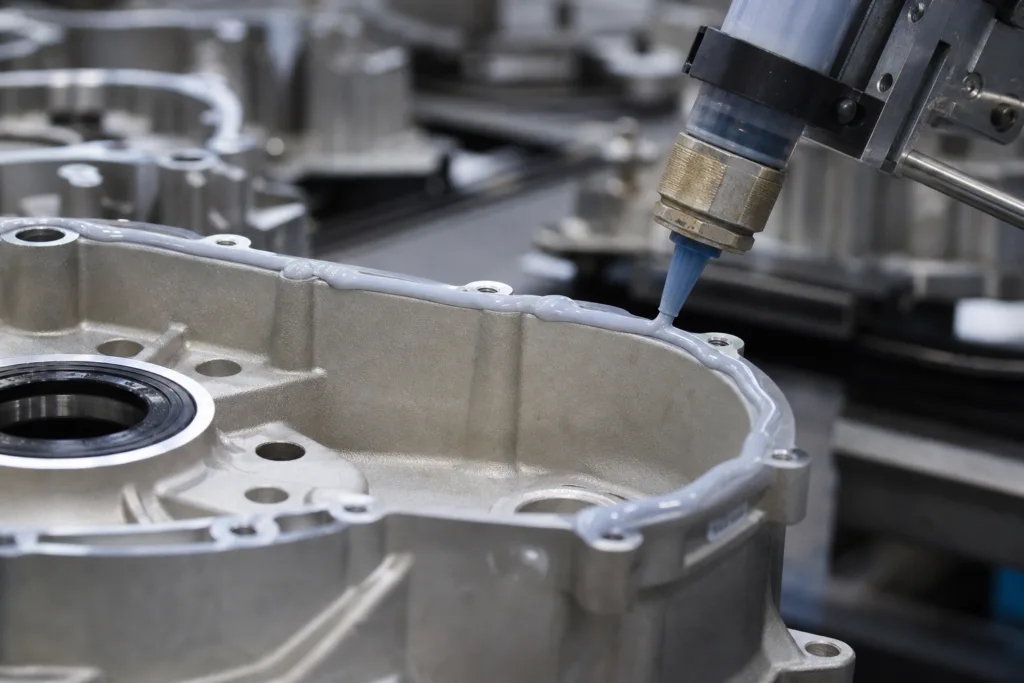
This matters in transport, building products, outdoor electronics, power equipment, and lighting. A bond that looks strong in a static room-temperature test may still fail in the field if the assembly moves daily. Flexibility also helps reduce vibration-induced crack initiation that can occur with more brittle systems.
In some automotive and mobility-related projects, a formulation such as ZDS-6190 high-performance silicone adhesive for automotive metal joints can illustrate the type of movement-tolerant performance buyers often evaluate where heat, vibration, and weather exposure overlap.
Heat resistance, UV resistance, and outdoor durability in metal assemblies
One of silicone’s strongest advantages is durability under environmental exposure. For outdoor metal assemblies, the adhesive may need to survive sunlight, rain, humidity, thermal shock, and long service intervals with minimal hardening or cracking. Silicone is often selected because it retains elasticity better than many alternatives under those conditions.
Still, buyers should avoid relying on broad claims like “high temperature resistant” without understanding the real operating profile. Ask:
- What is the continuous service temperature versus short-term peak exposure?
- Is the bond line shaded, enclosed, or directly exposed outdoors?
- Will the joint see fuel vapors, cleaners, salt, or process chemicals?
- Does temperature cycling occur with condensation?
- Is the silicone also expected to maintain dielectric insulation or a weather seal?
The service environment should be converted into a test plan, not just a verbal requirement.
Common metal-bonding failures: adhesion loss, creep, corrosion, and edge lift
Most failures fall into a few predictable categories:
- Adhesion loss: often caused by contamination, wrong cure chemistry, or poor wetting.
- Creep: the adhesive slowly deforms under sustained load or elevated temperature.
- Corrosion at the interface: risk increases when the wrong cure system is used on sensitive metals or moisture is trapped.
- Edge lift: common when thermal movement concentrates stress at the ends of the bond line.
- Coating failure: the adhesive stays attached, but the paint or powder coat detaches from the metal.
These failures are rarely solved by requesting “more strength” alone. They are solved by matching the chemistry to the substrate, improving surface preparation, controlling bond-line design, and validating the joint under realistic environmental conditions.
At ZDS, we usually encourage customers to review failed joints by asking three basic questions: what exactly was bonded, what contamination or coating was present, and what changed between the successful sample and the failing production part. That approach often reveals a process issue faster than simply comparing datasheet numbers.
What to validate before approval: peel strength, shear strength, movement tolerance, and aging tests
Industrial qualification should measure more than initial tack or room-temperature adhesion. For metal bonding silicones, we usually recommend a test matrix that reflects the true function of the joint.
Key validation points include:
- Lap shear comparison: useful for comparing candidate materials and surface prep methods. A recognized method such as How to qualify silicone adhesives for metal bonding with lap shear testing helps buyers build more comparable metal-to-metal data.
- Peel or edge-lift resistance: important where the joint sees flexing, panel movement, or concentrated end stress.
- Movement tolerance: evaluate whether the cured adhesive survives expansion and contraction without loss of adhesion.
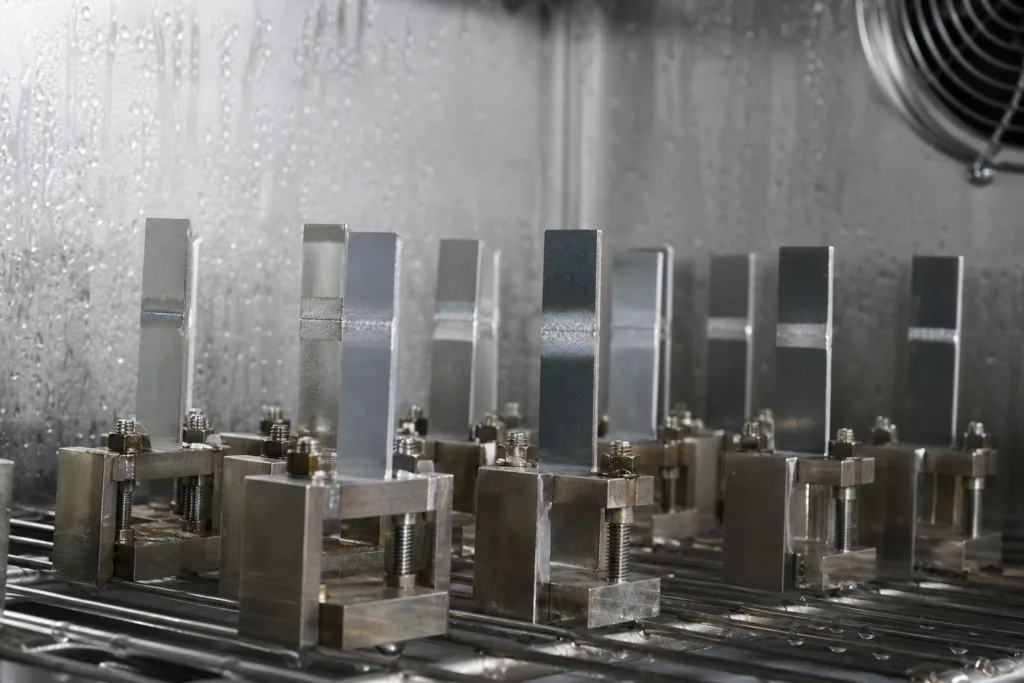
- Heat and humidity aging: initial results can be misleading if durability is not checked. A framework such as durability testing for silicone adhesive bonds under heat and humidity supports more realistic evaluation of retained performance after environmental exposure.
- Corrosion observation: inspect metal surfaces after cure and after environmental aging, especially in enclosed interfaces.
- Cohesive versus adhesive failure review: understand whether failure occurs in the silicone, at the interface, or within a coating layer.
For buyers, the goal is comparative qualification. Test values are useful when they are tied to the same substrate, same surface preparation, same cure schedule, and same environmental conditioning.
How to match cure speed, pot life, and production process requirements
Production success depends on more than chemistry compatibility. A silicone that performs well in the lab may still be a poor fit if it cures too slowly for line takt time, skins over too quickly for bead placement, slumps on vertical parts, or requires humidity conditions the factory cannot maintain.
Important process questions include:
- Is the product one-part RTV or two-part addition-cure silicone?
- What is the workable assembly window after dispensing?
- How quickly does skin formation start?
- What is the fixture requirement before moving the assembly?
- Will cure depth become a bottleneck in thick sections?
- Is automated dispensing needed?
- Does viscosity suit narrow beads, wide gaskets, or gap-filling bonds?
One-part RTV systems can simplify handling, while two-part systems may provide more controlled through-cure for larger sections or higher production speed. Neither is universally better; the right choice depends on bead size, assembly timing, and production throughput.
What to ask for in a technical data sheet and sample evaluation
When evaluating suppliers, ask for more than a headline strength claim. A useful technical review should include:
- cure chemistry and byproducts
- recommended substrates and any cautions for sensitive metals
- viscosity or consistency for your dispensing method
- skin time, tack-free time, and full cure behavior
- hardness and elongation guidance for movement tolerance
- temperature and weathering expectations
- primer recommendations, if any
- shelf life, storage conditions, and packaging sizes
- sample availability and expected lot-to-lot consistency
We also advise customers to request samples in the same packaging style planned for production where possible. Cartridge trials can identify basic adhesion, but pails, drums, or meter-mix formats may be more relevant for line validation. If private label or OEM supply is under consideration, discuss labeling, MOQ, batch traceability, and change-control expectations early.
How we help customers evaluate silicone adhesives for metal applications
From our adhesive manufacturing perspective, the most successful projects begin with a clear application brief rather than a generic request for “metal bonding silicone.” We typically want to understand the metals involved, whether coatings are present, expected temperatures, movement in service, exposure to water or chemicals, target dispensing method, required cure speed, and whether the adhesive must also seal, insulate, or absorb vibration.
That lets us narrow the field faster, suggest whether neutral cure is advisable, flag possible corrosion or coating risks, and plan meaningful sample trials. In custom projects, we may adjust viscosity, cure profile, hardness, or packaging format to better fit the production line. For OEM and private label buyers, the discussion also includes QC consistency, shelf-life planning, and supply continuity.
The value for procurement teams is not simply having more product choices. It is getting a decision path that connects formulation, substrate reality, test protocol, and manufacturing practicality before full approval.
Conclusion
Choosing a silicone adhesive for metal is really a joint-design and process decision disguised as a material purchase. The right product can solve movement, heat cycling, weather exposure, and sealing needs in one step. The wrong one can create corrosion risk, cure delays, edge lift, or coating failure that no strength claim will fix.
For industrial buyers, the smartest approach is to compare silicone options by cure chemistry, metal compatibility, surface preparation tolerance, movement capability, and validation plan. When those factors are aligned with the real production process, silicone becomes a highly practical solution for many metal assemblies that would stress more rigid systems.
FAQs
Can silicone adhesive bond aluminum reliably?
Yes, silicone can bond aluminum reliably when the surface is properly cleaned, the cure chemistry is compatible with the application, and the joint is designed for silicone’s flexible performance profile. Reliability improves when you test the exact aluminum finish used in production, especially if the parts are anodized, coated, or exposed to machining oils.
Is neutral cure silicone better than acetoxy cure for metal?
In many industrial metal applications, yes. Neutral cure silicone is often preferred for corrosion-sensitive metals, coated surfaces, enclosed joints, and outdoor assemblies because it reduces the compatibility concerns associated with acidic cure byproducts. The final decision should still be based on substrate testing and service conditions.
What surface preparation is usually needed before bonding metal with silicone?
Most metal bonding projects require at least controlled cleaning to remove oils, dust, and handling residue. Some applications also benefit from light abrasion or primer use, but those steps should be validated rather than assumed. The key is a repeatable process that production can maintain consistently, not just an aggressive lab-only preparation method.
How should buyers test a silicone adhesive for metal before approval?
Buyers should evaluate the adhesive on production-representative metal coupons using comparative shear or peel testing, then repeat testing after heat, humidity, and thermal cycling exposure. It is also important to inspect for edge lift, corrosion, and coating failure so that approval reflects actual service conditions rather than initial room-temperature adhesion alone.
Can silicone replace structural metal adhesives in every assembly?
No. Silicone is often selected for flexibility, sealing, vibration damping, and environmental durability, but it is not the right choice for every rigid high-load structural joint. If the design depends mainly on very high structural load transfer with minimal movement, another adhesive chemistry may be more suitable.
What should procurement teams ask a silicone adhesive manufacturer before sourcing?
Procurement teams should ask about cure type, recommended metal substrates, sample support, packaging options, shelf life, MOQ, batch consistency, technical documentation, and whether formulation adjustments are possible for viscosity, cure speed, or application method. Those details affect production stability just as much as the headline adhesive properties.