
Electronic assemblies rarely fail because of one dramatic event. In many cases, damage develops slowly as moisture, corrosive atmospheres, salts, oils, detergents, or process contaminants enter vulnerable areas around components, leads, solder joints, connectors, and substrate surfaces. That is why potting adhesive moisture protection is not only a materials topic, but also a design, process, and qualification issue. From our adhesive manufacturing perspective, the right potting system helps reduce exposure pathways, stabilize sensitive parts, and improve long-term reliability in electronics used indoors, outdoors, near chemicals, or in industrial service.
For teams comparing potting adhesive options for electronic protection, the real decision is usually more specific than “epoxy or polyurethane.” Buyers often need to balance moisture exclusion, dielectric performance, cure speed, viscosity, flow around components, adhesion to housing walls, rework tolerance, and supply consistency. We support these evaluations through formulation matching, sample review, process-fit guidance, package selection, and OEM or private label planning when electronics programs need stable mass-production potting performance.
Why Environmental Ingress Is a Major Electronics Reliability Risk
Electronics can be surprisingly vulnerable to small amounts of environmental ingress. Water does not need to flood a device to cause trouble. Humidity can condense, capillary action can pull liquids into narrow gaps, and contamination films on a board can combine with moisture to create conductive leakage paths. Over time, these conditions may drive corrosion, insulation loss, sensor drift, intermittent connections, metal migration, and coating or encapsulant interface failure.
In practical production settings, the risk becomes higher when assemblies have mixed materials, exposed solder points, sharp thermal cycling, trapped air pockets, or incomplete sealing around cable exits and enclosure walls. We often see buyers focus heavily on nominal resin type while underestimating fill geometry, venting, or cure control. A good potting compound can significantly reduce risk, but it cannot fully compensate for poor assembly design or an uncontrolled dispensing process.
Research on why moisture penetrates electronic packages also reinforces a key qualification lesson: assemblies that appear sealed at room conditions may still reveal weaknesses under humidity and heat stress. For industrial buyers, that means validation should reflect realistic service conditions rather than simple visual inspection after cure.
Moisture, Salt Air, Corrosive Atmospheres, and Chemical Splash
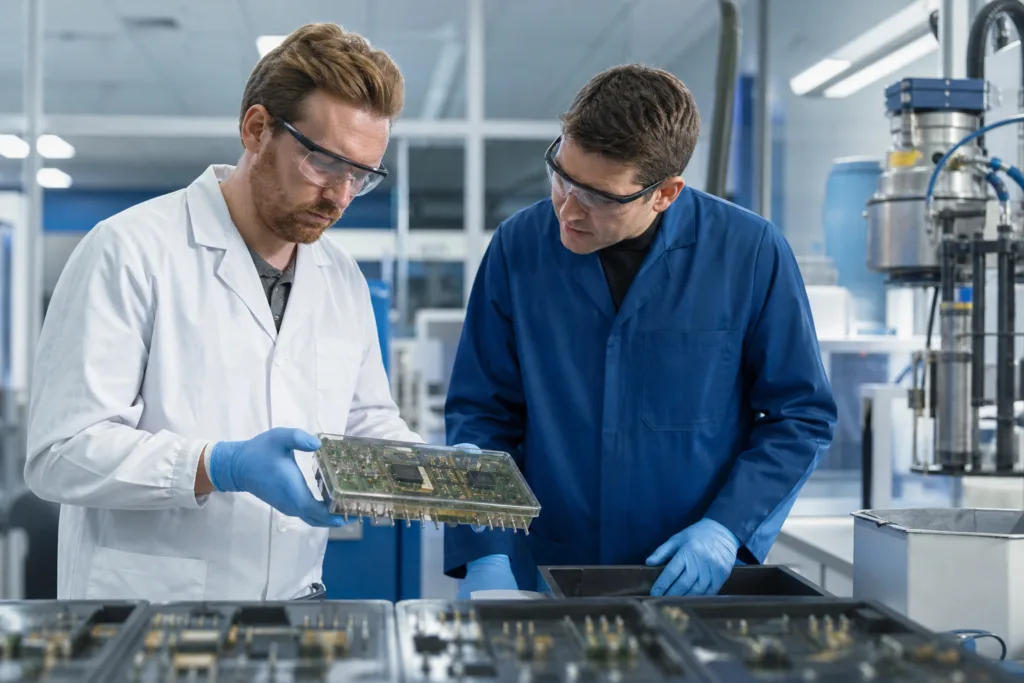
How moisture damages electronics
Moisture can enter through housing gaps, porous interfaces, cable entry points, microcracks, or weak adhesion lines. Once inside, it may lower surface insulation resistance, accelerate corrosion of exposed metals, and undermine bond interfaces. In potted assemblies, the goal is not only to cover components but to limit moisture transport paths and reduce retained condensation near critical circuitry.
How salt air and corrosive atmospheres increase failure risk
Marine and coastal environments are especially aggressive because salts increase conductivity and support corrosion on metal surfaces. Industrial atmospheres may also contain sulfur compounds, cleaning vapors, exhaust residues, or process chemicals that attack metals and interfaces. In these applications, encapsulation resin corrosion protection depends not just on bulk chemical resistance, but also on complete fill, edge sealing, and strong adhesion to enclosure surfaces so contaminants cannot creep underneath the material.
How chemical splash and contamination affect potted assemblies
Chemical exposure varies widely. One assembly may only face occasional detergent mist, while another sees oils, coolants, fertilizer residues, fuels, or diluted acids and alkalis. Electronic potting chemical resistance must therefore be matched to the real exposure profile: concentration, temperature, contact duration, frequency, and whether exposure is splash, immersion, vapor, or residue.
How Potting Materials Reduce Exposure Pathways in Electronic Assemblies
Potting materials protect electronics by surrounding and isolating vulnerable elements. When properly selected and applied, they can:
- reduce direct contact between contaminants and circuitry
- fill void spaces where condensation or residue may accumulate
- support component stability under vibration and thermal movement
- improve dielectric isolation
- limit oxygen and moisture access to sensitive interfaces
- help manage water splash and particulate contamination at the assembly level
However, the mechanism is not magic. Potting works because the material, substrate preparation, geometry, and curing process together create a durable barrier system. In some projects we recommend a more rigid formulation for mechanical support; in others, a softer system performs better because flexibility reduces interface stress and long-term cracking.
Potting Adhesive Moisture Protection: What It Can and Cannot Do
Potting adhesive moisture protection can be highly effective when the resin wets the assembly well, bonds properly to side walls, and cures without internal voids. It can slow moisture ingress, reduce condensation effects, and protect against splash, humidity, and contamination. It also often complements enclosure design by protecting the electronics even if the outer shell is not perfectly sealed.
But potting cannot solve every environmental problem. It cannot reliably offset major design flaws such as unsealed cable exits, trapped process contamination, sharp corners that trap air, weak substrate cleanliness, or a resin that becomes brittle in thermal cycling. It also cannot guarantee waterproof performance if the assembly includes pressure equalization needs, incompatible plastics, or service temperatures outside the resin’s practical range.
For outdoor controls, sensors, power modules, and exposed boards, we often discuss broader waterproofing adhesive support for exposed assemblies because moisture protection is usually one part of a combined sealing strategy that includes housing design, gasketing, cable management, and potting process discipline.
Encapsulation Resin Corrosion Protection and Long-Term Reliability
Corrosion protection depends on more than a resin’s advertised resistance. The material must adhere well to the actual substrates in the assembly, such as metals, FR-4, ceramics, connectors, wire insulation, and housing plastics. If adhesion is weak, microchannels can develop along interfaces, allowing moisture or corrosive residues to migrate into protected areas. This is one reason why complete material compatibility review is essential before sample approval.
Long-term reliability is also affected by modulus, shrinkage, and thermal expansion behavior. A very rigid encapsulant may initially seal well, yet repeated thermal cycling can create stress at corners, around tall components, or along dissimilar material interfaces. A softer polyurethane or silicone can sometimes maintain a more durable seal in assemblies that expand and contract significantly, while epoxy may be preferred when mechanical support, dimensional stability, or stronger structural locking is needed.
Why Adhesion to Housing Walls and Complete Fill Matter
A potted mass that only covers the board surface but does not bond well to the enclosure may leave leakage paths at the perimeter. In field failures, this edge condition is common: water enters through a seam or cable path, travels along the wall interface, and reaches the circuit despite the presence of cured resin. That is why we evaluate wall adhesion, corner wet-out, and fillet formation as seriously as bulk resin properties.
Complete fill matters for another reason: trapped voids become local weak points. Air pockets may collect moisture, expand under thermal load, or reduce dielectric integrity. In deep or narrow housings, the resin’s viscosity, degassing behavior, pour rate, and pot life all influence whether the cavity fills properly before gelation.
Where buyers need robust insulating performance with moisture resistance, formulations such as ZDS-168AB-T electronic potting adhesive for insulation and waterproofing are typically evaluated not only for cured properties, but also for flow behavior, edge coverage, and compatibility with the target enclosure and component layout.
How Void-Free Filling, Edge Sealing, and Cure Control Improve Protection
Void-free filling
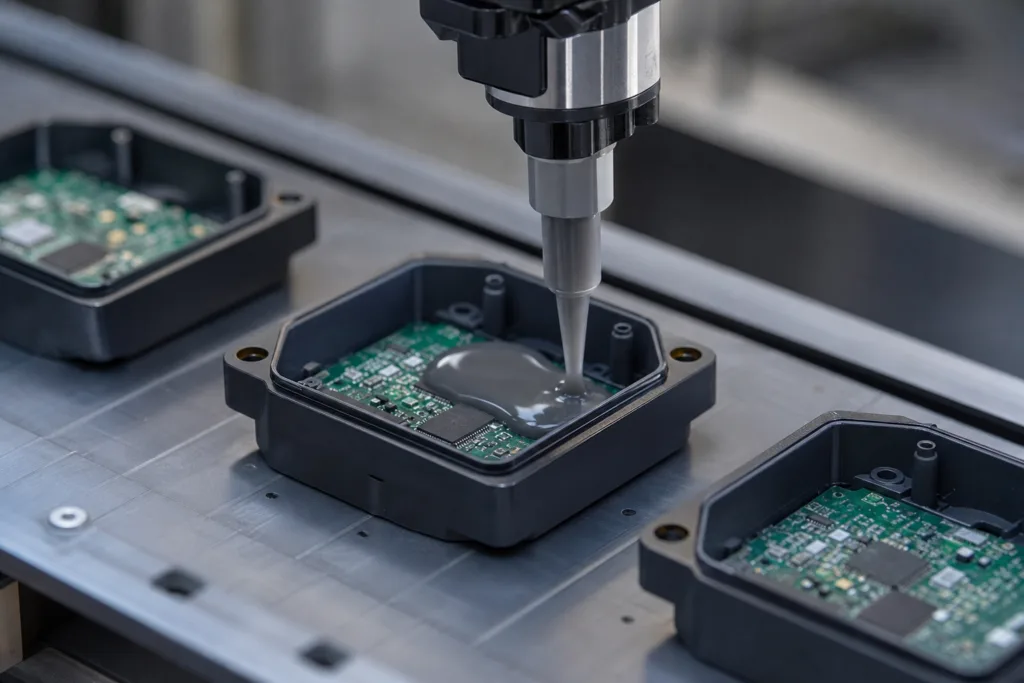
Void control starts before dispensing. Moisture-sensitive components, dusty housings, and residual cleaning agents can all interfere with wet-out. Low enough viscosity is needed for flow around fine geometry, but the material also needs suitable body so fillers do not separate and the resin does not drain from intended areas. Vacuum degassing, controlled mixing ratio, and thoughtful dispensing paths often improve internal quality more than simply choosing a different chemistry.
Edge sealing
Perimeter sealing around leads, pins, and cable exits is often the difference between a durable assembly and a short-lived one. We advise engineers to inspect not just the top surface after cure, but also wall contact lines, bottom corners, and transition zones where the resin meets molded plastic or metal interfaces.
Cure control
Incomplete cure can leave soft zones, poor chemical resistance, elevated water uptake, or unstable electrical properties. Excessive exotherm in thick sections can create shrinkage stress or internal defects. Cure control includes accurate ratio mixing, batch consistency, ambient condition awareness, and realistic cure verification before environmental testing or shipment.
Limits of Potting Protection When Geometry, Venting, or Process Is Poor
Some assemblies are difficult to pot well because they have undercuts, shielded cavities, very tall components next to narrow channels, or sealed pockets that trap air. Others need venting because temperature changes create internal pressure that can stress the encapsulant or housing. In these cases, the protection limit is often geometric rather than chemical.
Another common issue is false confidence from cosmetic appearance. A smooth top surface can hide poor bottom fill, isolated voids, or local delamination. This is where process development matters. At ZDS, we usually recommend that sample evaluation include sectioning, mass comparison, cure verification, and repeated trial runs rather than a single successful pour.
Common Failure Modes in Potted Electronics
Voids
Voids may result from fast mixing, trapped air, poor flow path design, or moisture contamination. They reduce barrier integrity and can become stress concentrators.
Shrinkage
Higher shrinkage can pull away from walls or stress delicate components. This matters especially in rigid systems and deep potting cavities.
Cracking
Cracking is often linked to thermal expansion mismatch, excessive rigidity, or cure stress. Even small cracks can become moisture ingress paths.
Poor wet-out
If the resin does not wet components and substrate surfaces well, hidden channels may remain. Surface energy, contamination, and viscosity all play roles.
Delamination
Delamination at housing walls or component interfaces is one of the most serious long-term risks because it creates continuous pathways for fluid migration.
What to Test Before Claiming Reliable Protection
Buyers should be cautious about broad waterproof or chemical-resistant claims that are not tied to realistic testing. Qualification should reflect the actual risk profile of the device: humidity, splash, immersion, salt exposure, washdown, thermal shock, or chemical contact. For many projects, useful testing may include:
- water absorption or weight gain over time
- water immersion and post-exposure electrical checks
- salt spray or salt-humidity exposure for corrosive environments
- chemical splash or immersion with appearance and property review
- thermal cycling to check cracking and interface stability
- dielectric and insulation resistance measurement before and after aging
- cross-section inspection for voids and delamination
When teams need a recognized framework for immersion-based validation, standard water immersion testing for moisture resistance is a useful reference point for building practical qualification plans rather than relying on marketing descriptions alone.
It is also helpful to understand that enclosure ratings and potting are related but not identical concepts. In outdoor or industrial electronics, Ingress protection standards for sealed electronics help explain how water and dust exposure are evaluated at the enclosure level. Potting can support that protection strategy, but it should be validated together with the complete assembly design.
Key Material Properties to Review Before Selection
| Property | Why It Matters | Typical Buyer Concern |
|---|---|---|
| Viscosity | Affects flow into gaps, bubble release, and fill completeness | Can the material reach all critical areas without trapping air? |
| Pot life | Determines usable working time after mixing | Is there enough time for batch dispensing in production? |
| Cure profile | Influences throughput, exotherm, and final properties | Can the line support room-temperature or heat-assisted cure? |
| Hardness | Relates to mechanical support and stress transfer | Does the assembly need rigidity or cushioning? |
| Flexibility | Important for vibration and thermal cycling durability | Will the encapsulant crack or maintain interface seal? |
| Thermal expansion | Affects stress on components and housing walls | Is the CTE mismatch acceptable for service conditions? |
| Water uptake | Influences long-term barrier performance | How stable is the material in humid or wet service? |
| Chemical resistance | Determines survival in industrial contamination exposure | Can it tolerate cleaners, oils, or process splash? |
For many electronics programs, we help compare these properties against the actual process window rather than an idealized lab scenario. That often reveals whether a standard grade is enough or whether adjustments in viscosity, hardness, cure speed, or filler package are needed.
How to Match Epoxy, Polyurethane, Silicone, or Other Systems to the Environment
Epoxy potting systems
Epoxy is often chosen where strong adhesion, dimensional stability, mechanical support, and good overall environmental resistance are important. It can be a strong option for power electronics, modules, sensors, and compact assemblies that need firm encapsulation. In our application work, ZDS-168AB high-strength potting adhesive for electronics is the kind of material buyers review when they need a more structural potting approach combined with electrical protection.
Polyurethane potting systems
Polyurethane is often useful where flexibility, lower stress, and good performance under vibration or thermal movement matter. It can suit assemblies that face outdoor weathering or moderate moisture exposure but cannot tolerate a very rigid encapsulant.
Silicone potting systems
Silicone is frequently considered when broad temperature flexibility and soft stress relief are priorities. It can be attractive for assemblies with large thermal swings or delicate components, although adhesion, chemical resistance, and process economics should be reviewed carefully for the target use.
Other systems and hybrid decisions
Some applications require specialty chemistry, thermal conductivity, flame behavior, low outgassing, or unusual substrate compatibility. In those cases, standard category labels are only a starting point. The better question is which resin family delivers the most appropriate balance of moisture resistance, mechanical behavior, cure practicality, and cost-performance for the full product life cycle.
Application Examples by Risk Level
| Environment | Main Threats | Potting Priorities |
|---|---|---|
| Indoor humidity | Condensation, dust, light contamination | Good wet-out, dielectric protection, stable cure |
| Outdoor weathering | Rain, humidity, temperature cycling | Wall adhesion, crack resistance, moisture barrier consistency |
| Marine or coastal | Salt air, corrosion, humidity | Strong edge sealing, corrosion pathway control, durability after cycling |
| Industrial equipment | Oil mist, cleaners, vibration, particulates | Chemical resistance, flexibility where needed, secure fill around components |
| Chemical exposure zones | Splash, vapor, residue attack | Specific media resistance testing, complete cure, interface stability |
Specification Checklist for Buyers and Engineers Before Sample Approval
- Define the real environment: humidity, splash, immersion, salt, or chemicals
- List all substrates: board, housing, wires, metals, plastics, seals
- Review cavity geometry and likely air-trap zones
- Confirm required viscosity and dispensing method
- Check pot life against actual production takt time
- Set cure conditions and inspection timing clearly
- Agree on electrical, mechanical, and environmental pass criteria
- Include post-aging adhesion and cross-section checks
- Review packaging size, storage conditions, and shelf life planning
- Decide whether standard grade or customized formulation is more practical
Projects that need guidance across these variables often benefit from structured adhesive selection technical support for environmental resistance, especially when procurement and engineering teams need to align on risk, qualification cost, and long-run production consistency.
When to Request Custom Formulation, OEM or Private Label Supply
A standard potting grade is often suitable when the assembly geometry is simple and the environment is moderate. Custom formulation becomes more valuable when one or more conditions are unusually demanding: very low viscosity is needed for fine-gap filling, cure must be accelerated without excessive exotherm, softness must increase to reduce stress, or chemical resistance must be improved for a specific process fluid.
OEM or private label supply also makes sense when buyers need consistent branding, fixed packaging formats, repeated production planning, or dedicated product management across multiple SKUs. From our manufacturing perspective, these programs work best when the qualification plan is defined early, including target properties, acceptance tolerances, batch consistency checkpoints, and packaging logistics.
How We Help Match Potting Materials to Environmental Threats
In electronics potting projects, the most useful supplier is usually the one that can connect chemistry, process, and production reality. We approach material selection by first understanding the failure mechanism the customer is trying to prevent: moisture-driven corrosion, washdown exposure, thermal cycling cracks, chemical splash, or dielectric instability. Then we compare resin family, viscosity window, cure profile, hardness, and adhesion behavior against the assembly geometry and manufacturing process.
This approach helps avoid a common mistake in sourcing: selecting only by a short list of headline properties. A data sheet matters, but so do wet-out behavior, bubble control, line speed compatibility, and consistency across scaled production batches. For industrial buyers, that is where supplier communication and sample discipline often matter as much as nominal chemistry.
Conclusion
Potting adhesive moisture protection is most effective when material choice, enclosure design, surface condition, dispensing method, and cure control all work together. The resin must fit the true environment, bond to the real substrates, and survive thermal and chemical stress without creating new failure paths through cracking, shrinkage, or delamination. For engineers and sourcing teams, the best qualification approach is practical rather than theoretical: define the threats clearly, test the full assembly realistically, and evaluate both material properties and process behavior before release to volume production.
FAQs
Can potting adhesive make electronics fully waterproof?
Potting adhesive can greatly improve resistance to water ingress, humidity, and contamination, but it does not automatically make every assembly fully waterproof. Final performance depends on enclosure design, cable exits, wall adhesion, complete fill, void control, cure quality, and whether the validation method matches real service conditions.
Which potting chemistry is usually better for moisture protection?
No single chemistry is always best. Epoxy is often chosen for strong adhesion and structural stability, polyurethane for flexibility and lower stress, and silicone for broad temperature tolerance and soft protection. The better choice depends on the assembly geometry, substrate mix, thermal cycling, and whether moisture exposure comes from humidity, splash, immersion, or corrosive atmospheres.
What should buyers test before approving a potting material?
At minimum, buyers should review water exposure behavior, post-aging electrical performance, adhesion after environmental stress, void formation, and thermal cycling durability. If the assembly will face salt, cleaners, oils, or chemical splash, those media should be included in the test plan using realistic exposure conditions and pass criteria agreed between engineering and procurement teams.
Why do potted electronics still fail in wet environments?
Potted assemblies can still fail when moisture travels through unsealed interfaces, trapped voids, wall delamination, cable entry gaps, or cracks caused by shrinkage and thermal stress. Failures also occur when contamination is left on the assembly before potting or when the resin is not fully cured and therefore cannot deliver its intended barrier and dielectric performance.
When is a custom potting formulation worth considering?
A custom formulation is worth considering when a standard grade does not match the process or environment well enough, such as when very low viscosity, a longer or shorter working time, softer cured hardness, improved chemical resistance, or special packaging is required. Customization can also help when scaling from sample work to stable, repeatable production.
What should procurement teams ask a potting adhesive supplier?
Procurement teams should ask about substrate compatibility, batch consistency, packaging formats, storage and shelf life, mix ratio control, cure verification, sample support, quality checkpoints, and whether the supplier can help evaluate failures found during pilot runs. These questions reveal whether the supplier can support real manufacturing needs rather than only provide a generic material list.