
An electronic adhesive does more than hold parts together. In electronic assembly, it can also manage heat, insulate circuits, protect sensitive components from moisture and vibration, support precise placement, and influence long-term reliability in the field. That is why adhesive selection should be tied not only to bond strength, but also to substrate behavior, curing conditions, line speed, electrical needs, and the environment the finished device will face.
For teams comparing materials across different product designs, it helps to explore the full adhesive portfolio in the context of bonding, sealing, coating, and thermal management rather than treating every assembly need as the same problem.
What electronic adhesives are and why they matter in reliable assembly
Electronic adhesives are formulated materials used in assemblies such as PCBs, sensors, display modules, optoelectronic devices, and power electronics. Depending on the use case, the adhesive may bond housings, secure components, encapsulate circuits, improve heat transfer, seal against moisture, or provide dielectric isolation.
Compared with purely mechanical fastening, an adhesive can reduce stress concentration, save space, improve design freedom, and help combine dissimilar materials. In compact electronics, those benefits matter because assembly density is high and many components are sensitive to thermal expansion mismatch, contamination, and movement during service.
In practice, engineers often evaluate electronics adhesive solutions for assembly and protection by looking at the full role of the material in the device, not just whether it bonds initially. A suitable formulation should remain stable through manufacturing, reflow-adjacent exposure where relevant, transport, storage, and long-term operation.
The core performance requirements for electronic assembly adhesives
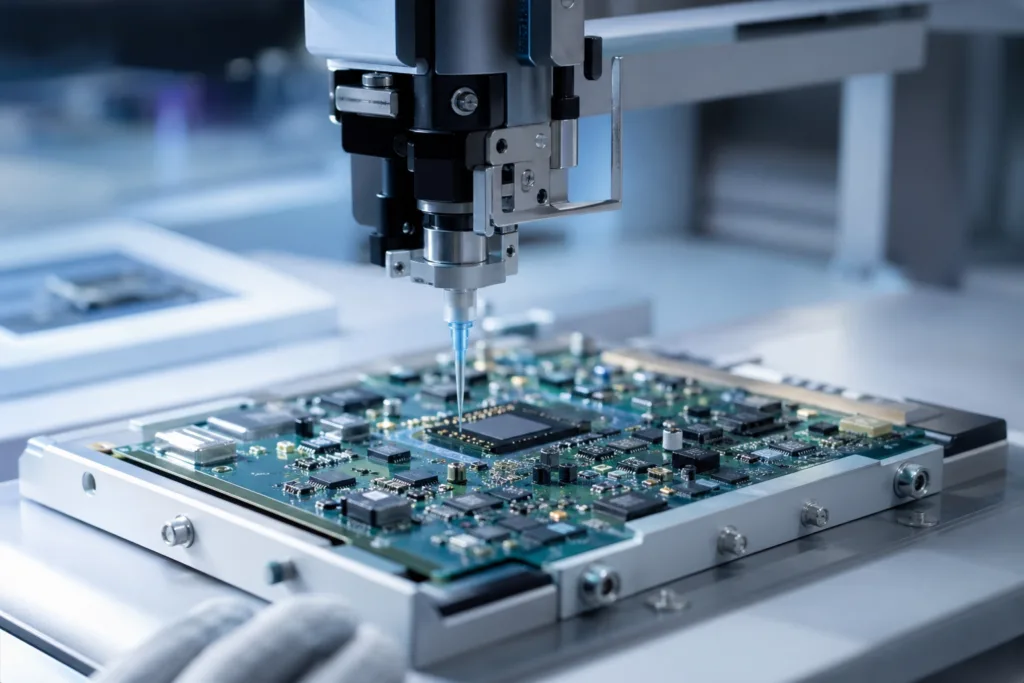
The right performance profile depends on the product, but several requirements appear repeatedly in electronics manufacturing:
- Substrate compatibility: The adhesive must wet and adhere to materials such as FR-4, metals, ceramics, glass, engineering plastics, and coated surfaces.
- Electrical behavior: The formulation may need to insulate, dissipate static, or conduct electricity in controlled pathways.
- Thermal behavior: It may need to resist elevated temperatures, cycle repeatedly, or transfer heat away from components.
- Mechanical stress control: Sensitive parts often need an adhesive that absorbs movement rather than creating rigid stress points.
- Process fit: Viscosity, cure mechanism, dispensing stability, and pot life or open time must align with the production line.
- Environmental durability: Moisture, chemicals, UV exposure, and vibration can all change performance over time.
These factors usually interact. For example, a very rigid material may offer high structural strength but create stress at a brittle component interface. A faster cure may improve throughput but reduce working time or increase shrinkage risk. Selection is therefore a balancing exercise rather than a search for one universally superior adhesive.
Thermal conductivity and heat management in electronics
Heat is a major reliability driver in electronics. When components retain excessive heat, performance can drift and material aging can accelerate. In assemblies with LEDs, power supplies, battery systems, motor control electronics, or power semiconductors, thermal management often becomes a primary adhesive selection criterion.
A thermally conductive adhesive is typically used when the bond line must also help move heat between a component and a heat sink, housing, or metal substrate. Important considerations include thermal path length, bond line thickness, surface flatness, and whether the material must also provide electrical insulation.
For applications where heat transfer and bonding need to work together, products in the category of ZDS-929 thermal conductive adhesive for electronics illustrate the type of formulation engineers assess when heat dissipation cannot be separated from assembly design.
Thermal performance should not be evaluated in isolation. A highly filled material may improve heat transfer but also raise viscosity, which can affect dispensing precision, voiding tendency, and wetting on fine geometries. Engineers should weigh thermal benefit against manufacturing consistency.
Electrical insulation, dielectric performance, and when conductive adhesives are needed
Many electronic assemblies require the adhesive to act as an electrical insulator. In these cases, dielectric strength, volume resistivity, and resistance to leakage under humidity exposure become important. This is common in potting, encapsulation, coating, and component bonding where adjacent circuits must remain isolated.
At the same time, some designs require conductive adhesives for EMI grounding, die attach, flexible circuitry, or other electrical interconnection needs where solder is not ideal. Conductive formulations can be useful when temperature-sensitive parts, unusual substrates, or process limitations make traditional joining less suitable.
The key is to define the electrical role clearly. If the material is only meant to bond, conductivity may be a failure mode rather than a benefit. If it is meant to create an electrical path, then conductivity stability under aging, vibration, and thermal cycling becomes part of reliability validation.
Low stress, flexibility, and protection for sensitive components
Modern electronics often contain fragile chips, sensors, miniature passive components, thin glass, optical elements, and mixed-material packages. In these assemblies, the adhesive must do more than hold position. It should also reduce stress from cure shrinkage, coefficient of thermal expansion mismatch, shock, and vibration.
Flexible or lower-modulus systems can help protect delicate parts by absorbing movement rather than transferring it directly into the component. This is especially useful in sensor modules, wearable devices, display structures, and assemblies exposed to repeated thermal cycling.
Protection can also extend beyond bonding. In many PCB and control assemblies, designers pair bonding materials with protective coatings to shield circuitry from humidity, dust, and contaminants. For example, a product category such as ZDS-971 single-component PCB conformal coating reflects how coating layers can complement adhesive selection in broader electronic reliability planning.
Fast curing, production efficiency, and throughput considerations
Curing speed strongly affects production economics. A material that performs well in the field can still create bottlenecks if it requires long dwell times, complex mixing, or tightly controlled handling steps that do not fit the manufacturing line.
Common cure approaches include heat cure, room-temperature cure, moisture cure, dual cure, and UV cure. Each has trade-offs. Heat-cure systems may deliver strong performance but require oven capacity and temperature tolerance from all nearby parts. UV systems can cure rapidly, but line-of-sight limitations and shadowed areas must be considered. Moisture-cure materials can simplify processing but may cure more slowly in enclosed joints.
Procurement teams should evaluate not only material price, but also the total process cost: scrap risk, takt time, equipment compatibility, storage requirements, and consistency across shifts and factories.
Dispensing precision, rheology, and process stability in automated assembly
In automated assembly, rheology often determines whether a theoretically suitable adhesive will actually run well. Viscosity affects needle dispensing, jetting, screen printing, gap filling, bead shape, slump resistance, and edge control. Thixotropy can be important when the material must stay in place on vertical or fine-featured surfaces.
Process stability also depends on factors such as filler settling, air entrapment, stringing, nozzle clogging, and sensitivity to ambient conditions. Tight deposit control matters in electronics because small variation can change bond line thickness, thermal resistance, optical alignment, or overflow risk onto adjacent circuitry.
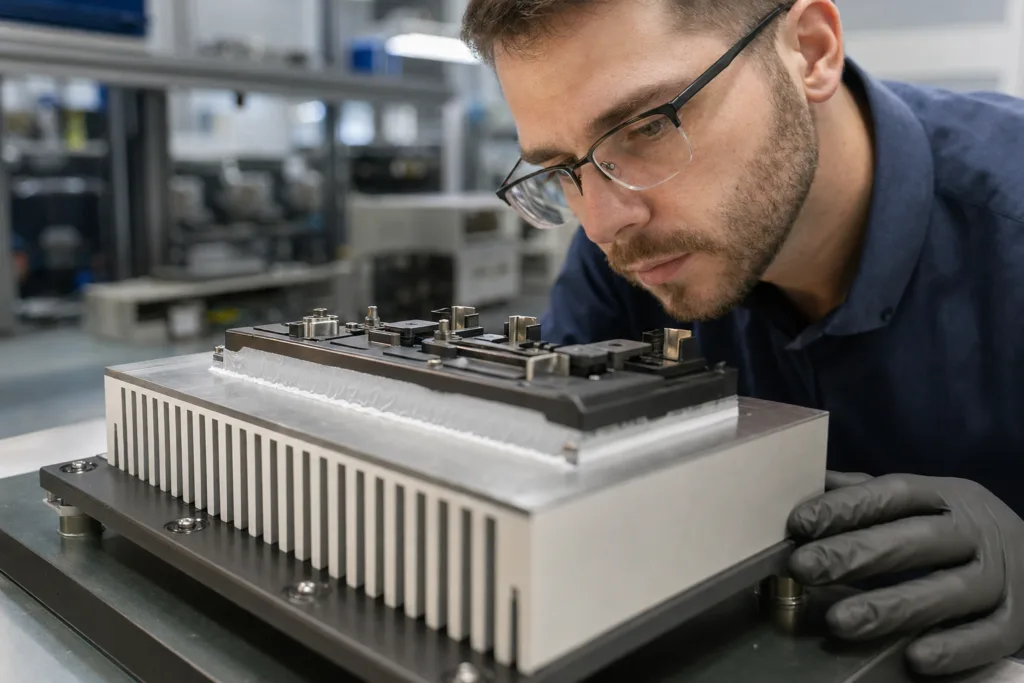
From a manufacturer perspective, ZDS often sees that many adhesive problems described as bond failure are actually process-fit issues: the formulation, dispensing method, component geometry, and cure schedule were never aligned closely enough at the evaluation stage.
Common types of electronic adhesives
Epoxy for electronics
Epoxy systems are widely used because they can provide strong adhesion, chemical resistance, dimensional stability, and good electrical insulation. They are common in structural bonding, encapsulation, potting, underfill-related applications, and thermally conductive assemblies. Their trade-off is that some epoxy systems are relatively rigid, so stress sensitivity should be checked carefully for delicate components.
Optical adhesive
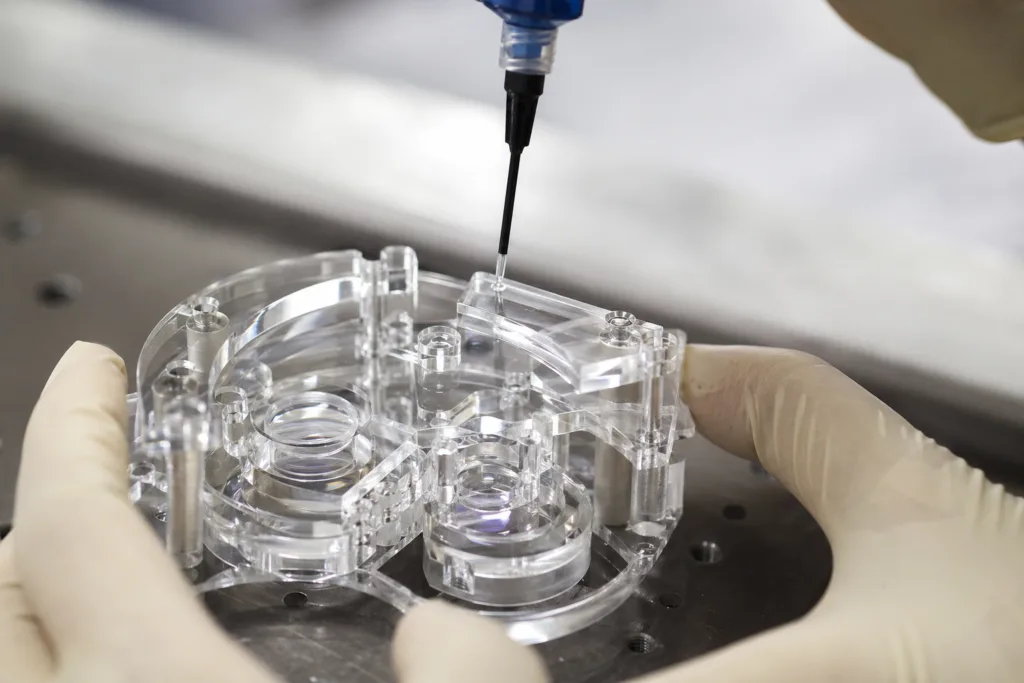
Optical assemblies need more than adhesion. They often require clarity, controlled refractive behavior, low yellowing tendency, clean cure, and low shrinkage to preserve alignment and light transmission. Cure speed can be especially valuable in precision positioning workflows. In this context, materials in the class of ZDS-190611C high-performance UV adhesive for precision optics represent the kind of solution considered for transparent and high-accuracy electronic modules.
Conductive adhesive
Conductive adhesives are selected when electrical interconnection, grounding, or conductive attachment is required. These systems can support designs where soldering is impractical, but they require careful validation for conductivity stability, contact resistance, and environmental aging.
Coating and encapsulation materials
Some electronic protection needs are better addressed by conformal coatings, sealants, potting compounds, or encapsulants than by a simple bonding adhesive. These materials may be used alone or alongside a primary adhesive depending on whether the design goal is insulation, environmental protection, tamper resistance, or vibration damping.
Typical application scenarios in electronic assembly
PCB assembly: Adhesives may be used for component staking, corner bonding, wire fixation, protection, and selective reinforcement where shock or vibration is expected.
Sensor bonding: Low-stress behavior is often critical because small dimensional changes can affect calibration or signal accuracy.
Display modules: Optical clarity, low outgassing, and precise dispensing are commonly important, especially around cover lenses and transparent substrates.
Optoelectronics: Alignment sensitivity, light transmission, and thermal management often need to be balanced together.
Power electronics: Thermal conductivity, dielectric reliability, and resistance to repeated heat cycling usually dominate selection.
How to select the right adhesive based on assembly process and end-use requirements
Start by defining the adhesive’s primary job. Is it mainly structural, thermal, insulating, conductive, optical, protective, or a combination? Once the main role is clear, selection becomes more disciplined.
Then map the material to the assembly process. Important questions include:
- Will the adhesive be dispensed, printed, jetted, or manually applied?
- Is one-component handling preferred, or can the line support mixing?
- What cure method is realistic given component sensitivity and equipment availability?
- How much placement time is needed before fixture or full cure?
- What tolerances exist for bond line thickness, overflow, and cosmetic appearance?
Finally, test against the end-use environment. A material that works well on the line may still fail if the product sees humidity, elevated temperature, vibration, fluid exposure, or outdoor service that was not considered during selection.
Key selection checklist
| Selection factor | Why it matters | What to check |
|---|---|---|
| Substrate | Different surfaces bond differently | Metal, plastic, glass, ceramic, coating, cleanliness, surface energy |
| Temperature | Affects cure and field reliability | Application temperature, peak exposure, thermal cycling |
| Curing method | Controls throughput and process fit | Heat, UV, moisture, room temperature, dual cure |
| Reliability target | Defines performance margin | Moisture, chemicals, shock, vibration, insulation, conductivity |
| Manufacturing constraints | Determines consistency and cost | Dispensing method, takt time, storage, rework, automation compatibility |
Common failure risks and how to avoid them in electronic adhesive selection
One common mistake is selecting only on initial bond strength. Electronics failures often come from a mismatch between the adhesive and the operating environment, not from low short-term adhesion.
Other frequent risks include:
- Poor surface preparation: Oils, oxides, mold release, and dust can reduce wetting and long-term adhesion.
- Wrong modulus: An overly rigid material can crack or stress sensitive assemblies.
- Inadequate cure: Shadowing, insufficient heat, or rushed line conditions can leave the material under-cured.
- Thermal mismatch: Different expansion rates between substrates can create fatigue over time.
- Overlooking rheology: A material that slumps, strings, or traps air may create hidden reliability problems.
- Ignoring protection needs: Some assemblies need a coating or encapsulation layer in addition to bonding.
These risks are usually reduced by testing under realistic conditions: actual substrates, real bond geometry, expected cure method, and representative environmental exposure rather than simplified bench trials alone.
Conclusion
Choosing the right electronic adhesive means matching material behavior to the assembly process and the product’s real service conditions. Thermal control, dielectric performance, flexibility, cure speed, dispensing stability, and substrate fit all matter, but not in the same order for every device. The most reliable selection is usually the one that balances performance requirements with manufacturing reality from the beginning.
FAQ
What is the main job of an electronic adhesive?
The main job of an electronic adhesive is to support reliable assembly by bonding components while also meeting needs such as insulation, heat transfer, sealing, vibration resistance, or environmental protection depending on the design.
How do I choose between a rigid and a flexible electronic adhesive?
Choose a rigid system when structural stability and dimensional control are the priority, but choose a more flexible system when the assembly contains delicate parts or dissimilar materials that will move under thermal cycling or vibration.
When is a thermally conductive adhesive necessary?
A thermally conductive adhesive is necessary when the bond line must help move heat away from components such as LEDs, power devices, or dense electronic modules where heat buildup can reduce performance or reliability.
Are conductive adhesives a replacement for solder in all electronics?
No, conductive adhesives are used in specific cases where process temperature, substrate type, design geometry, or material sensitivity makes them suitable, but they are not a universal replacement for solder.
Why does viscosity matter in electronic adhesive dispensing?
Viscosity matters because it affects how accurately the adhesive can be dispensed, how well it stays in place, how much air it traps, and whether the final bond line is consistent across automated production.
What causes electronic adhesive failure most often?
Electronic adhesive failure is often caused by poor surface preparation, incomplete cure, thermal expansion mismatch, unsuitable stiffness, or choosing a material that fits the bond but not the real operating environment.