
Choosing an adhesive for visible carbon fiber is different from choosing one for hidden structural joints. Once the weave, gloss, edge detail, or clear-coated surface remains in view, small bonding mistakes become immediate cosmetic defects. A reliable adhesive still matters, but so do glue line appearance, overflow control, cure clarity, edge staining, and the risk of surface damage during application or cleanup.
For teams comparing materials early, it helps to review broader carbon fiber bonding solutions before narrowing down a product for exposed cosmetic parts. That wider view makes it easier to separate hidden structural needs from appearance-sensitive bonding requirements.
Why appearance matters in exposed carbon fiber components
Visible carbon fiber is often selected as much for appearance as for weight or stiffness. In premium consumer goods, automotive trim, sports equipment, and decorative panels, buyers expect a clean weave, consistent gloss, and neat bond perimeter. A joint that is mechanically acceptable may still be rejected if the adhesive yellows, bleeds into the edge, creates haze under a clear part, or leaves a thick visible seam.
This changes the selection process. Engineers may focus on strength and durability, while designers care about bond line visibility and finish preservation, and procurement teams need a material that can be applied consistently at scale. The right decision usually comes from balancing all three rather than optimizing only one property.
What makes visible carbon fiber bonding different from standard structural bonding
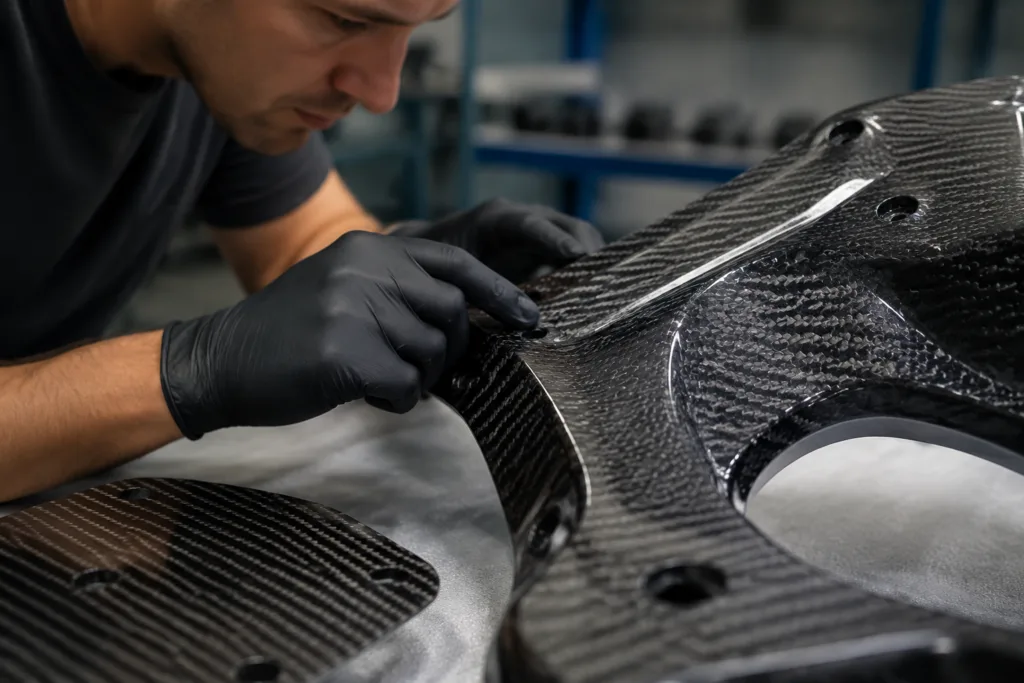
Standard structural bonding often assumes the joint is hidden, paintable, or easy to trim after cure. Visible carbon fiber parts rarely offer that forgiveness. The adhesive may sit next to polished edges, clear-coated surfaces, exposed chamfers, or transparent companion materials. Any squeeze-out can remain visible after assembly.
That is why many teams start by comparing viscosity control, clarity, and cure behavior before looking at raw bond strength alone. In some assemblies, epoxy adhesives for high-strength CFRP bonding remain the right baseline, but appearance-sensitive projects often require tighter control over flow, color stability, and edge definition than general structural work.
Glue lines, surface staining, overflow, and finish damage
The most common cosmetic failures in exposed carbon fiber are usually process-related rather than dramatic bond failures. Typical issues include:
- Visible glue lines: adhesive thickness is too high, too uneven, or too opaque for the joint design.
- Edge staining: low-viscosity material wicks into cut fiber edges, changing local color or gloss.
- Overflow and squeeze-out: too much adhesive or poor fixture pressure pushes material into visible zones.
- Surface haze: cleanup solvent, uncured residue, or incompatible chemistry affects the coated finish.
- Print-through or edge shadowing: adhesive color contrasts with the carbon weave or backing substrate.
- Rework damage: removing excess cured adhesive scratches the part or dulls a gloss coat.
These failures matter because visible carbon fiber does not hide inconsistency well. A small overflow line on black painted metal may go unnoticed, but the same defect next to a deep gloss twill weave stands out immediately.
How adhesive properties affect cosmetic results
Viscosity and flow control
Viscosity strongly affects whether the adhesive stays where it is placed. If it is too thin, it can migrate toward visible edges, wick into porous cut areas, or create non-uniform seams. If it is too thick, it may leave a raised bond line or trap air during placement. Appearance-sensitive assemblies often benefit from a controlled, non-slumping rheology that still wets the surface adequately.
Open time and assembly pace
Open time should match the actual assembly process. Very short working time can force rushed placement, misalignment, or messy cleanup. Excessively long open time may allow parts to drift or let adhesive continue flowing after placement. A stable process usually comes from matching adhesive working time to dispensing method, fixture setup, and operator handling window.
Cure behavior and optical cleanliness
For visible joints, cure behavior matters beyond speed. Some projects need a material that cures with minimal color shift, limited bubble retention, and a clean edge profile. In these cases, teams may assess options such as ZDS-181AB transparent adhesive for cleaner glue lines when the goal is to reduce visual disruption around the bond area. The key question is not just whether the adhesive bonds, but whether it stays visually acceptable after full cure and environmental exposure.
Application methods that reduce glue lines and rework
Material choice alone will not protect the finish if the application method is uncontrolled. Cosmetic carbon fiber assemblies usually improve when the process is designed to limit excess adhesive from the start.
Use precise dispensing
Controlled bead size reduces squeeze-out and improves repeatability. Manual over-application is one of the fastest ways to create visible cleanup problems. Meter-mix or fine-nozzle dispensing can help keep the adhesive inside the intended bond path.
Mask visible boundaries when needed
Masking can protect gloss surfaces near the joint, especially where edges are highly visible. The tape line should be planned so removal does not disturb partially cured adhesive or pull at a delicate topcoat.
Validate cleanup before production
Cleanup methods should be tested on actual surface finishes, not assumed from substrate type alone. A clear-coated carbon part may react differently than bare laminate or matte cosmetic CFRP. The most reliable approach is to confirm surface preparation steps that reduce cosmetic defects together with compatible cleanup timing, wipes, and handling practice.
Control fixture pressure
Too little pressure can leave a thick, inconsistent seam. Too much can force adhesive into visible areas. The right fixture approach creates a stable gap without flooding the edge.
Clear adhesive for carbon fiber parts vs. other bonding options
When appearance comes first, clear or visually discreet adhesives often move to the top of the shortlist. But clear is not automatically better. The joint design, substrates being joined, expected service conditions, and cure method still determine whether a transparent system is practical.
Clear adhesives can help when the bond line is exposed, when the companion material is transparent, or when a dark opaque seam would distract from the carbon weave. They can also simplify cosmetic acceptance in premium products where the user sees the joint directly. On the other hand, a transparent adhesive that yellows over time, cures brittle, or lacks sufficient gap control may create a different cosmetic problem later.
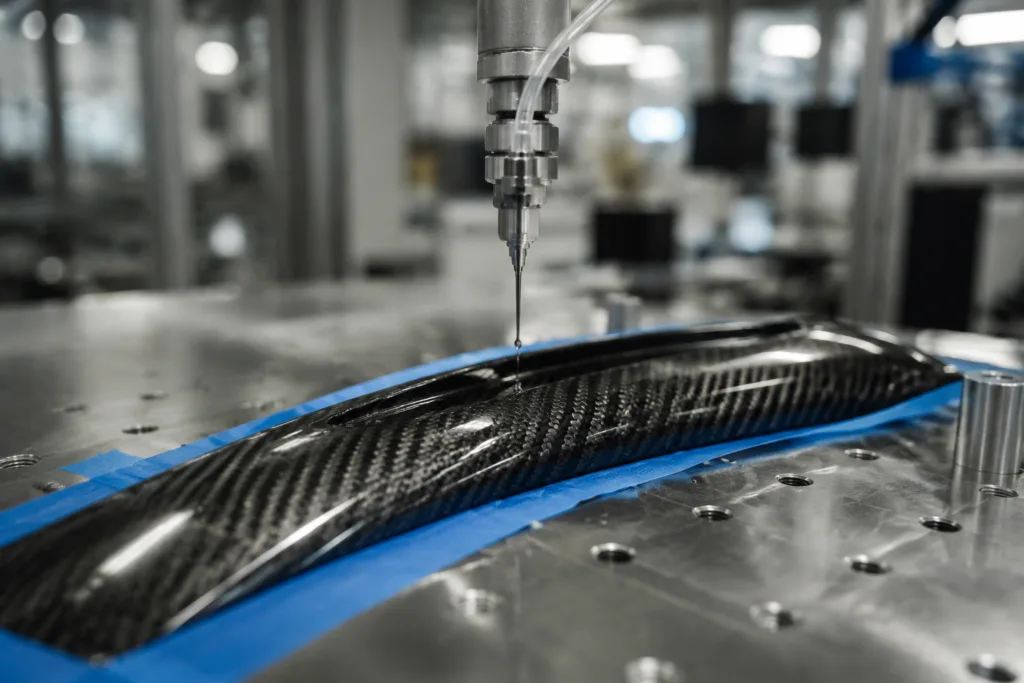
For removable fit checks, transparent assembly trials, or process evaluation on appearance-sensitive parts, some teams review options like ZDS-2201061 for removable clear bonding trials before locking a final production method. Trial-stage materials can be useful when the priority is to study bond line visibility and handling behavior without immediately committing to a permanent production setup.
Carbon fiber cosmetic bonding glue selection criteria
When comparing candidates, appearance-sensitive projects usually need more than a general datasheet check. A practical evaluation includes the following points:
| Selection factor | Why it matters for visible carbon fiber |
|---|---|
| Transparency or color | Determines how noticeable the bond line will be next to the weave, coating, or edge detail. |
| Viscosity | Affects flow, overflow risk, edge wicking, and final seam shape. |
| Cure shrinkage | Can influence edge pullback, stress marks, or visible seam irregularity. |
| Gap filling ability | Important if the parts are not perfectly flat or if dimensional variation exists. |
| Surface compatibility | Needed to avoid haze, softening, staining, or poor wetting on coated CFRP. |
| Heat and moisture resistance | Prevents later visual degradation in service conditions. |
| Rework behavior | Helps determine whether excess material can be removed without finish damage. |
In manufacturer discussions, ZDS typically sees better outcomes when customers define both the visual acceptance standard and the mechanical requirement at the same time. That prevents the common mistake of selecting a strong adhesive first and only later discovering that the bond line is too visible for the product.
Balancing cosmetic quality with structural reliability
The right adhesive for visible carbon fiber should not force a false choice between looks and performance. In many assemblies, the answer is to tune the joint design, adhesive rheology, and application process together. A slightly hidden flange, a controlled bond gap, or an improved dispensing path can allow the use of a more reliable adhesive without compromising appearance.
It also helps to define what the bond is actually doing. If the joint is lightly loaded decorative trim, cosmetic factors may dominate. If it carries vibration, peel stress, or temperature cycling, durability becomes more critical and may justify a less invisible bond line. Good specification work ranks these requirements in the correct order for the product.
Where these decisions matter most
Appearance-sensitive carbon fiber bonding is common in several markets:
- Premium consumer goods: devices, accessories, and housings where users directly inspect finish quality.
- Automotive trim: interior or exterior CFRP accents where edge neatness and long-term visual stability matter.
- Sports equipment: components where exposed carbon is part of the brand aesthetic.
- Decorative panels: architectural or industrial covers where the weave remains visible after installation.
Across these uses, acceptance criteria often include both mechanical hold and visual consistency under normal lighting, close-range viewing, and handling during assembly.
What to validate before approval
Before approving any adhesive for visible carbon fiber, teams should run practical validation rather than relying only on generic adhesive class assumptions. Useful checks include:
- Mockups: build real-looking assemblies using final or near-final substrates and edge conditions.
- Cure testing: observe bond line clarity, bubble retention, seam shape, and color after full cure.
- Surface compatibility checks: test on the actual clear coat, resin surface, or cosmetic laminate finish.
- Overflow simulation: intentionally evaluate how small over-application behaves and how it can be cleaned.
- Environmental review: examine whether heat, humidity, or light exposure changes visual appearance.
- Rework assessment: confirm whether mistakes can be corrected without scratching or clouding the part.
These checks are especially important when the carbon fiber surface finish comes from a separate supplier, because coating chemistry and edge porosity can change the final cosmetic result even when the base laminate looks similar.
Common mistakes that cause cosmetic rejection
Several avoidable mistakes repeatedly lead to scrap, rework, or slower production:
- Choosing by strength only and ignoring bond line visibility.
- Using a low-viscosity adhesive on exposed edges without wicking tests.
- Assuming cleanup solvents are safe for all clear-coated CFRP surfaces.
- Applying too much fixture pressure and forcing squeeze-out into visible zones.
- Skipping trial builds under realistic lighting and inspection distance.
- Not defining an acceptable glue line width before production.
Most of these problems can be prevented early by reviewing real parts, not just drawings, and by aligning design, process, and adhesive selection criteria before scale-up.
Conclusion
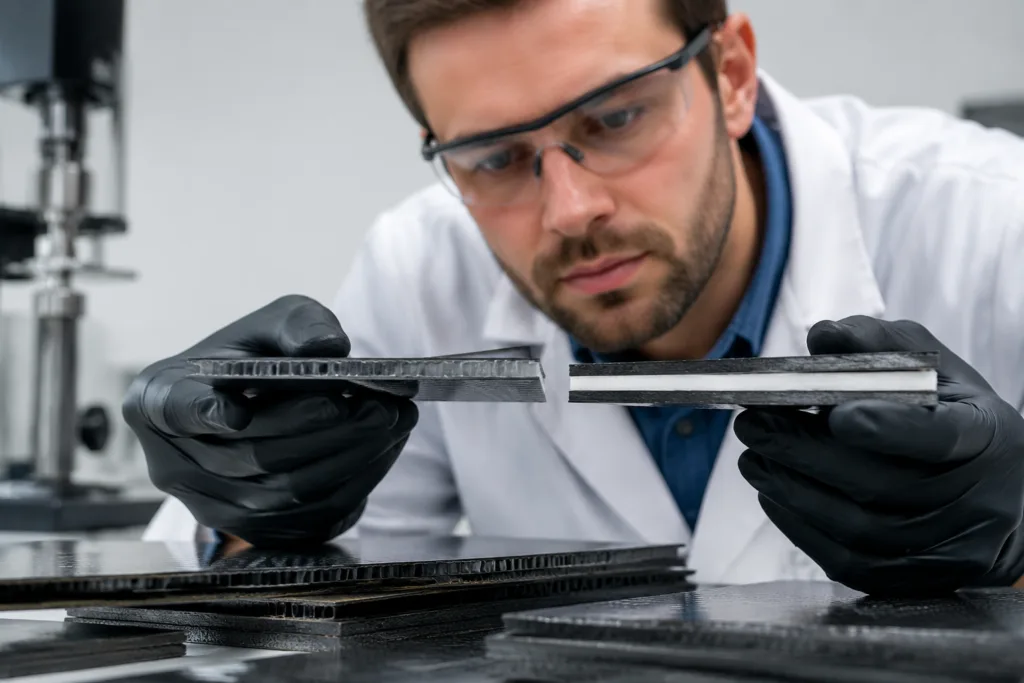
Selecting an adhesive for visible carbon fiber means managing appearance and performance together. The right material should bond the parts reliably while also controlling glue line visibility, edge staining, overflow, and finish compatibility. For most teams, the winning choice comes from testing actual surfaces, realistic gap conditions, and practical application methods rather than choosing only by adhesive category. When cosmetic quality is part of product value, bond aesthetics deserve the same level of engineering attention as strength and durability.
FAQ
What is the most important property in an adhesive for visible carbon fiber?
The most important property depends on the joint, but for exposed cosmetic parts the top priorities are usually controlled viscosity, surface compatibility, and a bond line appearance that stays acceptable after cure.
Are clear adhesives always better for visible carbon fiber parts?
No, because a clear adhesive can still yellow, trap bubbles, flow too much, or show a thick seam, so clarity should be evaluated together with cure behavior, edge stability, and durability.
Can carbon fiber edges absorb adhesive and create staining?
Yes, cut or porous edges can wick low-viscosity adhesive and create darker or glossier areas, which is why edge testing is important before approving a material.
How can I reduce visible squeeze-out on cosmetic CFRP assemblies?
Use controlled dispensing, define the bead size carefully, validate fixture pressure, and test masking and cleanup timing on the actual finished surface before production.
Should I prioritize strength or appearance for decorative carbon fiber trim?
You should prioritize according to the part function, but decorative trim usually needs a balanced choice where the adhesive meets service loads without creating an obvious or unstable bond line.
What should be tested before choosing a production adhesive for exposed carbon fiber?
At minimum, test real-part mockups for bond line visibility, cure clarity, overflow behavior, surface compatibility, environmental appearance stability, and the risk of damage during cleanup or rework.