
Automotive adhesive plays a central role in modern vehicle manufacturing because it helps join dissimilar materials, improve sealing performance, reduce noise and vibration, and support more efficient assembly. Compared with mechanical fastening alone, adhesives can distribute stress across a wider area, reduce localized deformation, and enable cleaner integration of metals, plastics, composites, glass, rubber, foams, and coated parts. For engineers, buyers, and product teams, the key challenge is not simply choosing an adhesive category, but matching the material system, process window, and durability requirements to the actual use case.
explore the full adhesive portfolio if you are comparing bonding, sealing, potting, or coating approaches across different automotive assemblies and need a clearer view of how formulation type relates to substrate and process fit.
Why automotive adhesives are widely used in modern vehicle manufacturing
Vehicle designs now combine lightweighting goals, mixed-material construction, styling demands, and stricter durability expectations. Adhesives help address these requirements by bonding thin panels, reinforcing assemblies without adding excessive point loads, and sealing joints that would be difficult to protect with fasteners alone. In many cases, adhesive use also supports better corrosion management because the bond line can isolate dissimilar materials and reduce moisture ingress when the correct system is selected.
Another reason automotive adhesive use has expanded is process integration. A single material may contribute to bonding, gap filling, vibration damping, and sealing in one assembly step. That can simplify part design and reduce the number of separate components needed in production. For teams reviewing automotive adhesive solutions for vehicle assembly, it is often useful to compare not just bond strength, but also line speed, cure method, application equipment, and rework implications.
Main automotive bonding needs
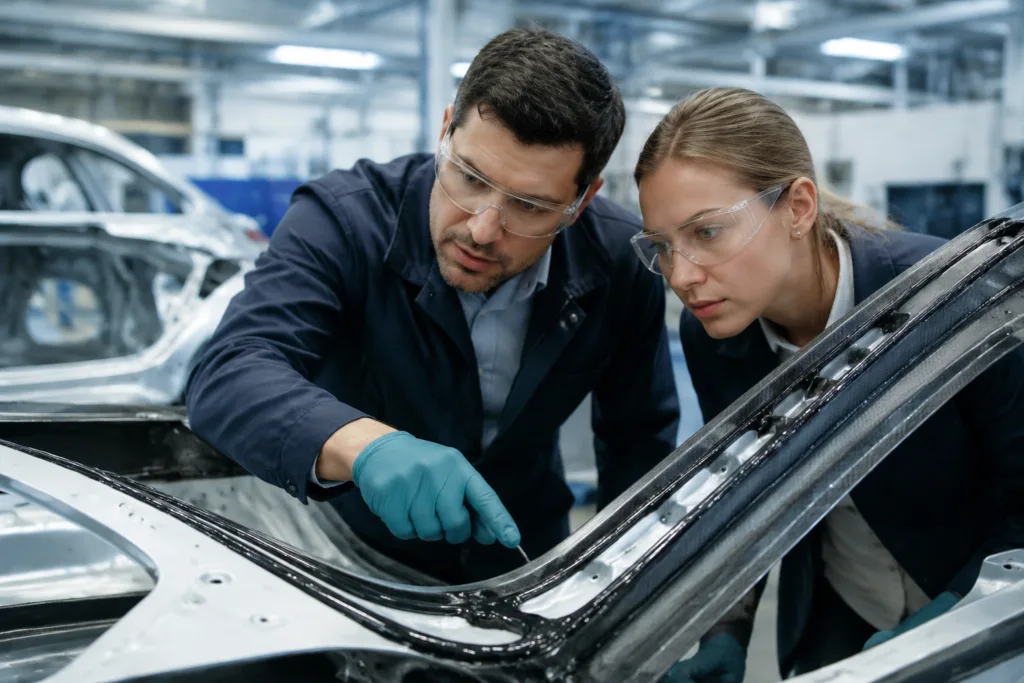
Structural bonding
Structural bonding is used where the adhesive contributes meaningful load transfer between components. Typical areas include body assemblies, brackets, reinforcements, roof modules, exterior panels, battery-related housings, and selected metal-composite interfaces. These applications usually require controlled strength, impact tolerance, and long-term resistance to temperature cycling and moisture.
Sealing
Sealing systems are used to block water, dust, air, chemicals, or road contaminants. Common examples include seam sealing, flange sealing, lamp assemblies, glazing-related interfaces, and underbody protection zones. In these areas, flexibility and environmental resistance often matter more than peak structural strength.
Damping and NVH control
Some materials are chosen less for high load-bearing performance and more for noise, vibration, and harshness control. These systems may damp panel resonance, cushion interfaces, or reduce buzz and rattle in interior and trim assemblies. Here, the balance between softness, adhesion, and aging resistance is critical.
Interior fixation
Interior bonding covers fabrics, foams, films, trim parts, emblems, headliners, instrument panel components, and soft-touch assemblies. Low odor, process cleanliness, appearance control, and compatibility with plastics and coated decorative surfaces are often major decision points.
Common automotive materials and typical bonding challenges
Metals
Steel, aluminum, and galvanized substrates remain common throughout vehicle structures. Bonding challenges include oil contamination, oxide layers, corrosion risk at the interface, and differences in thermal expansion when metals are paired with plastics or composites. Thin sheet metal can also distort around welds or fasteners, making adhesive bonding attractive where load distribution and appearance matter.
Plastics
Automotive plastics range from ABS and PC blends to PP, PE, PA, and engineering resins. The main challenge is that not all plastics bond equally well. Low-surface-energy materials such as polypropylene and polyethylene are especially difficult and may require primers, surface treatment, or a specialized formulation. Heat sensitivity is another issue because some plastics can warp or stress crack if the cure profile is too aggressive.
Composites
Composites can provide stiffness and weight reduction, but their surfaces may vary by resin system, fiber exposure, mold release residue, or coating layer. Consistent preparation is essential. Adhesive selection must account for peel forces, impact loading, and the mismatch in expansion behavior when composites are joined to metals.
Rubber and elastomers
Rubber parts such as seals, gaskets, mounts, and vibration-control components often require flexible bonding systems. The main issue is maintaining adhesion under repeated movement, compression, moisture exposure, and contact with automotive fluids. Compound variation can also affect results, so testing on the actual rubber grade is important.
Coated or painted surfaces
Many automotive joints are not made on bare substrates. E-coat, powder coat, painted surfaces, and treated metals each bring a different adhesion profile. In practice, adhesion may depend more on coating integrity than on the base material itself. A strong adhesive cannot compensate for a weak paint layer or poorly cured coating.
Mixed-material assemblies are increasingly common, which is why many teams review rubber bonding adhesive guidance for mixed-material parts alongside broader substrate compatibility checks when an assembly combines elastomers, plastics, and metal inserts.
Types of automotive adhesives
Structural adhesives
Structural systems are chosen when the bond line must transfer load and maintain integrity under stress, impact, or fatigue. Depending on design targets, they may be formulated for high stiffness, toughness, gap filling, or balanced flexibility. Epoxy, polyurethane, acrylic, and selected modified systems are common choices depending on cure conditions and substrate mix.
Rubber adhesives
Rubber-focused adhesives are used where flexibility, elongation, and repeated movement are more important than rigid strength. They are common in trim, seals, vibration-control parts, and bonded elastomer assemblies. Proper selection depends on the rubber type, expected compression or flexing, and the fluids or heat the part will encounter.
Sealants
Sealants are used to close gaps and protect joints from moisture, dust, and chemicals. They may also contribute some adhesive hold, but their primary function is environmental protection and movement accommodation. In automotive environments, sealants often need to maintain elasticity through thermal cycling and road exposure.
Specialty bonding systems
Some applications call for pressure-sensitive systems, hot melts, film adhesives, conductive materials, foam bonding products, or low-odor interior formulations. These are selected based on process speed, automation level, appearance requirements, and the sensitivity of surrounding materials.
How automotive structural adhesive performs in load-bearing and crash-relevant applications
Automotive structural adhesive is valued in load-bearing assemblies because it can spread stress over a broader bonded area instead of concentrating it at discrete mechanical fastener points. That can improve stiffness, reduce local fatigue risk, and support more stable dimensional performance in thin or lightweight structures. However, structural performance depends heavily on joint design. Overlap geometry, bond line thickness, cure completeness, and substrate preparation all influence the final result.
Crash-relevant performance is not simply about maximum static strength. Toughness, impact resistance, and behavior across low and high temperatures matter just as much. A very rigid adhesive may provide high initial strength but perform poorly if the assembly sees peel, shock, or differential movement. This is one reason engineers often evaluate when structural adhesives are the right choice before narrowing material options.
From a manufacturer perspective, ZDS typically sees structural adhesive selection succeed when teams align the chemistry with both performance targets and production constraints rather than treating strength data in isolation.
Where automotive rubber adhesive is used and what performance requirements matter most
Automotive rubber adhesive is commonly used in weatherstrips, seals, anti-vibration components, interior soft materials, gaskets, and assemblies where rubber must be fixed to metal or plastic carriers. In these cases, flexibility retention is usually the first requirement. The adhesive must hold through compression, bending, vibration, and thermal cycling without becoming brittle or losing adhesion at the interface.
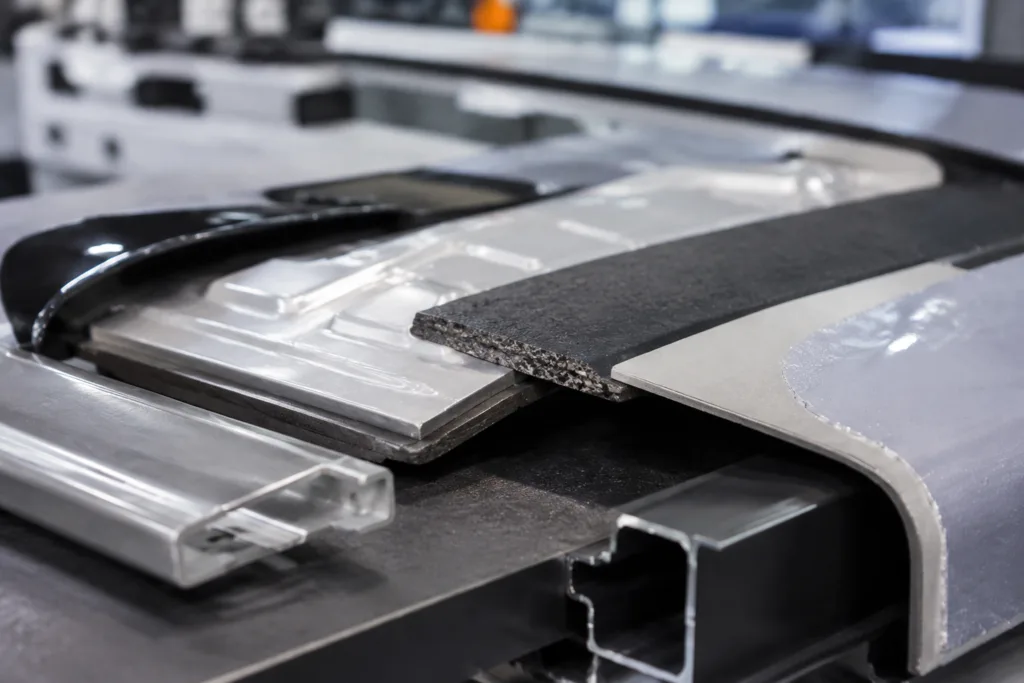
Resistance to oils, humidity, road splash, and cleaning agents may also be necessary depending on part location. For under-hood or exterior use, heat aging and moisture stability become more important. For interior rubber-to-foam or rubber-to-plastic interfaces, odor, appearance, and clean application may matter more. A product such as ZDS-PU928 high-strength PU adhesive for automotive exterior represents the kind of application-specific thinking often needed when durability, flexibility, and exterior exposure must be considered together.
Key process factors that affect bonding quality
Surface preparation
Even a suitable adhesive can fail if the surface is contaminated or unstable. Oils, dust, mold release, oxidation, weak paint layers, and moisture can all reduce bond reliability. Depending on the substrate, preparation may involve cleaning, abrasion, plasma or corona treatment, priming, or controlled drying. The goal is a stable, wettable surface, not just a visually clean one.
Curing method
Curing can occur through moisture, heat, mixing of two components, UV exposure, or pressure-sensitive tack depending on the system. The curing mechanism must fit the assembly environment. A material that cures well in open air may struggle in enclosed joints, while a heat-curing system may not suit heat-sensitive plastics or foam-backed components.
Temperature and humidity
Shop conditions influence viscosity, wetting, open time, and cure rate. Low temperature can make dispensing difficult and slow cure development. Excess humidity may interfere with some surfaces or accelerate skinning in moisture-curing products. Stable process conditions are often just as important as adhesive choice.
Pressure and fixturing
Some assemblies need clamping pressure to ensure proper wetting and bond line control. Too little pressure can leave voids; too much can squeeze out adhesive and starve the joint. Fixturing time also affects throughput, especially in high-volume automotive lines.
Assembly time
Open time and work life must match the real production sequence. If a line requires part repositioning or robot travel across multiple stations, a very fast-setting product may create variability. Conversely, a slow-curing product can create bottlenecks if early handling strength is needed.
Selection criteria for automotive adhesive
Choosing an automotive adhesive usually starts with the substrate pair, but that is only one part of the decision. Engineers and procurement teams should evaluate performance and process together.
- Substrate compatibility: Confirm adhesion to the actual metal grade, plastic type, rubber formulation, coating, or composite finish.
- Strength profile: Match shear, peel, and impact performance to the real loading mode instead of using one strength number alone.
- Flexibility and hardness: Rigid systems suit some structural assemblies, while flexible materials perform better in moving, vibrating, or sealing joints.
- Environmental resistance: Consider heat, cold, humidity, water, salt, UV, oils, fuels, and cleaners based on part location.
- Cure and assembly fit: Review open time, fixture time, full cure, mixing ratio, and dispensing method.
- Gap filling and viscosity: The adhesive must suit part tolerances, joint geometry, and application equipment.
- Production efficiency: Evaluate automation compatibility, storage stability, waste, and rework difficulty.
- Cost-performance balance: The lowest unit price may not be the lowest system cost if it creates slower curing, higher scrap, or more preparation steps.
Common failure risks and how to avoid them
Poor adhesion
This often comes from contamination, incorrect surface energy, or choosing a chemistry that does not match the substrate. Validate on production-like surfaces, not ideal lab coupons only.
Thermal aging
Repeated exposure to heat can harden, soften, or embrittle some adhesive systems. Testing should reflect both peak temperature and long-duration thermal exposure.
Vibration and fatigue damage
Vehicle assemblies experience continuous movement. A bond that survives static testing may still fail under cyclic stress if the adhesive is too brittle or the joint design introduces peel loading.
Chemical exposure
Road salt, oils, coolants, fuels, cleaners, and plasticizers can degrade certain materials. Review actual service exposure early in development instead of treating chemical resistance as a later check.
Practical selection tips for different automotive applications
| Application type | What matters most | Typical selection focus |
|---|---|---|
| Body or bracket bonding | Load transfer, toughness, durability | Structural system with controlled cure and strong metal adhesion |
| Exterior trim and panels | Weathering, movement, appearance | Flexible adhesive with outdoor resistance and good adhesion to painted surfaces |
| Seals and rubber parts | Elasticity, fatigue resistance, fluid exposure | Rubber-compatible formulation with long-term flexibility |
| Interior trim | Clean application, appearance, odor control | Low-odor, substrate-compatible adhesive suited to plastics, foams, or fabrics |
| Mixed plastic-metal assemblies | Differential expansion, surface energy differences | Toughened system with verified compatibility and suitable preparation |
| Seam and joint protection | Moisture sealing, movement accommodation | Sealant with durable elasticity and environmental resistance |
For many teams, the most practical path is to define the service environment first, then narrow by substrate pair, process, and required mechanical behavior. That approach usually produces better results than starting with chemistry names alone.
Testing, validation, and quality control considerations
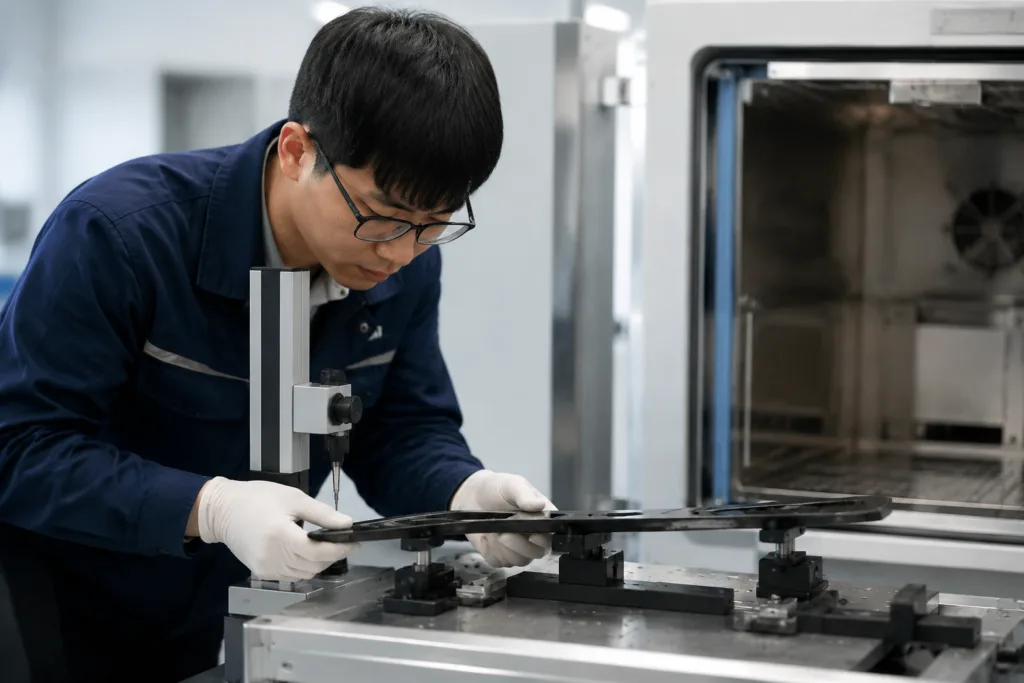
Automotive adhesive selection should be validated under conditions that resemble the final application as closely as possible. That means testing the actual substrates, coatings, part geometry, cure schedule, and expected environmental exposure. Small changes in surface finish or assembly timing can significantly alter results.
Useful validation may include lap shear, peel, environmental aging, thermal cycling, fluid exposure, vibration, and appearance checks depending on the part. Process control is equally important. Dispense consistency, mix accuracy for two-component materials, adhesive age, storage condition, and surface cleanliness should all be monitored on the line. In production, reliable bonding is usually the result of a controlled system rather than a strong adhesive alone.
Conclusion
The right automotive adhesive depends on more than whether the joint is labeled structural, sealing, or interior. Real success comes from understanding the substrates, joint design, movement profile, environmental stress, and production method together. When those factors are aligned, adhesives can support lighter designs, better sealing, improved durability, and cleaner assembly integration across a wide range of vehicle components.
For engineers, procurement teams, and product developers, a practical evaluation process starts with the use case, confirms substrate compatibility, and then compares performance trade-offs such as strength, flexibility, cure behavior, and durability. That method reduces avoidable failures and makes material selection more predictable in both development and production.
FAQ
What is automotive adhesive used for?
Automotive adhesive is used for structural bonding, sealing, vibration damping, trim fixation, rubber bonding, glazing-related assembly, and joining mixed materials such as metal, plastic, composite, foam, and coated surfaces.
How do I choose an automotive adhesive for plastic to metal bonding?
Start by identifying the exact plastic type, metal surface condition, service temperature, and loading mode, then select a formulation that can handle different surface energies and thermal expansion rates while fitting the required curing process.
Are structural adhesives always better than mechanical fasteners?
No, structural adhesives are useful when load distribution, lightweighting, sealing, or joining thin and dissimilar materials matters, but some assemblies still need fasteners for positioning, peel resistance, serviceability, or redundant retention.
Why do rubber bonding applications fail over time?
Common causes include poor surface preparation, incompatible adhesive chemistry, heat aging, repeated flexing, chemical exposure, and testing on a different rubber compound than the one used in production.
What process factor affects automotive adhesive performance the most?
Surface preparation is often the biggest factor because contamination, weak coatings, moisture, or low surface energy can prevent proper adhesion even when the selected adhesive is otherwise suitable.
Should automotive adhesive selection be based mainly on bond strength data?
No, bond strength data is only one part of selection, and long-term durability, flexibility, curing behavior, environmental resistance, application method, and production efficiency are usually just as important.