
Buying from a technical data sheet is not the same as buying from a label. A marine adhesive TDS guide helps engineers and procurement teams translate claims into project-relevant decisions, especially when the product is expected to face moisture, sunlight, vibration, temperature swings, and mixed substrates. For teams evaluating marine adhesive solutions for boat and composite assemblies, the key question is not whether a sheet says “marine grade” but whether the numbers, test methods, and cure behavior match the actual job.
This matters because marine applications vary widely. A bond above the waterline may need UV durability and weathering resistance. A below-waterline joint may need better water immersion performance and careful substrate preparation. A structural bond on a fiberglass panel asks different questions than a flexible seal around a deck fitting. ZDS LTD works with industrial buyers to review those variables before product matching, but the final selection always depends on the exact substrates, geometry, exposure, and processing route.
If you want a broader reference point while reading this article, compare the data with how to choose the right industrial adhesive for your application as a procurement framework, then return here to judge marine-specific claims.
Why marine grade wording is not enough
The phrase “marine grade” is often used as a marketing shortcut. On its own, it does not tell you whether the adhesive was tested on the relevant substrate, under the relevant exposure, or after the relevant aging method. A product can be suitable for one marine task and unsuitable for another.
General-purpose products may still perform well in some boat interiors, trim attachments, electronics housings, or non-structural sealing jobs. But a serious purchasing decision needs more than a category label. The TDS should show how the product behaves under load, after exposure, and during assembly. It should also state enough test detail to let you judge whether the result applies to your project.
A useful way to read the sheet is to ask three questions:
- What was tested?
- How was it tested?
- Does that test resemble my real application?
That logic reduces the risk of buying a product that looks strong on paper but behaves differently in service. ZDS LTD often helps customers compare chemistry options, such as silicone, polyurethane, epoxy, acrylic, or anaerobic products, but the comparison only becomes meaningful after the working environment is defined.
What a marine adhesive TDS should tell you first

Before reading the performance figures, check whether the TDS clearly identifies the product type, intended function, substrate scope, and cure mechanism. A complete sheet should help you understand whether the product is designed primarily for bonding, sealing, gap filling, potting, or a combination of these functions.
Pay attention to whether the document identifies:
- Chemistry or product family
- Intended use: structural bond, flexible seal, or protective encapsulation
- Cure method and practical application window
- Compatible substrates or surface types, if stated
- Required primer, mixing, or activation steps, if any
- Relevant test methods behind the published values
If a TDS leaves these points vague, treat the numbers carefully. A short sheet can still be usable, but only when the supplier can explain the missing context. For projects with more demanding exposure, buyers should also request the current technical data sheet, safety data sheet, and any project-specific compliance documents before approving the product.
How to read durability data
Durability claims are often where marine buyers focus first, and for good reason. Water, UV, and temperature exposure can change adhesive behavior over time. But the value of durability data depends on the test design, not just the headline result.
Water resistance and immersion
Water resistance can mean several things. It may refer to splash exposure, humidity, periodic washdown, or prolonged immersion. Those are not equivalent. A product that tolerates intermittent wetting may not behave the same after continuous immersion or repeated wet-dry cycling.
When a sheet gives water resistance data, check whether the test was based on immersion, conditioning before testing, or post-immersion bond retention. That distinction matters because water can weaken the interface, soften the bulk material, or affect fillers and primers differently. For immersion-related claims, a more relevant question is whether the bond was tested after exposure, not simply whether the product was placed in water.
For buyers comparing proof points, why adhesive bonds weaken after water exposure is a useful reminder that moisture can act on several failure modes at once.
Where possible, look for test methods that describe preconditioning, immersion duration, temperature, and substrate. If the data does not describe those variables, ask for the underlying method or a product-specific test report.
Salt exposure and corrosion context
Salt spray data is common in marine and coastal discussions, but it should be read as comparative exposure data rather than a full prediction of field life. Salt spray can highlight corrosion tendencies or coating breakdown, but it does not reproduce every marine variable such as UV, mechanical stress, splash dynamics, or cyclic wetting.
If a supplier references salt spray, the number is most useful when paired with substrate type, joint design, and post-exposure mechanical data. The what test data buyers should review before approving waterproof adhesives article is a practical companion when the technical file looks thin.
For formal context, ASTM’s immersion and salt spray methods are often referenced in technical discussions: water immersion adhesion test for marine adhesives and salt spray testing limitations for marine products. These are not proof of ZDS LTD product performance, but they help buyers ask better questions.
UV durability and weathering
UV exposure matters especially above the waterline, on exposed deck hardware, and on visible seals or bond lines. A TDS may mention UV resistance, weathering resistance, or outdoor durability, but these phrases are not interchangeable. UV can affect color, surface cracking, embrittlement, or loss of flexibility depending on chemistry and formulation.
Read the UV claim in context. Ask whether the product was tested after UV exposure, whether the data reflects retained strength, and whether appearance changes were part of the evaluation. For some marine applications, visual stability matters less than retained function. For others, surface chalking or discoloration may be unacceptable even if the joint remains intact.
Temperature range
Marine environments can combine heat, cold, solar loading, and thermal cycling. A TDS may list an operating or service temperature range, but that does not automatically define the most severe condition the product can tolerate. It is safer to read the range as one part of the selection picture and confirm whether the value refers to short-term exposure, continuous service, or a specific test condition.
How to read mechanical data
Mechanical values tell you how a cured adhesive behaves under stress, but they only make sense when tied to the joint design. A product with high strength and low flexibility may suit one rigid structural bond and fail prematurely in a movement-heavy seal. Another product may stretch well but provide insufficient structural support.
Modulus
Modulus describes stiffness. In practical terms, it tells you how rigid or flexible a cured adhesive is likely to be. A higher modulus usually means a stiffer joint, which can help in structural load transfer but may be less forgiving when bonded parts move differently. A lower modulus usually means more flexibility, which can be helpful in sealing joints, absorbing vibration, or accommodating thermal movement.
Do not treat low modulus as universally better for marine use. Flexible systems can handle movement well, but they may not be the right answer where the joint must hold alignment or carry repeated mechanical load. ZDS LTD can help compare modulus in relation to the real joint, but the meaning only becomes clear once the substrate and movement profile are known.
Elongation
Elongation indicates how much the cured material can stretch before failure under the specified test. For marine buyers, this often matters when bonding dissimilar materials or sealing joints that flex under wave motion, engine vibration, or thermal expansion. Higher elongation may support movement, but again it does not replace the need to verify strength, adhesion, and environmental resistance together.
Tensile, peel, and shear strength
These three values are often used as shorthand for performance, but each one describes a different load mode. Tensile data shows resistance to pulling forces, shear data shows sliding resistance, and peel data shows resistance to edge-lifting forces. Marine joints often see a mix of these loads, especially when parts flex or vibration is present.
When comparing sheets, ask which failure mode matters most in your assembly. A product that looks strong in shear may still be poor in peel. For a more detailed foundation, peel, shear, and tensile strength explained can help buyers connect the terminology to the real joint.
How to interpret process data
Processing behavior is often the difference between a product that works in a lab and one that works on a production line or in service repairs. For marine buyers, a TDS should make the working window clear enough to support planning.
Work time and open time
Work time, open time, or pot life tells you how long the material remains usable after mixing or after application, depending on the system. This matters for large assemblies, multi-point dispensing, and manual installation on boats or marine equipment. A short working window can speed cure but may reduce assembly flexibility. A longer window can help with positioning but may slow throughput.
Skin time
Skin time is relevant for sealants and one-part products. It indicates when the surface begins to form a skin, which affects tooling, finishing, and contamination control. If skin time is too short for your process, the team may struggle to smooth or position the bead before surface closure.
Full cure
Full cure is not the same as handling strength. A product may be touch-dry or fixture-ready before it has achieved its full properties. For marine work, confirm whether the TDS distinguishes between handling, fixture, and full cure, and whether humidity, thickness, or temperature influences the process. Never assume that a general cure statement applies to every bead size or bondline thickness.
Non-sag and application window
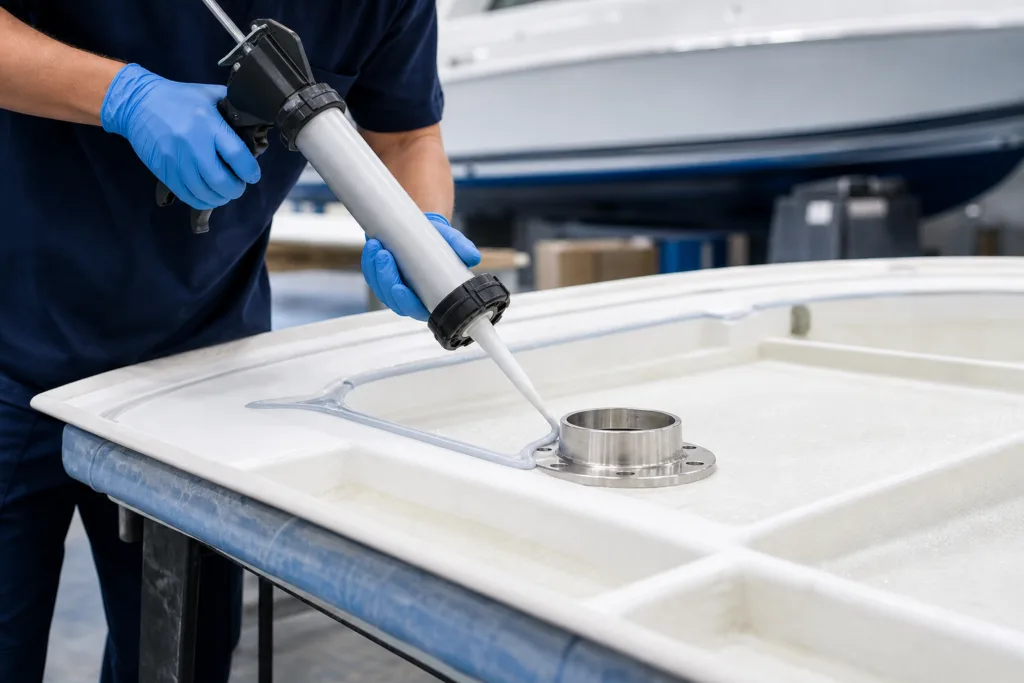
For vertical seams, deck joints, and overhead work, non-sag behavior can be critical. It helps the bead stay where it is applied. But non-sag is not just a convenience term; it affects joint geometry and final appearance. Check whether the property was stated for a specific test setup or material consistency. If the surface is very smooth, coated, or contaminated, application behavior may differ from the TDS description.
Above-waterline vs below-waterline use
The application zone changes the performance question. Above-waterline jobs face more UV, air exposure, and thermal cycling. Below-waterline jobs face more continuous moisture, hydrostatic pressure, and long-term immersion concerns. A TDS that looks acceptable for one zone may not be enough for the other.
Below-waterline use usually pushes buyers to examine immersion data, adhesion retention, and substrate preparation more closely. Above-waterline use often shifts attention toward weathering, UV, flexibility, and maintenance access. The point is not that one chemistry is always better, but that the service environment defines which data deserves priority.
For some projects, a silicone-based solution may be appropriate where flexibility and water sealing are more important than structural load, while other projects may call for a polyurethane or epoxy system. ZDS LTD can review those trade-offs without assuming the answer from the application name alone. Product-specific options such as ZDS-999 silicone waterproof adhesive for outdoor and underwater use may be discussed only after the substrate and environment are known.
Structural bonding vs sealing
Many marine jobs blur the line between sealing and bonding, but the TDS should tell you which function the product is designed to support. A structural adhesive is expected to transfer load between parts. A sealant is expected to keep out water or contaminants while accommodating movement. Some products do both to a degree, but that does not mean they are equally strong in both roles.
For structural bonding, focus on substrate compatibility, joint design, stiffness, and retained strength after exposure. For sealing, focus on flexibility, movement accommodation, bead stability, and environmental resistance. If you need both functions, ask whether the product can be validated in the exact joint geometry rather than assuming the chemistry name is enough.
In practice, the decision often comes down to whether the joint is carrying load or simply closing a gap. If the answer is mixed, ZDS LTD may recommend reviewing the assembly drawing, the material list, and the service conditions before discussing a product shortlist.
How substrate compatibility changes the reading of a TDS
Marine assemblies rarely use a single substrate. Fiberglass, aluminum, stainless steel, coated metal, wood, ABS, PVC, polycarbonate, and painted surfaces can all appear in the same project. A TDS that reports strength on one substrate does not automatically prove the same result on another.
Surface energy, porosity, coatings, and contamination all affect wetting and bond formation. That means a product may look excellent on clean metal and behave differently on a gelcoat, a weathered composite, or a plastic part with release agents. If the TDS lists surface preparation, follow it closely; if it does not, ask for guidance before approving the product.
Marine buyers should also remember that coated or painted surfaces can fail at the coating interface rather than the adhesive interface. In those cases, the apparent adhesive failure is actually a coating adhesion issue. This is one reason that representative-part testing is more valuable than relying on generic chemistry assumptions.
For some projects, a higher-viscosity or potting-style system may be more appropriate around components that need environmental protection. In those cases, product-level discussion such as ZDS-PU951 high-strength waterproof PU potting compound may help narrow the processing route, but only after the application is clearly defined.
What standards and test conditions may sit behind the numbers
Numbers on a TDS are only meaningful when the test conditions are visible. A strength value without the substrate, surface preparation, cure, and conditioning method is hard to compare. The same is true for water resistance or UV durability data.
When reviewing a sheet, ask whether the data was generated under a recognized standard, a supplier internal method, or a customer-specific test. None of these is automatically wrong, but they carry different weight. Standard methods improve comparability, while internal methods may be useful but need more interpretation.
Good technical documentation usually states:
- Test substrate
- Surface preparation
- Bondline or joint type
- Cure or conditioning procedure
- Exposure method
- Failure mode or retained property
If those details are missing, the sheet may still be a starting point, but not a final approval document. Buyers should confirm the current TDS and related data package before moving to procurement or field use.
Red flags in a marine adhesive TDS
Some warnings are easy to spot once you know what to look for. The biggest issue is vague wording paired with strong claims. Another problem is a data sheet that gives headline numbers without methods.
| Red flag | Why it matters | What to ask instead |
|---|---|---|
| “Marine grade” with no test detail | The phrase may be marketing language only | Ask what was tested, on which substrate, and under what exposure |
| Waterproof claim without immersion context | Splash resistance is not the same as immersion durability | Request water exposure method and post-exposure performance data |
| Strength values with no failure mode | You cannot tell if the joint or substrate failed first | Ask for peel, shear, or tensile method and failure description |
| UV resistance with no aging conditions | Different exposure protocols produce very different outcomes | Request the aging method and what property was measured after exposure |
| Process times without temperature context | Work time and cure can shift with shop conditions | Confirm the test temperature and thickness used for the reported values |
When a sheet raises these flags, the best move is not to reject it immediately. It is to ask for the underlying technical file, then compare that information against your assembly and service requirements.
A practical marine sealant property checklist
Before shortlisting products, use a checklist that keeps the conversation tied to the actual job. This is especially useful when comparing multiple vendors or multiple chemistries.
- Primary function: bond, seal, pot, or combine these roles
- Exposure zone: above-waterline, below-waterline, splash, or submerged
- Substrates: metal, fiberglass, wood, plastic, coated surface, or mixed materials
- Movement: rigid joint, vibration, thermal expansion, or flexing parts
- Assembly method: manual application, cartridge dispensing, automated dispensing, or repair use
- Process window: work time, skin time, fixture time, and full cure expectations
- Environmental exposure: water, salt, UV, heat, cleaning chemicals, or temperature cycling
- Documentation: current TDS, SDS, and any needed compliance documents
This checklist is also useful when preparing a request to ZDS LTD. The more clearly the application is described, the more precisely the chemistry and packaging options can be reviewed.
How to compare two marine bonding adhesives side by side
A direct comparison should never stop at one headline number. A practical review looks at the full picture: durability, mechanics, process behavior, and suitability for the joint design.
| Comparison point | Product A | Product B | Why it matters |
|---|---|---|---|
| Primary function | Bonding or sealing | Bonding or sealing | Confirms whether the chemistry fits the job |
| Exposure zone | Above-waterline or below-waterline | Above-waterline or below-waterline | Changes the durability priorities |
| Substrate scope | List the stated substrates | List the stated substrates | Prevents overgeneralizing the test data |
| Stiffness or flexibility | Higher or lower modulus | Higher or lower modulus | Controls movement tolerance and load transfer |
| Process window | Work time and skin time | Work time and skin time | Affects assembly speed and manual handling |
| Exposure data | Water, UV, salt, temperature | Water, UV, salt, temperature | Shows how close the test resembles the application |
When the data sheets are close, the deciding factor is often not the highest reported number but the most relevant test design. That is where project context matters more than chemistry labels.
How to validate TDS claims before production or field use

Representative-part testing is the safest way to move from technical sheet to real application. The goal is not to prove a material perfect. The goal is to see whether it behaves acceptably in the actual joint.
A useful validation plan usually includes:
- Production-relevant substrates and surface preparation
- Representative bondline or seal geometry
- Expected cure and handling conditions
- Wet, UV, vibration, or chemical exposure relevant to the service environment
- Observation of application behavior, bead control, cure progression, and failure mode
For marine projects, this step matters because moisture, coatings, and joint design can change performance in ways that a generic test coupon will not show. A supplier can help review the plan, but it should not be treated as final engineering approval until the parts are tested in context.
That is also where ZDS LTD can be useful as a manufacturing and formulation partner. The team can review the substrate set, compare chemistry families, discuss packaging format, and support trial planning without assuming the result in advance.
How ZDS LTD helps buyers interpret marine adhesive data
In a sourcing conversation, the most efficient path is usually to start with the application data, then map that to likely chemistry families. ZDS LTD can review the project inputs, discuss whether the job leans toward bonding, sealing, potting, or a mixed function, and help narrow the short list before samples are requested.
This is especially useful when the TDS language is broad or when two products seem similar but behave differently in processing or service. A technical review can focus on the evidence that matters: substrate compatibility, exposure route, required flexibility, and the practical working window. Buyers can then decide whether to ask for samples, additional documents, or a formulation discussion.
For projects where the sheet leaves open questions, bring the assembly drawing, substrate list, process temperature, exposure profile, and target production method. That allows a more grounded comparison and avoids overreliance on generic marine wording.
Frequently Asked Questions
What is the first thing I should check in a marine adhesive TDS?
Start with the product function, cure type, and intended use. Then confirm the test methods, substrate conditions, and whether the values were measured after relevant exposure such as water, UV, or heat.
Does a higher bond strength number always mean a better marine adhesive?
No. Strength must be read with the joint design, substrate, modulus, and exposure conditions. A higher number in one test may not mean better performance in peel, immersion, or flexible joints.
How do I know whether a product is suitable for below-waterline use?
Check whether the TDS includes immersion-related data, substrate details, and post-exposure performance. If the document only mentions water resistance in general terms, ask for the full test context before approving it.
Why do work time and skin time matter for marine assemblies?
They determine how long you can position the part, finish the bead, or complete the assembly before the material starts to set. That affects both production efficiency and final joint quality.
What should I send ZDS LTD when asking for help reading a marine adhesive TDS?
Send the substrates, joint drawing, exposure conditions, process method, expected load, and any documentation or compliance needs. That gives enough context for a more relevant product and data-sheet review.