
In exterior construction, the bond line is rarely static. Panels warm up in the sun, frames cool at night, substrates expand at different rates, and buildings move under wind, load, and seasonal change. For that reason, choosing a thermal movement construction adhesive is less about finding a strong adhesive in isolation and more about matching flexibility, adhesion, and environmental resistance to how the assembly actually behaves in service.
For projects where movement, weather exposure, and mixed materials are all part of the equation, our construction adhesive support for movement-sensitive assemblies page is a useful starting point. At ZDS, we work with builders and technical buyers on formulation fit, viscosity control, cure behavior, and production-ready packaging so an adhesive can be evaluated not only on paper but also in real installation conditions, sample trials, and bulk supply planning.
Why buildings and panels move more than buyers often expect
Many adhesive failures in facades, curtain wall-related trims, cladding interfaces, and architectural panel systems begin with a simple assumption: if two parts are fixed together, they will stay dimensionally aligned. In practice, exterior assemblies are continuously moving. Solar heating can make dark metal panels expand significantly during the day, while shaded sections stay cooler. Rain, wind, and nighttime cooling then create contraction. Structural members, backing boards, fasteners, and skins may all respond differently.
This matters because an adhesive joint is not only carrying static load. It is also absorbing shear, peel, and cyclic stress as parts move in different directions. A product that looks adequate in a short-term adhesion test may still fail in service if it cannot tolerate repeated expansion and contraction. That is why a thermal movement construction adhesive should be selected as part of the whole assembly design, not just as a bonding material.
Thermal expansion and substrate mismatch
Different construction materials expand at different rates. Metals, polymers, mineral boards, wood-based panels, and stone composites all respond differently to temperature and moisture. When two bonded substrates do not move together, the adhesive layer must absorb that mismatch. The greater the mismatch, the more the bond line must act like a stress-relief layer rather than a rigid connector.
A practical way to think about it is this: if the substrates expand in opposite or unequal ways, the adhesive sees movement even when the installation looks stable from the outside. That movement is usually concentrated at edges, corners, fastener transitions, and terminations where stress is highest.
When engineers discuss movement allowance, joint size is often part of the answer. ASTM’s guidance on movement-based joint design is a useful technical reference because it frames the issue as a design problem, not just a material problem. For background on sealant joint width and movement calculations, the key takeaway is that geometry must be planned around expected movement before the bond is approved for production.
How to interpret CTE, joint movement, and service conditions before choosing an adhesive
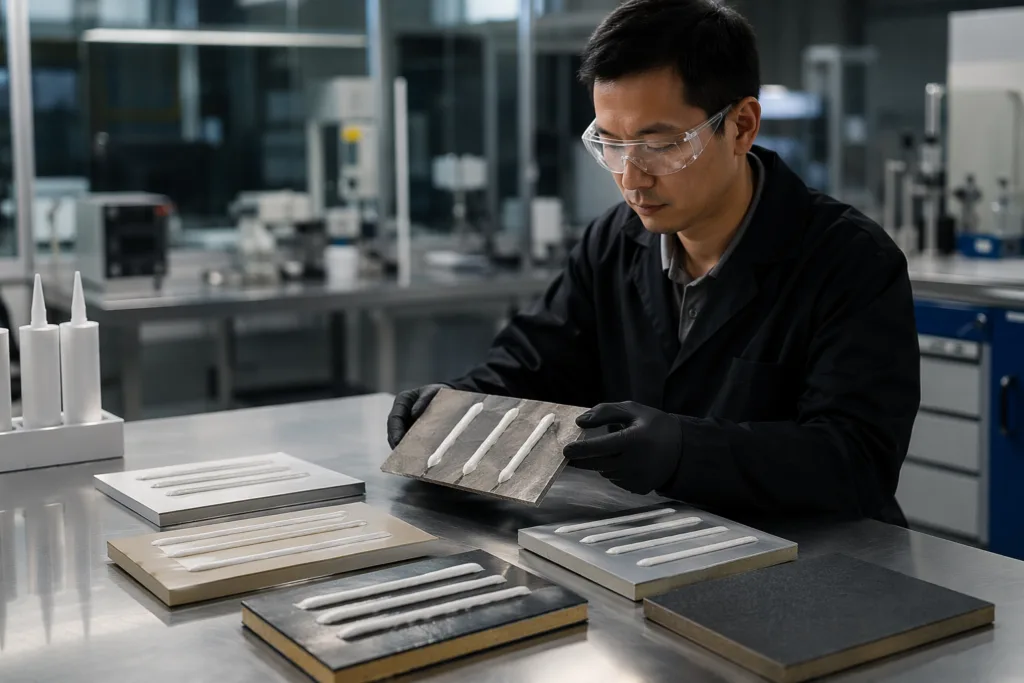
Before selecting an adhesive, buyers and engineers should understand three questions: how much movement will occur, how often will it repeat, and what conditions will the assembly face while that movement occurs?
- CTE mismatch: Coefficient of thermal expansion differences can create continuous strain across the bond line.
- Joint movement: Panels and frames may move in compression, extension, and shear, not just in one direction.
- Service conditions: UV exposure, moisture, freeze-thaw cycles, pollutants, cleaning chemicals, and vibration can weaken an otherwise acceptable bond.
From a manufacturing perspective, we often recommend that buyers treat these as linked variables. A flexible adhesive that works well in one climate may be too soft in a high-load region, while a stronger and more rigid product may crack in a high-movement façade. The right answer depends on the balance between strength, elongation, modulus, and durability.
What the technical data sheet should tell you
When reviewing a technical data sheet, do not stop at “adhesion” and “cure time.” For movement-prone exterior assemblies, the most useful information often includes modulus, elongation, hardness, temperature resistance, weathering resistance, and the recommended bond line thickness. If the supplier provides guidance on substrate preparation and primer use, that is also important.
In our formulation and qualification work, we look for consistency between the product’s advertised behavior and its likely mechanical role. Is it meant to carry load? Accommodate movement? Seal against weather? Or do all three? One adhesive may not be ideal for every function, especially in mixed-material assemblies where structural demands and seal performance can conflict.
Rigid vs. flexible adhesive strategies: when each one succeeds or fails
Rigid adhesives can deliver excellent load transfer and high initial strength, but they can struggle when the assembly undergoes repeated dimensional change. Flexible adhesives, by contrast, can absorb movement and help maintain the bond under changing temperatures, but they may not be suitable where maximum stiffness or immediate structural rigidity is required.
| Strategy | Strength of approach | Main risk | Typical fit |
|---|---|---|---|
| Rigid bonding | High load transfer and dimensional stability | Cracking or edge debonding under movement | Stable substrates with limited thermal cycling |
| Flexible bonding | Movement absorption and stress relief | Lower stiffness if overused in load-critical areas | Exterior panels, mixed materials, weather-exposed joints |
| Hybrid strategy | Balances strength and elasticity | Requires careful design and validation | Assemblies with both load and movement requirements |
In practice, the choice is rarely about “strong” versus “weak.” It is about whether the adhesive’s modulus is compatible with the assembly’s movement profile. A product that is too rigid can transfer stress into the substrate or fasteners. A product that is too soft can creep under sustained load or lose dimensional stability. The best outcome is usually a controlled balance.
What makes an elastic adhesive suitable for construction panels and exterior assemblies
An elastic adhesive is not automatically the correct solution just because a project involves movement. The adhesive still needs enough cohesive strength, adhesion to the substrate, and environmental resistance to remain intact over time. For exterior panel systems, the useful properties are often a combination of:
- Elongation: helps the bond line stretch with movement instead of tearing.
- Controlled modulus: helps reduce stress transfer to the substrate.
- Weather resistance: supports performance under UV, moisture, and temperature cycling.
- Bond durability: helps resist aging, creep, and edge degradation.
- Application stability: maintains usable viscosity and consistent dispensing in production.
From our adhesive manufacturing perspective, the challenge is not simply making a material softer. It is tuning the formulation so the adhesive remains workable during installation, cures reliably at the intended temperature, and still performs after months or years of outdoor exposure.
For readers comparing product families, our adhesive selection technical support for matching flexibility and durability service is relevant when the project involves trade-offs among cure speed, movement tolerance, and production flow. That selection step often determines whether the first sample becomes a viable production material or a dead end.
How adhesive choice changes for different exterior substrates
Different substrates create different design problems. The same adhesive may work well on one material pair and fail on another because of surface energy, thermal response, stiffness, porosity, or moisture sensitivity.
Metal panels and frames
Metal tends to move more predictably with temperature, but large panel surfaces can still build stress quickly because heat spreads unevenly across the face of the part. Bond lines may also see high peel load at edges. For metal-to-metal or metal-to-coated-surface bonding, surface preparation and corrosion considerations matter as much as adhesive chemistry.
In these applications, a flexible or semi-flexible adhesive can help absorb thermal cycling while retaining grip on smooth, low-porosity surfaces. If the bond must also tolerate weather exposure, UV stability becomes a critical selection point.
Composite boards and polymer-based panels
Composite boards often introduce a different challenge: they may be dimensionally stable in one direction and more responsive in another, or they may have a surface layer that behaves differently from the core. Some polymeric panels also expand and contract more than metal, which increases the mismatch at interfaces.
For these materials, the adhesive must be compatible with the surface chemistry and avoid excessive shrinkage during cure. If the adhesive cures too fast or shrinks too much, internal stress can build before the bond is fully stabilized.
Stone facings and mineral-based elements
Stone and mineral substrates are often stiff and durable, but they can be brittle and sensitive to point loads. A very rigid adhesive may transmit too much stress into the stone, while an overly soft adhesive may not support the panel adequately. Moisture management is also important, especially when bonding porous materials or assemblies exposed to cyclic wetting and drying.
Mixed-material assemblies
Mixed-material bonds are where thermal movement issues become most visible. A metal frame, composite panel, and sealant edge may all move differently under the same weather conditions. In these projects, the adhesive layer often needs to serve as the main stress buffer while also supporting alignment and load distribution.
For exterior bonding where polyurethane performance may be useful, we often point technical buyers to materials such as ZDS-8202AB permanent anti-yellowing PU adhesive 74D for exterior bonding when the project requires a balance of toughness, flexibility, and visual stability. The point is not that one product fits all projects, but that chemistry should match the service environment and the substrate pair.
Surface preparation, joint design, and bond-line thickness
Even a well-formulated adhesive can fail if the installation details are poor. For movement-prone assemblies, the bond line is part of the design. Surface preparation, joint design, and bond-line thickness all influence how stress is distributed.
Surface preparation
Dust, release agents, oxidation, moisture, and construction-site contamination can reduce adhesion significantly. A flexible adhesive does not compensate for poor cleaning. In fact, if the bond is weaker at the surface, movement will usually expose that weakness faster. That is why preparation needs to be standardized before pilot runs move into production.
We cover this topic in more detail in our surface preparation steps that improve bond reliability article because construction teams often underestimate how much variation comes from substrate condition rather than adhesive chemistry.
Bond-line thickness
Bond-line thickness affects both movement accommodation and cure behavior. If the bond line is too thin, the adhesive may not have enough volume to absorb movement. If it is too thick, cure may slow down, bubbles may become harder to control, and sag or creep can appear before full cure.
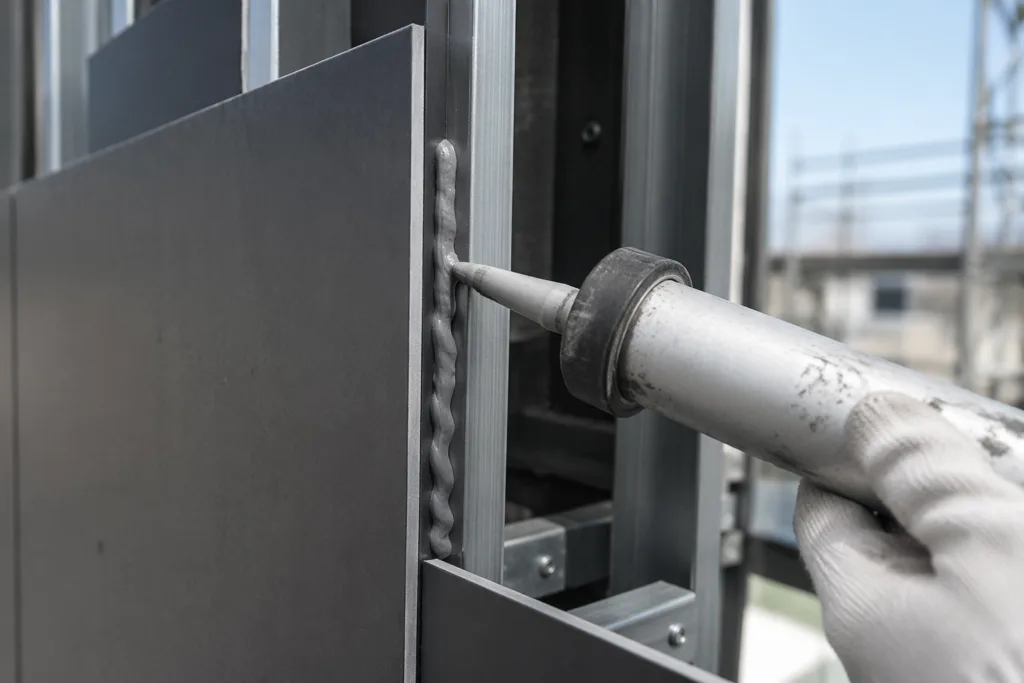
In practical production terms, we prefer to define the target bead size, spacing, compression, and clamp strategy before recommending a product. That is one reason technical support matters: a formula that seems promising in a lab sample can behave very differently when applied to a long, vertical façade panel in a warm environment.
Joint geometry
Where possible, geometry should reduce peel and concentrate the adhesive in a shear-friendly configuration. This is especially important in assemblies that see periodic thermal cycling. A good adhesive cannot fully compensate for a joint that creates unnecessary stress concentrations.
Common failure modes when thermal movement is ignored
When a project underestimates movement, failure can appear in several ways. These are not always immediate breakages; sometimes the problem begins as a small service issue and becomes a maintenance failure later.
- Cracking: a rigid bond line may fracture as the substrates expand and contract.
- Debonding: adhesion loss often starts at the edge where stress is highest.
- Creep: a soft adhesive may slowly deform under sustained load or heat.
- Seal loss: movement can open pathways for water, dust, or air infiltration.
- Visible distortion: the panel may remain attached but show print-through, edge pull, or alignment drift.
These failure modes are often linked. For example, a bond that creeps can eventually lose edge contact, and edge loss can then accelerate water ingress and UV degradation. That is why movement tolerance should be validated alongside adhesion strength.
When buyers want a broader view of why bonds fail in real service, our common causes of adhesive bond failure article is a useful companion. It helps separate installation issues, substrate issues, and formulation issues, which is important when evaluating samples across multiple sites.
What to validate before approval: testing flexibility, adhesion, weathering, and durability
Testing should simulate the actual application, not just produce a favorable laboratory number. For a thermal movement construction adhesive, the most useful evaluations usually involve both initial bonding and aged performance.
One useful technical reference is ASTM’s discussion of substrate durability under environmental exposure. For exterior bonding decisions, the guide on UV, moisture, and lap-shear durability of structural attachments reinforces a simple point: a bond should be judged after exposure to water, salt fog, UV, and heat, not just by initial strength.
Recommended validation checklist
- Adhesion on the actual production substrate, not only on test coupons
- Movement cycling or thermal cycling where feasible
- UV and moisture exposure for exterior use
- Shear and peel retention after aging
- Compatibility with primers, coatings, and adjacent sealants
- Dispensing behavior under expected production temperature
- Cure completeness at the actual bond-line thickness
We also recommend evaluating failure mode. A test that fails by cohesive tearing in the adhesive may be more encouraging than one that peels cleanly from the substrate, because the second result often points to surface compatibility issues. That distinction matters when selecting between a silicone, acrylic, polyurethane, or hybrid approach.
How to match cure speed, modulus, elongation, and environmental resistance to project requirements
Project teams often ask for a fast cure, but speed alone is not enough. If the adhesive cures too quickly, workers may lose positioning time on large panels or complex frames. If it cures too slowly, throughput suffers and parts may need longer support or clamping. The right cure speed depends on how the assembly is handled during installation and how soon it must enter service.
For movement-prone exterior assemblies, modulus and elongation often matter just as much as cure speed. A low-modulus system can absorb motion better, while a slightly higher modulus may provide better shape retention and load support. The right choice depends on panel size, joint geometry, and expected temperature swing.
Environmental resistance is equally important. Exterior bonds may be exposed to rain, condensation, freeze-thaw cycles, alkaline dust, cleaning agents, and UV. A flexible adhesive that cannot retain properties after weathering will not solve the problem long term. Likewise, a highly durable adhesive that is difficult to dispense or meter consistently may create production waste and installation variability.
For buyers comparing chemical families, our silicone adhesive options for flexible sealing and weather resistance page is particularly relevant when the project needs long-term movement accommodation and exterior durability. In many building applications, silicone is selected not because it is universally stronger, but because it remains stable while the assembly continues to move.
For applications that need a faster-setting option and structural bonding behavior, acrylic adhesive solutions for fast-setting structural bonding may be worth reviewing when production speed and handling strength are key concerns. The right answer still depends on the movement profile, but this comparison helps teams narrow the field before sampling.
Supplier and sample evaluation checklist for construction adhesive projects
When procurement and engineering teams evaluate suppliers, the real question is not only whether the adhesive works once, but whether it can be produced consistently and supported well enough for ongoing construction use.
Questions to ask during supplier review
- Can the adhesive be adjusted for viscosity, open time, hardness, or cure profile?
- Is the formula suitable for the actual substrate pair and surface condition?
- What sample sizes and packaging formats are available for pilot work and rollout?
- How is shelf life managed during storage and shipping?
- What QC checks are used to keep batch-to-batch consistency?
- Can the supplier support OEM, private label, or project-specific customization?
From our side, these questions are important because construction projects often fail at the handoff between technical approval and production reality. A product may be technically sound but still unsuitable if it is difficult to package, too sensitive to ambient conditions, or inconsistent across lots. That is why the role of a manufacturing partner matters as much as the chemistry itself.
If your team wants to compare adhesive families, production readiness, and application support in one place, the ZDS homepage is a practical starting point for understanding how we approach formulation, supply, and technical collaboration.
How ZDS supports custom adhesive formulation for movement-tolerant exterior bonding
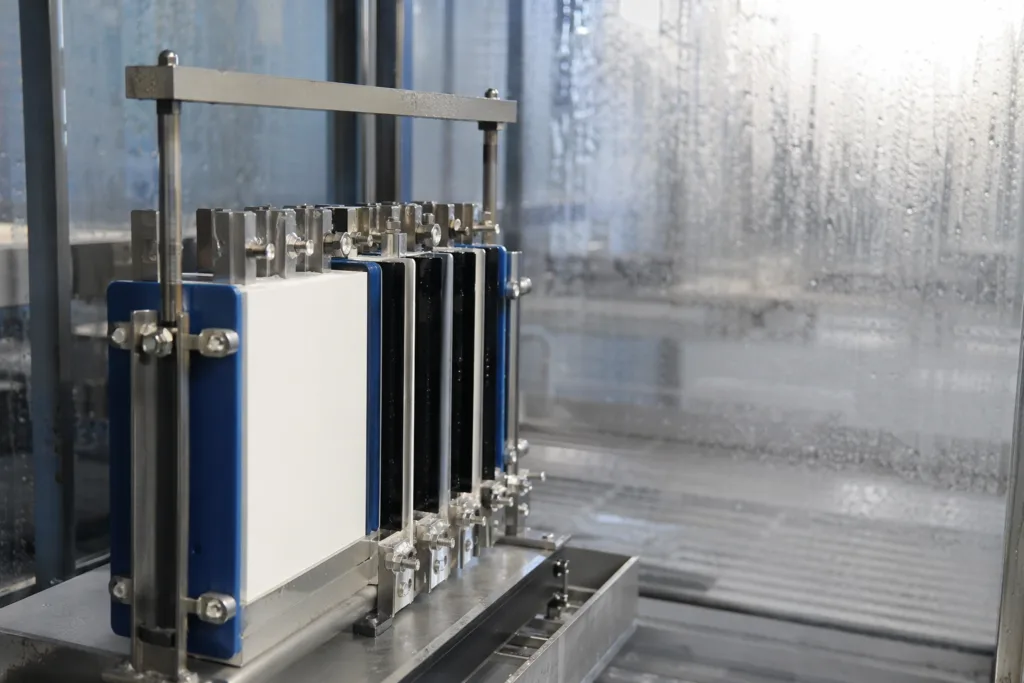
In movement-sensitive exterior assemblies, the most effective adhesive is often not an off-the-shelf answer. It may need tuning for viscosity, cure profile, elongation, hardness, color stability, or packaging format. At ZDS, we support those decisions from a manufacturing perspective by aligning the adhesive to the substrate, the installation method, and the long-term service environment.
For example, one project may need a more flexible bond line for thermal cycling, while another needs stronger early handling strength for a panel installation schedule. A third may require anti-yellowing behavior for exposed exterior joints. These are not minor preferences; they can determine whether the product performs well in the field.
We also pay close attention to evaluation structure. Sample testing should be designed around the actual assembly, not just a simplified coupon. If the application involves mixed materials, we look at stress points, edge exposure, cure depth, and compatibility with nearby sealants or coatings. That approach helps buyers avoid approving a material that looks good in a brochure but struggles in a real installation.
For teams planning custom projects, our custom adhesive formulation for application-specific movement risk service is relevant when standard products do not match the project’s thermal expansion, load, or weathering requirements. Custom work can be useful when the bond line, substrate pair, or environmental load profile falls outside normal assumptions.
Conclusion
Thermal movement is not a side issue in exterior bonding; it is one of the main design conditions. The best thermal movement construction adhesive is the one that fits the assembly’s real movement, substrate mismatch, and environmental exposure while still supporting workable production and reliable installation. That means looking beyond initial strength and evaluating flexibility, adhesion durability, bond-line geometry, cure behavior, and supplier consistency together.
For builders, engineers, and procurement teams, the safest path is to treat adhesive selection as a system decision. When the substrate pair, joint design, and service conditions are clear, the adhesive can be matched with much better confidence. When those inputs are uncertain, sample testing and technical collaboration become essential. That is where formulation support, validation planning, and production experience make a measurable difference.
FAQs
How do I know if a project needs a flexible adhesive instead of a rigid one?
If the assembly uses dissimilar materials, large exterior panels, or surfaces exposed to daily heating and cooling, a flexible or semi-flexible adhesive is often safer because it can absorb movement instead of transferring it into the substrate. The key is to balance flexibility with enough strength for the load and service conditions.
What is the biggest mistake buyers make when selecting construction adhesives for exterior panels?
The most common mistake is focusing only on initial bond strength and ignoring movement, weather exposure, and substrate compatibility. A product can test well at first and still fail later if it cannot survive repeated thermal cycling, moisture, or UV exposure.
Do I need surface primer for movement-prone bonding applications?
Not always, but primer can improve adhesion on difficult or low-energy surfaces, and it may help stabilize performance on certain metals, coated panels, or mineral substrates. The decision should be based on the actual substrate, the adhesive chemistry, and the supplier’s trial results.
How important is bond-line thickness in thermal movement applications?
Very important. A bond line that is too thin may not absorb movement well, while one that is too thick can create cure issues, sag, or bubble control problems. The adhesive should be applied at a thickness that supports both movement accommodation and production reliability.
Can I use the same adhesive for metal panels and composite boards?
Sometimes, but not automatically. Metal and composite boards often expand differently and present different surface-energy and stiffness conditions. A single adhesive may work only if its modulus, adhesion profile, and cure behavior are matched to both substrates and the joint design.
What should I ask a supplier before approving a construction adhesive for production?
Ask about customization options, sample availability, shelf life, cure profile, viscosity control, QC consistency, and whether the product has been evaluated on the actual substrate pair. For exterior work, also ask how the adhesive behaves after moisture, UV, and heat exposure.