
Building adhesives play a central role in modern construction because many assemblies now depend on controlled bonding rather than only mechanical fastening. In practice, the right adhesive can improve load distribution, reduce vibration, simplify installation, support waterproofing, and help teams join dissimilar materials that would otherwise be difficult to fix together. For buyers, contractors, and project teams, adhesive selection is less about choosing a generic product category and more about matching performance requirements to the real conditions of the jobsite.
For readers comparing manufacturers, chemistries, and application fit, it can help to explore ZDS’s adhesive portfolio as a reference point for how building adhesive systems are typically organized by substrate, exposure condition, and processing need.
Why building adhesives matter in modern construction
Construction assemblies are exposed to movement, moisture, temperature swings, dust, uneven surfaces, and time pressure. That means an adhesive must do more than stick at the moment of installation. It must maintain performance after curing, tolerate the expected service environment, and fit the application process used on site or in prefabrication.
In many projects, building adhesives are used to support panel installation, flooring, trim attachment, insulation fixing, waterproofing layers, facade elements, glazing-related assemblies, and joint systems that need both bonding and sealing. Teams reviewing construction adhesive solutions for building projects usually compare not just strength, but also cure profile, movement capability, weather resistance, and ease of application.
Common uses of construction adhesives in building projects
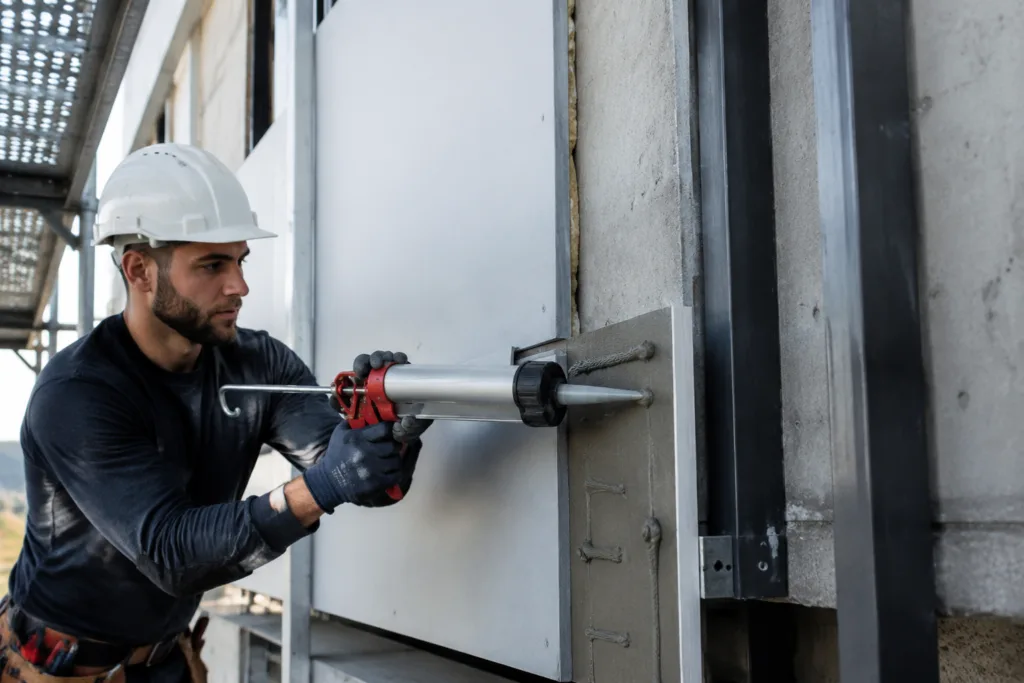
The term building adhesives covers a wide range of uses, from non-structural interior bonding to demanding exterior exposure. Typical applications include:
- bonding decorative panels and interior wall components
- installing flooring materials and underlayment layers
- fixing insulation boards and composite construction elements
- joining wood, metal, concrete, and plastic parts
- supporting waterproof assemblies around joints and penetrations
- bonding facade details and exterior trim components
- repair and maintenance work where drilling or welding is not preferred
Each use changes the performance priorities. A fast interior fit-out may value grab, open time, and low odor, while an exterior weather-exposed joint may depend more on UV resistance, flexibility, and long-term water resistance.
Indoor vs. outdoor applications: different performance demands
Indoor applications are often more controlled. Temperature is usually stable, UV exposure is limited, and moisture may be occasional rather than constant. In these cases, the key selection points often include clean application, sufficient bond strength, compatibility with finishes, and a cure schedule that supports installation speed.
Outdoor applications are less forgiving. Adhesives may face rain, ponding water, freeze-thaw cycling, sunlight, substrate expansion and contraction, and contaminants from dust or construction residue. A product that performs well indoors can fail outdoors if it lacks the flexibility or environmental resistance needed for real movement and weathering.
That is one reason many specifiers look at polyurethane adhesives for durable construction bonding when the assembly needs toughness, substrate tolerance, and a more resilient bond line under variable site conditions.
Key performance requirements: bond strength, durability, flexibility, and cure time
Bond strength
Bond strength matters, but it should be judged in context. High advertised strength alone does not guarantee field success. Teams should ask whether the adhesive bonds well to the actual substrates in the project, whether the load is static or dynamic, and whether peel, shear, or impact resistance matters most. A bond that looks strong in a simple test may underperform when exposed to movement or poor surface conditions.
Durability
Durability is the ability to keep performing over time. In construction, long-term exposure is often more important than initial tack. Adhesives may need to resist moisture ingress, creep under sustained load, thermal cycling, cleaning chemicals, or repeated expansion and contraction. Durable performance usually comes from the right chemistry matched to the service environment, not from choosing the hardest material available.
Flexibility
Flexibility is critical when substrates move differently. Concrete, aluminum, wood, and plastic do not expand and contract at the same rate. If the cured adhesive is too rigid, stress can concentrate at the interface and eventually cause cracking or bond failure. Flexible systems are especially valuable in facade details, outdoor joints, mixed-material assemblies, and applications subject to vibration.
Cure time
Cure time affects both productivity and risk. A slower cure may provide better working time for alignment, while a faster cure can reduce clamping or downtime. The right balance depends on bead size, temperature, humidity, and whether the application is factory-based or on site. Procurement teams should confirm not only handling time but also the full cure conditions required to reach final performance.
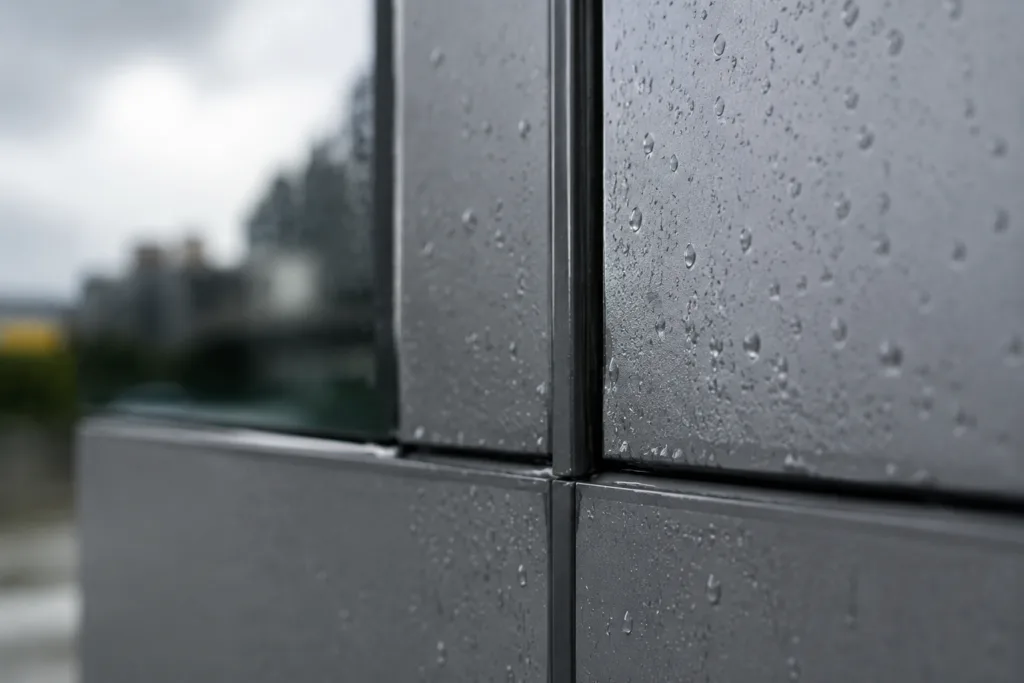
Waterproofing and weather resistance: what construction environments require
Moisture exposure can range from occasional splash to continuous outdoor weathering or even submerged conditions. For that reason, waterproofing performance should be defined clearly. Some adhesives resist intermittent moisture but are not suitable for standing water. Others can maintain elasticity and bond integrity under long-term wet exposure.
Weather resistance also includes UV stability, temperature cycling, and resistance to cracking or chalking over time. In many outdoor applications, silicone adhesives for weatherproof sealing and bonding are considered because they typically offer good movement accommodation and environmental durability where rigid chemistries may struggle.
Where the project specifically involves harsh outdoor moisture exposure, roof details, facade penetrations, or other demanding wet environments, reviewing use cases for ZDS-999 silicone waterproof adhesive for outdoor use can help clarify the difference between basic water resistance and true weather-exposed waterproof bonding performance.
Substrate compatibility: concrete, metal, wood, glass, plastic, and composite materials
Substrate compatibility is one of the most common sources of success or failure. An adhesive that bonds well to one material may struggle with another because of surface energy, porosity, alkalinity, oil contamination, or dimensional movement.
Concrete and masonry
Concrete can be porous, dusty, alkaline, and moisture-retaining. Surface condition matters as much as adhesive chemistry. Weak surface laitance or trapped moisture can undermine the bond even when the product itself is suitable.
Metal
Metal surfaces may introduce issues with oxidation, oil residue, and thermal expansion. The bond line may need enough strength and flexibility to handle movement without edge lifting or stress cracking.
Wood
Wood changes dimension with humidity and can absorb part of the adhesive. A formulation needs enough wetting ability and flexibility to cope with seasonal movement.
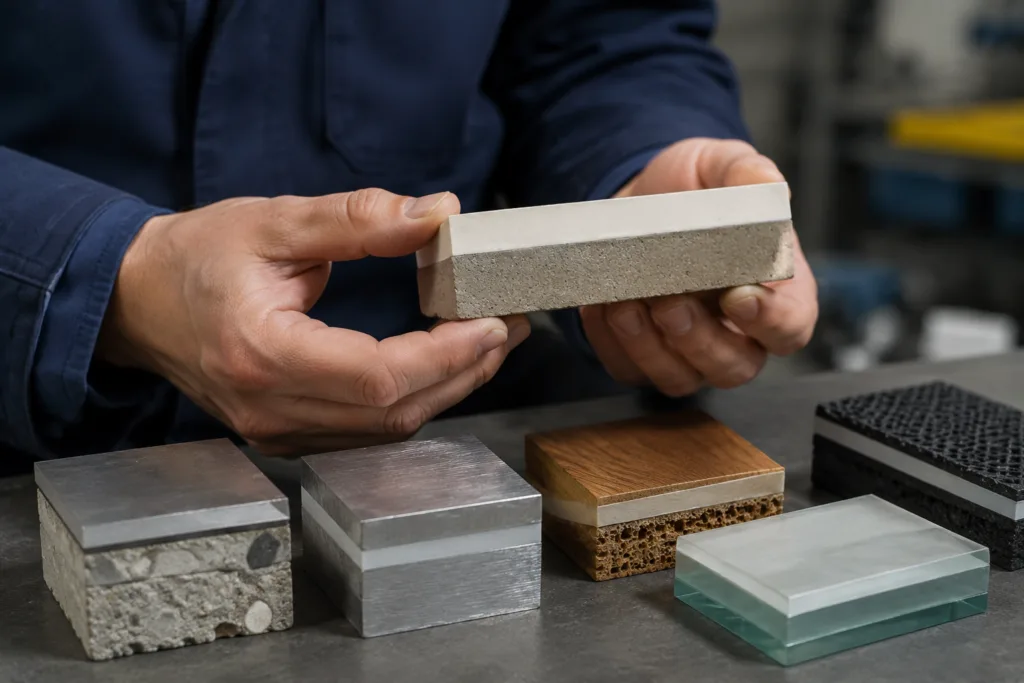
Glass
Glass requires stable adhesion and careful compatibility review, especially where transparency, edge exposure, or weathering is involved. Not every construction adhesive is appropriate for glazing-adjacent use.
Plastic and composites
Low-surface-energy plastics can be difficult to bond without special formulation or pretreatment. Composite panels may also combine materials with different movement profiles, which increases the importance of elasticity and adhesion balance.
From a manufacturer perspective, ZDS often sees substrate mismatch as the main reason an apparently strong adhesive underperforms in the field. Reviewing the full substrate pair, surface condition, and service environment together is usually more useful than selecting by chemistry name alone.
Adhesive vs. sealant: functional differences and when to use each
Adhesives are primarily selected to join materials and transfer load. Sealants are primarily selected to close gaps and block the passage of water, air, or dust while tolerating movement. Some products may look similar in packaging, but their intended function is different.
If the assembly needs strong attachment between components, adhesive properties should lead the decision. If the main need is movement accommodation and environmental closure of a joint, sealant properties should lead. Problems occur when a sealant is expected to carry meaningful load or when a rigid adhesive is expected to manage large joint movement.
How adhesive sealants combine bonding and sealing functions
Adhesive sealants sit between the two categories. They are useful when an application needs both attachment and environmental sealing in the same bead. Common examples include perimeter joints, trim installation, panel edges, penetrations, and mixed-material interfaces where moderate bonding and durable sealing are both required.
The trade-off is that hybrid performance does not eliminate the need to define priorities. A product optimized for elasticity may not offer the same structural load transfer as a purpose-built bonding adhesive. Likewise, a high-strength adhesive may not accommodate joint movement as effectively as a dedicated sealant. Project teams should decide which function is critical and evaluate the product accordingly.
Selecting industrial building adhesives for specific project conditions
A practical selection process starts with the use condition, not the product label. Buyers should define whether the application is interior or exterior, static or moving, porous or non-porous, vertical or horizontal, exposed to water or only humidity, and installed in factory conditions or on an open jobsite.
Useful screening questions include:
- What substrates are being joined?
- How clean and controlled will the surface preparation be?
- Will the bond line experience movement, vibration, or impact?
- Is water resistance enough, or is waterproof exposure expected?
- How quickly must the assembly be handled or loaded?
- Does the application require gap filling?
- Will UV or outdoor weathering affect the joint?
- Is rework possible if alignment changes during installation?
These questions usually narrow the chemistry options faster than comparing generic strength claims.
Procurement checklist: technical data, standards, safety, and cost considerations
For procurement teams, a building adhesive should be evaluated as a process material, not just a unit price item. A lower-cost product can become expensive if it slows installation, needs extensive rework, requires difficult surface preparation, or fails early in service.
A practical review checklist includes:
- Technical data: confirm substrate fit, cure conditions, movement capability, temperature tolerance, and environmental resistance.
- Application method: check viscosity, sag resistance, dispensing method, and whether the product suits manual or automated use.
- Surface preparation requirements: identify cleaning, drying, abrasion, or priming steps before installation.
- Safety and handling: review storage conditions, shelf life, and site handling requirements.
- Consistency of supply: make sure the manufacturer can support repeat production quality.
- Total installed cost: consider labor efficiency, waste, cure delays, and failure risk rather than cartridge price alone.
In many RFQ situations, asking for sample validation conditions, recommended surface preparation, and expected cure performance under actual site conditions gives a clearer comparison than requesting only a datasheet.
Common mistakes to avoid when choosing or applying building adhesives
- Choosing by chemistry name alone: polyurethane, silicone, and other systems each have strengths, but performance still depends on formulation and use condition.
- Ignoring substrate condition: dust, moisture, oil, weak surface layers, or incompatible coatings can cause failure.
- Overlooking movement: rigid bonds in moving assemblies often fail prematurely.
- Confusing water-resistant with waterproof: outdoor exposure needs careful qualification.
- Loading the joint too early: handling strength is not the same as full cure.
- Underestimating application environment: temperature and humidity can change cure behavior significantly.
- Using one product for every task: standardization helps procurement, but forcing a single adhesive into every use case increases risk.
Conclusion
The right building adhesives are selected by matching performance requirements to the real construction environment. Bond strength matters, but so do flexibility, cure profile, substrate compatibility, waterproofing needs, and long-term durability. For construction professionals, the most reliable path is to define the actual service conditions first, then compare adhesive options based on how they perform in that exact context rather than on general claims alone.
FAQ
What are building adhesives used for in construction?
Building adhesives are used for bonding panels, flooring, insulation, trim, facade elements, waterproof details, and mixed-material assemblies where secure attachment and process efficiency are important.
How do I choose between an adhesive and a sealant?
Choose an adhesive when the main job is joining materials and carrying load, and choose a sealant when the main job is closing a joint against water, air, or dust while allowing movement.
Are all building adhesives suitable for outdoor use?
No, outdoor applications usually require added resistance to UV, moisture, temperature cycling, and substrate movement, so indoor-grade products may not hold up in exterior service.
Why is substrate compatibility so important?
Different materials have different surface energies, porosity, contamination risks, and expansion rates, so an adhesive must be matched to the actual substrate pair and service conditions to perform reliably.
What is the biggest application mistake with construction adhesives?
One of the most common mistakes is poor surface preparation, because dust, oil, moisture, weak surface layers, or incompatible coatings can reduce adhesion even when the adhesive itself is appropriate.
What should procurement teams ask for when comparing building adhesives?
Procurement teams should ask for substrate compatibility guidance, cure conditions, environmental resistance details, surface preparation requirements, packaging and shelf life information, and realistic performance under actual project conditions.