
Diagnostic cartridges, lateral-flow style test cassettes, reader-compatible plastic housings, and microfluidic-adjacent components create a demanding environment for adhesive selection. A suitable diagnostic device adhesive must do more than bond two parts together. It may need to seal narrow interfaces, protect channels from overflow, hold optical parts in alignment, maintain transparency, resist sterilization or cleaning exposure, and avoid adding contamination risk to sensitive assays. In our manufacturing work, we have found that device teams usually succeed when they evaluate adhesive chemistry, dispensing behavior, cure method, and cleanliness requirements as one integrated assembly problem rather than as separate purchasing decisions.
If your project involves plastics, films, membranes, or miniature housings that need controlled sealing and repeatable assembly, our medical adhesive solutions for diagnostic device assembly are relevant because the challenge is rarely just bond strength. Teams often need viscosity control for fine dispensing, cure behavior that fits takt time, low-bloom or low-outgassing performance near sensitive components, substrate-specific adhesion, and packaging formats that support pilot builds before scale-up. We help customers evaluate these points through formulation adjustment, sample trials, process matching, and production-consistency planning for OEM and private label programs.
What makes diagnostic cartridges and test cassettes a special adhesive application
Diagnostic assemblies are usually small, tolerance-sensitive, and process dependent. Bond lines may sit next to fluid paths, reaction zones, filter media, membranes, transparent windows, or snap-fit housings. In many cases, the adhesive is functionally part of the device architecture. It can influence channel geometry, venting behavior, capillary flow reliability, optical readability, and long-term sealing stability.
That is why adhesive selection for these assemblies cannot rely on a generic “medical grade” label alone. Engineers should ask how the adhesive behaves during dispensing, whether it wets too aggressively on low-energy plastics, whether it shrinks during cure, whether it creates internal stress in thin molded parts, and whether uncured residue could migrate into critical areas. For procurement teams, this means supplier evaluation should include process fit and lot consistency, not just price and lead time.
Why precision adhesive control matters
Small medical diagnostic components leave little room for process variation. A minor increase in viscosity drift can change bead width. A slight cure imbalance can create tacky edges or undercured pockets. A transparent top film can distort if cure shrinkage is not managed. In cartridge and cassette assembly, the adhesive often has to perform under tight dimensional limits while remaining compatible with plastics such as PC, PMMA, ABS, COC, COP, PET, and multilayer film structures.
From our adhesive manufacturing perspective, this is where early cross-functional review is valuable. Design, process, quality, and sourcing teams should agree on the real success criteria: leakage threshold, optical appearance, allowable squeeze-out, fixture method, cure window, environmental resistance, and contamination controls. Those criteria often determine whether UV, acrylic, epoxy, silicone, or a hybrid system is realistic.
Diagnostic device adhesive selection starts with assembly geometry
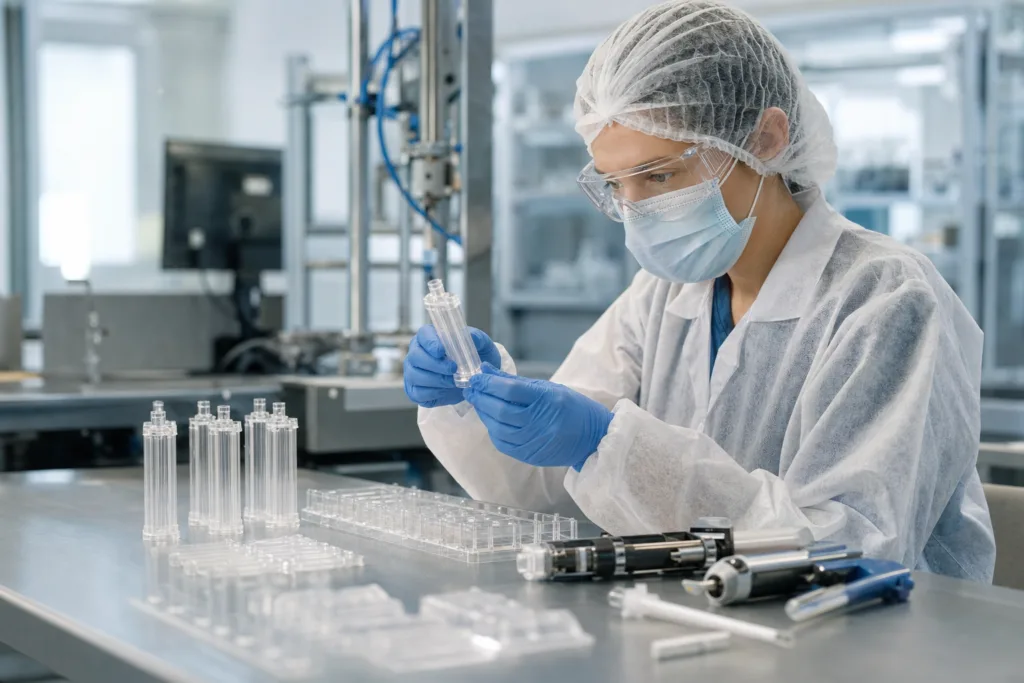
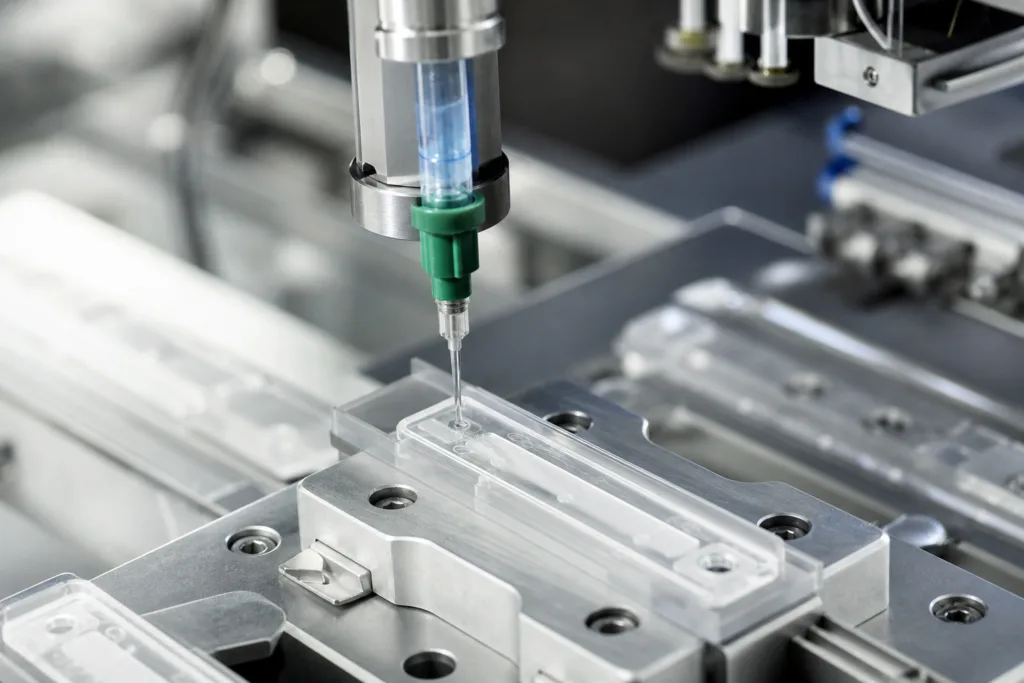
The first technical screen should be the geometry of the bond area. Narrow channels, recessed pockets, transparent covers, filter frames, membrane seats, and housing seams all place different demands on adhesive rheology. A low-viscosity product may spread beautifully on one part but wick into nearby paths on another. A high-viscosity material may stay in place but trap voids when compressed. Where cure must happen through a clear cover, light transmission and shadow zones become critical.
Teams that need structured evaluation often benefit from adhesive selection technical support for precision assemblies because material choice, dispense pattern, cure sequence, and fixture design interact strongly in small-format diagnostics.
Small bond lines, channel protection, and alignment
Three risks repeatedly appear in these products: adhesive entering a fluid path, uneven bond thickness, and positional shift before full cure. Overflow into a channel can change assay timing or block flow entirely. Poor bond uniformity can create leak points or optical inconsistency. Misalignment can affect reader registration, gasket compression, or membrane placement.
For microfluidic-adjacent designs, capillary behavior deserves special attention. Even when the adhesive is not intended for use inside a microchannel, narrow gaps can draw liquid unexpectedly. A useful technical perspective on channel-related bonding behavior is discussed by capillary flow and bond-line management in microchannel assembly, which reinforces why flow control, residence time, and interface geometry must be validated before production release.
Compatibility of transparent plastics, films, and rigid housings
Diagnostic device assemblies commonly combine rigid molded parts with films, membranes, mesh, filters, or transparent lids. The bond must hold across different thermal expansion rates, different surface energies, and different stiffness levels. The more mixed the material stack, the more important stress management becomes.
| Substrate or part type | Typical adhesive concern | Selection focus |
|---|---|---|
| PC or PMMA clear cover | Crazing, optical haze, shrinkage stress | Low-stress cure, clarity, compatible surface wetting |
| COC or COP diagnostic body | Lower surface energy, tight dimensional tolerances | Adhesion promotion, low flow into channels, stable bond line |
| PET film or laminated membrane | Wrinkling, poor wet-out, edge lift | Controlled viscosity, flexible bond, low curl stress |
| ABS or filled housing | Surface variability, molded-part stress | Toughness, process latitude, thermal cycling resistance |
| Filter or porous insert | Adhesive bleed into active area | Precise dispense, rapid fixture, limited penetration |
In substrate matching, chemical compatibility matters as much as lap shear values. Some plastics are highly sensitive to aggressive ingredients or internal stress from cure shrinkage. Some films need flexibility because rigid cure can create edge peel during sealing or thermal exposure. In practice, a slightly lower-strength but lower-stress formulation may outperform a harder adhesive in long-term device stability.
A broader technical review of substrate compatibility and bond validation methods for diagnostic device adhesives is useful when teams compare plastics, elastomers, and validation methods such as peel, leakage, and mechanical bond testing.
Adhesive chemistry options for diagnostic assembly
UV-curable systems
UV-curable adhesives are attractive when the assembly includes light-accessible bond areas and short cycle time is important. They can support rapid fixture, clean dispense profiles, and high-throughput automation. They are often chosen for transparent plastic-to-plastic joints, filter frames, or small precision features. However, UV cure is only reliable when light reaches the bond area sufficiently. Shadowed regions, pigmented parts, and deep bond lines need careful review.
For porous or filter-related interfaces, a product like ZDS-22083104 UV adhesive for filter material bonding reflects the kind of targeted selection logic needed when adhesive placement must be controlled near active material.
Acrylic systems
Acrylic adhesives can offer a useful balance of adhesion, processing speed, and toughness. They may fit housings and general sealing tasks where transparency is helpful and cure speed matters. The trade-off is that acrylic behavior must be screened carefully for odor, shrinkage, and compatibility with stress-sensitive plastics or delicate optical zones.
Epoxy systems
Epoxies are often chosen where chemical resistance, structural integrity, or dimensional stability is important. They can work well for rigid assemblies, sensor attachment, or locations where a harder final state is acceptable. Their limitations may include longer cure cycles, higher modulus, mixing complexity in two-part versions, and greater stress on thin or brittle substrates if flexibility is needed.
Silicone systems
Silicones are valuable when flexibility, low stress, thermal range, or sealing durability is the priority. In diagnostic housings or transparent interfaces that benefit from movement tolerance, a material such as ZDS-795 transparent silicone adhesive for medical devices represents the type of option teams may review when they need softness, clarity, or stress relief rather than a hard structural bond.
Hybrid approaches
Some diagnostic projects need a compromise: moderate flexibility, faster handling strength, lower movement during cure, or better adhesion across mixed substrates. Hybrid systems can be useful when a single conventional chemistry leaves too much trade-off between cure speed and stress control.
How cure behavior affects bond quality and contamination risk
Cure is not just a timing question. It affects flow stop, final stress state, residual monomer risk, edge cleanliness, and line productivity. In small-format diagnostics, the chosen cure mechanism should match both geometry and cleanliness expectations.
| Property | Why it matters in diagnostic assembly | Typical implication |
|---|---|---|
| Viscosity | Controls bead shape and migration | Too low may wick; too high may cause gaps or voids |
| Open time | Defines placement window before position drift or skinning | Must fit manual or automated takt time |
| Fixture time | Affects handling and alignment retention | Shorter fixture can improve throughput |
| Cure depth | Important in grooves, shadow zones, or thick sections | Undercure can weaken seal and increase residue risk |
| Hardness or modulus | Influences stress on films and brittle plastics | Overly rigid cure may warp or craze parts |
| Transparency | Matters near reader windows and visual inspection zones | Haze or yellowing can reduce product acceptance |
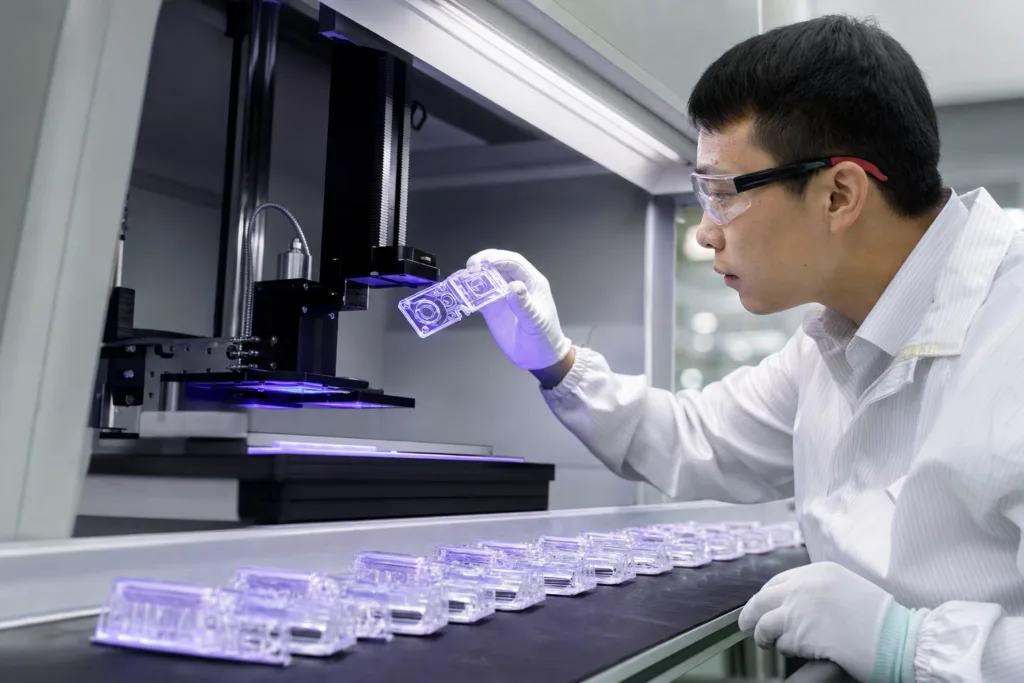
When UV curing is used, teams should validate lamp intensity, wavelength fit, exposure distance, and actual light transmission through the assembled parts. A bench test that cures a coupon well may not translate to a recessed production joint. We often recommend that customers compare top, edge, and shadow-zone cure behavior separately because partial cure can leave tacky margins that are not obvious during early trials.
For narrow, precision-bonded parts, ZDS-3330a fast cure UV needle bond adhesive illustrates how fast fixture can support alignment-sensitive assembly, but only if light access and dose control are engineered correctly.
Low-contamination assembly: outgassing, extractables, leachables, and particles
Diagnostic devices may operate near sensitive reagents, membranes, channels, sample-contacting zones, or optical detection paths. This makes contamination control a primary adhesive-selection issue. Buyers should ask whether the adhesive chemistry could introduce volatile residues, mobile low-molecular-weight species, particles from brittle cure, or process debris from poor dispensing control.
Adhesives should be assessed not only as cured solids but as process materials. Uncured splatter, stringing, overflow, wipe residue, and degraded material from poor storage can all become contamination sources. For medical-device material review, biocompatibility and chemical characterization requirements for adhesive systems provide an important framework for thinking about chemical characterization, extractables, and leachable risk within a broader risk-management process.
In practical terms, contamination-risk review should cover:
- whether the adhesive is used near sample or reagent pathways
- whether curing leaves residual tack or incomplete conversion
- whether the process creates fumes, bloom, or visible deposits
- whether trimming, punching, or handling after cure sheds particles
- whether storage conditions could change viscosity or cure response over time
In our formulation and production work, we encourage customers to define contamination risk early, because a chemistry that bonds well may still fail device validation if cleanliness expectations are not met.
Common failure risks in cartridges and test cassettes
Overflow into channels or active areas
This usually comes from low viscosity, excessive dispense volume, poor gap control, or pressure during mating that forces adhesive beyond the intended perimeter. Design of stop features and bead path is often as important as adhesive type.
Poor bond uniformity
Nonuniform pressure, warped molded parts, inconsistent bead placement, or trapped air can create weak spots and leak paths. This is especially common in long housing seams and transparent lids.
Incomplete cure
Undercure can result from shadowed UV areas, inaccurate mix ratio in two-part systems, insufficient dwell, or poor environmental control. The visible surface may look acceptable while internal cure remains incomplete.
Warpage and stress cracking
Rigid cure, high shrinkage, or mismatch in thermal expansion can distort thin parts. Clear plastics are particularly vulnerable because stress may appear later as haze, cracking, or optical distortion.
Filter or membrane interference
When adhesive creeps into a porous structure, the active area can be reduced or blocked. Product selection should consider penetration tendency, cure speed after placement, and whether a fillet is acceptable.
How to match adhesive properties to assembly constraints
There is no universal diagnostic device adhesive for every cartridge or cassette format. The right match depends on how the device is assembled and what failure matters most.
| Assembly constraint | Property to prioritize | Why |
|---|---|---|
| Fine bead on small flange | Medium to high viscosity with stable rheology | Helps maintain bead definition |
| Clear optical window bonding | Transparency and low-stress cure | Reduces haze and distortion |
| Mixed rigid and flexible parts | Moderate flexibility | Improves stress accommodation |
| High-throughput automated line | Short fixture time and process repeatability | Supports takt time and lower WIP |
| Potential chemical exposure | Chemical resistance after cure | Maintains seal integrity |
| Tight leak requirement | Uniform wetting and controlled cure shrinkage | Improves seam continuity |
At this stage, it helps to involve ZDS or another qualified manufacturer early enough to compare test coupons, real components, and production methods. Many adhesive decisions look simple on a data sheet but become more complex when clear plastics, narrow channels, light-curing limitations, membrane seating, and inspection requirements are considered together.
What to validate before scale-up
Before moving from development builds to pilot and volume production, we recommend validating the adhesive in the actual device architecture, not only on flat plaques. The key is to test the bond in the conditions that create real assembly stress.
Essential validation points
- Adhesion: confirm bonding on production-grade substrates, including aged or cleaned surfaces
- Seal integrity: verify leakage resistance under expected pressure or fluid exposure
- Chemical resistance: review response to buffers, cleaning agents, and relevant process liquids
- Thermal cycling: assess dimensional stability and crack formation after temperature changes
- Optical impact: check haze, yellowing, and distortion near reader or viewing zones
- Process repeatability: compare multiple lots, operators, or automated runs
Validation should also include acceptance criteria for squeeze-out, cured appearance, alignment retention, and any odor or residue concerns. These often become hidden release blockers if they are left undefined until later quality review.
Process and production checks that reduce assembly variation
Stable production depends on more than choosing the right chemistry. Diagnostic assembly benefits from a disciplined process window that controls application and cure in a measurable way.
Dispensing accuracy
Evaluate shot size, bead width, start-stop behavior, and stringing tendency. A stable formula still needs compatible needles, valves, and line pressure settings.
Fixture design
Fixtures should locate parts without over-compressing the adhesive. Excess pressure can force material into sensitive zones or create thickness variation.
UV exposure control
If using UV cure, verify intensity at the actual bond area, not just at the lamp face. Bulb age, shielding, dust, and part geometry can all change delivered energy.
In-line quality inspection
Useful checks include vision confirmation of bead placement, cure-state checks, leak screening, and sample destructive testing by lot. Teams should define what is monitored per unit versus per batch, especially for critical seals.
Supplier quality review should also consider change control and manufacturing consistency in the context of FDA quality system requirements for medical device manufacturing, particularly when an adhesive becomes part of a validated device assembly process.
Documentation to request from adhesive suppliers
For diagnostic cartridge and cassette projects, technical buyers should request more than a brochure. A serious supplier conversation usually includes:
- technical data sheet with cure method, viscosity range, hardness, and substrate notes
- safety data sheet
- recommended storage conditions and shelf life
- lot-to-lot consistency information or quality summary data
- sample test reports tied to the proposed application where available
- packaging options suitable for development, pilot, and production use
- change notification expectations for raw materials or process adjustments
These documents help engineering and procurement teams compare candidate materials on practical manufacturing terms, not just marketing claims.
How to evaluate a medical adhesive manufacturer for diagnostic device assembly
When choosing a supplier, buyers should assess whether the manufacturer can support the actual assembly problem. We suggest reviewing five areas.
Application understanding
The supplier should ask about substrates, bond-line dimensions, cure access, cleanliness requirements, and likely failure modes. If the conversation stays generic, technical fit may be weak.
Formulation flexibility
Some projects need adjustment in viscosity, cure speed, clarity, or flexibility. A manufacturer that can discuss these variables is often better suited for OEM programs and scale-up support.
Sampling and test support
Early sample work should be structured. Good suppliers help define what to test, what pass/fail criteria matter, and what observations may predict later problems.
Production consistency
Lot stability, packaging reliability, and traceable manufacturing controls matter because even a small shift in flow behavior can affect miniature diagnostic assemblies.
Communication and change control
Medical and diagnostic programs move more smoothly when technical and sourcing teams can get clear answers on shelf life, storage, substitutions, and validation impact.
How we support customers working on diagnostic assembly adhesives
At ZDS, we approach these projects as a combination of material science and process engineering. We usually start by understanding the substrate stack, bond geometry, exposure environment, cleanliness needs, and production method. From there, we help screen candidate chemistries, compare viscosity and cure behavior, and plan sample builds around the most realistic failure risks.
Where needed, we can discuss formulation direction for transparency, flexibility, faster fixture, or lower flow tendency. We also help customers think through packaging format, shelf-life handling, pilot-line evaluation, and how to separate true adhesive failure from design or process-related variation. This is especially useful for cartridges, cassettes, and microfluidic-adjacent parts where a small process drift can look like a materials problem.
Conclusion
Choosing a diagnostic device adhesive for cartridges, test cassettes, and microfluidic-adjacent components requires a broader view than bond strength alone. The right material must fit the geometry, cure method, cleanliness target, substrate set, and production process at the same time. When engineers and sourcing teams validate adhesive flow, cure completeness, contamination risk, and repeatability early, they reduce late-stage surprises and improve scale-up confidence. For most diagnostic assemblies, the winning adhesive is the one that supports stable manufacturing and device performance together.
FAQs
What is the most important property in a diagnostic device adhesive?
The answer depends on the assembly, but in many diagnostic products the most important issue is controlled behavior rather than maximum strength. A suitable adhesive should maintain bead definition, avoid channel overflow, cure reliably in the real joint, and remain compatible with plastics, films, and any sensitive functional area nearby.
Are UV adhesives always the best choice for test cassettes and cartridges?
No. UV systems are attractive because they can cure quickly and support high-throughput assembly, but they only work well when light can reach the bond area consistently. Shadow zones, opaque parts, thick sections, or stress-sensitive plastics may make another chemistry more reliable for the actual production process.
How can we reduce the risk of adhesive contamination in diagnostic assemblies?
Start by reviewing the adhesive as both a cured material and a process material. Evaluate outgassing, extractables, possible leachables, stringing, residue, overflow, and incomplete cure. It also helps to define cleaning, handling, storage, and post-cure inspection requirements early so contamination control is built into development instead of added later.
What tests should we run before scaling up a cartridge or cassette adhesive?
At minimum, run adhesion, leak or seal-integrity testing, cure verification, dimensional or optical inspection, and exposure checks against relevant chemicals and temperature changes. These tests should be performed on real parts or representative assemblies because flat coupon results rarely capture all production risks in miniature diagnostic devices.
What should procurement ask from an adhesive supplier for diagnostic device projects?
Procurement should request a technical data sheet, SDS, storage and shelf-life details, packaging options, lot consistency information, and any available sample test data relevant to the intended substrates and process. It is also useful to ask how the supplier handles change control and whether formulation adjustment is possible if pilot builds reveal process issues.
Can a manufacturer customize adhesive properties for diagnostic device assembly?
In many cases, yes. Depending on the chemistry and project needs, a manufacturer may be able to adjust viscosity, cure speed, flexibility, clarity, or packaging format. Customization is most effective when the customer provides clear information on substrates, dispense method, cure conditions, failure concerns, and validation targets.