
Choosing the right industrial adhesive is rarely about finding the highest published strength number. In real manufacturing, bond success depends on fit: the substrate pair, joint geometry, service environment, curing method, dispensing process, line speed, and quality control discipline all matter. Engineers and procurement teams usually see the same pattern during supplier evaluation: a product that performs well in a generic test may still create rework, cosmetic issues, cure inconsistency, or field failures if it does not match the actual application. A practical selection process starts with the job the adhesive must do, then works backward into chemistry, process, testing, and supplier capability.
If your project involves lightweight structures, cosmetic composite surfaces, or demanding stiffness-to-weight targets, carbon fiber adhesive solutions for high-value composite parts deserve early attention. In these situations, we typically help customers align resin chemistry, viscosity, cure profile, gap control, and surface appearance requirements before volume production. That is especially useful when the bond must balance structural performance with finish quality, or when OEM and private label programs require repeatable packaging, sample validation, and production consistency from the same manufacturing source.
What an industrial adhesive is and why application fit matters
An industrial adhesive is a formulated bonding material designed for manufacturing use rather than casual assembly. Depending on the chemistry, it may bond, seal, reinforce, insulate, transfer heat, absorb vibration, or protect sensitive assemblies from moisture and contamination. In practice, the right adhesive is the one that reliably supports the full service life and process conditions of the part, not the one with the most aggressive marketing language.
From our manufacturing perspective, buyers make better decisions when they separate “strength” into usable categories: static load, impact resistance, peel resistance, fatigue durability, flexibility, gap-filling ability, and retention after heat or moisture exposure. A rigid metal bracket, a sealed electronics enclosure, and a decorative composite trim panel may all need very different formulations even if the same two substrates are involved.
Start by defining the real bonding requirement
Before comparing products, define what the bond must survive and how it will be made. A good internal brief usually includes:
- Substrates and their surface condition
- Expected load type: shear, peel, cleavage, tensile, vibration, or shock
- Operating temperature range
- Exposure to water, humidity, oils, fuels, cleaners, or UV
- Required gap fill or bond line thickness
- Dispensing method and production takt time
- Fixture time, open time, and full cure expectations
- Appearance requirements, including squeeze-out and surface marking
- Electrical insulation or thermal conductivity needs
- Quality checks and validation plan before launch
That discipline prevents a common sourcing mistake: selecting by chemistry name alone. “Epoxy” or “silicone” is not a complete specification. Within each family, formulations vary widely in viscosity, toughness, hardness, cure behavior, adhesion profile, and environmental resistance.
Industrial adhesive chemistry overview
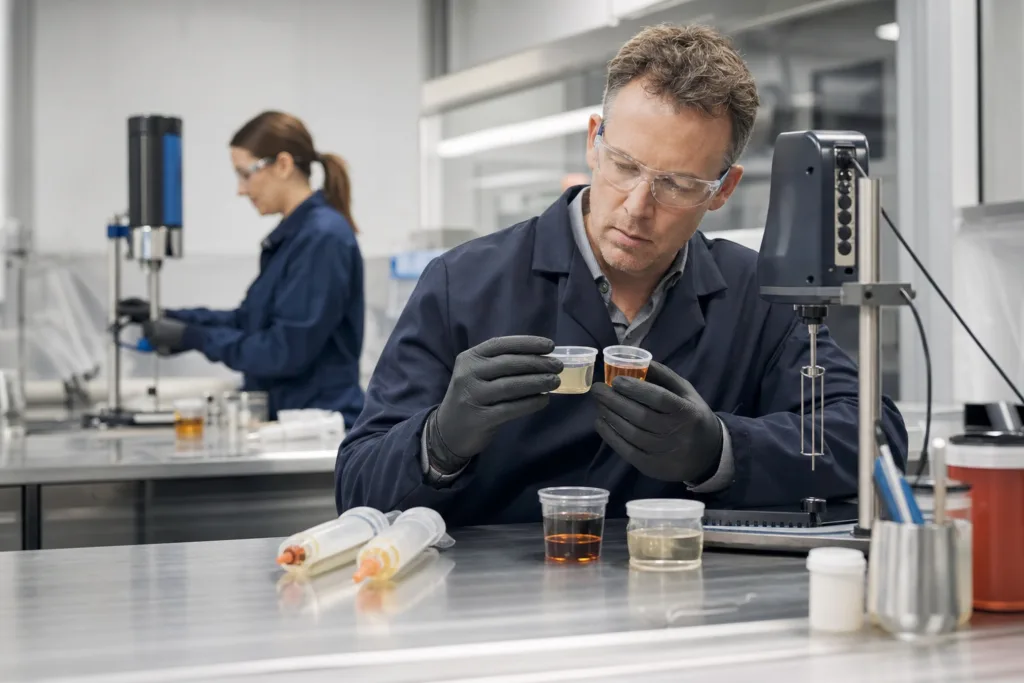
Most industrial adhesive decisions come down to a few major chemistry families. Each offers advantages, trade-offs, and processing implications.
| Adhesive Type | Typical Strength Profile | Process Advantages | Common Limits | Typical Applications |
|---|---|---|---|---|
| Epoxy | High shear strength, good rigidity, strong metal and composite bonding | Available in room-temperature or heat-cure systems, good gap filling | Can be brittle if not toughened, longer cure in some grades | Structural bonding, electronics potting, tooling, composites |
| Silicone | Moderate bond strength, high flexibility | Excellent temperature and weather resistance, stress relief | Lower structural strength, slower cure in some one-part systems | Sealing, gasketing, electronics protection, thermal interface assembly |
| Polyurethane | Tough and flexible, good impact handling | Useful for dissimilar materials and vibration environments | Moisture sensitivity during processing in some systems | Panel bonding, potting, flexible assembly, transportation |
| Acrylic | Fast structural bonding, strong on many metals and composites | Quick fixture, less surface preparation in some cases | Odor, shrinkage, or handling trade-offs depending on system | Composites, metals, structural assembly |
| UV-Curing | Fast cure in exposed areas, controlled processing | Very high line speed where light access is available | Needs UV access, shadow areas require dual-cure strategies | Glass bonding, optics, electronics assembly |
| Instant Cyanoacrylate | Very fast handling strength on close-fitting parts | Minimal fixture time for small components | Limited gap fill, brittleness, reduced durability in some environments | Small part assembly, positioning, quick repair processes |
For composite structures and rigid assemblies, epoxy and acrylic systems often dominate the shortlist. Where a bonded joint must tolerate movement, thermal cycling, or differential expansion, silicone and polyurethane become more attractive.
When appearance matters as much as bond integrity, material-specific guidance is useful. For example, projects involving exposed weave or cosmetic laminates often benefit from thinking about choosing an adhesive for visible carbon fiber parts without affecting the finish early, before fixture design and squeeze-out control are finalized.
How to evaluate substrate compatibility
Substrate compatibility is where many adhesive programs are won or lost. The same formulation may bond blasted aluminum well but struggle on oily stainless steel, powder-coated steel, low-surface-energy plastic, or glossy composite skins. Compatibility is not just about the base material; it also includes coatings, mold release, oxidation, contamination, and surface energy.
Metals
Aluminum, steel, and stainless steel are common bonded substrates. Watch for oil residue, oxidation, and inconsistent roughness. A rigid structural adhesive can work very well if the surface is clean and stable. For outdoor or humid service, corrosion pathways at the bond edge should also be considered.
Plastics
Engineering plastics vary dramatically. ABS, PC, and some acrylics are easier to bond than polyethylene or polypropylene. Stress cracking risk, solvent sensitivity, and thermal expansion all need review. If a plastic part sees impact or repeated flex, a slightly tougher adhesive is often safer than a highly rigid one.
Glass and ceramics
These materials often favor adhesives with clean adhesion and stable environmental resistance. Transparency requirements may push the project toward UV systems, while thermal shock or movement may favor silicone.
Composites and coated surfaces
Composite adhesion can depend on resin type, fiber exposure, release agents, sanding profile, and whether the surface is painted or clear coated. In structural CFRP programs, toughness matters as much as raw lap shear. For applications that need faster assembly and strong bonding across varied surfaces, ZDS-8100AB acrylic structural adhesive for durable CFRP bonding is a useful example of the kind of chemistry buyers often evaluate against epoxies when balancing speed and durability.
Key performance properties to compare
Technical data sheets list many numbers, but not all of them carry equal decision value. Selection should focus on the properties most connected to your failure mode.
- Lap shear strength: useful for rigid overlap joints, especially on metals and composites
- Peel strength: important where one substrate can flex or where edge lifting is possible
- Tensile strength: relevant but often less representative of real joint behavior than shear or peel
- Elongation and flexibility: critical for thermal cycling, impact, and dissimilar materials
- Hardness: helps indicate rigidity, handling, and stress transfer
- Toughness: often more important than peak strength for real-world durability
For engineer-led qualification, lap-shear data should be treated as a comparison tool rather than a universal prediction of field performance. It is valuable to use a standardized lap-shear test to compare adhesive strength under controlled preparation and test conditions, especially when screening structural epoxies and acrylics. Even then, the final decision should include peel, impact, and environmental aging where relevant.
That is why we often encourage customers to look beyond one headline strength value. In structural joint design, there is a meaningful difference between static strength and long-term survivability under peel, fatigue, and vibration. For teams comparing rigid systems, it helps to understand fatigue, peel, and impact performance in epoxy adhesive joints before locking the specification.
Environmental resistance requirements
An adhesive that looks strong in the lab can decline quickly if the environment was underestimated. The service environment should be translated into qualification tests and chemistry choices.
| Environment | What to Ask | Chemistry Considerations |
|---|---|---|
| High temperature | Continuous or intermittent exposure? Peak assembly temperature? | Epoxy and silicone are common choices depending on rigidity needs |
| Water or humidity | Immersion, splash, condensation, or outdoor weathering? | Silicone, selected polyurethane, and qualified epoxy systems may fit |
| Chemicals | Which fluids, how often, and at what temperature? | Resistance varies sharply by formulation; test with real media |
| UV exposure | Outdoor use or intermittent sunlight only? | Silicone often performs well; some epoxies may yellow or embrittle |
| Thermal cycling | Large CTE mismatch between bonded parts? | Toughened or flexible systems often outperform rigid brittle ones |
Where weather resistance and movement both matter, a lower-modulus adhesive may outlast a stronger but more brittle option. Where precision and dimensional stability matter more, a higher-modulus system can still be the better choice.
Process and manufacturing factors that influence adhesive success
Procurement teams often compare unit price first, while engineering teams focus on performance data. In production, however, process fit often determines the true cost. A lower-cost adhesive that causes short pot life losses, dispenser clogging, or long fixture stations can become expensive very quickly.
Viscosity and dispensing method
Low-viscosity adhesives can wet surfaces well and flow into narrow gaps, but they may also run, wick, or create mess on vertical assemblies. High-viscosity systems offer bead control and gap retention but may trap air or require stronger dispensing equipment. The ideal range depends on part geometry, bond line, and line setup.
Pot life, open time, and fixture time
Two-part systems need careful alignment with operator speed and batch size. If pot life is too short, material waste rises and process variation appears. If fixture time is too long, throughput suffers. One-part heat-cure and UV-cure systems can solve some of these issues, but they introduce equipment and access requirements.
Cure conditions
Room-temperature curing is convenient, but heat can accelerate cure and improve final properties in many systems. UV curing offers speed but only where light reaches the bond. Moisture-curing products simplify mixing but can be slower in deep sections.
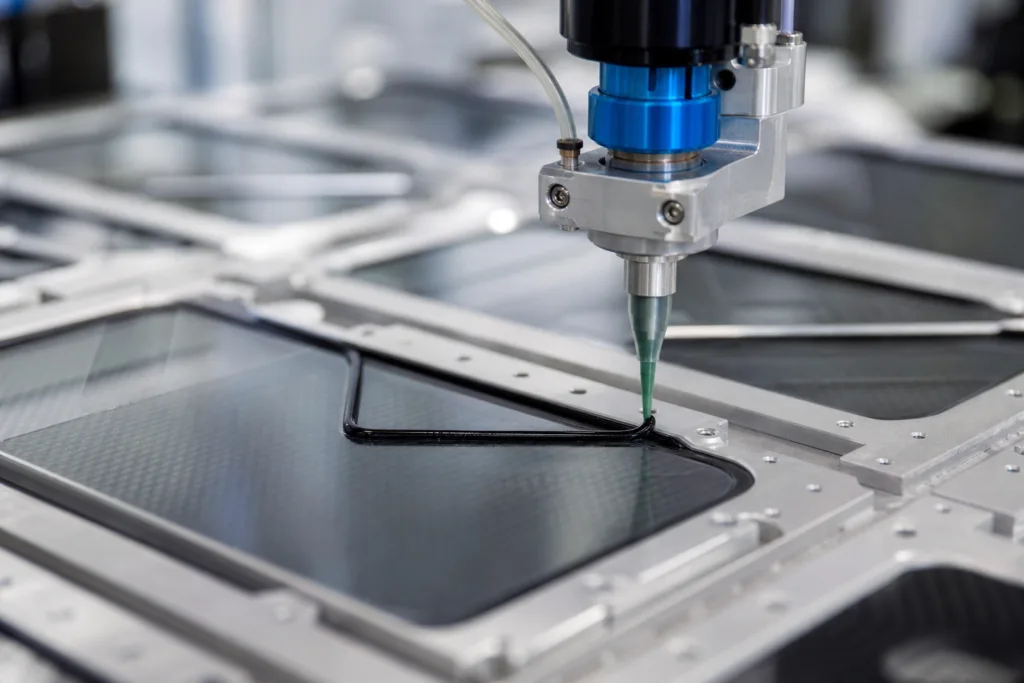
At ZDS, we usually frame process matching as a production engineering exercise: what bead shape is needed, what gap must be held, how fast parts move, what cure window is acceptable, and how much variability the line can tolerate. That thinking often changes the shortlist more than headline strength values do.
When thermal conductivity or electrical insulation becomes decisive
In electronics, battery, LED, power module, and sensor assemblies, bonding is only part of the requirement. The adhesive may also need to insulate electrically, dissipate heat, or protect components from moisture and vibration. That changes chemistry selection, filler loading, viscosity, and cure behavior.
Thermally conductive systems are usually more filled, which can increase density and viscosity. That affects dispensing pressure, wetting, and bubble release. Electrical insulation demands stable dielectric performance and low defect rates, especially in potting and encapsulation. In those applications, buyers should ask not only for target property values but also for processing guidance: maximum potting depth, exotherm control, bubble management, and recommended cure schedule.
Surface preparation and pretreatment
Surface preparation is one of the most underappreciated drivers of bond consistency. Even a strong adhesive can fail if the substrate carries oil, dust, oxide, release agent, moisture, or polishing residue. The right pretreatment depends on the substrate and the failure risk.
- Cleaning: remove oil, dust, mold release, and handling contamination
- Abrasion: increase mechanical keying where appropriate
- Primers: improve adhesion on difficult surfaces or in harsh environments
- Contamination control: standardize gloves, wipe materials, and timing before bonding
One important practical point: over-preparation can also create inconsistency if operators use different abrasives or leave loose dust. The goal is a repeatable process, not simply a more aggressive one.
How to interpret TDS and datasheets for real production use
A technical data sheet is a starting point, not a guarantee of field performance. Buyers should read it with application questions in mind.
| TDS Item | Why It Matters in Production |
|---|---|
| Mix ratio | Affects dispensing equipment choice and cure consistency |
| Viscosity | Determines flow, wetting, bead stability, and pumpability |
| Pot life / working time | Sets operator window and waste risk |
| Fixture time | Influences takt time and fixturing needs |
| Hardness | Signals rigidity, flexibility, and stress transfer tendency |
| Operating temperature | Guides environmental fit but should be validated in the real joint |
| Shelf life and storage | Important for inventory planning and batch rotation |
We recommend checking whether the reported test method, substrate, cure condition, and sample geometry reflect your use case. If not, the number is still useful, but only as directional guidance. Teams handling complex composite assemblies often benefit from early adhesive selection technical support for composite bonding projects so the TDS is interpreted alongside process realities rather than in isolation.
Common selection mistakes that cause failure or inefficiency
- Choosing only by maximum strength value without considering failure mode
- Ignoring substrate coatings, release agents, or contamination
- Selecting a cure speed that does not match production timing
- Using a rigid adhesive in a high-movement joint
- Underestimating peel, impact, or thermal cycling
- Skipping bond-line and gap-fill planning
- Approving a sample without validating packaging, shelf life, and batch repeatability
Most of these issues are preventable if the adhesive is treated as part of a full assembly system rather than a stand-alone material purchase.
When a standard adhesive is not enough
Standard products work well in many applications, but some programs need formula adjustment. Typical triggers include unusual substrate combinations, low-temperature cure requirements, tighter viscosity windows, reduced odor, longer working time, improved flexibility, flame-related requirements managed within customer specifications, or private label packaging needs.
In our formulation and production work, custom development is often less about inventing an entirely new chemistry and more about tuning performance around the process: changing rheology for automated dispensing, adjusting cure balance for seasonal conditions, or improving toughness for a specific joint design. That can be especially valuable when a standard product passes a lab test but remains difficult to scale consistently.
Sample testing and validation before mass production
A good sample plan reduces risk and speeds up confident approval. We typically suggest a staged approach:
- Bench screening on real substrates
- Initial cure and handling assessment under actual process timing
- Mechanical tests aligned to likely failure mode
- Environmental aging such as heat, humidity, or fluid exposure
- Pilot run to check dispensing, cleanup, and operator repeatability
- Packaging and storage review for production planning
Validation should include both performance and manufacturability. A sample that bonds well but creates voids, cosmetic defects, or difficult rework may not be the right production choice.
Supplier evaluation checklist for engineers and buyers
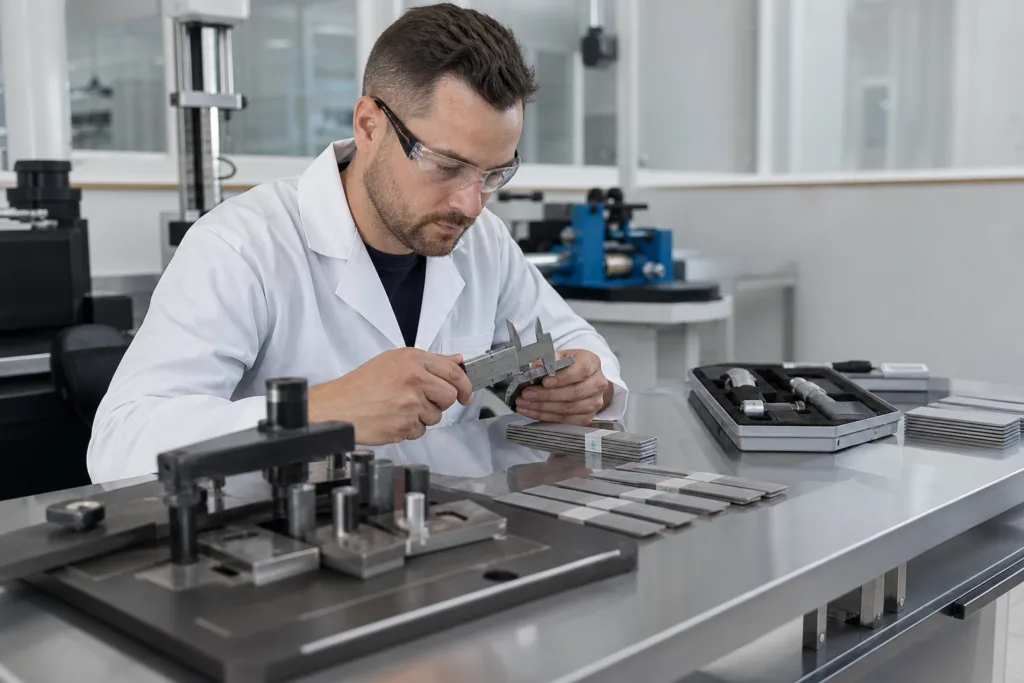
Supplier selection is not only about material price or sample performance. For industrial programs, manufacturing discipline and communication quality matter just as much.
| Evaluation Area | Questions to Ask |
|---|---|
| Batch consistency | How is in-process QC managed, and how stable are key properties? |
| Technical support | Can the supplier discuss substrate prep, cure, and failure analysis clearly? |
| MOQ and packaging | Are trial packs and production pack sizes both available? |
| Lead time | Can supply support pilot phase and scaled demand without disruption? |
| Customization capability | Can viscosity, cure speed, packaging, or labeling be adjusted if needed? |
| Documentation | Are TDS, storage guidance, and handling recommendations complete? |
For OEM and private label buyers, this evaluation should also cover labeling control, packaging compatibility, sample revision management, and how formulation changes are documented over time.
Cost-performance trade-offs and final decision framework
The most economical adhesive is usually not the cheapest per kilogram. A better cost-performance choice may reduce fixture time, scrap, labor, pretreatment steps, or warranty risk. In our experience, the best decision framework is to compare candidate adhesives across five categories: bond performance, environmental durability, process efficiency, quality stability, and supply fit.
If two products perform similarly in testing, the better choice is often the one that creates a wider process window and fewer operator-dependent variables. That reduces hidden cost at scale. Final approval should come after real-substrate testing, line simulation, and a clear agreement on storage, packaging, and replenishment planning.
In short, selecting an industrial adhesive should be a structured engineering and sourcing decision. When the bond requirement, substrate behavior, process window, and supplier capability are all reviewed together, teams can choose with more confidence and far fewer surprises during scale-up.
FAQs
How do I choose between epoxy, acrylic, and polyurethane adhesives?
Start with the joint requirement rather than the chemistry name. Epoxy is often selected for rigid structural bonding and good heat resistance, acrylic is attractive when faster fixture and broad substrate bonding are needed, and polyurethane is useful when flexibility, impact resistance, or movement between parts matters more. The right decision should also account for cure speed, dispensing method, and environmental exposure.
What is the most important property to compare in an industrial adhesive?
There is no single most important property for every application. Lap shear is useful for overlap joints on rigid parts, but peel strength, toughness, elongation, and retained performance after heat or moisture exposure may be more important in real service. The key is to match the property you compare to the way the joint is actually loaded and used.
Can one adhesive bond all metals and plastics in production?
No adhesive works equally well on every substrate and surface condition. Metals, engineering plastics, low-surface-energy plastics, coated surfaces, and composites all behave differently, and contamination or release agents can change results again. A better approach is to shortlist adhesives by substrate family and then verify with real-part testing and surface preparation control.
When should we ask for a custom adhesive formulation instead of a standard product?
You should consider customization when standard products almost work but miss an important process or performance target, such as viscosity for automated dispensing, pot life for assembly timing, cure speed, flexibility, color, packaging format, or adhesion to a difficult substrate. Customization is also common in OEM and private label programs where labeling, pack size, and production consistency matter alongside technical performance.
What should be included in an adhesive sample test plan before mass production?
A practical sample plan should include bonding trials on actual substrates, cure evaluation under your real process conditions, mechanical testing based on likely failure mode, environmental aging, and a pilot run that checks dispensing behavior and operator repeatability. It should also confirm storage, shelf life, packaging suitability, and whether the material stays consistent across more than one batch.
How should procurement teams evaluate an adhesive supplier beyond price?
Procurement should review batch consistency, technical response quality, packaging flexibility, MOQ, lead time, documentation, and whether the supplier can support troubleshooting or formula adjustment if production issues appear. A low price matters less if the material introduces waste, unstable cure, frequent line interruptions, or weak communication during scale-up.