
Choosing the right led adhesive is rarely just a bonding decision. In LED and electronics assembly, adhesive performance affects optical alignment, cycle time, thermal transfer, component stress, moisture protection, and long-term field reliability. A material that cures fast but traps heat can shorten device life. A thermally efficient system that is too rigid can crack during thermal cycling. The practical challenge is to balance speed, precision, thermal management, and durability in one stable process.
explore ZDS’s adhesive solutions as a useful reference point when comparing curing methods, thermal behavior, and assembly requirements across LED modules, display components, circuit protection, and electronic subassemblies.
Why adhesive selection matters in LED and electronics assembly
LED packages and electronic assemblies often combine dissimilar materials such as aluminum, copper, ceramics, glass, engineered plastics, FR-4, and flexible films. Each substrate expands and contracts differently under heat. That means the adhesive has to do more than stick two parts together. It also has to manage stress, maintain alignment, and sometimes provide heat transfer or environmental protection.
In high-throughput production, the adhesive also has to fit the process window. Dispensing consistency, open time, cure speed, and post-cure handling strength all influence yield. For many manufacturers, the right answer is not simply the strongest adhesive, but the one that delivers the most stable assembly result under real production conditions.
Core requirements for a good LED adhesive
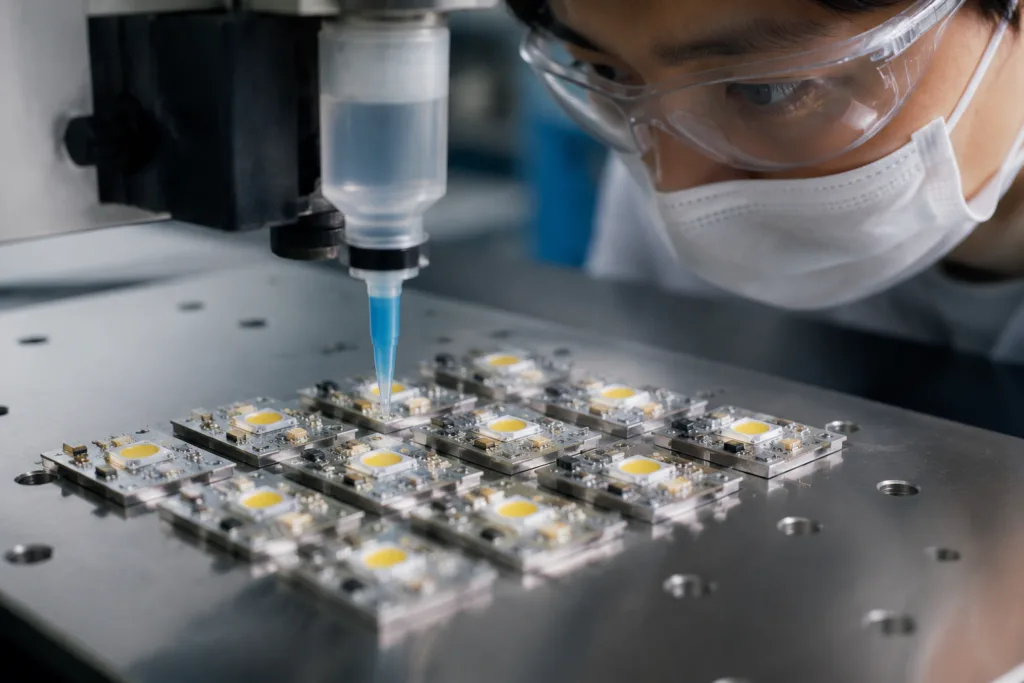
A suitable material usually needs to satisfy several requirements at the same time:
- Precision: controlled flow, low stringing, and reliable placement in narrow bond lines or tiny components
- Low stress: enough flexibility or elongation to absorb thermal mismatch
- Thermal performance: either insulation or heat transfer depending on the design
- Fast processing: quick fixture time, short cure cycles, or easy integration with inline equipment
- Long-term reliability: resistance to heat, moisture, vibration, aging, and thermal cycling
- Electrical compatibility: appropriate dielectric behavior and safe use around sensitive circuits
Failure usually appears when one of these factors is overlooked. Common examples include bond weakening from moisture ingress, LED shift from shrinkage, cracking from excessive rigidity, yellowing in exposed optical areas, or declining output because heat is not dissipated efficiently.
Key performance criteria and common failure modes
Bond integrity and shrinkage control
For LED fixing and electronic positioning, cure shrinkage matters because even a small movement can affect alignment or stress solder joints and brittle components. Lower-shrink systems are often preferred where optical consistency or fine placement accuracy is important.
Thermal behavior
Some assemblies need the adhesive to insulate electrically while moving heat away from LEDs, drivers, or power components. Others need only mechanical fixation with modest heat exposure. Matching thermal conductivity to actual heat load is more practical than assuming every LED assembly needs the highest possible value.
For applications centered on heat flow from electronic components into metal housings or heat sinks, a product such as ZDS-929 thermal conductive adhesive for electronics illustrates the type of material category engineers often evaluate when both bonding and heat dissipation are required.
Environmental durability
Moisture, cleaning agents, outdoor exposure, and thermal cycling can slowly degrade an otherwise acceptable bond. Electronics used in lighting, displays, controls, and industrial devices often benefit from a material with balanced adhesion, flexibility, and resistance to aging rather than a brittle high-hardness system chosen only for initial strength.
Electronic adhesive categories and where each fits
UV adhesives
UV-curable systems are often selected for fast assembly, precise dispensing, and clean production. They are especially useful where one-part processing and short tack-free times improve throughput. Their limitation is cure accessibility: UV light must reach the bond area, or a secondary cure mechanism may be needed in shadowed zones.
Thermally conductive adhesives
These are used when heat transfer is part of the design requirement. They can reduce dependence on clips, screws, or thermal pads by combining attachment and thermal path creation. Trade-offs can include higher viscosity, filler settling concerns, and more demanding dispensing behavior.
Silicones
Silicones are often chosen for flexibility, weather resistance, and stress absorption. They can work well in LED modules exposed to temperature swings or outdoor conditions. However, cure speed and handling time may be slower than UV-based options.
Epoxies
Epoxies can provide strong adhesion, chemical resistance, and dimensional stability. They are often useful where structural integrity and durability matter more than flexibility. The main caution is that highly rigid epoxies may increase stress on sensitive components during thermal cycling.
Acrylics and hybrid systems
Acrylic systems can offer a useful balance of speed and adhesion across different substrates, while hybrids can be designed to combine toughness, processing speed, and environmental resistance. Selection depends on whether the assembly priority is positioning, sealing, heat movement, or protection.
How thermal conductive adhesive supports heat dissipation
In LEDs, temperature directly affects lumen maintenance, color stability, and service life. If junction heat cannot move efficiently away from the package, the assembly may suffer reduced performance even if the bond itself remains intact. This is why thermal adhesive selection should be tied to the complete heat path, including substrate, housing, and heat sink geometry.
Thermally conductive adhesive is most useful when it forms a thin, continuous interface with minimal voids. Excess thickness usually increases thermal resistance, so dispensing control matters as much as material conductivity. In practice, engineers should evaluate viscosity, wetting, bond-line control, and cure profile alongside thermal properties.
When reviewing thermal designs, manufacturers such as ZDS typically look at the combined effect of substrate compatibility, assembly method, and target heat load rather than choosing a formulation on conductivity alone.
When UV glue is the best choice
UV glue is often the best fit when production speed and clean handling are top priorities. It allows precise, on-demand curing, which can simplify inline manufacturing and reduce work-in-progress delays. For LED lenses, display components, small electronic parts, and quick-fixture operations, that can be a major advantage.
UV materials are especially effective when the assembly has:
- good light access to the bond line
- small or controlled adhesive volumes
- tight positioning requirements
- high throughput targets
- low tolerance for long thermal cure cycles
For example, ZDS-2109011 UV acrylic adhesive for LED screens represents the kind of fast-curing material category often considered where LED display assembly demands quick handling and accurate placement.
How to match adhesive chemistry with the application
Bonding and fixing
For component attachment, the priority is usually placement accuracy, handling strength, and compatibility with substrate movement. UV acrylics, epoxies, or hybrids may be appropriate depending on cure access and stress sensitivity.
Potting and encapsulation
These applications usually require volume filling, environmental protection, and electrical reliability. Low exotherm, low stress, and good flow around components are often more important than very fast surface cure.
Sealing and protective coverage
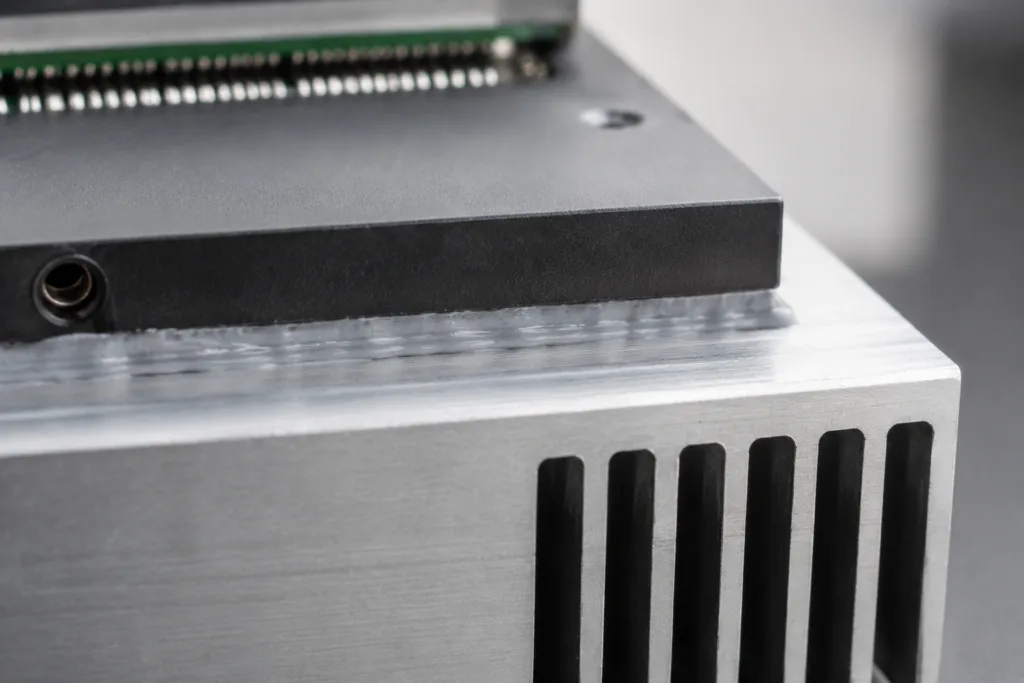
When the goal is barrier protection against moisture, dust, or vibration, flexibility and long-term stability often matter more than rigid structural strength. In circuit-level protection scenarios, ZDS-201-10R circuit board protective glue reflects the type of material used when boards need an added protective layer rather than only a point-bond adhesive.
Heat management
If the assembly must transfer heat while also securing parts, thermal conductive systems become the main category to assess. In these cases, viscosity, filler loading, and bond-line control are central to performance.
Equipment matching guide for dispensing and curing
Material selection and equipment selection should be treated as one decision. A good adhesive can still create quality problems if the dispensing method is unstable or the curing setup is poorly matched.
Dispensing systems
Low- to medium-viscosity UV materials may work well with jetting, needle dispensing, or time-pressure systems when deposit size must be tightly controlled. Higher-viscosity thermally conductive materials often require more robust positive displacement equipment to maintain repeatability and reduce variation caused by filler-heavy formulations.
UV curing equipment
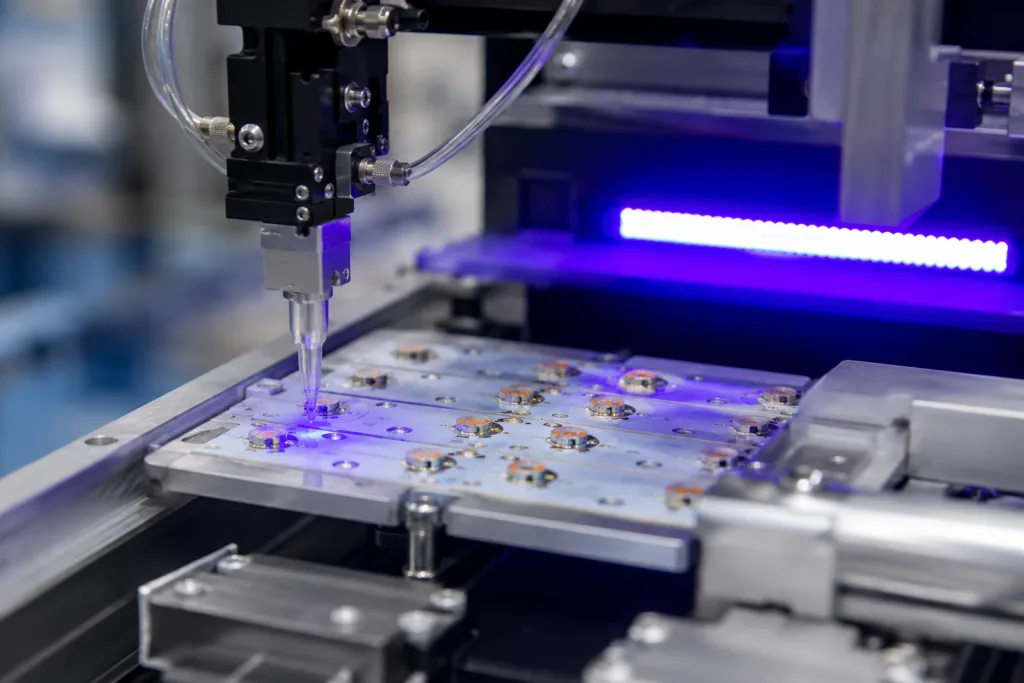
The lamp type, wavelength match, exposure time, and fixture design all affect cure quality. Assemblies with shadowed areas or variable geometry need special attention. A fast UV system can improve throughput, but only if the adhesive receives uniform energy across the full bond area.
In electronics and LED fixing applications where rapid cure and precise dispensing are central, ZDS-687W UV adhesive for electronics and LED fixing is the type of solution buyers often compare when aligning material choice with dispensing and UV process capability.
Process control considerations
Key controls include bead size consistency, air entrapment reduction, substrate cleanliness, adhesive temperature management, and cure verification. Even a well-chosen material can underperform if the process allows poor wetting, inconsistent bond lines, or under-cure.
Precision and low-stress application methods
Fragile components and tight assemblies benefit from methods that limit mechanical load during application. Controlled dispensing pressure, accurate shot sizing, and stable fixturing help prevent component shift. Lower modulus or more flexible materials are often preferable where substrates have different coefficients of thermal expansion.
To reduce stress-related failures, it is often useful to:
- keep bond lines consistent rather than excessively thick
- avoid over-constraining parts that need thermal movement
- select lower-shrink materials for fine alignment areas
- minimize trapped voids in thermally functional bonds
- validate cure completeness before full-scale production
Reliability factors that matter over time
Initial bond strength is only one part of reliability. In LEDs and electronics, the more meaningful question is whether the bond remains functional after temperature swings, humidity exposure, vibration, and aging. A material that performs well in a short bench test may still fail in service if it becomes brittle, loses adhesion, or allows moisture penetration.
| Reliability factor | Why it matters | What to check |
|---|---|---|
| Thermal cycling resistance | Prevents cracking and adhesion loss during repeated heating and cooling | Flexibility, modulus, substrate mismatch tolerance |
| Moisture resistance | Reduces corrosion risk and bond degradation | Sealing behavior, water exposure durability |
| Aging stability | Supports longer service life and stable assembly performance | Hardness shift, discoloration, embrittlement tendency |
| Electrical compatibility | Protects circuit function and insulation integrity | Suitability around live or sensitive components |
| Adhesion retention | Maintains mechanical security over time | Performance after heat, humidity, and stress exposure |
Common selection mistakes and how to avoid them
- Choosing on cure speed alone: fast cure is helpful, but not if thermal or environmental performance is inadequate.
- Ignoring substrate mismatch: rigid materials may fail on assemblies with different thermal expansion rates.
- Overlooking dispensing behavior: a suitable chemistry can still create defects if viscosity does not match the equipment.
- Assuming higher thermal conductivity always solves heat issues: interface quality and bond-line thickness are equally important.
- Not validating shadow cure conditions: UV systems require real assessment of light access.
- Testing only initial adhesion: reliability screening should include thermal and moisture exposure relevant to the end use.
A practical framework for choosing the right led adhesive
A structured selection process usually works better than comparing product names alone. Start with the application function, then narrow by process and reliability needs.
Step 1: Define the adhesive job
Is the material mainly for fixing, thermal transfer, sealing, potting, or board protection? One product rarely optimizes all functions equally.
Step 2: Review substrates and geometry
Check whether the parts are metal, plastic, glass, ceramic, or mixed materials, and whether the bond line is exposed to UV light or hidden in shadow.
Step 3: Match cure method to production
If speed is critical and the joint is accessible, UV cure may be ideal. If heat transfer is the main challenge, a thermal conductive adhesive may be more appropriate. If environmental sealing dominates, flexible protective systems may be a better fit.
Step 4: Confirm reliability needs
Evaluate the expected temperature range, humidity exposure, vibration, and service life. This is where low-stress behavior and retention of adhesion often matter more than headline strength.
Step 5: Validate with process trials
Run dispensing and cure trials under realistic production conditions. Include bond-line consistency, cure completeness, handling time, and post-aging performance in the evaluation.
Conclusion
The right led adhesive supports much more than assembly speed. It helps protect alignment, manage heat, reduce stress, and maintain long-term reliability across real operating conditions. For LED and electronics manufacturing, the most effective choice usually comes from balancing chemistry, thermal needs, dispensing method, cure strategy, and durability testing as one integrated process rather than separate decisions.
FAQ
What is the most important factor when choosing a led adhesive?
The most important factor is the actual job the adhesive must perform, such as fixing, heat transfer, sealing, or protection, because that determines the right balance of cure speed, flexibility, thermal performance, and reliability.
When should UV adhesive be used in electronics assembly?
UV adhesive is a strong choice when the bond area is accessible to light, fast handling is needed, and precise dispensing is important for small parts or high-throughput assembly lines.
Are thermally conductive adhesives always necessary for LEDs?
No, they are mainly necessary when the adhesive is part of the heat path, while lower-power or non-thermal bonding tasks may only need stable mechanical attachment without significant thermal conductivity.
Why do some electronic adhesive bonds fail after thermal cycling?
Bonds often fail after thermal cycling because the adhesive is too rigid, the substrates expand at different rates, or the bond line and cure profile were not suitable for repeated temperature changes.
How does dispensing equipment affect adhesive performance?
Dispensing equipment affects deposit size, void formation, bond-line consistency, and repeatability, so even a suitable adhesive can produce weak or inconsistent results if the application method is poorly matched.
What should be tested before selecting an adhesive for production?
Before final selection, it is practical to test substrate adhesion, dispensing stability, cure completeness, handling time, thermal or moisture resistance, and performance after realistic aging conditions.