
Bonded rubber seals, pads, and gaskets can pass an initial assembly check yet lose sealing force or detach after months of compression, temperature change, vibration, and moisture exposure. The reason is often not adhesive strength alone. Rubber continues to deform during service, while the adhesive interface must transfer load between an elastomeric substrate and a mating surface. This guide explains how compression set and recovery behavior affect rubber bonding solutions for compressive parts, and how engineers and buyers can evaluate the complete joint rather than relying only on an initial bond-strength value.
For industrial sourcing, the central question is practical: will the bonded assembly maintain its intended contact, cushioning, position, or seal after repeated compression? A reliable answer requires information about the rubber compound, bond geometry, surface preparation, adhesive flexibility, curing process, and service environment. No adhesive chemistry should be selected from the application name alone.
Why Rubber Recovery Behavior Matters in Bonded Components
Rubber recovery is the tendency of an elastomer to return toward its original shape after a compressive load is reduced or removed. In a seal or gasket, recovery helps maintain contact pressure against a housing, cover, flange, or mating surface. In a pad or damper, recovery influences thickness retention, vibration isolation, and the ability to accommodate movement.
Recovery is not always complete or immediate. The response depends on elastomer formulation, density, temperature, compression level, loading time, geometry, and the surrounding environment. Some materials show a substantial delayed response, while others retain a permanent deformation after extended compression. When rubber is bonded at one face, recovery forces and dimensional changes are transferred into the adhesive layer.
This creates a joint-design issue. The adhesive may need to tolerate movement parallel to the interface, peel at an edge, and local stress caused by uneven compression. A stiff adhesive can provide useful dimensional restraint in some designs, but it may also concentrate stress when the rubber flexes. A more compliant adhesive may follow movement better, but its resistance to heat, chemicals, creep, and long-term load must be checked for the specific formulation.
For this reason, a rubber-bonding project should define the required mechanical behavior of the whole assembly. The bond must not simply remain attached during a short test. It should maintain the required contact, alignment, damping, or sealing function after representative compression and recovery cycles.
What Compression Set Means in Practical Terms
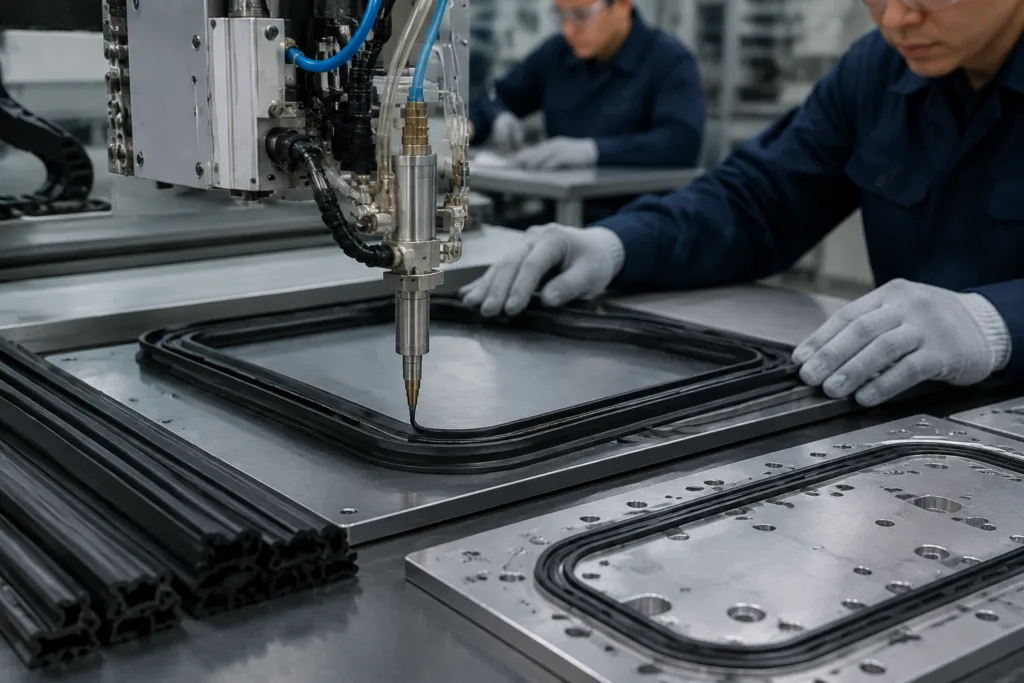
Compression set describes the permanent deformation remaining after an elastomer has been compressed for a defined period and then allowed to recover under a specified test procedure. A higher compression set generally means that more of the original deformation remains. A lower result generally indicates better dimensional recovery under that particular test condition, but it does not automatically predict adhesive durability in every design.
Compression set is a property of the rubber system and test method, not a standalone rating for a bonded assembly. The result can vary with temperature, compression ratio, exposure time, specimen geometry, and recovery period. Buyers should therefore request the test conditions as well as the reported result. Comparing values generated by different methods can lead to an incorrect material choice.
In production terms, compression set may appear as reduced gasket thickness, lower sealing force, a pad that no longer returns to its original height, or a damper that has lost part of its travel. If the rubber is bonded to a rigid carrier, the permanent change can produce shear, peel, or edge lift in the adhesive layer. If the bond is made to another flexible component, the interface may experience repeated strain as both parts move.
How Compression Set Affects Sealing, Cushioning, and Load Retention
A gasket seals by maintaining sufficient contact with the mating surfaces. As compression set develops, the gasket may exert less recovery force. The result can be a smaller sealing margin, especially where the joint also experiences pressure variation, vibration, thermal expansion, or assembly tolerance. Adhesive bond failure may then be a consequence of lost geometry rather than the original cause.
For cushioning pads, thickness retention affects impact absorption and contact pressure. A bonded pad can also be pulled at its perimeter when the free portion of the rubber recovers differently from the constrained portion. In dampers, dynamic movement may repeatedly load the adhesive at the edge of the bonded area. In each case, the design should distinguish between rubber fatigue, permanent deformation, and adhesive-interface failure.
The following framework helps separate the main risks:
| Observed change | Possible mechanism | Information to investigate |
|---|---|---|
| Seal loses contact pressure | Rubber compression set or inadequate recovery | Compression conditions, temperature, geometry, and required sealing force |
| Edge begins to lift | Peel stress from constrained recovery or uneven loading | Bond width, edge design, adhesive flexibility, and surface preparation |
| Pad becomes permanently thin | Elastomer creep or compression set | Rubber formulation, load duration, and thickness retention requirements |
| Bond cracks after cycling | Interfacial fatigue, adhesive embrittlement, or excessive strain | Cycle profile, temperature, vibration, and cured adhesive behavior |
How Repeated Compression Loads the Adhesive Interface
Compression does not always place the adhesive in simple compression. When a rubber part is squeezed, the elastomer may bulge sideways. When it recovers, the bonded region may move relative to the rigid substrate. This produces a combination of shear, tensile strain, and peel, particularly near corners and bond-line terminations.
Stress is often highest where the bond ends abruptly. A sharp corner, narrow bond line, sudden thickness change, or unsupported rubber edge can magnify local deformation. Voids, contamination, incomplete wetting, and inconsistent adhesive thickness can further reduce the effective bond area. A joint that appears acceptable in a static inspection may therefore fail during repeated compression cycling.
Typical failure modes include interfacial debonding, cohesive cracking within the adhesive, tearing of the rubber near the bond, edge lift, and seal loss without visible detachment. Failure analysis should identify where the separation occurred. Adhesive residue on one substrate may indicate interfacial weakness, while rubber tear may show that the interface was stronger than the elastomer under that test condition. The interpretation still depends on the complete test setup and must not be generalized from one specimen.
Applications in Seals, Pads, Dampers, and Gaskets
Bonded seals may use adhesive to join a rubber profile, secure a seal to a carrier, or hold a component during assembly. Pads may be attached to housings, covers, brackets, or equipment frames. Dampers and isolators can combine a flexible rubber element with metal or rigid polymer inserts. Gaskets may be bonded to improve positioning or simplify installation.
Each application creates a different balance between movement and restraint. A static gasket may need dimensional stability and resistance to moisture or fluids. A vibration pad may need a joint that follows cyclic displacement without transferring excessive stress to the rubber. A thin seal may require controlled adhesive placement so that excess material does not interfere with compression or create a leak path.
Before requesting a recommendation, document whether the adhesive is structural, positioning, sealing, or temporary assembly support. Also state whether the joint remains under compression continuously or experiences intermittent loading. These details affect chemistry selection, bond geometry, cure strategy, and validation testing.
Substrate and Elastomer Variables
EPDM, NBR, silicone, neoprene, polyurethane, and foam rubber do not present identical bonding surfaces. Their surface energy, additives, plasticizer behavior, porosity, modulus, and resistance to solvents can vary. Even within one elastomer family, different compounds and manufacturing processes can change adhesion results.
EPDM may be selected for weathering or environmental exposure, while NBR is commonly associated with applications involving oils, but the actual compound and service conditions must be confirmed. Silicone is flexible and can present a difficult surface for many adhesives. Neoprene, polyurethane, and foam materials can differ substantially in surface texture, cell structure, and cohesive strength. A hard-to-bond surface may require mechanical preparation, chemical treatment, or a compatible primer, subject to process and safety review.
The rigid mating substrate also matters. Metals, painted surfaces, engineering plastics, and coated parts may require different preparation methods. Mold-release residue, processing oil, dust, oxidation, and handling contamination can cause inconsistent wetting. A cleaning method that works for a metal carrier may swell, weaken, or damage a rubber substrate. Process trials should use production-intent materials rather than generic sheets wherever possible.
Adhesive Selection Factors for Compression-Loaded Rubber Parts
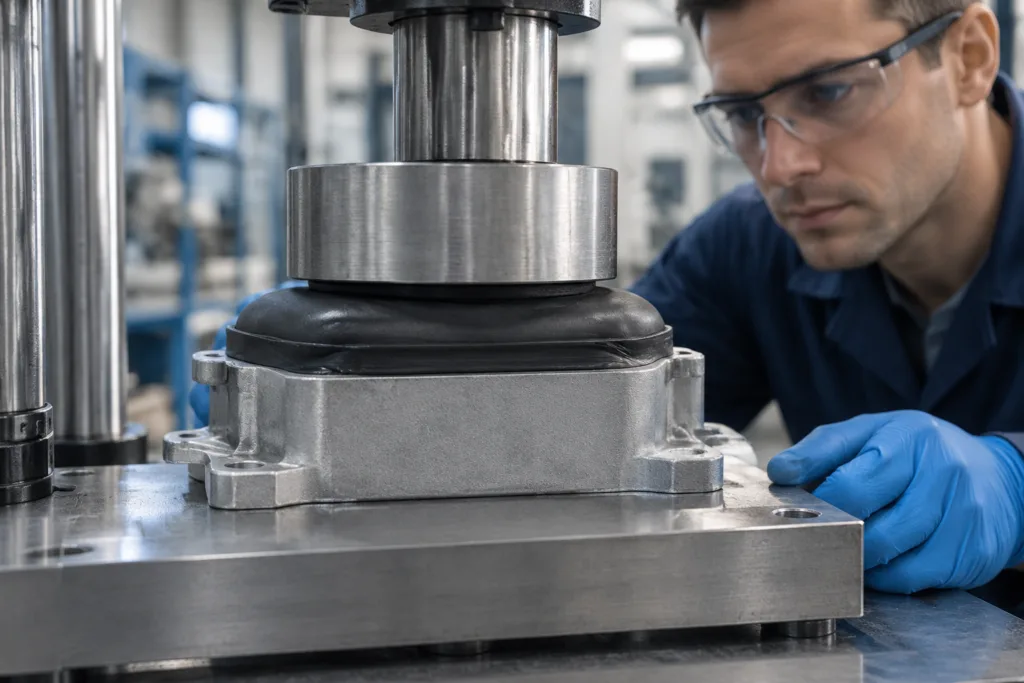
The phrase compression set adhesive rubber bonding describes a system-selection problem. The adhesive must be compatible with the rubber and the mating substrate, but it must also accommodate the expected deformation. Review the following factors together:
- Rubber type, hardness range, density, surface finish, and likely additives.
- Bond-line thickness, bonded area, edge geometry, and expected movement.
- Continuous compression, intermittent compression, impact, vibration, or cyclic displacement.
- Required flexibility, elongation, creep resistance, and resistance to peel.
- Operating temperature, moisture, fluids, chemicals, UV exposure, and pressure.
- Application method, open time, fixture time, cure mechanism, and production takt time.
- Need for one-part or two-part processing, automated dispensing, or controlled adhesive volume.
- Documentation, packaging, workplace handling, and compliance requirements for the selected product.
General chemistry guidance can help frame the discussion. Flexible silicone-based systems may be considered where movement, weathering, or recovery is important, but the selected formulation must be checked for substrate compatibility and required cure conditions. Epoxy systems may be considered where higher rigidity or structural restraint is required, although their cured behavior may not suit a highly moving rubber joint. Cyanoacrylate products can be relevant to certain fast-fixturing rubber applications, but cure speed, gap, surface condition, and long-term exposure must be evaluated. A general example of rubber-focused fast bonding is described in this rubber bonding product reference; it should be treated as selection context, not evidence of ZDS LTD product performance.
Actual performance depends on the selected formulation and must be confirmed in current technical documentation and representative-part testing. Buyers comparing silicone adhesive options for flexible sealing and recovery with other chemistries should compare service behavior, not only nominal strength.
Surface Preparation and Process Control
Surface preparation is often the most controllable factor in rubber-bonding consistency. Define the cleaning agent, wiping method, drying time, abrasion level, primer use, and maximum time between preparation and bonding. The process should prevent prepared surfaces from being touched or exposed to contamination before adhesive application.
Primers can improve adhesion for selected substrates, but they are not universal fixes. Compatibility with the rubber compound, adhesive, production equipment, and environmental controls must be confirmed. Excess primer, incomplete drying, or uncontrolled application can create a weak boundary layer. Any primer process should be validated with the exact production materials.
Dispensing control is equally important. Excess adhesive can reduce the designed compression, while insufficient coverage can leave unbonded areas. Viscosity, nozzle selection, temperature, bead size, mixing quality for two-part systems, and material age can affect consistency. The current technical data sheet and safety data sheet should guide handling, storage, and process controls for the selected product.
Cure conditions should be treated as a process variable rather than an assumption. Temperature, humidity, fixture pressure, open time, and access to air or light may influence cure. A production trial should verify that the adhesive reaches the required condition before the part is released to compression, packaging, or downstream assembly.
Environmental Demands and Durability Testing
Compression cycling should be combined with the environments expected in service. Heat can accelerate rubber deformation and affect adhesive modulus. Moisture can change interfaces and contribute to corrosion or swelling. Fluids may soften one material, extract additives, or reduce adhesion. Vibration can turn small edge defects into progressive fatigue damage.
Useful validation plans may include compression aging, recovery retention, peel strength after cycling, shear retention, thermal aging, humidity exposure, fluid immersion, and vibration where relevant. The exact method, duration, load, temperature, and acceptance criteria should be agreed by the product team. Suggested tests are not final engineering approval; they are a basis for designing a project-specific validation program.
Test representative assemblies, not only flat laboratory coupons. Include actual rubber geometry, production surface preparation, adhesive volume, cure process, mating substrate, compression fixture, and realistic recovery time. Inspect both functional performance and failure location. For a gasket, measure sealing behavior or contact retention where practical. For a pad, evaluate thickness and position retention. For a damper, assess the required dynamic response and attachment integrity.
How to Read Technical Data Sheets
A technical data sheet should be read as a description of a specific product and test method, not as a universal prediction. Check the listed substrates, preparation instructions, cure mechanism, viscosity, open time, fixture or handling guidance, temperature information, and mechanical test methods. Determine whether the reported value is tensile, lap shear, peel, or another measure, and ask whether it reflects the actual rubber and rigid substrate in your design.
Look for limitations as carefully as headline values. A data sheet may not address compression cycling, permanent deformation, recovery, chemical exposure, or long-term peel. Ask ZDS LTD to confirm which documents apply to the selected formulation and whether additional project testing is needed. The supplied guide on reading a rubber adhesive TDS for peel, flexibility, and compatibility can help procurement and engineering teams organize this review.
Common Selection Mistakes
- Choosing an adhesive from rubber type alone without reviewing bond geometry and service movement.
- Using initial bond strength as a substitute for compression, recovery, peel, and environmental testing.
- Ignoring the rigid substrate coating, mold-release residue, or production cleaning process.
- Allowing adhesive thickness or overflow to change the designed compression of a seal.
- Releasing parts before cure conditions have been verified for the selected formulation.
- Testing generic rubber coupons instead of production-intent compounds and molded surfaces.
- Assuming a flexible adhesive will automatically resist creep, heat, fluids, or long-term compression.
- Failing to define acceptable leakage, displacement, bond failure, or recovery limits before trials.
How ZDS LTD Can Support the Evaluation
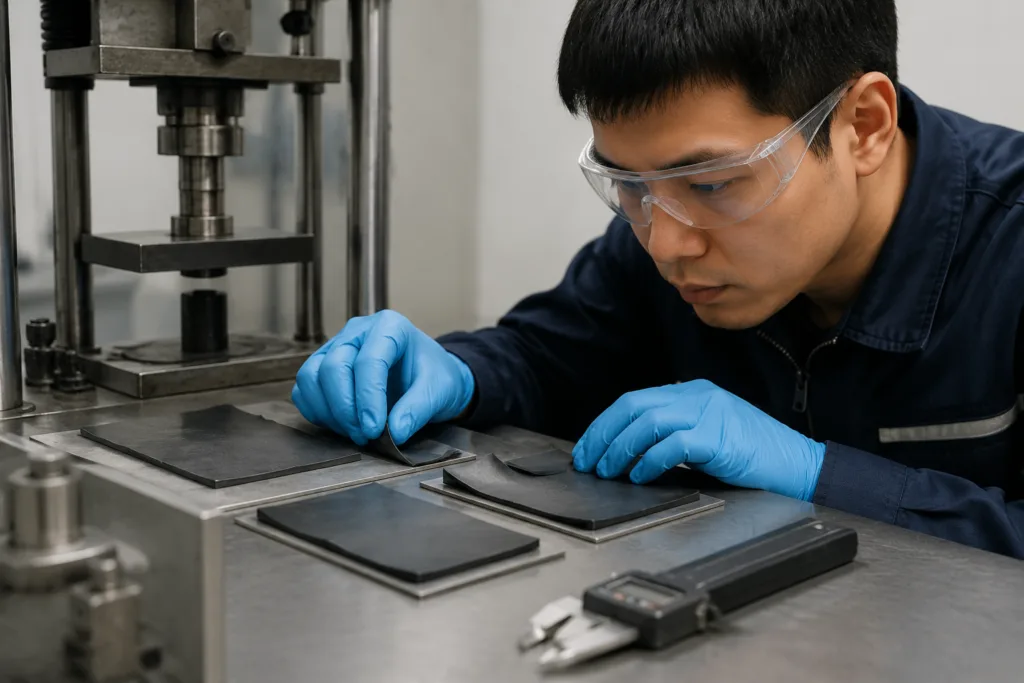
ZDS LTD can review the rubber compound, mating substrate, bond dimensions, compression profile, production method, operating environment, and expected order requirements as part of an industrial adhesive project. This information can support an initial chemistry discussion, product matching, sample evaluation, or application-specific formulation review where appropriate.
A useful request package should include drawings or photographs, substrate names, surface treatments, rubber hardness or density where available, compression percentage, duty cycle, temperature range, exposure to moisture or fluids, required assembly speed, dispensing equipment, packaging expectations, and target validation tests. It should also identify whether the buyer needs an existing product, private-label evaluation, OEM or ODM discussion, or a formulation adjusted for a particular process.
During technical discussions, ZDS LTD can help organize sample trials and documentation review, while final approval remains the responsibility of the product owner based on its design and validation requirements. Buyers should request confirmation of current technical data, safety information, compliance documents, packaging formats, production conditions, and supply arrangements for the selected product. For projects where the selection criteria are complex, adhesive selection technical support for rubber mechanics can provide a structured starting point for the technical conversation.
Near the quotation or sampling stage, share enough detail for a meaningful review. The broader rubber adhesive manufacturing scope is only a starting point; the correct product and process depend on the actual assembly. Provide the substrates, part dimensions, compression conditions, operating environment, production requirements, documentation needs, and expected order profile so ZDS LTD can assess the project without relying on assumptions.
Conclusion
Reliable bonded rubber parts must survive two linked demands: the adhesive must form a consistent interface during manufacturing, and the assembled rubber must continue to deform and recover without overloading that interface. Compression set can reduce contact pressure or change geometry, while recovery forces can create peel, shear, and fatigue at bond edges. These mechanisms are especially important in seals, pads, dampers, and gaskets exposed to repeated loading.
A sound sourcing decision therefore combines elastomer data, bond design, surface preparation, cure control, environmental exposure, and long-term testing. Initial adhesion is useful, but it is only one part of the evidence. Representative-part trials and project-specific documentation give engineers and procurement teams a stronger basis for selecting an adhesive system that supports the intended service life.
Frequently Asked Questions
Does lower compression set guarantee a reliable adhesive bond?
No. Lower compression set may support better rubber shape retention under a defined test condition, but bond reliability also depends on substrate compatibility, adhesive flexibility, bond geometry, surface preparation, cure, and environmental exposure.
Which adhesive chemistry is best for bonding compressed rubber parts?
There is no universal choice. Silicone, epoxy, cyanoacrylate, polyurethane, acrylic, or other systems may be relevant depending on rubber type, movement, gap, cure process, temperature, chemicals, and required durability. The selected formulation must be confirmed by testing.
What information should a buyer provide when requesting a rubber-bonding recommendation?
Provide the rubber and mating substrate, part drawings, surface condition, bond area, compression profile, movement, operating environment, production method, required cycle time, packaging needs, and validation criteria. Representative samples are also valuable.
Should rubber adhesive testing use production parts?
Yes, wherever practical. Production-intent parts capture molded texture, additives, tolerances, surface preparation, adhesive volume, cure conditions, and compression geometry that may not appear in flat coupon testing.
What documents should be reviewed before approving an adhesive for seals or gaskets?
Review the current technical data sheet, safety data sheet, applicable compliance documents, processing instructions, packaging information, and project test results. Confirm that the documents apply to the selected formulation and intended application.