
A reliable ceramic to plastic adhesive joint is rarely chosen by chemistry name alone. These assemblies combine two materials that behave very differently under load, temperature change, and surface preparation. Ceramic may look easy to bond because it feels hard and stable, while plastic may appear simple because it is common in molded parts. In practice, the pairing creates a demanding interface where stiffness mismatch, plastic surface energy, cure shrinkage, and thermal movement all affect long-term durability. Buyers evaluating ceramic bonding solutions for industrial assemblies usually need more than a product label. They need a selection logic that fits substrates, process constraints, and service conditions.
This guide is written for sourcing teams, engineers, and manufacturers that need to bond ceramic to thermoplastics or thermosets in housings, sensors, insulators, wear components, electronics, decorative parts, or mixed-material assemblies. The goal is not to declare one chemistry universally best. Instead, it is to show how to reduce risk before committing to samples, tooling, qualification, or volume purchasing.
Why ceramic-to-plastic bonding is harder than it looks
Ceramic and plastic create opposite demands on the adhesive layer. Ceramic is generally rigid, dimensionally stable, and often tolerant of compression but less forgiving in peel or impact if stress concentrates at an edge. Plastic can be flexible or semi-rigid, may expand more with heat, and in some grades can present a low-energy surface that resists wetting.
That means the bond line must often do several jobs at once:
- Adhere to a mineral-based surface and an organic polymer surface
- Absorb movement caused by thermal expansion mismatch
- Maintain enough cohesive strength without becoming too brittle
- Wet surfaces consistently despite texture and energy differences
- Fit the production cure method and assembly speed
Many field failures occur not because the adhesive was low quality, but because the selected chemistry matched one side of the assembly better than the other. An adhesive that bonds ceramic strongly can still fail if it cannot tolerate plastic movement. Likewise, a flexible adhesive that handles thermal cycling may still underperform if it cannot wet the specific plastic without pretreatment.
Why ceramic-to-plastic bonding combines two very different material behaviors
From a design perspective, ceramic is usually the more rigid and brittle component. Common industrial ceramics, whether used for insulation, wear resistance, dimensional stability, or heat resistance, do not deform much before stress is transferred into the adhesive interface. Plastics vary more widely. ABS, PC, PA, PBT, PMMA, PPS, PE, PP, and filled engineering grades all behave differently, and molded parts may include release agents, fillers, or glass fiber that influence adhesion.
Three practical consequences follow:
- Stress redistribution is uneven. The plastic side may flex while the ceramic side stays stable, concentrating strain at the bond edge.
- Surface behavior differs. Ceramics can be easier to wet after proper cleaning, while some plastics need activation before dependable adhesion is possible.
- Thermal movement is asymmetric. During cure and later service, the plastic often moves more than the ceramic, especially in larger parts or under thermal cycling.
For engineers, this means bond design matters almost as much as chemistry. Lap area, adhesive thickness, gap uniformity, corner geometry, and whether the joint sees peel, shear, torsion, or impact should be reviewed before sample approval.
Stiff ceramic vs more compliant plastic: what each substrate demands from the adhesive
The ceramic side typically favors an adhesive that can develop strong interfacial contact and resist crack propagation from a hard surface. The plastic side often favors some toughness or flexibility, depending on the polymer and service environment. If the adhesive is too rigid, it may transfer stress sharply into the ceramic or debond from the plastic during movement. If it is too soft, it may creep under sustained load or lose positional accuracy.
In practical terms, the adhesive often needs a balanced profile:
- Good wetting on both substrates
- Sufficient cohesive strength for the load case
- Enough elongation or toughness to tolerate mismatch
- Controlled shrinkage during cure
- Resistance to the actual operating environment
For static indoor assemblies, a relatively rigid structural adhesive may work well. For temperature swings, vibration, drop shock, or uneven part movement, a tougher or more elastic system may be safer. Final selection depends on actual part geometry and service conditions, not only on the material names.
Surface energy and wetting considerations on the plastic side
Plastic is often the more difficult bonding surface. Some engineering plastics bond reasonably well after cleaning. Others, especially lower-surface-energy materials, may resist wetting so the adhesive beads up, leaves voids, or shows weak initial tack. Even when short-term adhesion looks acceptable, poor wetting can reduce long-term reliability under humidity, heat, or stress.
Buyers should confirm:
- The exact polymer family, not just the trade part name
- Whether the plastic is filled, reinforced, coated, painted, or plated
- Whether mold release, processing oil, or migration from additives is present
- Whether the part can tolerate abrasion, plasma, corona, primer, or flame treatment where appropriate
Low-energy plastics are a common reason why a test on one molded lot passes and a later production lot fails. Surface variability can be as important as adhesive choice. If the program involves several plastic suppliers or changing resin grades, that variability should be part of the validation plan.
How ceramic surface texture, cleanliness, and pretreatment affect bond reliability
Ceramic surfaces are not automatically bond-ready. Smooth glazed surfaces, sintered finishes, machining residue, polishing compounds, dust, and handling contamination can all affect adhesion. Texture can help mechanical interlocking in some cases, but roughness alone does not replace cleaning or surface compatibility.
Useful review points include:
- Whether the ceramic is glazed, polished, porous, machined, or as-fired
- Whether the bond area has absorbed moisture or contamination
- Whether abrasion changes fit-up, appearance, or tolerance
- Whether a primer or surface activation step is allowed in production
As general guidance, surface preparation and pretreatment methods such as cleaning, abrasion where suitable, and activation methods can materially affect bond performance and durability. However, the exact method must be confirmed for the selected ceramic, plastic, and adhesive system. Excessively aggressive pretreatment can also damage appearance or alter dimensions.
Teams that want repeatable results should document not only the prep method, but also the acceptable delay between prep and bonding, since surfaces can be recontaminated during storage or handling.
Thermal expansion mismatch and stress buildup during curing and service
Thermal stress is one of the most important hidden risks in ceramic-to-plastic assemblies. Plastic usually expands and contracts more than ceramic. If the adhesive cures rigidly, shrinkage during cure may preload the joint. Later, service temperature changes can add repeated stress at the interface. The result may be edge lifting, microcracking, gradual debonding, or brittle fracture after repeated cycles.
This issue becomes more severe when:
- The bonded area is large
- The ceramic insert is thick and inflexible
- The plastic wall is thin and moves easily
- The assembly sees wide temperature swings
- The adhesive layer is too thin to absorb movement
- The joint geometry creates peel at corners or ends
Thermal expansion mismatch does not automatically rule out structural bonding. It does mean that engineers should consider adhesive modulus, toughness, bond-line thickness, and cure profile together. A slower or lower-stress cure can sometimes reduce residual stress. In other cases, a more flexible chemistry may offer better durability than a harder one, even if its initial lap shear value is not the highest on paper.
Choosing the right adhesive chemistry for ceramic-to-plastic assemblies
No single chemistry suits every ceramic-plastic pair. The right choice depends on whether the application needs structural strength, impact resistance, thermal shock tolerance, fast handling, optical access, gap filling, or environmental resistance.
| Adhesive chemistry | General advantages | Typical trade-offs in ceramic-to-plastic bonding |
|---|---|---|
| Epoxy | Often selected for strong structural bonding, gap filling, and adhesion to many rigid substrates | Some grades can be too rigid for high thermal mismatch or impact unless toughened; cure schedule and shrinkage must be reviewed |
| Polyurethane | Can provide useful flexibility and stress absorption | Heat resistance, moisture sensitivity, and long-term chemical exposure performance depend strongly on formulation |
| Silicone | Useful when flexibility and temperature movement accommodation are important | Lower structural rigidity and different adhesion profile may limit use in load-bearing joints |
| Acrylic or PMMA structural | Can offer toughness and bonding to some plastics with less prep than some other chemistries | Odor, cure behavior, gap, and substrate sensitivity must be checked case by case |
| UV-curing adhesive | Fast processing where light access is available and parts are suitable | Shadowed areas, opaque ceramics, or nontransparent plastics can restrict cure depth and reliability |
| Cyanoacrylate | Very fast fixture on small close-fitting parts | Can be brittle and less suitable for thermal mismatch, impact, larger gaps, or long-term environmental stress |
For many industrial mixed-material joints, epoxies, toughened acrylics, polyurethanes, or silicones become the main shortlist depending on load and movement. A product such as ZDS-703AB-1 structural epoxy adhesive for durable bonding may be relevant when the assembly needs structural holding and durable bond formation, but exact suitability still depends on the ceramic grade, plastic type, bond geometry, curing process, and service environment.
Where light-curing assembly is possible and one substrate allows UV access, options such as ZDS-3313 UV adhesive for high-strength plastic bonding may enter evaluation, but shadow areas and ceramic opacity must be checked carefully before relying on UV cure for the full joint.
Key performance requirements to define before comparing products
Buyers often start with bond strength, but strength alone is not enough. The right specification should include the failure risks most relevant to the assembly.
Adhesion strength and cohesive integrity
Ask whether the joint mainly sees shear, peel, cleavage, compression, or vibration. A material that performs well in one mode may fail in another.
Flexibility and toughness
These properties matter when the plastic moves, the assembly is dropped, or thermal cycling is expected. Toughness is especially important in reducing brittle failure from stress concentration.
Heat and thermal cycling resistance
Consider both peak temperature and repeated temperature change. Passing a room-temperature bond test does not prove reliability in service.
Chemical and humidity resistance
Cleaning agents, oils, fuels, condensate, or outdoor exposure can weaken some interfaces over time. Confirm actual resistance in current product documentation and testing.
Electrical, cosmetic, or process-specific needs
Some assemblies require insulation, low outgassing, non-sag application, controlled color, or fast fixture. These criteria can eliminate otherwise promising chemistries.
How application conditions change the best adhesive choice
The same ceramic-to-plastic pairing can need different adhesives in different products.
- Electronics housings and sensor assemblies: often need controlled dispensing, dimensional stability, resistance to thermal cycling, and compatibility with small bond lines.
- Wear parts and mechanical inserts: may require high load transfer, gap filling, and resistance to shock or vibration.
- Decorative or visible assemblies: appearance, low squeeze-out, and surface cleanliness can be as important as strength.
- Insulating or heat-exposed components: thermal stress management and long-term temperature resistance become more important than simple room-temperature fixture speed.
This is why project review should include operating temperature range, part size, visible finish requirements, process takt time, and whether the bond line is accessible for metered dispensing, clamping, or curing equipment.
Surface preparation and process controls that improve bond consistency
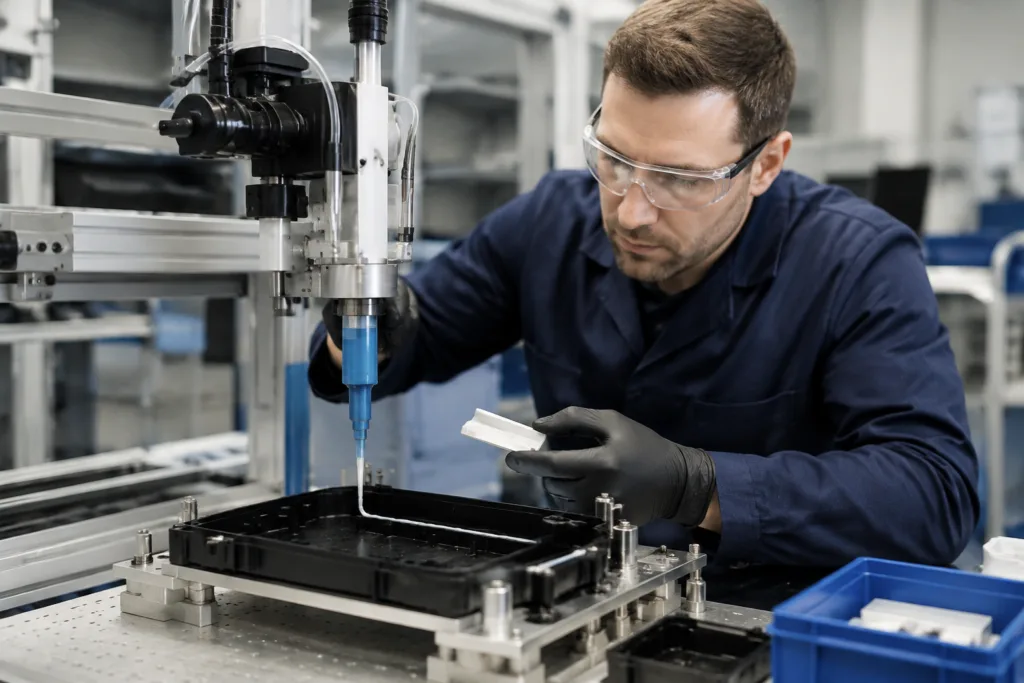
Even a suitable adhesive can fail in production if the process is inconsistent. Ceramic-to-plastic bonding benefits from a defined and repeatable surface and dispensing routine. Teams that need robust scale-up should review surface preparation steps that improve wetting and adhesion and translate them into line-ready work instructions.
Common process controls include:
- Incoming part cleanliness standards
- Defined wipe solvent or cleaning method where appropriate
- Abrasion specification if allowed on the ceramic or plastic
- Controlled time between prep and bonding
- Meter-mix ratio control for two-part systems
- Dispense volume and bond-line thickness control
- Fixture and clamping consistency
- Cure temperature and time verification
- Lot traceability for adhesive and substrate batches
For mixed-material projects, many buyers also ask for adhesive selection technical support for mixed-material bonding so that substrate review, sample planning, and process conditions are aligned before pilot production. This helps avoid the common problem of choosing samples on bench convenience rather than production reality.
Common failure risks in ceramic-to-plastic joints
Failure mode analysis matters because different defects point to different corrections.
| Observed issue | Possible cause | Typical corrective direction |
|---|---|---|
| Peel failure at edge | Joint design concentrates stress; adhesive too rigid; bond line too thin | Adjust geometry, increase toughness, review thickness and load path |
| Brittle fracture | High modulus adhesive with impact or thermal shock | Evaluate tougher formulation and service-condition testing |
| Clean debond from plastic | Poor wetting, contamination, low surface energy, incompatible chemistry | Review plastic identification, pretreatment, cleaning, and adhesive compatibility |
| Creep or movement over time | Adhesive too soft for load or temperature | Raise structural performance or redesign support features |
| Thermal cycling damage | Expansion mismatch and residual cure stress | Evaluate lower-stress cure, tougher adhesive, and bond-line design changes |
It is useful to inspect whether failure is adhesive at the interface, cohesive within the adhesive, or substrate-related. That information often reveals whether the next step should be surface treatment, chemistry change, cure adjustment, or part redesign.
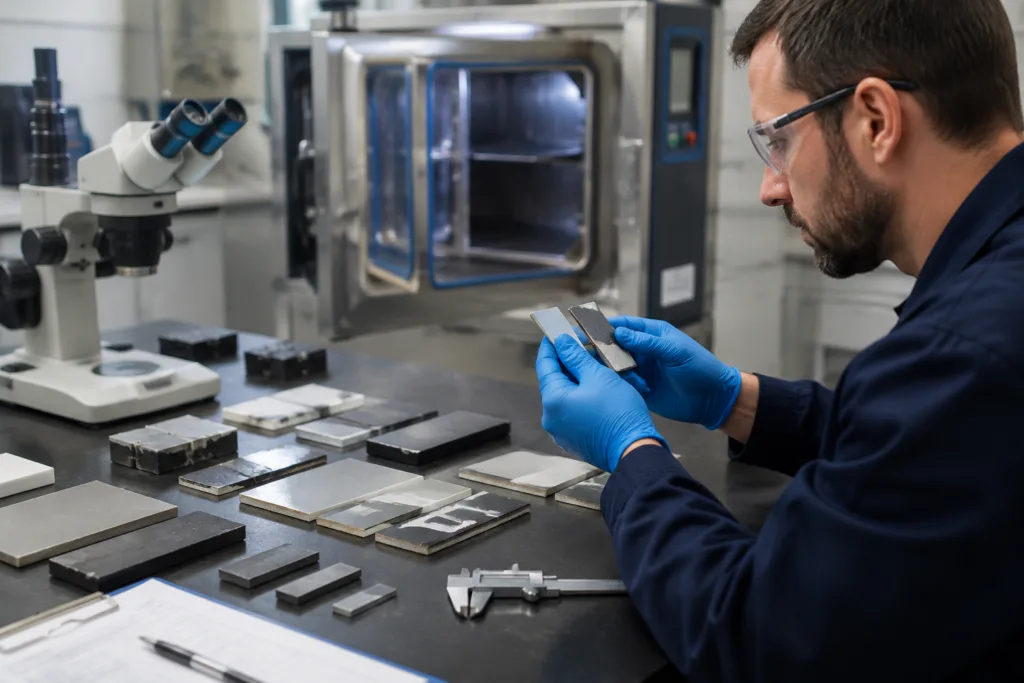
Testing and validation before mass production
For scenario-driven searches like this one, the most important advice is simple: do not approve a ceramic to plastic adhesive only on an initial hand test. Qualification should reflect actual service conditions.
A practical validation plan may include:
- Bonding real production substrates, not generic lab coupons alone
- Testing multiple substrate lots and molded-part batches
- Checking cure completeness under realistic line conditions
- Evaluating bond strength after heat, humidity, thermal cycling, and chemical exposure as relevant
- Reviewing failure mode, not just pass or fail numbers
- Comparing bond performance with target bond-line thickness variation
- Confirming assembly fit, clamp time, and operator handling window
Request the current technical data sheet and safety data sheet for shortlisted materials, and confirm whether additional compliance or application documents are needed for the project. Actual values and suitability must be verified for the selected formulation rather than assumed from chemistry type.
When custom formulation is needed for mixed-material ceramic plastic bonding
Off-the-shelf products may not always balance adhesion, flexibility, cure profile, and production speed well enough. Custom formulation or product adjustment may be worth discussing when:
- The plastic is difficult to bond and pretreatment options are limited
- The assembly sees severe thermal cycling
- Dispensing or thixotropy requirements are unusual
- Color, flow, or cure speed must match a narrow process window
- The bond line must combine structural holding with impact tolerance
- OEM or private-label supply requires packaging or identification changes
In those cases, the most useful starting point is a clear substrate and process brief. ZDS LTD can review bonding conditions, sample expectations, and documentation needs to determine whether standard products are sufficient or whether a more tailored evaluation is justified.
How ZDS helps customers evaluate ceramic-to-plastic adhesive options
For industrial buyers, the value of manufacturer input is usually not a generic recommendation but a structured narrowing of risk. ZDS LTD supports project discussions by reviewing substrate combinations, application method, curing constraints, and required durability targets. Depending on the project, that may include sample evaluation, product matching, packaging discussion, and coordination around trial conditions.
Early technical review is especially useful when the bond involves low-energy plastics, visible cosmetic requirements, larger bonded areas, or high thermal movement. At that stage, teams can share part drawings, substrate details, service temperatures, expected loads, line process limitations, and forecast purchasing needs. Buyers who are still building the shortlist can also review broader ceramic adhesive options for mixed-material component design before requesting project-specific evaluation.
Practical selection checklist for procurement, engineering, and production teams
Before requesting samples or quotations, prepare the following information:
- Exact ceramic type and surface condition
- Exact plastic resin and whether it is filled, coated, or molded with release agents
- Part dimensions and bond area
- Required bond-line thickness or gap range
- Primary load type: shear, peel, impact, vibration, or thermal cycling
- Operating temperature range and exposure conditions
- Required assembly speed and cure method
- Manual or automated dispensing process
- Cosmetic, electrical, or regulatory documentation requirements
- Expected annual volume and packaging preference
With these inputs, the manufacturer can usually narrow the evaluation path more effectively than if the request only states “need ceramic to plastic adhesive.” Better inputs reduce unnecessary sample loops and help procurement compare offers on technical fit rather than product labels alone.
Frequently Asked Questions
What is the best ceramic to plastic adhesive for industrial assemblies?
There is no universal best choice. Selection depends on the ceramic grade, plastic type, surface condition, joint geometry, curing process, temperature range, mechanical load, and environmental exposure. Epoxy, polyurethane, silicone, acrylic, UV-curing, or other systems may be suitable depending on the project, and final approval should be based on representative-part testing.
Do low-surface-energy plastics always require pretreatment before bonding to ceramic?
Not always, but many do benefit from surface activation or a carefully selected adhesive system. The need for plasma, primer, abrasion, or another pretreatment depends on the exact plastic, contamination level, and required durability. This should be confirmed during sample trials with the intended production parts.
Why do ceramic-to-plastic joints fail after thermal cycling even when initial strength looks good?
Initial room-temperature strength does not capture stress caused by different thermal expansion rates. As the plastic moves more than the ceramic, the adhesive interface can accumulate strain, especially if the bond line is thin or the adhesive is brittle. Cure shrinkage, joint geometry, and edge stress can further increase the risk.
Can UV adhesive be used for ceramic-to-plastic bonding?
It can be considered when the joint design allows adequate light access and the substrates do not block cure in critical areas. Opaque ceramics, shadow zones, and thicker bond lines can limit UV effectiveness, so cure depth and fixture reliability must be checked on real parts before production approval.
What information should buyers send when requesting a bonding recommendation or quotation?
Provide the exact ceramic and plastic materials, surface condition, part drawings or photos, bond dimensions, gap range, curing method, operating temperature, mechanical loads, chemical exposure, production process, and estimated order needs. That information helps ZDS LTD review whether a standard product, a different chemistry, or a more customized evaluation is appropriate.