
Bonding carbon fiber to metal can solve a real manufacturing problem: it joins lightweight composite parts to aluminum, steel, or other metal structures without adding unnecessary fasteners or distortion. But the same joint that looks simple on a drawing can become a high-risk interface in production. A reliable carbon fiber to metal adhesive must manage different thermal movement, variable surface condition, bond-line geometry, and service loads that often include vibration, moisture, and temperature cycling.
For buyers and engineers evaluating this type of joint, the key question is not whether adhesive bonding works in principle. The better question is which adhesive system, surface preparation route, and validation plan fit the actual assembly. For mixed-material projects, ZDS LTD can review substrate details and project requirements as a carbon fiber adhesive manufacturer support for mixed-material bonding partner rather than as a one-size-fits-all supplier.
This guide focuses on the decisions that affect reliability: thermal expansion mismatch, surface prep, adhesive stiffness, joint design, and the tests that should come before release to production. For a broader selection framework, buyers can also use adhesive selection technical support for high-stress joints when comparing chemistry options and process constraints.
Why carbon fiber-to-metal joints are high-value and high-risk
CFRP-to-metal bonding is attractive because it can reduce weight, distribute load over a larger area than a fastener, and create cleaner assemblies. It is also high risk because the two materials do not move the same way under heat and load. Carbon fiber laminates are anisotropic, meaning their properties change with fiber direction and layup. Metals expand more uniformly and often more than the composite, especially during temperature swings.
That difference matters during cure, cooling, and service. If the joint design is too stiff, the adhesive layer can see concentrated peel stress at the edges. If the adhesive is too soft or the surface prep is inconsistent, the joint may resist initial load but lose durability under vibration or moisture. In practice, reliability comes from treating the bonded joint as an engineered structure, not just a chemical attachment.
What makes CFRP-to-metal bonding different from metal-to-metal bonding
Metal-to-metal bonding usually starts with more predictable thermal movement and more uniform substrate behavior. CFRP-to-metal assemblies add complexity in three ways. First, the composite side may be resin-rich, textured, painted, or otherwise variable depending on the laminate process. Second, the metal side may be aluminum, steel, or coated metal with very different oxide behavior. Third, the adhesive must tolerate differential strain without becoming a crack initiation point.
Because of that, a product that works well in a simple metal bracket may not be the right choice for a carbon fiber frame. ZDS LTD can help narrow the chemistry family only after reviewing the substrates, loading, and process window. For structural epoxy options, see epoxy adhesives manufacturer options for structural bonding when your project needs a starting point for comparison.
Thermal expansion mismatch and joint stress
Thermal expansion mismatch is one of the most important design issues in mixed-material bonding. When the assembly heats up or cools down, the metal and the composite try to change size at different rates. That movement may be small in absolute terms, but at the bond line it becomes stress. The joint may experience peel at the edges, shear across the middle, and cyclic fatigue over repeated temperature swings.
This is why buyers should avoid choosing a carbon fiber to metal adhesive by chemistry name alone. A rigid adhesive may transfer load efficiently but can amplify edge stress. A more flexible adhesive may absorb movement better but may not provide the stiffness needed for a load-bearing bracket. The right answer depends on bond area, overlap length, operating temperature range, and whether the part sees repeated heat soak or rapid thermal cycling.
For readers who need technical background on movement-driven stress, the article on how thermal movement affects adhesive selection can help frame the conversation before final product review. For validation planning, external reference material on qualification and thermal-cycling requirements for adhesive-bonded joints is also useful as a general model for demanding service environments.
How differential movement creates peel, shear, and fatigue risk
In a simple overlap joint, shear load is often the goal, because adhesives generally manage distributed shear better than edge peel. But in real assemblies, movement rarely stays in pure shear. Thermal growth, part flex, clamp release, and vibration can all create peel forces at the ends of the joint. That edge loading is where failures often begin.
Fatigue risk rises when the joint is repeatedly cycled through small motions rather than one single overload event. Microcracks can start at voids, contamination, or thin bond-line areas and then grow over time. This is why joint geometry and bond-line control matter as much as adhesive chemistry. If the interface is not prepared correctly, the strongest formulation on paper may still fail early in service.
Surface preparation on both CFRP and metal sides
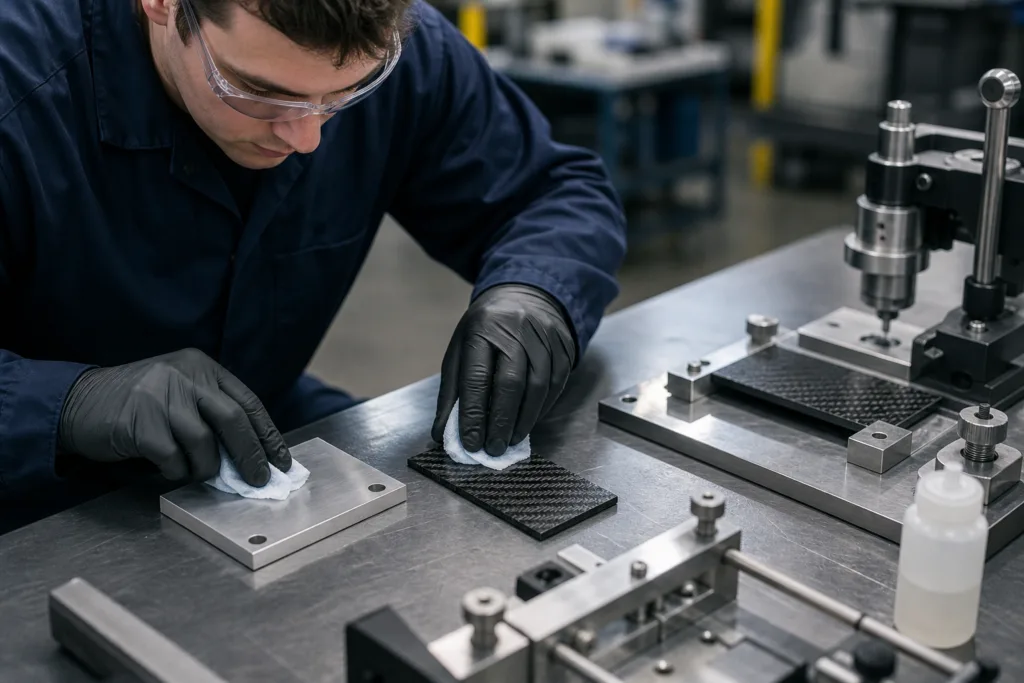
Surface preparation is usually the difference between a promising laboratory bond and a production-ready joint. The goal is to remove weak boundary layers, contamination, and anything that prevents the adhesive from wetting the surface properly. On carbon fiber laminates, that may mean cleaning and creating a controlled texture without damaging fibers. On metals, it often means removing oils, oxides, and process residues so the adhesive contacts sound material.
ZDS LTD publishes practical guidance on surface preparation steps that improve bond reliability, which is useful when engineering teams need to define a repeatable process for suppliers or contract assemblers. For mixed-material programs, this process step should be documented, not left to operator judgment.
Choosing the right prep method for aluminum, steel, and CFRP laminates
Aluminum often needs controlled cleaning and surface activation to handle oxide layers and production contamination. Steel may need similar cleaning, with attention to corrosion state and coating removal where relevant. Carbon fiber laminates can be more sensitive because aggressive abrasion may expose fibers or create inconsistent surface energy if done poorly.
The correct method depends on the exact substrate finish, laminate construction, and final appearance requirements. Some projects use sanding or abrasion, others use chemical cleaning, plasma, or other surface activation methods. The important point is consistency. A process that is effective in one plant may not translate to another unless the same tools, timing, and inspection steps are maintained. Buyers should ask how the supplier will verify surface condition before adhesive application.
Adhesive toughness, modulus, and bond-line thickness
For structural bonding, adhesive performance is not just about ultimate strength. Toughness, modulus, and bond-line thickness all influence how the joint behaves when the assembly flexes or experiences thermal movement. A high-modulus adhesive can support a stiff joint, but it may also transmit more stress into the composite and metal edges. A tougher, more compliant system may better absorb movement, but only if it still carries the designed load.
Bond-line thickness is equally important because it affects stress distribution, wetting, and gap accommodation. Too thin, and the joint may starve or become unforgiving to part tolerances. Too thick, and the structure may lose stiffness or create cure issues depending on the formulation. Since actual performance depends on the selected product, buyers should confirm the intended bond-line range in the current technical data sheet before release.
How to balance strength, flexibility, and impact resistance
There is no universal balance that works for every carbon fiber-to-metal assembly. Instead, the adhesive should be chosen around the dominant risk. If the concern is static load on a controlled fixture, stiffness may be more important. If the concern is vibration, drop impact, or repeated thermal movement, toughness and strain tolerance become more valuable. If the concern is production tolerance, gap-filling behavior and surface wetting may matter more than peak laboratory numbers.
That trade-off is why sample testing on representative parts is essential. It is also why ZDS LTD evaluates the whole joint, not only the resin type. A project may benefit from discussion of formulation, application method, and packaging format before any final recommendation is made.
Selecting the right adhesive chemistry for carbon fiber to metal bonding
Different chemistries solve different problems. Epoxy systems are often considered when a rigid structural bond, good load transfer, and process control are priorities. Modified toughened systems may be preferred when some strain accommodation is needed. Other chemistries can suit specific low-load, fast-assembly, or sealing needs, but they should not be chosen by name alone.
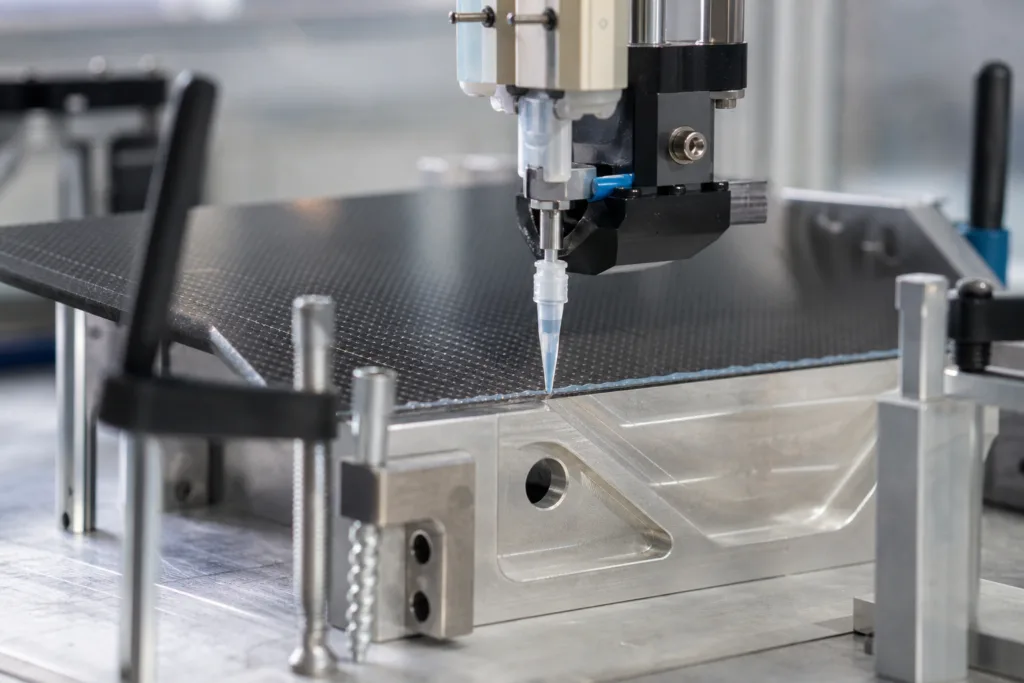
For many engineering buyers, epoxy is the first chemistry to review because it is widely used in structural assemblies and can be formulated across a broad range of stiffness and cure profiles. Still, the final selection depends on the substrate, surface prep, and production speed. For a deeper look at the chemistry family, review epoxy adhesives manufacturer options for structural bonding alongside the actual joint requirements.
Some projects may also be suitable for a specific formulated product such as ZDS-703AB-1 structural epoxy adhesive for demanding assemblies, but only after the application, service environment, and documentation requirements have been reviewed. A named product should never be treated as automatically correct for every carbon fiber-to-metal joint.
Applications in automotive, drones, industrial frames, and lightweight equipment
Carbon fiber-to-metal bonding appears in lightweight supports, vehicle components, industrial equipment, UAV structures, and other assemblies where stiffness-to-weight ratio matters. In automotive and mobility programs, vibration and temperature cycling often dominate the qualification plan. In drones and aerial equipment, weight and dynamic loading can be key. In industrial frames, long-term dimensional stability and maintenance access may matter more.
These use cases all share one requirement: the adhesive must fit the assembly process, not just the part drawing. If production requires short handling time, clean dispensing, or local repairability, that will influence chemistry choice as much as structural performance.
Design considerations for joints exposed to vibration, heat, and moisture
Even a well-prepared joint can fail if the design ignores service exposure. Vibration can gradually loosen edge areas or initiate microcracks. Heat can accelerate stress relaxation or aging. Moisture can attack weak boundaries, especially if the bond line has contamination or incomplete wetting. The joint should therefore be designed with enough overlap area, controlled geometry, and appropriate sealing where needed.
Buyers should also consider assembly orientation. A bond line that performs well in a controlled bench trial may behave differently when gravity, clamping access, or cure schedule changes on the factory floor. For that reason, validation should include the real substrate finish, real fixturing, and the expected environmental exposure, not just laboratory coupons.
Common failure modes under vibration and temperature cycling
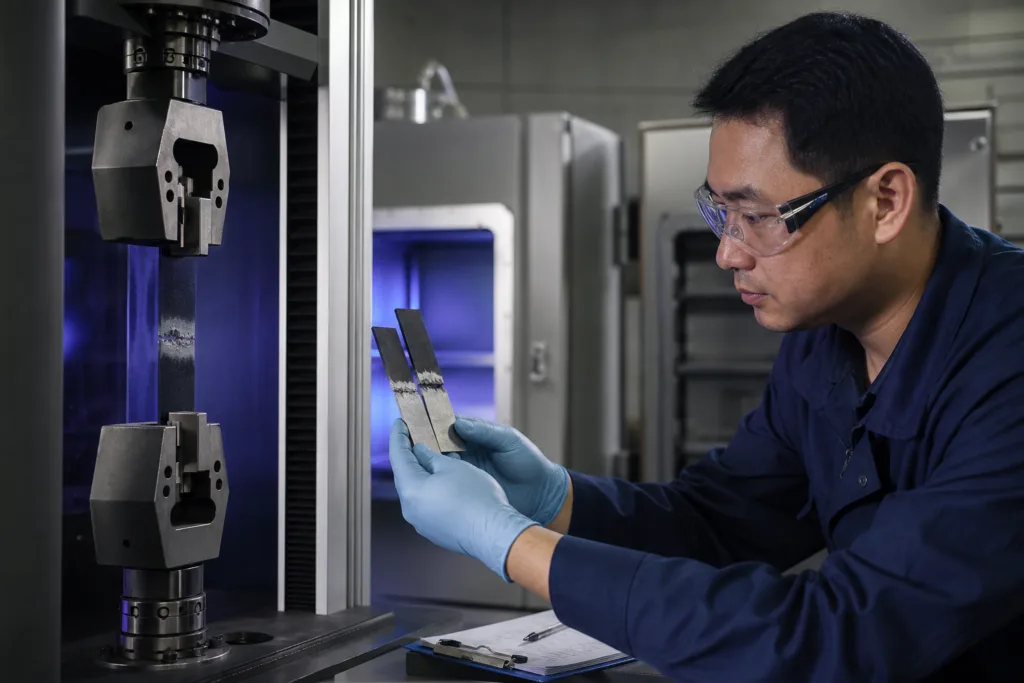
Typical failure modes include adhesive failure at the interface, cohesive failure within the adhesive layer, fiber-side damage on the composite, and substrate-side issues on the metal. Each mode tells a different story. Interfacial failure may indicate contamination or poor activation. Cohesive failure may mean the adhesive is being stressed beyond its design window. Substrate damage can show that the bond is stronger than the base material in that specific condition, but it still needs engineering review.
When failures appear after cycling, the root cause is often not one single factor. It may be a combination of insufficient surface prep, too-stiff adhesive behavior, or a joint geometry that concentrates stress at the ends. A structured failure review is more useful than a simple pass/fail label.
How to evaluate bond performance through testing and sample validation
Testing should begin with representative coupons or parts that match the intended substrates, surface prep, and bond geometry. The goal is to confirm that the selected adhesive can be processed consistently and will survive the expected service conditions. That usually means checking static strength, environmental exposure, vibration sensitivity, and after-aging retention as required by the project.
Where projects are highly demanding, buyers can use published qualification frameworks as a model for planning. The external reference on qualification and thermal-cycling requirements for adhesive-bonded joints is a useful example of the kind of discipline needed for critical bonded structures, even outside aerospace.
Representative testing should also confirm manufacturing practicality. A product that performs in a lab but is difficult to meter, mix, dispense, or cure on your line creates procurement risk. Validation should therefore include both mechanical performance and process repeatability.
| Decision area | What to confirm | Why it matters |
|---|---|---|
| Substrates | CFRP layup, metal type, coatings, and surface finish | Different surfaces require different prep and wetting behavior |
| Loading | Static, impact, peel, shear, vibration, and fatigue exposure | Load type drives adhesive stiffness and toughness needs |
| Thermal exposure | Operating range, thermal cycling, and cure-cooldown history | Movement mismatch can create edge stress and long-term fatigue |
| Process | Mixing, dispensing, open time, fixturing, and cure method | Production compatibility affects consistency and throughput |
| Documentation | TDS, SDS, and any compliance documents for the selected grade | Buyers need current documents before approval |
What buyers should ask before choosing a supplier
Before selecting a carbon fiber to metal adhesive supplier, procurement and engineering teams should request enough information to reduce technical and supply risk. The best discussion is specific, not generic. A supplier can only evaluate the project properly when the full joint context is shared.
- What are the exact carbon fiber laminate type, metal substrate, and any coatings or primers?
- What joint geometry, overlap area, and bond-line target are planned?
- What loads will the assembly see: shear, peel, vibration, impact, or fatigue?
- What are the operating temperature range and any thermal cycling conditions?
- Will the joint see humidity, salt spray, fuels, oils, or cleaning chemicals?
- What surface preparation steps are already available on the production line?
- What dispensing, mixing, or cure equipment will be used?
- Is the goal prototype validation, pilot production, or recurring bulk supply?
- What technical documents are required before approval?
These questions help the supplier decide whether a structural epoxy, a tougher modified system, or another formulation family should be considered. They also help determine if a standard product is enough or if the project needs more specific matching support. ZDS LTD can review this information and discuss the supply route, documentation, and packaging format once the application is defined.
How ZDS LTD helps customers evaluate carbon fiber-to-metal adhesives
ZDS LTD supports mixed-material bonding projects by reviewing substrates, surface condition, process requirements, and service conditions before recommending a chemistry direction. That may include comparing epoxy options, discussing application method, or aligning the product format with the production line. For projects that need structural epoxy sourcing, the team can review product families and documentation expectations through the epoxy adhesives manufacturer options for structural bonding page and related technical discussion.
Where a specific product is being considered, ZDS LTD can help evaluate whether it fits the requested joint design and whether sample testing is the right next step. The point is not to force a generic answer, but to reduce selection risk before trial work begins. Buyers should still confirm the current technical data sheet, safety data sheet, and any applicable compliance documents for the exact grade under review.
If your project involves a carbon fiber structure bonded to aluminum, steel, or another metal, share the substrate details, loading profile, thermal exposure, and production requirements. ZDS LTD can then review whether the project is better served by an existing product, a formulation discussion, or a private-label and packaging conversation aligned to your process.
Frequently Asked Questions
What is the biggest risk in carbon fiber to metal bonding?
The biggest risk is usually the combination of thermal expansion mismatch and poor surface preparation. Together they can create peel stress, interface weakness, and early fatigue. Joint geometry and adhesive selection also matter, so the assembly should be evaluated as a system.
Is epoxy always the right carbon fiber to metal adhesive?
No. Epoxy is often a strong starting point for structural bonding, but the right choice depends on the substrates, loads, production speed, and environmental exposure. A tougher or more flexible formulation may be better in some projects, so the selected product must be confirmed against the actual application.
What surface preparation should be done before bonding?
At minimum, both the carbon fiber and metal sides should be cleaned and prepared so the adhesive can wet a sound surface. The exact method depends on the metal type, coating, laminate finish, and production process. Buyers should confirm the recommended prep method with the supplier and validate it on representative parts.
How should a buyer validate a new bonding system?
Use representative parts or coupons with the real substrates, bond geometry, and surface prep. Then check mechanical performance and environmental exposure relevant to the job, such as vibration or thermal cycling. The goal is to confirm both bond strength and process repeatability before production release.
What information should be sent to ZDS LTD for review?
Share the substrate types, coatings, joint design, loading conditions, operating temperature range, environmental exposure, production method, and any document requirements. With that information, ZDS LTD can review chemistry options, packaging format, and sample evaluation needs for the project.