
Stable EV battery production depends on more than choosing an adhesive with the right chemistry. In automated lines, battery adhesive dispensing has to support bead shape, cycle time, substrate variation, and cure behavior without creating downtime or rework. When the adhesive is too thin, too fast, too slow, or too sensitive to temperature change, the line shows it immediately through bead collapse, stringing, poor coverage, or inconsistent fill.
If your project involves pack sealing, module bonding, potting, or thermal interface management, battery adhesive manufacturing support for EV pack assembly can help connect material choice to production reality. From our manufacturing perspective, the right answer is usually not a single property target but a balanced specification: viscosity that runs through the equipment, open time that matches takt time, cure speed that fits the assembly rhythm, and a formulation that stays consistent from sample to mass production.
Why Battery Adhesive Dispensing Depends on Process Control
Battery lines are unforgiving because the adhesive is often doing more than one job at once. It may need to seal against moisture, bond dissimilar substrates, manage vibration, and keep up with a high-speed automated station. In that environment, process control matters as much as bond strength. A formulation that looks excellent on a datasheet can still fail in production if the bead profile changes with temperature, if the mixer holds too much dead volume, or if the adhesive skins before placement is complete.
For EV battery programs, we usually evaluate the dispensing process in terms of repeatability, not just performance. Repeatability means the adhesive can be pumped, metered, and placed in the same way shift after shift, even when ambient conditions change slightly. It also means the material tolerates normal pauses, start-stop events, and equipment variation without becoming difficult to restart. That is why battery adhesive dispensing should be treated as a process-control topic, not just a materials-selection topic.
The production questions engineers should ask first
- Will the adhesive keep a stable bead during long runs and short pauses?
- Does the line require a wide-area spread, a narrow bead, or multiple metered dots?
- Can the material tolerate the actual fixture time and cure window on the line?
- Will substrate dust, oil, or surface energy variation affect wetting and adhesion?
How Viscosity, Filler Loading, and Rheology Affect Pumpability and Bead Stability
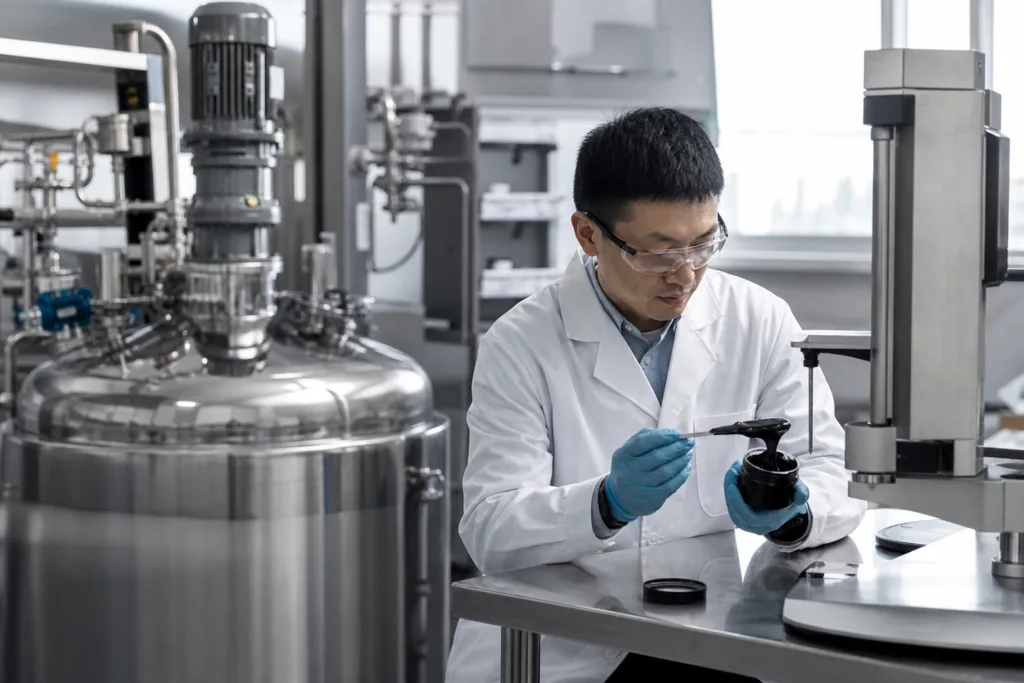
Viscosity is only one part of the story. In battery production, rheology often matters more because the adhesive is exposed to shear in pumps and mixers, then has to recover enough structure to hold its shape after deposition. We use rheology to describe how a material flows under force and how it rebuilds after that force is removed. The NIST rheology terminology guide is a useful reference when teams want to use terms like thixotropy and shear thinning precisely, because those behaviors are central to bead control and stop-start consistency.
Filler loading also changes the process picture. Fillers can improve thermal performance, reduce shrinkage, or modify mechanical behavior, but they can also raise pump load, increase abrasion inside the equipment, and make nozzle selection more sensitive. A heavily filled adhesive may deliver the performance target, yet still require a different pump type, larger nozzle ID, higher dispense pressure, or slower line speed to stay stable. That is why adhesive selection and equipment selection should be done together.
| Material trait | What it does on the line | What buyers should confirm |
|---|---|---|
| Low viscosity | Flows easily but may spread or sag | Bead hold, edge control, and gap behavior |
| High viscosity | Holds shape better but is harder to pump | Pressure capability, nozzle size, and temperature sensitivity |
| Thixotropic structure | Shears during dispensing, then recovers after placement | Stop-start stability and anti-slump performance |
| High filler loading | Can improve thermal or mechanical performance | Abrasion, clogging risk, and uniform mixing |
Matching Adhesive Chemistry to the Battery Application
Different battery tasks need different balances of flexibility, hardness, cure speed, and environmental resistance. For structural bonding around packs or components that see vibration and repeated thermal cycling, a polyurethane approach may be attractive because it can combine toughness with some movement tolerance. For programs where flexibility and impact resistance matter, ZDS-pu925 high-strength PU adhesive for power batteries represents the kind of battery-specific material profile buyers often compare during qualification.
For thermal path management, the adhesive must do a different job. It needs to transfer heat while remaining dispensable, electrically safe when required, and stable across the cure profile. That is where thermally conductive adhesive solutions for heat-sensitive assemblies become relevant. A heat-focused adhesive usually trades off some workability for thermal performance, so the line team should verify whether the chosen product still fits the nozzle, bead width, and open time needed by the process.
Potting and encapsulation add another layer of complexity. The material must flow into irregular spaces, release trapped air, and cure without voids or excessive shrinkage. It also has to protect cells, busbars, sensors, or control modules from moisture, dust, vibration, and mechanical shock. The key is to match the chemistry to the job rather than forcing one material family to cover every battery operation.
Wide-Area Application vs Localized Bonding
Some EV battery operations need a continuous seal or coverage layer across a broad area, while others need localized dots, short beads, or edge bonding. Wide-area application is usually more sensitive to sag, leveling, and cure uniformity. Localized bonding is usually more sensitive to bead initiation, cut-off, and positional accuracy. The adhesive can be excellent in one pattern and troublesome in the other if the rheology and dispense hardware are not aligned.
In our development work, we compare application patterns early because they change the demands on the material. A wide-area seal wants good leveling without runout. A localized bond wants fast shape recovery and clean stop-start behavior. If the wrong pattern is chosen, the line may compensate with extra process steps, but that usually adds cost and variability rather than solving the root issue.
| Application pattern | Typical use | Main risk |
|---|---|---|
| Continuous bead | Sealing, perimeter bonding, edge protection | Stringing, sag, and overlap variation |
| Discreet dots | Component placement, localized fixing | Dot size drift and placement accuracy |
| Wide spread | Thermal interface or large-area coverage | Air entrapment and thickness inconsistency |
| Potting fill | Protection of modules and electronics | Void formation and overflow control |
Open Time, Fixture Time, and Assembly Rhythm in Automated Battery Production
Open time and fixture time define how well a material fits the actual rhythm of the line. If the adhesive begins to set before the part is seated, the line may see poor wetting or misalignment. If it stays open too long, the assembly can drift, move under its own weight, or require longer downstream holding time. For two-part systems, the practical question is not only how long the material remains usable after mixing, but also how long it remains workable under the real conditions of the plant. An ISO reference for pot life, working life, and automation window for two-part adhesives is useful because it reinforces the distinction between lab measurements and production usability.
Open time should be matched to the full process path: dispense, travel, part placement, compression, and any pre-cure dwell. If the line has a robotic cell plus a manual subassembly station, the adhesive must survive both operating tempos. For that reason, buyers should share the complete takt flow with the supplier, not just the target cure time. A small mismatch in working time can become a large productivity loss when the line runs at scale.
How Equipment and Cure Profile Influence Consistency
Dispensing equipment can magnify or reduce material problems. Gear pumps, screw pumps, pressure pots, and progressive cavity systems all interact differently with filler-heavy materials and shear-sensitive formulations. Nozzle design affects bead width, pressure drop, and the ability to restart cleanly after pauses. Even the temperature of the feed tank or hose can change viscosity enough to affect deposition.
Cure profile matters just as much. Heat curing can accelerate throughput, but it also tightens the window for part placement. Moisture-curing systems may simplify equipment in some cases, yet they can be sensitive to humidity and surface conditions. UV-curing materials can offer very fast cycle times where line-of-sight access exists, but battery assemblies often need shadow-area planning. The best production setup is the one that makes the adhesive behave predictably under real factory conditions, not the one that looks ideal on paper.
When customers want a broader systems view, we often point them to ZDS because the right adhesive decision is usually tied to formulation support, process matching, and supply planning together. In practice, the material choice, mixer choice, nozzle choice, and cure choice all belong in the same conversation.
Common Production Problems and What Usually Causes Them
Most dispensing defects can be traced back to a small set of process mismatches. Once you know the pattern, diagnosis becomes much faster.
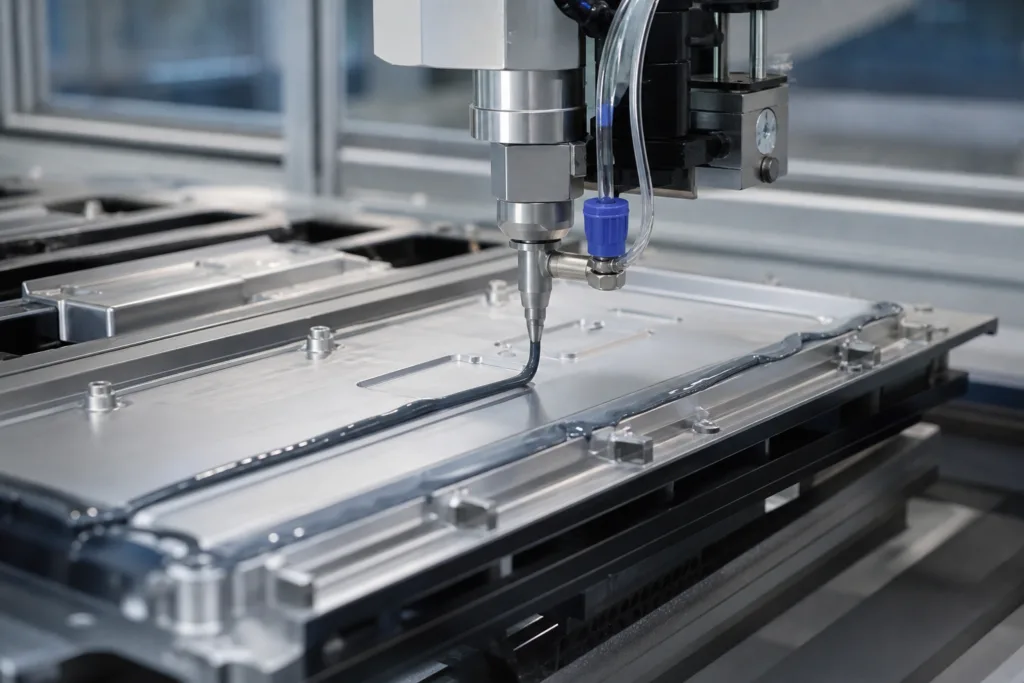
- Clogging: often linked to particle size, filler settlement, partial cure in the nozzle, or insufficient purge discipline.
- Bead collapse: usually caused by low structure recovery, excessive temperature, or a viscosity profile that is too soft for the application.
- Inconsistent coverage: can come from unstable pressure, poor calibration, or changes in substrate wetting.
- Air entrapment: commonly appears in potting and wide-area spread when the material is dispensed too fast or the venting path is poor.
- Stringing: tends to show up when cut-off is slow, the nozzle is not well matched, or the adhesive has too much elastic recovery.
These issues are not only material problems. They can also reflect a mismatch between the adhesive and the machine settings. That is why troubleshooting should always include the mixer, hose length, nozzle geometry, temperature control, and line speed, not just the adhesive datasheet.
What to Share with a Supplier Before Selecting a Battery Adhesive
Better input leads to better formulation decisions. When buyers give a supplier only a generic performance target, the first sample often misses the real process need. When they provide a complete process picture, the formulation discussion becomes much more productive and usually shortens the trial cycle.
At minimum, share the substrate list, bond line thickness, dispense pattern, operating temperature range, electrical or thermal requirements, cure constraints, and target production rate. Include whether the line uses robots, semi-automatic stations, or manual backup steps. If you are evaluating a custom or private-label program, explain the target package size, storage conditions, shelf-life expectations, and annual volume profile. For process-matched development and practical trial planning, adhesive selection technical support for process-matched dispensing helps translate those details into a workable formulation brief.
When we evaluate a project, we also ask about failure tolerance. Is the higher risk a slow cure, a bead defect, a thermal hotspot, or a moisture leak? The answer changes the priority order. Some programs want the highest thermal performance possible, while others would rather accept slightly lower conductivity in exchange for easier dispensing and higher uptime. The best specification is the one that supports the factory, not just the lab result.
Sample Testing and Validation Before Full-Scale Production
Sample evaluation should always be connected to the real line. A bench test is useful, but it is not enough if the plant uses a different nozzle, different dwell time, or a different ambient temperature. We recommend checking three things during validation: processability, performance, and consistency. Processability tells you whether the adhesive runs cleanly. Performance tells you whether the cured material meets the mechanical, thermal, or electrical need. Consistency tells you whether the result holds across multiple batches and multiple shifts.
A practical validation plan often includes bead continuity checks, weight or volume verification, cure confirmation, adhesion checks after environmental exposure, and visual inspection for voids or edge pullback. If the material is used in potting or encapsulation, examine bubble release and depth uniformity. If it is used in thermal management, confirm wetting and interface coverage after compression. If it is used in structural bonding, verify that the assembled part still meets handling and vibration expectations after cure.
How to Reduce Production Risk Through Packaging and Supply Planning
Battery production is not only about formulation performance. It is also about supply stability. Packaging format can make a major difference in line uptime. Cartridges may be convenient for lower-volume or service operations, while pails, drums, and bulk containers are better suited to sustained automated production. The best package is the one that reduces handling steps, contamination risk, and material waste.
Procurement teams should also evaluate shelf life, storage temperature, minimum order quantity, and lead time before approving a material. A product that performs well in a sample run can still create risk if it has a narrow storage window or if the supply rhythm does not fit the production forecast. For OEM and private-label programs, batch consistency is especially important because a small shift in viscosity or cure response can change line settings and cause recurring adjustment work.
How We Think About Customization for EV Battery Programs
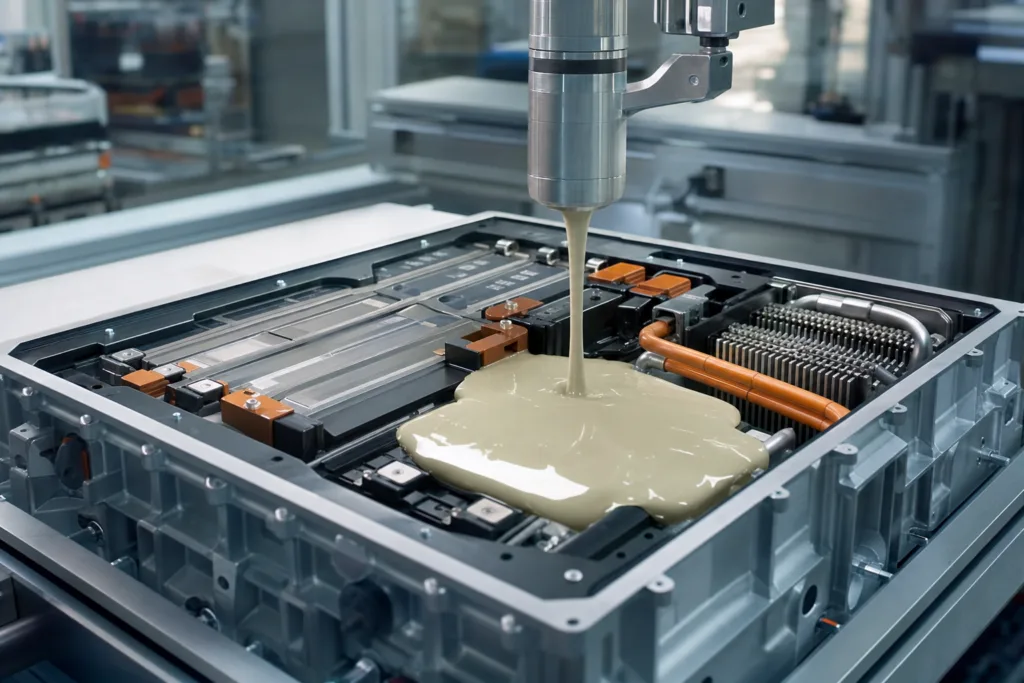
From a manufacturing perspective, battery adhesive dispensing succeeds when the formulation and the line settings are developed together. At ZDS, we usually look at customization in terms of the real constraints: target bead geometry, pump compatibility, cure schedule, thermal load, and long-term stability. That approach helps avoid the common mistake of choosing a material only by general chemistry family.
Custom formulation is often worth considering when the application has unusual thermal demands, narrow fixture windows, special packaging requirements, or a mixed substrate stack that is hard to bond consistently. In those cases, the goal is not just to make an adhesive that works in principle. The goal is to make one that works the same way every time the line runs.
Conclusion
Battery adhesive dispensing is a production discipline as much as a materials decision. The right adhesive must be pumpable, stable, and predictable while still meeting the battery pack’s sealing, bonding, thermal, or protection requirements. When viscosity, open time, bead control, and automation fit are balanced correctly, the line runs more smoothly and the risk of rework drops.
For EV battery manufacturers, the best approach is to define the process first, then match the adhesive to it. That means testing with the actual equipment, confirming cure behavior under real cycle times, and planning supply details early. When those pieces line up, the adhesive becomes a reliable part of the production system instead of a recurring source of variation.
FAQs
What makes battery adhesive dispensing different from general adhesive application?
Battery adhesive dispensing is usually tied to tighter control of bead shape, cure timing, and material consistency because the adhesive must fit automated assembly, thermal demands, and long production runs. In many EV applications, the adhesive also supports sealing, bonding, potting, or thermal management at the same time, so process stability matters as much as final strength.
How do we know whether viscosity is suitable for our line?
The best way is to test the adhesive on the actual pump, nozzle, hose, and part geometry rather than relying on a general viscosity number alone. A suitable material should move cleanly through the equipment, hold its bead after deposition, and remain stable across the full operating temperature range of the line.
Should one adhesive be used for bonding, sealing, and potting?
Sometimes one family can cover more than one task, but the requirements are often different enough that a single material becomes a compromise. Bonding may need stiffness or toughness, sealing may need flexibility, and potting may need void-free flow and insulation. The right choice depends on which requirement is most critical.
What should be checked during sample testing?
Check whether the adhesive dispenses consistently, holds its bead, wets the substrates, cures within the planned window, and meets the needed mechanical, thermal, or electrical performance after cure. For potting or wide-area applications, also look for bubble release, edge stability, and thickness uniformity.
How can we reduce stringing and bead collapse?
Start by checking nozzle design, cut-off behavior, material temperature, and the adhesive’s recovery after shear. If the material is too soft or the dispense settings are not matched to the rheology, stringing and collapse become more likely. A small change in speed, pressure, or nozzle size can make a significant difference.
What information should we share with a supplier before requesting samples?
Share the substrate list, target dispense pattern, line speed, cure method, temperature range, electrical or thermal requirement, packaging preference, and expected annual volume. The more complete the process picture, the easier it is for the supplier to recommend a material that fits both production and procurement needs.