
For many manufacturers, the real question is not whether welding is good or whether adhesives are strong enough in the abstract. The practical question is where adhesive bonding vs welding metal becomes the smarter process decision for a specific assembly, load case, finish requirement, and production environment. In our work with industrial bonding programs, we see this comparison come up most often when teams want to reduce heat distortion, improve external appearance, join thinner sections, or combine metals that are difficult to weld together efficiently.
If your project involves lightweight metal parts, painted or coated substrates, thin sheet, mixed-material assemblies, or a need for cleaner visible seams, metal bonding adhesive manufacturing support can help move the decision from theory to a testable production plan. At ZDS, we support manufacturers with formulation matching, viscosity and cure adjustment, sample evaluation, packaging options, and production consistency planning so bonded metal assemblies can be assessed against actual service conditions rather than assumptions.
Welding remains essential in many metal fabrication environments. It can create highly rigid joints, deliver immediate handling strength, and fit heavy structural designs where heat input is acceptable. But adhesive bonding has become a serious engineering option because it solves problems welding cannot solve well, especially around surface finish, dissimilar materials, vibration management, and thin-part distortion. In many assemblies, the answer is not replacement at all. It is a smarter split of functions between welds, rivets, and structural adhesives.
Why manufacturers compare adhesive bonding and welding
Manufacturers usually start this comparison when one of five pressures appears: weight reduction, visible surface quality, material freedom, rework from thermal distortion, or total process cost. Welding may be familiar, but familiarity does not always mean it is the best fit for current product design goals. As products get lighter, more compact, and more appearance-sensitive, joining methods need to support those shifts.
From our adhesive manufacturing perspective, the decision should be based on joint function, not habit. A welded joint concentrates load along a seam or spot pattern. A bonded joint can spread load across a wider area, which can reduce local stress and help protect thinner substrates. This broader load transfer is one reason designers revisit bonded metal joints when fatigue, vibration, and cosmetic finish matter.
Teams also compare joining methods because procurement and production planning are affected differently. Welding requires heat source management, operator control, distortion management, surface finishing after joining, and often secondary appearance work. Adhesive bonding introduces different variables: surface preparation, bond line control, cure schedule, and inspection planning. Neither route is inherently simpler in every case; each shifts where process discipline is required.
What welding does well in metal assemblies
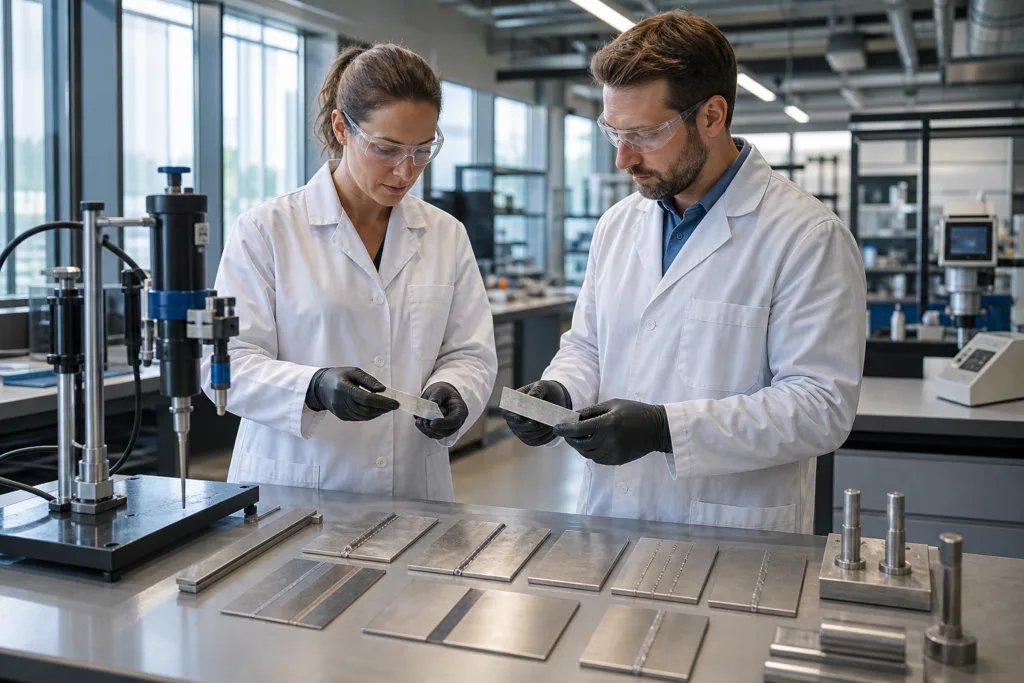
Welding still performs extremely well when the design demands a rigid metallic connection, high-temperature service beyond adhesive capability, or very fast post-join handling without cure delay. It is especially practical when the materials are weld-compatible, section thickness is sufficient, and cosmetic post-finishing is already built into the manufacturing flow.
Welding is often a strong fit for:
- thick-section steel structures
- frames where joint rigidity is the top priority
- applications exposed to very high continuous temperatures
- fabrication lines already optimized around welding cells
- assemblies where visible weld seams are acceptable or hidden
It also has the advantage of familiarity in many factories. Process windows, operator expectations, and inspection methods are often already established. That matters. A joining process does not succeed in production just because the chemistry or metallurgy is sound; it succeeds when the factory can repeat it consistently.
What adhesive bonding can improve in metal joining
The strongest case for adhesive bonding appears when the joint needs more than raw rigidity. Adhesives can help improve stress distribution, appearance, corrosion isolation, thin-substrate compatibility, and the joining of metals that are awkward to weld together. Industry design guidance on why structural adhesive joints can improve load distribution and corrosion isolation aligns with what we see in application development: a bonded interface often creates options that a heat-based joining method limits.
In practical terms, adhesives can improve metal assembly by:
- reducing localized heat input
- avoiding burn-through on thin gauges
- preserving coatings or appearance-critical surfaces in some designs
- joining dissimilar metals with less galvanic and thermal mismatch concern
- creating smooth exterior surfaces without weld marks
- adding damping against vibration and impact
- supporting lighter designs by reducing the need for overlapping reinforcement or heavy mechanical joining features
For engineering teams choosing adhesive for industrial metal assembly, the key is to match the chemistry and cure profile to the real use case rather than assuming all metal adhesives perform alike. Acrylics, epoxies, polyurethanes, and hybrid systems each handle toughness, speed, flexibility, and environmental exposure differently.
Dissimilar metals and greater material freedom
One of the most useful differences in adhesive bonding vs welding metal decisions is material flexibility. Welding generally prefers compatible metals and often penalizes combinations with different melting behavior, coating systems, or thermal expansion characteristics. Adhesive bonding opens the door to combinations such as aluminum to steel, stainless to coated steel, or metal to composite-backed assemblies where direct welding is impractical or damaging.
This matters in lightweight product development. Designers may want aluminum for weight, stainless for corrosion resistance, and coated steel for cost control in the same assembly. Adhesives can act as a joining layer and an isolation layer at the same time. In some assemblies, that helps reduce direct metal-to-metal contact that may otherwise accelerate corrosion risk when moisture is present.
The trade-off is that dissimilar-metal bonding usually demands more careful surface review, adhesion testing, and environmental validation. A concept can look attractive on paper but fail if oxide layers, oils, conversion coatings, or sealants interfere with wetting and adhesion.
Reduced distortion and lower heat input for thin or sensitive parts
Thin sheet metal, decorative outer panels, precision housings, and assemblies with tight dimensional control often expose the limits of welding. Heat can warp the part, alter fit-up, damage nearby finishes, or create visible surface marking that requires grinding and refinishing. Bonding avoids direct thermal stress on the joint area, which is often the biggest practical reason manufacturers evaluate conversion.
We commonly advise teams to focus not only on whether distortion exists, but on what distortion costs. If rework, straightening, cosmetic repair, or reject rate increases because of heat input, adhesive bonding may produce a better total manufacturing result even if the adhesive itself is not the lowest-cost line item.
This is also where product-specific evaluation matters. Some programs benefit from tough acrylics with faster fixture speed, while others need more temperature-resistant epoxies. For example, ZDS-8100AB acrylic structural adhesive for versatile bonding reflects the kind of option engineers may consider when they need a structural bonding route with practical handling characteristics for metal assemblies.
Thinner substrates, lower weight, and cleaner appearance
Welding often drives design compromises. To avoid burn-through or maintain weld integrity, teams may select thicker material than the final product truly needs. They may also add flanges, overlap width, or reinforcement features to support welding access and seam quality. Adhesive bonding can reduce some of those constraints, allowing more freedom in thin-gauge design and visible-surface finishing.
Because bonded joints do not require weld beads on the exterior, the finished appearance can be much smoother. This is valuable in consumer-facing products, appliances, transportation interiors, enclosures, architectural components, and appearance-sensitive equipment housings. Adhesives can also reduce the need for grinding and filling operations that add labor and variability.
From a production standpoint, a cleaner exterior finish may be more than cosmetic. It can simplify downstream coating or painting by removing weld-related surface irregularities. In assemblies where the external skin is part of the product value, that can justify serious comparison work.
When adhesives can replace welding
Adhesives can replace welding when the joint is designed for bonding, the service temperature is within adhesive limits, the surfaces can be prepared consistently, and the load profile suits bonded performance. The best candidates are not always the heaviest-looking parts. They are often parts where loads are spread over area, peel stress can be minimized, and the product benefits from lower heat input or better appearance.
Good candidates often include:
- panel bonding and skin attachment
- covers, housings, and enclosures
- stiffener-to-panel assemblies
- mixed-metal brackets with distributed loads
- vibration-prone assemblies where a more damped joint is useful
- products where visible weld marks are undesirable
That said, replacement should never be approved by headline strength alone. Lap shear numbers are only one part of the decision. A bonded joint may test well in shear but fail early if the geometry creates peel, cleavage, or sustained edge loading. This is why conversion programs need both design review and application testing.
Teams exploring when manufacturers can replace mechanical joining should evaluate whether the adhesive is carrying the primary structural load, sealing while another feature carries the load, or doing both. These are different design questions and they should not be blended together.
Load profile, joint design, and service environment requirements
A bonded metal joint performs best when the design keeps the adhesive mainly in shear or compression over a broad area. It performs less favorably when the joint forces concentrated peel or cleavage at an edge. This is one of the biggest mindset changes when moving from welding to bonding: the joint geometry must be designed to help the adhesive succeed.
| Design factor | Usually favors welding | Usually favors adhesive bonding |
|---|---|---|
| Very high service temperature | Yes | Usually no, unless within adhesive capability |
| Thin visible outer panel | Often difficult | Often favorable |
| Dissimilar metals | Often limited | Often favorable with validation |
| Immediate no-cure handling | Yes | Needs fixture or cure strategy |
| Smooth external finish | Requires post-finishing | Often favorable |
| Large-area stress distribution | Localized seam or spots | Often favorable |
Engineers should review:
- static versus dynamic loading
- shear, peel, and cleavage exposure
- continuous versus intermittent temperature
- water, oils, fuels, cleaners, or salt exposure
- vibration frequency and amplitude
- coefficient of thermal expansion mismatch
- joint gap and bond line thickness control
At ZDS, we normally recommend discussing failure mode targets early. If a team expects the bonded interface to survive impact, thermal cycling, and vibration while preserving appearance, the adhesive must be selected for toughness and environmental durability, not just nominal strength.
Strength, peel, shear, and fatigue in bonded metal joints
Comparing adhesives with welds only by ultimate strength is misleading. Welds and bonded joints fail differently, distribute load differently, and respond differently to cyclic stress. Bonded joints often shine in fatigue-sensitive designs because they spread stress instead of concentrating it at a weld toe or localized joint point. But they also depend more heavily on stable bond line geometry and process consistency.
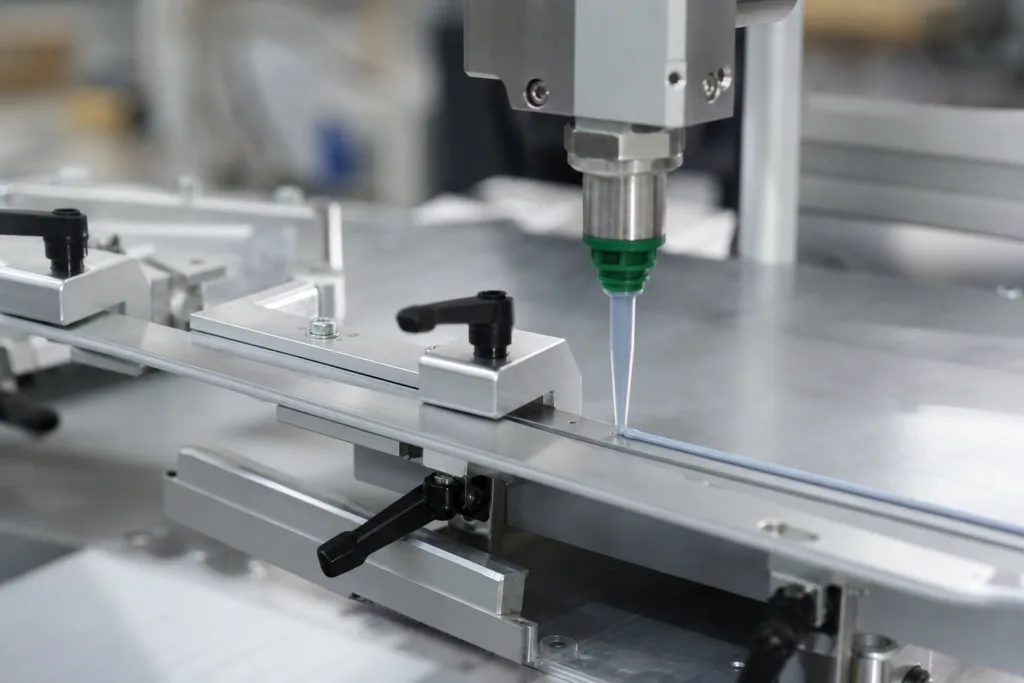
Engineers typically validate metal-bonded joints with test methods matched to the real failure risks, including shear, peel, impact, creep, and fatigue. A useful summary of common test standards used to evaluate adhesive-bonded metal joints helps explain why qualification should not stop at a single coupon test. In our project work, production-representative test panels are often more revealing than ideal lab-only samples.
If the assembly sees edge peel, vibration, or impact, tougher systems may outperform more brittle high-strength chemistries. For example, ZDS-282AB high-strength epoxy adhesive for bonding reflects the type of material a team may assess when stiffness, heat resistance, and strong metal adhesion matter, but the final selection still depends on geometry and environment.
Temperature, moisture, vibration, and chemical exposure limits
Service environment is often the deciding factor in whether glue can replace welds or only complement them. Adhesives have real limits, and those limits must be respected. High continuous temperature, aggressive solvents, hot oil exposure, or large thermal cycling swings can shift the decision away from full adhesive replacement or toward a hybrid solution.
Questions we ask during evaluation include:
- What is the normal operating temperature and the short-term peak?
- Will the joint see water immersion, condensation, or high humidity?
- Are cleaners, fuels, oils, or process chemicals present?
- Is the assembly subject to vibration, impact, or shock?
- Will the product be painted, baked, or heat-cycled after bonding?
Moisture and heat do not automatically rule out adhesive bonding, but they do narrow the chemistry options and raise the importance of long-term aging tests. Procurement teams should also ask whether the chosen adhesive has acceptable shelf life, packaging format, and storage requirements for the plant’s actual inventory flow.
Surface preparation and contamination control for reliable bonding
Surface preparation is where many promising bonding programs succeed or fail. Metals may carry oil, oxide, passivation residue, drawing compound, fingerprints, conversion coating variation, or laser-cut contamination that interferes with adhesion. Even a strong adhesive cannot compensate for an unstable interface.
That is why qualification work should define cleaning method, abrasion or activation if needed, drying conditions, time window before bonding, and acceptance criteria for prepared parts. The ASTM guidance for preparing metal surfaces before adhesive bonding is a useful reference point because it highlights how preparation methods vary by alloy type and why the process must be controlled rather than treated casually.
In production, contamination control usually matters as much as the chemistry itself. We encourage teams to document who cleans, what solvent or wash process is used, whether gloves are required, how long parts can sit before bonding, and how rework is handled. Small gaps in this routine often explain inconsistent field results.
When hybrid joining is more realistic
Many successful metal assembly programs use hybrid joining rather than pure replacement. Adhesive plus rivets, adhesive plus spot welds, or adhesive plus localized mechanical retention can combine the strengths of each method. The adhesive distributes load, damps vibration, seals the interface, and improves appearance. The secondary joining method provides immediate fixture, redundancy, or confidence in abusive service conditions.
Hybrid joints are often realistic when:
- the assembly must be handled before full cure
- the product sees occasional overload beyond normal design load
- the customer wants visible process security during transition from welding
- the line already includes fastening or spot welding stations
- seal integrity and structural retention are both required
This route can be especially useful in conversion programs where teams want to reduce weld count instead of eliminating welding entirely. Lower weld density may still reduce distortion, surface finishing work, and material thickness requirements while preserving familiar process checkpoints.
Design considerations before conversion
Before converting a welded metal assembly to adhesive bonding, we suggest reviewing the design through four filters: substrate condition, joint geometry, cure compatibility, and inspection strategy. These are the practical gates that determine whether conversion is robust or fragile.
Metal type and surface treatment selection
Aluminum, galvanized steel, stainless steel, painted metal, and plated surfaces all present different bonding behavior. Surface treatment consistency is often more important than nominal metal type. A stable coated surface may bond more predictably than a bare surface with uncontrolled oxidation.
Joint geometry, bond line thickness, and clamping
Bond lines that are too thin may starve the joint, while bond lines that are too thick can reduce strength or slow cure depending on chemistry. The joint should support wetting, adhesive coverage, and repeatable spacing. Temporary clamping or fixturing should prevent movement without squeezing out too much material.
Cure speed, handling strength, and cycle time
An adhesive may be technically suitable but operationally poor if it does not fit the factory cycle. Open time, fixture time, room-temperature cure, heat acceleration, and dispensing method all need review. What works in a lab may bottleneck a line if cure progression does not match takt time or available floor space.
Inspection, testing, and QC before scale-up
We recommend a staged validation path: lab coupons, production-like assemblies, environmental aging, process capability checks, and then pilot production. QC should include mix ratio control for two-part systems, dispense consistency, surface cleanliness checks, cure verification, and destructive audit testing at defined intervals.
Cost-performance trade-offs and total manufacturing impact
Adhesive cost per kilogram does not answer the joining economics question. Manufacturers should compare total process impact: rework, cosmetic finishing, scrap, line speed, fixturing, energy, surface preparation labor, operator training, and warranty risk. In some programs welding remains clearly more economical. In others, bonding reduces enough secondary work that the total result improves even if the material cost is higher.
Procurement teams should also look at supply format. Cartridge, pail, drum, or static-mix packaging affects waste, labor, and equipment planning. OEM and private label programs may also need label format, batch traceability, and shelf-life planning aligned with customer delivery schedules.
| Cost driver | Questions to ask |
|---|---|
| Material usage | What bead size, bond line, and waste rate are realistic? |
| Equipment | Will dispensing, fixturing, or cure acceleration equipment be required? |
| Surface prep | Can current cleaning steps support adhesive reliability? |
| Rework | Does bonding reduce distortion or appearance-related rework? |
| Throughput | Can cure and fixture time fit the line layout? |
| Quality risk | What inspection method will catch process drift early? |
How we evaluate adhesive-based metal assembly strategies
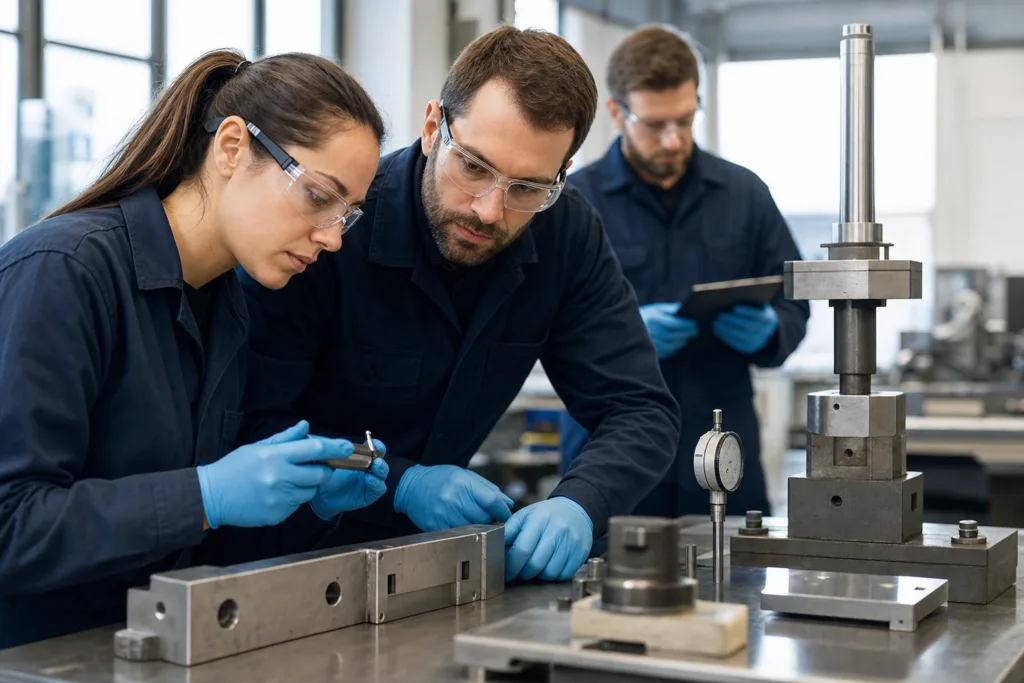
At ZDS, we approach metal assembly projects by starting with the assembly function, not with a one-size-fits-all product recommendation. We review the metals involved, the expected load path, the service environment, the line process, and the appearance target. From there, we narrow likely adhesive families, define surface preparation assumptions, and recommend sample testing that reflects real use.
For some customers, the right answer is a faster-curing acrylic for production efficiency. For others, it is a more temperature-resistant epoxy or a hybrid joint with limited welds retained. We also see OEM and private label buyers needing packaging changes, viscosity adjustments, or cure-speed tuning to match their own equipment and assembly flow.
The most reliable programs are the ones that treat conversion as an engineering project rather than a product substitution. That means agreeing on pass-fail criteria, testing prepared parts rather than idealized surfaces, and evaluating bulk production consistency before the line is committed.
Conclusion
In the debate over adhesive bonding vs welding metal, there is no universal winner. Welding remains highly effective for many structural and high-temperature assemblies. Adhesive bonding becomes compelling when manufacturers need lower heat input, smoother appearance, lighter designs, broader material combinations, or better stress distribution. The right decision comes from joint design, environmental validation, surface control, and process fit, not from habit or headline strength values.
For manufacturers evaluating whether glue can replace or complement welding, the most useful next step is usually a structured trial: define the load case, prepare production-representative surfaces, test likely adhesive families, and compare not only strength but also distortion, finish quality, throughput, and total manufacturing impact.
FAQs
Can adhesive bonding really replace welding in metal assemblies?
Yes, in some assemblies it can, but only when the joint is designed for bonding, service temperature stays within adhesive limits, surface preparation is controlled, and the load profile is suitable for a bonded interface. It is most realistic for panels, housings, covers, stiffeners, and mixed-metal assemblies where distributed load, appearance, and low distortion matter more than extreme heat resistance.
Are bonded metal joints strong enough for vibration and fatigue?
They can be, and in some designs they perform very well because adhesives spread stress over a larger area and can add damping. The important point is that fatigue performance depends heavily on joint geometry, adhesive toughness, and edge stress control. Validation should include vibration and cyclic loading tests that reflect the actual assembly, not only simple static strength coupons.
What surface preparation is usually needed before bonding metal?
Most metal bonding projects require removal of oil, dust, oxide, and process residue, followed by a defined cleaning and handling routine. Depending on the substrate, that may include solvent cleaning, alkaline washing, abrasion, activation, or priming. The exact method should be qualified for the specific alloy and coating because uncontrolled surface variation is a common cause of inconsistent bond performance.
When is a hybrid joint better than adhesive alone?
Hybrid joining is often better when immediate fixture strength is needed, when the assembly may see occasional overload, or when a production team wants added confidence during conversion from welding. Combining adhesive with rivets, spot welds, or localized fasteners can provide redundancy while still improving load distribution, sealing, and visible surface quality.
How should procurement teams evaluate a metal bonding adhesive supplier?
Procurement should look beyond quoted price and ask about formulation stability, batch consistency, packaging options, shelf life, technical response speed, sample support, and whether the supplier can help align adhesive choice with substrates, cure conditions, and production equipment. A capable manufacturer should also be able to discuss QC checkpoints and realistic validation steps before scale-up.
What is the biggest mistake in adhesive bonding vs welding metal comparisons?
The most common mistake is comparing a welded joint and a bonded joint as if they work the same way. They do not. Many weak results come from copying the weld geometry and simply adding adhesive. A fair comparison requires redesigning the joint for bonded load transfer, controlling surface preparation, and testing under the actual environmental and mechanical conditions the assembly will face.