
Electronics assemblies use metal parts for far more than simple fastening. Heat sinks manage thermal load, shielding cans control EMI, brackets hold mechanical position, and housings protect sensitive circuits from shock, moisture, and contamination. Choosing the right metal adhesive for electronics means balancing bond strength with thermal behavior, electrical function, process efficiency, and long-term reliability. In our formulation and production work, we often find that the correct choice is not just about sticking two parts together; it is about managing heat, stress, insulation, corrosion risk, cure speed, and assembly consistency across real manufacturing conditions.
If your project involves aluminum heat sinks, stainless shielding parts, coated brackets, or mixed-material electronic housings, our metal bonding solutions for electronics are typically evaluated against the full production context rather than bond strength alone. That includes viscosity for dispensing, fixture time for throughput, thermal transfer needs, insulation or conductivity requirements, environmental exposure, and packaging format for pilot runs or bulk supply. This kind of early selection logic helps manufacturers reduce rework, shorten sample cycles, and align the adhesive formula with both performance targets and line conditions.
Why electronics use metal bonding for more than structural fixation
Mechanical fasteners still have an important place in electronics, but adhesives can solve problems that screws, clips, and welding often cannot solve cleanly. Adhesives help distribute stress, reduce galvanic issues in some assemblies, limit vibration noise, seal against dust and moisture, and simplify low-profile designs where space is tight. In many products, the adhesive becomes part of the thermal path, dielectric system, or assembly tolerance strategy.
For electronics manufacturers, this changes the buying decision. A metal adhesive may need to hold a bracket, but it may also need to resist heat from nearby power devices, avoid shorting circuits, cure without damaging sensitive components, and remain stable under thermal cycling. That is why we recommend defining the function of the bond line before narrowing down chemistry.
Where metal adhesives are used in electronics
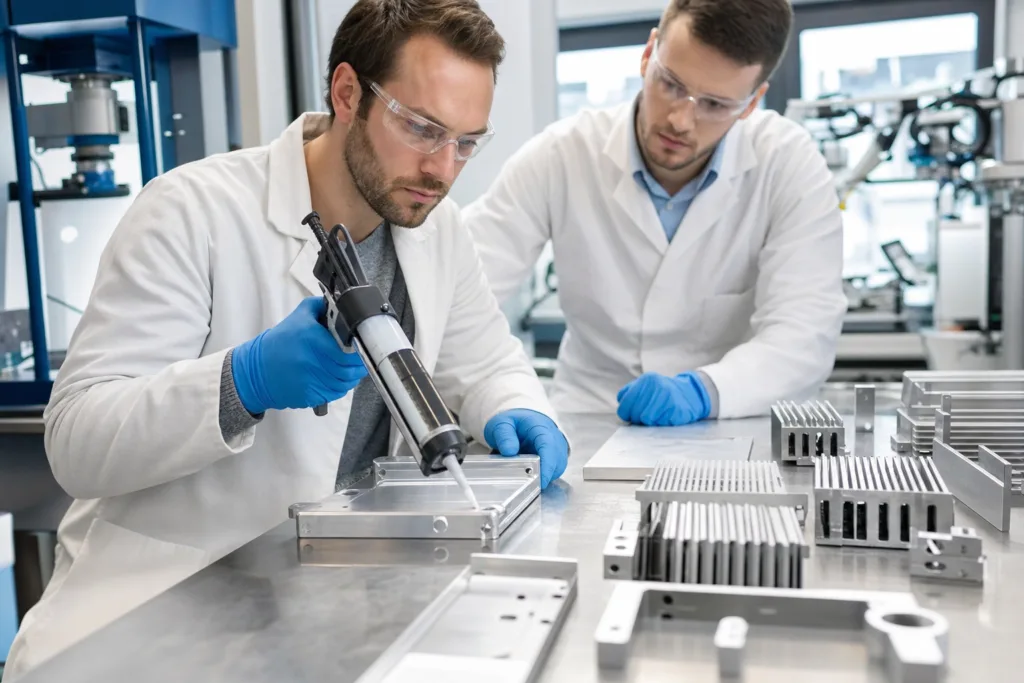
Common applications include:
- Bonding heat sinks to metal frames or component carriers
- Attaching EMI shielding parts and shielding covers
- Fixing brackets, clips, reinforcement plates, and stiffeners
- Sealing or bonding metal housings, lids, and enclosures
- Joining metal inserts to polymer or composite electronics parts
- Securing small metal components where welding would distort parts or damage nearby assemblies
These applications do not all need the same adhesive family. Some prioritize thermal transfer, some dielectric insulation, some peel resistance on thin gauge metal, and others demand low-stress flexibility under vibration. This is where application-specific selection becomes more valuable than choosing a generic “metal glue.”
What makes a metal adhesive suitable for electronics applications
A suitable electronics adhesive should match the assembly in five ways: substrate compatibility, process compatibility, thermal behavior, electrical behavior, and reliability profile. We usually assess these points together because a strong bond in one condition can still fail if the adhesive is too rigid, too insulating, too conductive, too slow to cure, or too difficult to dispense consistently.
| Requirement area | What buyers should review | Why it matters in electronics |
|---|---|---|
| Substrate fit | Aluminum, stainless steel, plated steel, coated metal, mixed material | Surface energy, oxide layers, and coatings affect wetting and adhesion |
| Thermal profile | Thermal conductivity, heat resistance, thermal cycling stability | Heat sinks and enclosures often see repeated heating and cooling |
| Electrical profile | Insulating or conductive behavior, dielectric needs, EMI role | Prevents shorts or supports grounding and shielding strategy |
| Mechanical profile | Shear, peel, impact, vibration, toughness, flexibility | Thin metals and assembled products face stress concentration |
| Process fit | Viscosity, pot life, open time, fixture time, cure method | Determines line speed, automation fit, and repeatability |
Conductive vs. non-conductive bonding
One of the most important early decisions is whether the bond line should conduct electricity or insulate against it. Many electronics assemblies require non-conductive bonding because the adhesive is close to traces, terminals, or exposed leads. In those cases, dielectric safety and stable insulation are critical.
Conductive systems are different. They may be selected when the bond must contribute to grounding, shielding continuity, or circuit-level conductivity. Even then, buyers should not assume every conductive adhesive behaves the same. Filler type, filler loading, bond line thickness, contact pressure, and substrate cleanliness can all affect electrical continuity. For teams comparing options, our guide to electrically conductive adhesives in electronics is useful when the bond must support an electrical function as well as mechanical holding power.
In practice, non-conductive adhesives are often safer for brackets, enclosures, and structural metal parts near electronics unless there is a defined electrical design reason to use a conductive formula.
Thermal performance requirements for metal parts
Heat management is a major reason electronics designers use bonded metal components. A heat sink interface may need the adhesive to transfer heat efficiently, maintain intimate contact across surface irregularities, and survive operating temperatures without embrittlement or pump-out. A metal cover near a hot power module may not need high thermal conductivity, but it still needs heat resistance and dimensional stability.
When heat dissipation is part of the bonding function, the buyer should distinguish between:
- Thermal conductivity: ability to transfer heat through the bond line
- Heat resistance: ability to retain properties at elevated temperature
- Thermal cycling stability: ability to survive repeated expansion and contraction
These are related but not identical. An adhesive can resist heat but still transfer it poorly. Another can show decent thermal conductivity but crack under long-term thermal cycling if the cured matrix is too rigid for the substrate combination. For assemblies where the adhesive is part of the thermal path, we generally recommend reviewing thermally conductive adhesive options for heat dissipation before finalizing cure method or package design.
For some electronics heat sink assemblies, a product such as ZDS-929 thermal conductive adhesive for electronics may fit where both bonding and heat transfer are required, especially when a fastener-only design leaves air gaps or creates uneven contact pressure. The key is still application matching rather than assuming one thermal product fits every metal interface.
Electrical considerations in shielding, insulation, and dielectric safety
Electrical requirements often decide the adhesive family even before mechanical strength is reviewed. If the bonded metal part sits above a PCB, around power devices, or near connectors, the adhesive may need stable insulation properties and resistance to leakage under humidity. If the bonded metal is part of a shielding path, grounding path, or conductive enclosure strategy, conductivity may be intentional.
Questions we encourage teams to answer include:
- Should the bond line electrically isolate one metal part from another?
- Can accidental squeeze-out create shorting risk?
- Does the adhesive sit near high-voltage spacing zones?
- Will humidity or contamination affect dielectric performance?
- Is shielding continuity required across the joint?
These questions matter because an adhesive that looks acceptable on a simple lap shear test may still be unsuitable around active electronics if its electrical profile is wrong.
Mechanical requirements: strength, stress, and durability
Metal components in electronics face mixed loads. A bracket can see peel during handling. A shield can vibrate. An enclosure joint can expand and contract every power cycle. A frame may experience drop shock. Because of this, the highest advertised tensile number is rarely the most useful selection criterion.
We usually focus on mechanical balance:
- Shear strength for overlap joints and structural retention
- Peel resistance for thin gauge metals and edges
- Toughness for shock and impact
- Flexibility for CTE mismatch and vibration damping
- Hardness for dimensional support and gap control
Rigid chemistries such as some epoxies can work well when alignment and stiffness matter, especially on stable metal-to-metal joints. More flexible systems such as certain silicones or polyurethanes may be better when thermal mismatch, vibration, or thin sections create high stress. The right answer depends on the real loading pattern, not just the substrate names.
Substrate compatibility and surface preparation
Aluminum, steel, stainless steel, plated metals, and powder-coated surfaces all behave differently. Aluminum oxides form quickly and can influence wetting. Stainless steel may require more careful preparation to achieve repeatable adhesion. Coated or painted surfaces introduce another variable because the actual bond may be to the coating rather than the base metal. Mixed-material assemblies can add differential expansion and adhesion asymmetry.
From our manufacturing perspective, surface condition is one of the most common hidden reasons for inconsistent results with a metal adhesive for electronics. Oil residue, stamping lubricant, oxidation, finger contamination, or unqualified coating changes can cause failure even when the adhesive chemistry is otherwise suitable. Standards-based preparation logic such as surface preparation for metal bonding helps frame cleaning, abrasion, treatment, and process control discussions in a more repeatable way.
Practical surface-prep checkpoints include:
- Confirm what the adhesive is actually bonding to: bare metal, oxide, plating, coating, anodized layer, or conversion coating
- Control cleaning method and drying process
- Avoid switching pretreatment chemistry without revalidation
- Define acceptable roughness or abrasion method if used
- Keep prepared surfaces within a controlled bonding window
In electronics production, even a good adhesive can become unreliable if the line does not control these variables.
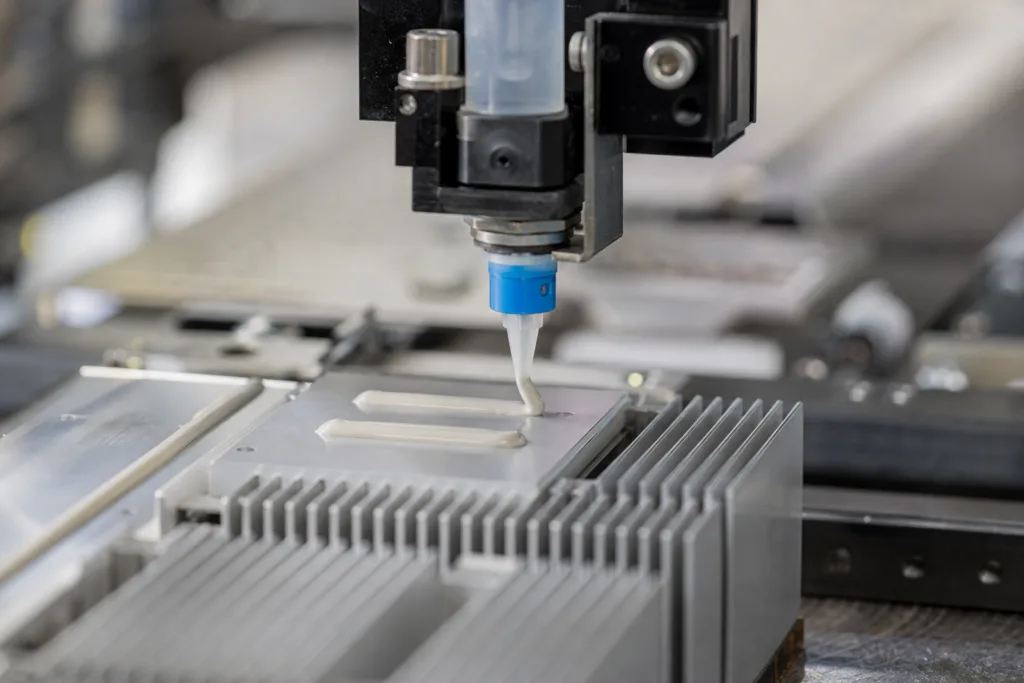
Cure behavior and process fit
The same adhesive can look excellent in the lab and fail in production planning if cure behavior does not match the line. Buyers should evaluate:
- Single-component or two-component system
- Room-temperature cure, heat cure, UV cure, or moisture cure
- Open time and pot life
- Fixture time and handling strength development
- Dispensing viscosity and thixotropy
- Gap-filling capability
- Automation compatibility and mixing requirements
For example, a two-part epoxy may offer strong structural performance, but if the assembly line needs long open time with rapid fixture after placement, formulation tuning becomes important. A silicone may absorb thermal stress better, but if the bonded area is deep and cure depends on atmospheric moisture, internal cure speed may limit throughput. A UV-curing system can be efficient for exposed bond lines, but hidden joints or opaque metal parts require a different strategy.
That is why many electronics teams involve electronics adhesive manufacturing support early in sample planning. Small changes in viscosity, cure profile, filler content, or package format can make a major difference in dispensing stability and takt time without changing the underlying design intent.
Selection logic for heat sinks, shields, brackets, frames, and enclosures
| Application | Typical adhesive priority | Common chemistry direction | Key caution |
|---|---|---|---|
| Heat sinks | Thermal transfer plus reliable bond | Thermally conductive epoxy or silicone | Do not confuse heat resistance with thermal conductivity |
| EMI shields | Dimensional stability, electrical intent, fine dispensing | Conductive or insulating adhesive depending design | Avoid accidental shorts from conductive squeeze-out |
| Brackets and clips | Shear strength, peel resistance, vibration durability | Toughened epoxy, acrylic, or flexible system | Thin metal edges often fail in peel before bulk shear |
| Frames and stiffeners | Alignment, stiffness, low shrinkage | Structural epoxy or acrylic | Check stress on nearby fragile components during cure |
| Housings and enclosures | Seal, bond, environmental resistance | Silicone, polyurethane, epoxy depending design | Review moisture, chemical, and thermal exposure together |
In our project discussions, the fastest way to narrow options is to define the part’s primary job first. If it is moving heat, start with thermal path needs. If it is controlling EMI, define conductivity or insulation logic. If it is carrying load, review bond geometry and stress mode. If it is sealing an enclosure, review gap, flexibility, and environmental resistance.
Common mistakes with general-purpose metal adhesives in electronics
A common sourcing mistake is assuming any strong metal adhesive is suitable for electronics. General-purpose products often miss one or more electronics-specific requirements.
- Choosing by room-temperature strength only
- Ignoring dielectric or conductivity requirements
- Overlooking thermal cycling stress between dissimilar materials
- Bonding to coated metal without verifying coating adhesion
- Selecting viscosity that cannot be dispensed accurately on small parts
- Using a cure schedule that overheats nearby components
- Assuming squeeze-out is harmless in compact assemblies
- Skipping aging, humidity, and vibration validation
Another frequent issue is using a very rigid structural adhesive on a thin or mismatched assembly where repeated thermal movement gradually creates edge cracking. The initial bond can look excellent, then decline in field conditions. This is why stress management matters as much as headline strength.
How to read technical data sheets for electronics metal bonding
Technical data sheets are useful, but they should be read as screening tools, not final proof of application success. We suggest buyers check the following:
- Test substrate used for adhesion values
- Cure condition behind the published numbers
- Viscosity range and whether it suits the intended dispensing method
- Working life or pot life under actual production temperature
- Hardness and elongation as clues to stress behavior
- Thermal conductivity method and units, if relevant
- Electrical properties under the right conditions
- Recommended storage and shelf life
At ZDS, we encourage customers to compare data sheets against their own assembly conditions rather than comparing one line item in isolation. A product with lower published strength may outperform a “stronger” product if it cures more uniformly, fills gaps better, or manages stress more effectively in the actual device.
Testing and validation for long-term reliability
Electronics metal bonds should be validated under realistic thermal and mechanical conditions. Room-temperature hand tests or short-term pull checks are not enough for assemblies that will run hot, vibrate, or cycle outdoors.
A practical qualification plan often includes:
- Thermal cycling across the intended operating range
- High-temperature exposure and property retention checks
- Humidity or damp-heat aging
- Vibration and shock evaluation
- Adhesion checks after environmental aging
- Visual inspection for cracking, delamination, corrosion, or squeeze-out migration
When temperature-dependent load bearing matters, high-temperature mechanical testing and qualification is a useful reference point for discussing metal-to-metal adhesive performance beyond room-temperature data. This is especially relevant for heat-generating electronics where shear retention at elevated temperature can differ significantly from initial bench results.
We also recommend validating process variables, not just adhesive chemistry. Mix ratio, dispensing pressure, degassing, bond line thickness, fixture pressure, and cure dwell can all influence reliability.
When custom formulation is needed
Standard products are often enough for straightforward brackets or enclosure bonds, but custom formulation becomes more valuable when the application combines multiple demands. Examples include:
- Need for both thermal conductivity and controlled flexibility
- Specific viscosity window for automated dispensing
- Fast fixture with extended workable time
- Low-odor or low-outgassing needs near sensitive components
- Modified hardness to reduce stress on thin metal parts
- Packaging changes for cartridge, pail, or meter-mix dispensing
- Private label supply for OEM brands or distributors
In these cases, we typically start with the assembly function, test plan, and production method, then adjust the formula or package around those constraints. That approach is often more efficient than forcing a general product into an unsuitable process.
How we support OEM and ODM metal bonding programs
For electronics manufacturers, adhesive selection is rarely just a chemistry question. It is also a supply, QC, and communication question. We support projects by reviewing substrates, geometry, cure constraints, operating environment, and throughput goals together. Sample evaluation should include not only bond performance but also dispensing behavior, line cleanliness, squeeze-out control, and consistency from pilot to bulk production.
Where customers need OEM or private label planning, we also look at packaging size, MOQ fit, labeling requirements, shelf-life management, and production forecasting. That is particularly important for electronics programs where line stoppage from adhesive inconsistency can be more costly than the adhesive itself.
Procurement checklist for selecting an electronics metal adhesive supplier
Procurement teams can reduce risk by asking structured questions early:
- Has the supplier reviewed the exact metal substrates and surface condition?
- Can the supplier explain why the proposed chemistry fits the electrical and thermal design?
- Are cure conditions realistic for the production line?
- Can the adhesive be supplied in the needed packaging format?
- Is there a clear sample evaluation process?
- Are QC controls and lot consistency discussed transparently?
- Can the formula be adjusted if pilot runs expose viscosity, fixture, or stress issues?
- Is shelf life practical for your purchasing and inventory cycle?
For commercial investigation buyers, the right supplier is usually the one that helps prevent qualification problems before they become field failures.
Conclusion
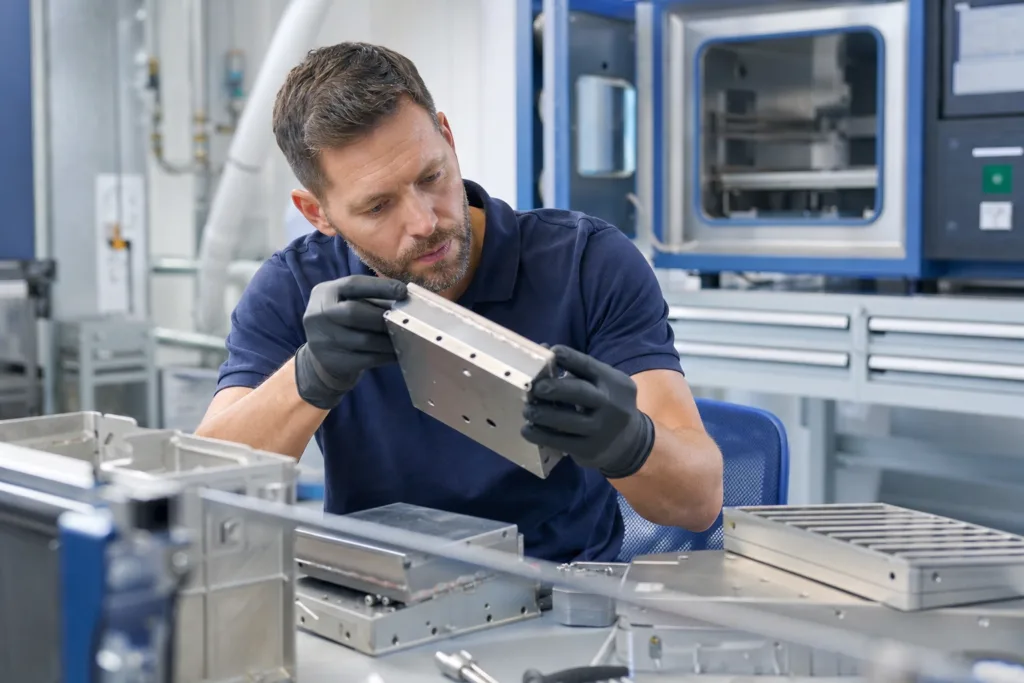
The right metal adhesive for electronics depends on more than metal type or headline bond strength. Heat flow, electrical behavior, vibration, thermal cycling, surface condition, and cure process all shape whether an adhesive will work reliably in heat sinks, shielding parts, brackets, frames, and enclosures. From our adhesive manufacturing perspective, the most successful projects are the ones that define the real function of the bond line early, test under realistic conditions, and treat process fit as part of performance. That selection logic gives engineers and procurement teams a better basis for comparing suppliers, evaluating samples, and moving from prototype to repeatable production.
FAQs
What is the most important factor when choosing a metal adhesive for electronics?
The most important factor is the actual function of the bonded joint in the device. A heat sink bond may prioritize thermal conductivity, a bracket may prioritize toughness and vibration resistance, and a shield may need either insulation or conductivity depending on the design. The best choice usually comes from matching thermal, electrical, mechanical, and process requirements together rather than selecting only by metal type or published strength.
Can one adhesive work for heat sinks, shields, brackets, and enclosures?
Sometimes one adhesive can cover multiple uses, but in many electronics assemblies the requirements are too different for a single formula to perform equally well everywhere. Heat sinks may need thermal transfer, shielding parts may need controlled electrical behavior, and enclosure joints may need sealing flexibility. It is usually better to confirm whether one product truly fits all operating conditions before trying to simplify the bill of materials.
How much does surface preparation affect metal bonding in electronics?
Surface preparation has a major effect on reliability and repeatability. Oils, oxides, handling contamination, or coating variations can reduce wetting and create weak interfaces even when the adhesive chemistry is appropriate. In production, controlled cleaning, defined treatment steps, and a consistent bonding window after preparation are often just as important as the adhesive itself.
When should an electronics manufacturer request a custom adhesive formulation?
A custom formulation is worth discussing when standard products come close but do not fully match the application. Typical reasons include needing a different viscosity for dispensing, a better balance between stiffness and flexibility, faster fixture with workable open time, special thermal or electrical behavior, or packaging changes for production equipment and supply planning. Customization is especially useful when the adhesive must support both product performance and line efficiency.
What tests should be included before approving a metal adhesive for electronics production?
Approval testing should reflect actual service conditions, not just bench bonding. A practical plan often includes thermal cycling, elevated-temperature exposure, humidity aging, vibration or shock checks, adhesion review after aging, and inspection for cracking, delamination, or harmful squeeze-out. If the metal bond carries load at higher temperature, temperature-relevant mechanical testing should also be part of the qualification discussion.
What should procurement teams ask an adhesive supplier before placing bulk orders?
Procurement teams should ask how the supplier evaluated the substrates, electrical needs, thermal environment, and cure process; whether the adhesive is available in the required packaging; what the shelf life and storage conditions are; how lot consistency is controlled; what sample support is available; and whether formulation or packaging adjustments are possible after pilot trials. These questions help confirm that the supplier can support repeatable production rather than only sending a sample that works once.