
Industrial design teams often ask whether acrylic adhesive replace welding decisions are realistic or just attractive in theory. In practice, acrylic structural adhesives can replace some welds, rivets, and screws, reduce the number of mechanical fasteners in many assemblies, and improve appearance, weight, and mixed-material design freedom. But success depends on more than bond strength alone. Engineers and buyers need to evaluate load paths, joint geometry, surface condition, cure behavior, environmental exposure, process fit, and validation methods before changing an established assembly method.
If your project involves mixed substrates, visible exterior panels, vibration-prone assemblies, or a need to lower drilling and joining steps, our acrylic adhesive manufacturing solutions for structural bonding are relevant because they help connect design intent with manufacturing reality. At ZDS, we typically support customers by narrowing acrylic chemistry options, matching viscosity and work life to the assembly process, checking whether the target substrates need special surface preparation, and planning sample validation before bulk production so the transition from fasteners to bonding is controlled rather than experimental.
Why industrial teams consider replacing welds and fasteners
From a manufacturing perspective, the question is rarely whether adhesives are universally better than welding or screws. The real question is whether the assembly performs better overall when bonding becomes the primary joining method or a complementary method. Acrylic structural adhesives are considered when designers want to join thin sheet metal without distortion, bond plastic to metal without introducing stress concentration, improve sealing while joining, or avoid cosmetic marks from rivets and screws.
Compared with discrete fastening points, adhesive bonding spreads load across a larger area. That can reduce local stress peaks, especially on thinner substrates, coated parts, and brittle plastics. It can also help when designers want smooth external surfaces, fewer drilled holes, lower risk of galvanic interaction around metal fasteners, or improved fatigue behavior under vibration.
Another practical driver is process simplification. In some assemblies, bonding can combine joining, gap filling, and sealing in one step. When this works well, manufacturers may reduce hole preparation, hardware inventory, torque control, post-weld finishing, or secondary leak-sealing operations. That does not automatically mean lower cost, but it often changes the cost structure from labor-intensive hardware handling to controlled material dispensing and cure management.
How acrylic structural adhesives work in load-bearing assemblies
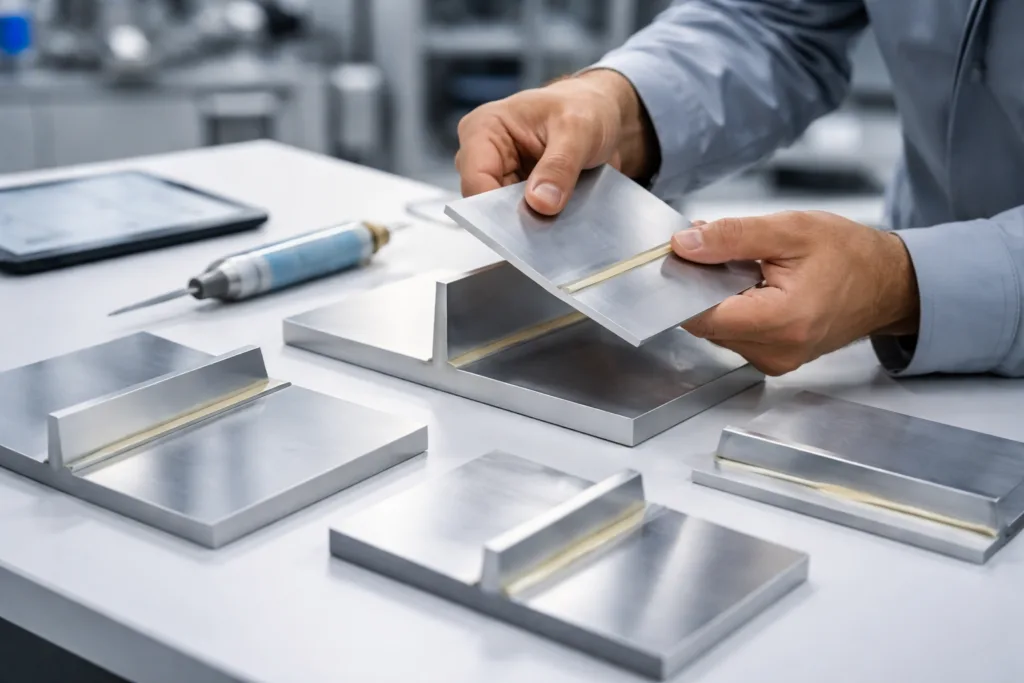
Acrylic structural adhesives are formulated to create durable bonds with relatively high toughness and good adhesion to many metals, composites, and selected plastics. In industrial assemblies, their value is not simply “stickiness.” Their role is to transfer load through a continuous bonded interface while accommodating some movement, thermal mismatch, and vibration that would otherwise concentrate around fastener holes or weld seams.
From our formulation experience, acrylic systems are often selected when a project needs a balance of strength, impact resistance, and practical processing. Many grades tolerate less-than-perfect surface conditions better than some other structural adhesive chemistries, although surface preparation still matters. They can also be useful where production teams need room-temperature curing options and where mixed-material bonding makes welding impossible or impractical.
For early screening, some manufacturers start with a general-purpose grade such as ZDS-8100AB acrylic structural adhesive for versatile bonding when evaluating broad substrate compatibility and assembly handling before narrowing to a more specialized formulation.
What acrylic adhesives can improve
Weight reduction and cleaner design
Replacing rows of screws, brackets, or reinforcement plates can reduce hardware count and local mass. On equipment covers, panels, housings, enclosures, and interior structural parts, adhesives may help create lighter assemblies with cleaner lines and fewer visible joining marks. This is especially relevant when product appearance matters or when designers want uninterrupted surfaces for painting, coating, or weather sealing.
Stress distribution
Welds and fasteners create load transfer at localized points or lines. Adhesives distribute that load over bonded area. This can improve fatigue behavior and reduce crack initiation risk on thin substrates, particularly where holes weaken the part or welding introduces heat-affected distortion.
Material flexibility
One of the strongest reasons to consider bonding instead of screws is the ability to join dissimilar materials. Plastic-to-metal, coated aluminum-to-composite, or glass-to-frame assemblies can be difficult with traditional fastening unless extra brackets or inserts are added. Acrylic adhesives can simplify these designs if the joint is engineered properly.
Where adhesives can replace or reduce welding, rivets, and screws
Acrylic adhesives are most effective when the bonded joint can be designed to work in shear, compression, or distributed load rather than peel or cleavage. Good candidates include sheet metal panel bonding, stiffener attachment, enclosure assembly, trim and cover bonding, plastic-to-metal subassemblies, equipment housings, transportation interiors, and mixed-material structures where moderate structural performance and vibration durability are needed.
For straightforward metal assemblies, a formulation like ZDS-3206 acrylic adhesive for bonding metals may be considered during evaluation when designers want to reduce spot welds or replace some rivets in non-extreme heat zones.
| Assembly condition | Acrylic adhesive potential | Mechanical fastening still favored when |
|---|---|---|
| Large overlap area available | High | Access for bonding is poor or cure time is unacceptable |
| Thin sheet or cosmetic surface | High | Joint must be immediately loadable with no cure wait |
| Mixed materials | High | Substrate surface is unstable or contamination cannot be controlled |
| High peel or prying load | Moderate to low | Joint geometry cannot be redesigned to reduce peel |
| Very high continuous temperature | Moderate to low | Thermal conditions exceed adhesive capability |
| Field disassembly required | Low to moderate | Frequent maintenance removal is necessary |
Application scenarios where bonding instead of screws makes sense
In industrial products, screws are often used because they are familiar, visible, and easy to inspect. Yet they are not always the most efficient design choice. Bonding becomes attractive when drilled holes create weakness, when torque control is inconsistent, when vibration causes loosening, or when sealing washers and extra hardware complicate assembly.
Common examples include metal skins bonded to frames, plastic covers attached to metal brackets, decorative or protective panels, equipment doors with bonded reinforcements, transportation interior modules, and electronics-related housings where both joining and stress damping are desired. For mixed substrates, ZDS-3355H acrylic adhesive for plastic-to-metal bonding reflects the type of formulation engineers often review when trying to avoid inserts, clips, or multiple screw points.
Another useful scenario is when the design needs thermal resistance beyond general room-temperature service but still wants acrylic processing advantages. In these cases, engineers may screen options such as ZDS-2204201 acrylic PC bonding adhesive for high-temperature assemblies for plastic components near warmer operating zones, while still validating real service temperatures and long-term aging.
Where mechanical reinforcement is still needed
Adhesives are not a universal substitute for mechanical joining. We generally advise keeping or adding mechanical reinforcement when the assembly experiences high peel forces, shock loading concentrated at an edge, severe continuous heat, or safety-critical loads where redundant retention is required. Hybrid joints are also common. In many real products, adhesive handles distributed load, sealing, and vibration damping, while a limited number of screws or rivets provide positional security, peel resistance, or immediate handling strength before full cure.
Situations that often still justify fasteners include removable service panels, parts requiring field replacement, joints exposed to direct flame or very high sustained temperatures, and designs where bond line thickness cannot be controlled. When a joint sees mostly tensile peel instead of overlap shear, changing to adhesive without redesigning the geometry is usually risky.
Key design factors that decide whether replacement is viable
Joint geometry
The joint must give the adhesive enough bonded area to transfer load. A poor adhesive choice can fail, but a strong adhesive in a poor joint design can also fail. Overlap joints, stepped joints, and bonded flanges usually perform better than edge-loaded butt joints. Designers should aim to convert peel into shear wherever possible.
Substrate stiffness and thickness
Very thin or flexible substrates can benefit from the stress-distribution advantages of adhesives. But if one side flexes far more than the other, the bond line may see repeated peel stresses. Matching adhesive toughness to substrate behavior is important.
Tolerance and gap management
Acrylics can often tolerate moderate gaps better than some rigid systems, but excessive bond line variation causes inconsistent performance. Part fit-up, bead size, fixture strategy, and bond line control features all affect result consistency.
Substrate compatibility for metals, plastics, composites, and mixed assemblies
Substrate compatibility is one of the first technical screens in any fastener-to-adhesive conversion. Metals such as steel, stainless steel, and aluminum are common candidates, but alloy, coating, oil residue, and oxide condition all influence bonding. Plastics require even more care because surface energy varies widely. ABS, PC, acrylic, and some composites can be more straightforward than low-surface-energy materials such as PP or PE unless surface treatment or primer strategies are used.
Mixed-material bonding is where acrylic chemistry often creates the most design value. Welding cannot join plastic to metal, and screws may need inserts, washers, or molded bosses that increase complexity. A bonded solution may remove those design burdens, but only if the plastic can tolerate assembly stress, cure exotherm, and service environment. At ZDS, we usually ask customers for exact substrate grades, coatings, and expected temperature range before recommending a sample route, because “metal” or “plastic” alone is not enough for a meaningful selection.
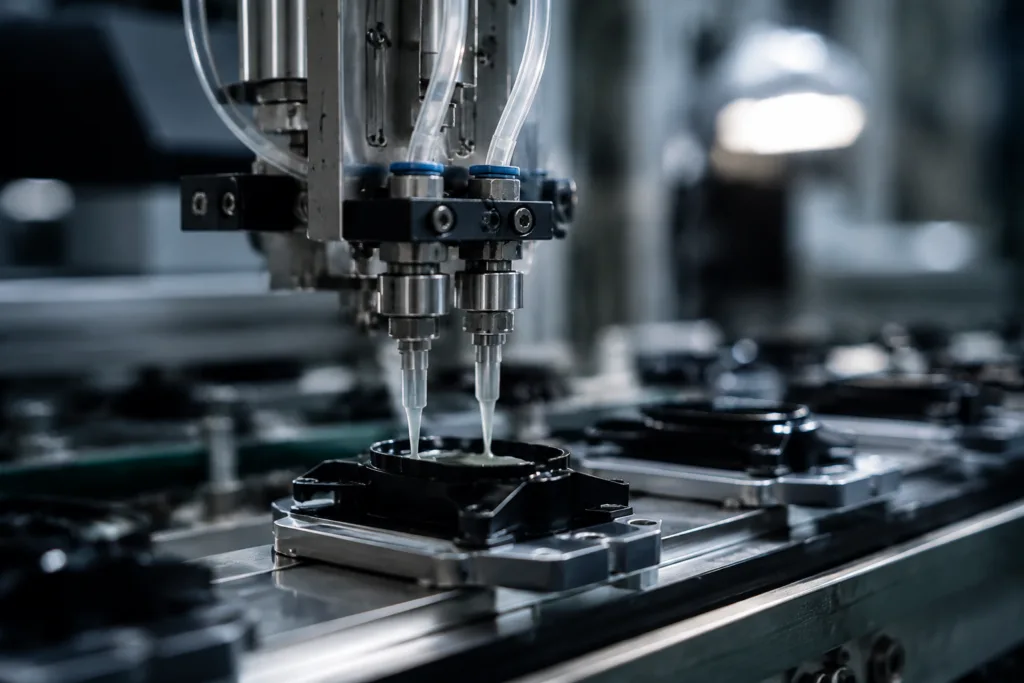
| Substrate pair | Typical viability with acrylic structural adhesive | Main caution |
|---|---|---|
| Steel to steel | Good | Surface oil, corrosion, and joint design |
| Aluminum to aluminum | Good | Oxide layer stability and pretreatment consistency |
| Plastic to metal | Often good | Plastic type, thermal expansion mismatch |
| Composite to metal | Often good | Surface resin condition and peel loading |
| Glass to frame | Application dependent | Impact, edge stress, and weathering needs |
| PP or PE to metal | Challenging | Low surface energy may require treatment |
Surface preparation, joint design, and bond line control
Many disappointing adhesive trials are actually preparation or design problems. Surface preparation should remove oils, dust, release agents, oxidation, and loose coatings. Depending on substrate, this may involve solvent cleaning, abrasion, plasma, corona, or chemical pretreatment. The required level depends on the material and performance target. A simple lab success on hand-cleaned coupons does not always translate to production if plant contamination is uncontrolled.
Joint design and bond line thickness are equally important. Acrylic adhesives need enough thickness to wet the surfaces and absorb stress, but too much thickness can slow cure and reduce consistency. Spacer beads, shims, formed flanges, or controlled fixture pressure can help keep the bond line stable. Designers converting from rivets to adhesive often underestimate the need for overlap area and edge protection.
Load type, vibration resistance, impact resistance, and long-term durability
When comparing adhesives with welding or screws, engineers should avoid reducing the decision to one static strength number. Real assemblies see combinations of shear, tensile, peel, impact, vibration, and thermal cycling. Acrylic structural adhesives are often favored because they can be tougher than brittle systems and can damp vibration better than rigid joining methods.
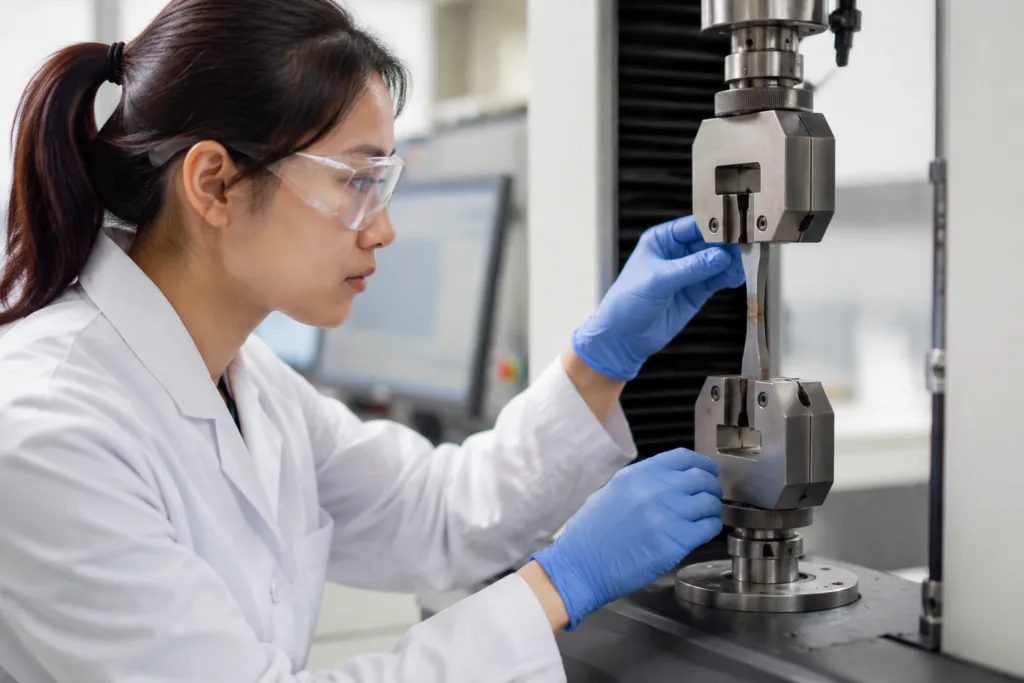
Validation should include bond testing that reflects the assembly load mode, not just convenient laboratory coupons. For metal overlap joints, the widely used ASTM D1002 single-lap shear test is one recognized method for comparing apparent shear performance during development, but it should be treated as one part of a broader validation plan rather than the only decision metric.
In long-term service, durability depends on stress level, edge exposure, substrate movement, environmental attack, and manufacturing consistency. An adhesive that survives static lab loading may still fail prematurely if edge peel, cyclic impact, or fluid exposure was not considered in the original design review.
Environmental requirements that can change the answer
Environmental exposure is often the dividing line between a successful adhesive conversion and a costly redesign. Heat reduces the strength of most polymer-based adhesives as temperature rises, and different acrylic formulations have different service limits. Moisture can affect interface durability, especially if surface preparation was weak or if edge sealing is poor. Chemicals such as fuels, cleaners, oils, acids, or alkalis can also attack the adhesive or the substrate interface.
Outdoor use adds UV and weathering concerns. In some assemblies, the adhesive is protected between opaque substrates and direct UV is less important. In other designs, edge exposure and thermal cycling become major durability drivers. Buyers should ask not only “what temperature can this adhesive survive?” but also “for how long, under what load, and after what environmental conditioning?” That question usually leads to more realistic product qualification.
Cure speed, pot life, open time, and line compatibility
An adhesive that looks ideal on paper can still fail at the production planning stage. Cure speed must match line rhythm, fixture availability, part size, and assembly takt time. Pot life matters for hand mixing, cartridge use, and automated dispensing stability. Open time matters when operators need time to position large panels or align components before clamping.
From a manufacturing viewpoint, process compatibility often decides whether acrylic adhesive replacement is practical. If the line requires immediate handling strength, temporary fixtures or a hybrid joint may be needed. If the product is large and assembly time is long, a very fast-setting grade may become difficult to use consistently. We often help customers compare not only ultimate bond strength but also practical handling windows, viscosity for bead control, and whether the adhesive can be dispensed cleanly into the actual joint.
Common mistakes in fastener-to-adhesive conversion
- Assuming a strong adhesive can rescue a poor joint design. Lack of overlap area and peel-heavy geometry remain major failure causes.
- Testing on ideal coupons only. Production surfaces, coatings, and contamination levels may be very different from lab-prepared panels.
- Ignoring service temperature and chemicals. Room-temperature success is not enough for outdoor, engine-adjacent, or washdown environments.
- Skipping bond line control. Uneven gaps cause variable cure and variable performance.
- Overlooking maintenance needs. If the part must be regularly removed, permanent bonding may not be the right route.
- Comparing material cost only. Total assembly cost should include labor, hardware, hole preparation, finishing, sealing, inspection, and scrap risk.
How to test and validate an acrylic adhesive replacement design
A proper validation plan should move from material screening to assembly-level confirmation. We usually recommend a staged approach: initial substrate compatibility checks, small coupon tests, environmental conditioning, pilot assembly trials, and then full-process confirmation. The exact sequence depends on risk level and product criticality.
Useful validation elements include lap shear screening, peel or cleavage checks where relevant, vibration simulation, thermal cycling, humidity exposure, chemical splash testing, and destructive testing on actual or representative joints. It is also important to test failure mode. Cohesive failure within the adhesive tells a different story from adhesive failure at the substrate interface or substrate cracking. Buyers and engineers should also compare fresh performance with aged performance after realistic conditioning.
For sourcing teams, validation should extend beyond performance data sheets. Ask how the supplier controls viscosity range, mix ratio accuracy for two-part systems, batch traceability, storage conditions, shelf life, and packaging consistency. These factors affect line repeatability as much as headline strength numbers do.
Cost, process efficiency, and total assembly value
When teams compare acrylic bonding with welding, riveting, or screws, the lowest material price rarely gives the best decision. A more useful comparison looks at total assembly value. Hardware has visible unit cost, but also hidden labor for drilling, fastening, torque verification, inventory handling, and cosmetic finishing. Welding has equipment, energy, skilled labor, heat distortion risk, and post-process cleanup. Adhesive bonding introduces material cost, dispensing equipment, cure waiting, and process control requirements.
The strongest business case for bonding usually appears when adhesive joining removes multiple secondary steps, reduces part count, improves aesthetics, lowers rework, or enables a simpler mixed-material design. The weakest case appears when the joint area is too small, cure time disrupts throughput, or the product requires regular disassembly. Procurement teams should therefore compare total manufacturing impact, not just price per kilogram or price per cartridge.
How we help evaluate whether acrylic adhesive can support the design goal
At ZDS, we approach this decision as a technical fit question rather than a one-size-fits-all product question. We typically review substrate pairings, target loads, service temperature, expected chemicals, desired cure speed, assembly method, and packaging preference before recommending sample options. If needed, we also help narrow whether the project should use a general structural acrylic, a tougher mixed-substrate grade, or a more heat-focused formulation.
For OEM, ODM, and private label buyers, the practical questions often extend beyond chemistry. MOQ, lead time, packaging format, labeling, storage conditions, and batch-to-batch consistency all matter when moving from prototype to recurring production. A supplier should be able to explain not only what the adhesive does, but also how it fits the actual line and how quality will be maintained over repeat orders.
Conclusion
So, can acrylic adhesive replace welding, riveting, or screws? In many industrial assemblies, yes—fully in some cases, partially in many others, and not at all in a few. The right answer depends on joint design, substrate compatibility, load type, environmental exposure, process timing, and the quality of validation. Acrylic structural adhesives are often most effective when they are used to distribute stress, simplify mixed-material assembly, improve appearance, and reduce fastener count rather than being treated as a direct one-for-one swap without redesign. The better the engineering review and sample testing plan, the more reliable the conversion decision will be.
FAQs
Can acrylic adhesive fully replace welding in metal assemblies?
It can in some metal assemblies, especially where the joint has enough overlap area, service temperature is within adhesive limits, and the main loads are shear or distributed stress rather than edge peel. It is less suitable where the assembly sees extreme heat, direct flame, or very high structural loads without room for proper joint design. Many successful projects use adhesive to replace some welds rather than all welds.
Is adhesive bonding stronger than screws or rivets?
It depends on how strength is defined and how the joint is designed. Screws and rivets provide concentrated mechanical retention at specific points, while adhesives spread load across an area and can improve fatigue and vibration behavior. In a well-designed overlap joint, acrylic structural adhesive can outperform mechanical fastening for stress distribution, but point-load resistance, peel resistance, and immediate handling strength may still favor mechanical methods.
What materials can acrylic structural adhesives bond well?
Acrylic structural adhesives often bond well to many metals, composites, and selected plastics such as ABS or PC, depending on formulation and surface condition. Mixed-material assemblies are one of their strongest use cases because they can join combinations that welding cannot. Low-surface-energy plastics like PP and PE are more challenging and may require surface treatment or an alternate adhesive strategy.
What testing should be done before replacing screws with adhesive?
Testing should start with substrate compatibility and coupon screening, then move into assembly-representative trials that reflect actual load direction, environmental exposure, and production conditions. Good validation usually includes shear testing, peel or impact checks where relevant, thermal cycling, humidity or chemical exposure, and evaluation of failure mode after aging. Real process conditions matter, so production-like surfaces and bond line control should be included in the trial plan.
How do MOQ and lead time affect industrial adhesive selection?
MOQ and lead time matter because a technically suitable adhesive is not enough if supply planning does not fit your launch schedule or recurring production volume. Buyers should confirm available packaging sizes, sample availability, standard production lead time, shelf life, storage conditions, and whether custom formulation changes will affect order quantity or replenishment timing. These factors become especially important when moving from pilot builds to stable procurement.
When is a hybrid design with both adhesive and fasteners the better choice?
A hybrid design is often better when the assembly needs immediate handling strength, backup retention, improved peel resistance, or extra security in demanding environments. It is also useful when the bonded joint does most of the stress distribution and sealing work, while a reduced number of screws or rivets handles positioning, edge restraint, or service safety. For many industrial products, hybrid joining offers a lower-risk transition than a full fastener elimination.