
Choosing an adhesive for TPE bonding is different from selecting a glue for rigid plastics. Soft plastics and elastomeric parts do not just need initial adhesion. They also need a bond line that can stretch, recover, resist peel at the edges, and survive thousands of bending, twisting, or compression cycles without cracking. For engineers and buyers, that means the right choice depends on substrate chemistry, joint design, movement type, curing method, and the real service environment rather than bond strength alone.
Review plastic bonding solutions first if your assembly includes multiple plastic types, overmolded parts, or flexible-to-rigid combinations, because material pairing usually determines whether a standard adhesive will work or whether a more tailored system is needed.
Why flexible plastics are harder to bond than rigid plastics
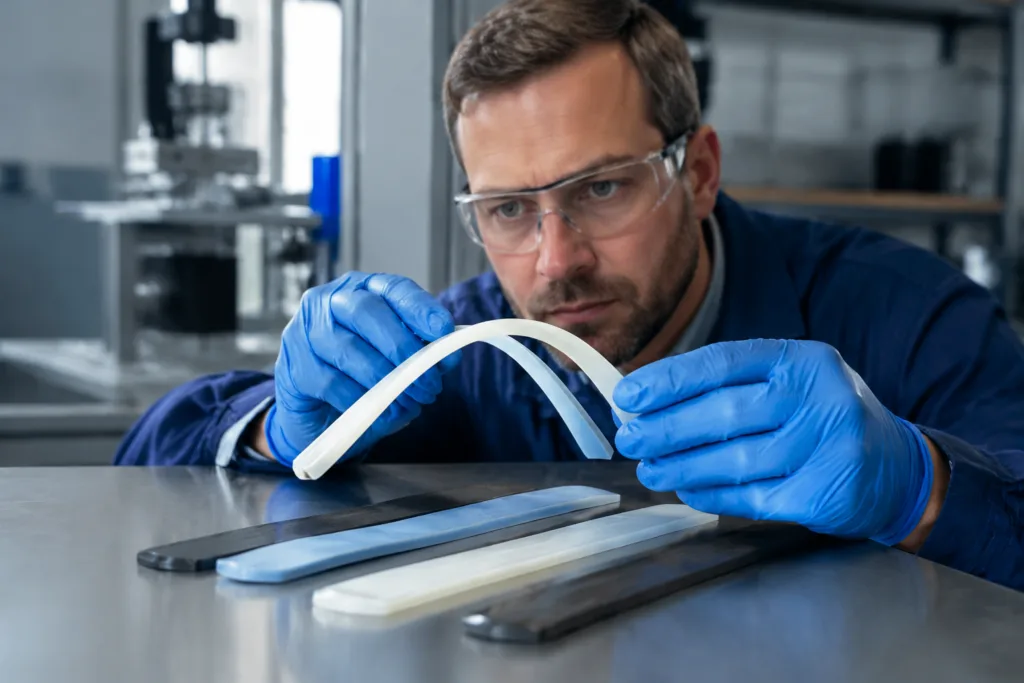
TPE, TPU, and similar soft polymers create two problems at the same time. First, some grades have lower surface energy or contain additives that reduce wetting and make adhesion less reliable. Second, even when the adhesive wets the surface well, the bonded joint still has to move with the part. A rigid adhesive on a flexible substrate often fails at the interface or at the bond edge because the cured film cannot absorb repeated strain.
This is why a bond that looks strong in a simple hand pull test may fail quickly in the field. The real requirement is not just static holding power. It is dynamic durability under movement, recovery, and long-term stress.
What makes TPE, TPU, and other soft polymer parts difficult to bond
Low or variable surface energy
Many flexible plastics are harder to wet than metals, glass, or engineering plastics. Some TPE families are especially challenging because formulation differences can change bondability from one grade to another.
Plasticizers, oils, and additives
Soft materials may contain processing aids, slip agents, mold release residues, or migrating ingredients that interfere with adhesion. Even if the surface seems clean, these components can weaken the bond over time.
High deformation during use
Wearables, grips, seals, soft housings, and flexible covers may bend sharply at one location. That creates concentrated peel and cyclic fatigue, which is often more damaging than simple shear loading.
Mixed-material assemblies
Flexible plastics are often bonded to PC, ABS, metal, coated surfaces, fabrics, or rigid inserts. A good adhesive has to match both substrates and tolerate the difference in stiffness between them.
How adhesion, flexibility, and peel resistance work together
For dynamic assemblies, high tensile or lap shear values alone can be misleading. Flexible plastic bonding performs better when three factors are balanced:
- Adhesion: the ability to wet and anchor to the substrate surface.
- Flexibility: the ability of the cured adhesive to deform without cracking.
- Peel resistance: the ability to resist lifting forces at edges, corners, and bend zones.
An adhesive can be very strong but still brittle. It can also be very soft but lack enough cohesive strength. The right balance depends on whether the part mainly stretches, bends, compresses, or experiences intermittent impact.
Key material differences: TPE vs TPU vs other soft plastics
TPE is a broad family, not a single material. Bonding results can vary significantly depending on whether the base chemistry is styrenic, olefinic, vulcanizate, polyester-based, or another blend. Some grades bond fairly well after proper cleaning, while others need surface treatment or a primer to get acceptable durability.
TPU is often more bondable than difficult low-energy elastomers, but grade differences still matter. Hardness, surface finish, additives, and whether the TPU is polyester-based or polyether-based can affect both initial bonding and long-term performance in moisture or heat.
Other flexible plastics and elastomeric substrates such as soft PVC, silicone rubber, and certain rubber-like overmolds require their own selection logic. They may look similar in use, but their surface chemistry and movement profile can demand a completely different adhesive family.
Where TPU must be bonded to rigid transparent plastics in compact assemblies, a product class such as ZDS-3310C TPU-to-PC UV adhesive can be relevant because the substrate pairing and curing method are already aligned with a common flexible-to-rigid design challenge.
How repeated movement changes bond performance
Flexible joints usually fail from fatigue, not from a single overload event. Repeated movement creates micro-damage that accumulates at the interface or inside the adhesive layer. The type of motion matters:
- Bending: often creates edge peel on the outer radius of the bend.
- Compression: may cause creep, squeeze-out stress, or recovery-related debonding.
- Twisting: can combine shear and peel in an uneven pattern.
- Repeated flexing: may create crack growth from small defects or thin bond edges.
Short, sharp bends usually require more flexibility and better peel resistance than gentle deflection over a large radius. Parts that recover quickly after bending can also place rebound stress on the bond line.
Common bond line failure modes
Edge peel
This is common when the joint starts or ends in a high-bend area. The adhesive may hold in the middle while the edge slowly lifts and propagates inward.
Interface cracking
If the adhesive does not wet the substrate well enough, cyclic movement can create tiny cracks at the boundary between the adhesive and the plastic.
Cohesive failure
Sometimes the adhesive sticks to both surfaces but tears within itself. This usually suggests insufficient internal strength, poor cure development, or excessive movement for the adhesive modulus.
Loss of flexibility over time
Heat, moisture, UV exposure, or chemical contact can stiffen or degrade some adhesives. A joint that was flexible at assembly may become brittle in service.
The most important selection criteria for adhesive for TPE bonding
When comparing options, focus on the operating reality of the part rather than only the adhesive chemistry name. The most useful screening criteria are:
- Substrate compatibility: exact plastic grade, hardness, and mating material.
- Movement profile: bending radius, cycle count, deformation frequency, and whether the load is constant or intermittent.
- Required flexibility: whether the bond must elongate, recover, or simply tolerate moderate deflection.
- Peel resistance: especially important for edges, tabs, corners, and thin sections.
- Curing method: UV, moisture, heat, two-part reaction, or room-temperature cure.
- Viscosity and application control: whether the adhesive needs gap filling, bead stability, or thin-film wetting.
- Environmental resistance: heat, humidity, oils, cleaners, sweat, UV, or outdoor exposure.
- Production fit: open time, fixture speed, automation compatibility, and rework difficulty.
For molded badges, key chains, decorative soft components, and similar assemblies that need a compliant cured bond line, products in the category of ZDS-8300AB flexible PU glue for soft parts are often considered because flexibility and appearance can matter as much as simple hold strength.
Surface energy, treatment, and primer considerations
Many bonding failures start before the adhesive is even applied. If the surface is contaminated, poorly wetted, or chemically resistant, the adhesive cannot build a durable interface.
Cleaning
Remove mold release, oils, dust, and handling residue with a process validated for the specific plastic. Aggressive solvents should be checked carefully because some flexible materials can swell, haze, or extract additives.
Surface activation
Corona, plasma, flame treatment, or controlled abrasion may improve wetting on difficult grades. The value depends on the plastic type and how quickly the treated surface loses activation before bonding.
Primers
Some flexible substrates benefit from a primer, especially when low surface energy or additive migration is an issue. However, primers add process steps, drying time, and variation risk, so they should be justified by test results rather than assumed.
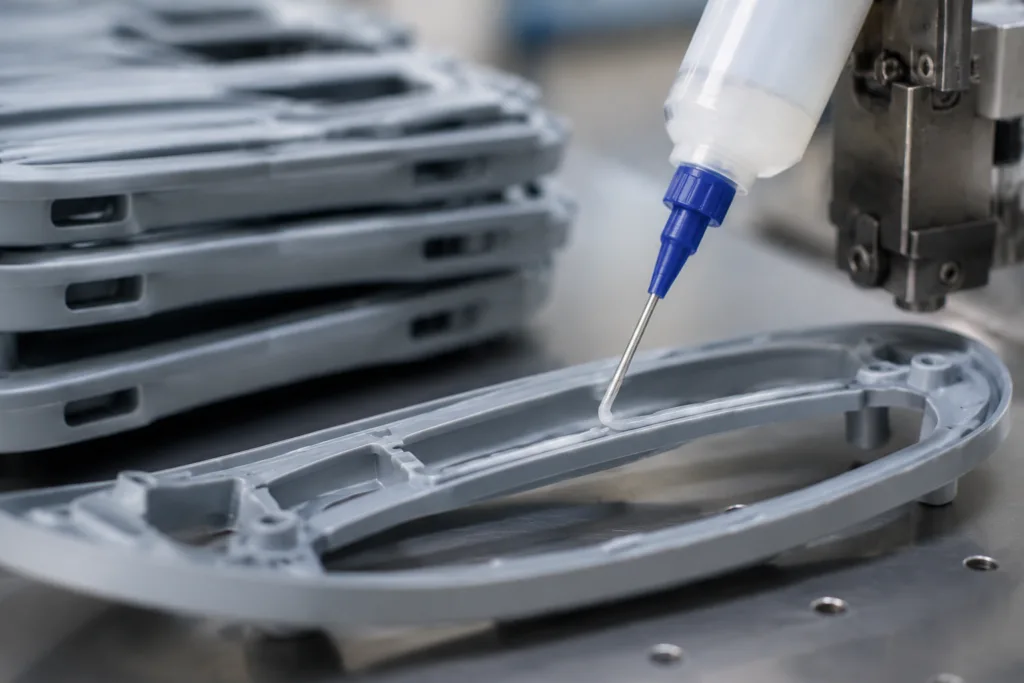
A manufacturer perspective is helpful here because the recommendation should be tied to actual substrates and motion. In many projects, ZDS reviews not just the adhesive type but also the cleaning method, primer need, and cure path to reduce mismatch between lab success and production performance.
When to use polyurethane, silicone, acrylic, epoxy, or specialty elastomeric adhesives
Polyurethane adhesives
Polyurethane systems are often a strong starting point for flexible plastic assemblies because they can combine adhesion, elasticity, and decent cohesive strength. They are commonly considered when the joint needs to absorb movement or maintain a softer bond line.
Silicone adhesives
Silicones are useful when extreme flexibility or high-temperature stability is a priority, but they may not offer the same adhesion profile on every plastic without special surface preparation. They are more often selected when movement and temperature tolerance outweigh structural strength needs.
Acrylic adhesives
Certain acrylics can work well on plastics and seals when fast processing or specific substrate affinity is needed. Flexible grades are more relevant than brittle structural ones in dynamic applications. For assemblies that need a compliant seal-like bond behavior, ZDS-100 elastic sealing adhesive reflects the type of option often reviewed.
Epoxy adhesives
Epoxies are usually not the first choice for highly dynamic soft plastic joints because many cured systems are too rigid. They can still be useful in limited-motion zones, rigid inserts, or where chemical and heat resistance are more important than elasticity.
Specialty elastomeric and UV-curing systems
Some applications need a more specific match, especially for TPU-to-rigid plastic assemblies, optical parts, compact electronics, or fast fixture requirements. In those cases, a targeted option such as ZDS-3310D2 TPU bonding adhesive for durable joints may fit better than a general-purpose flexible adhesive because the cure speed and substrate pairing can be optimized together.
How service conditions change the right choice
An adhesive that performs well on the production floor can still fail in real use if the environment changes its modulus, adhesion, or internal integrity.
- Temperature: heat can soften some systems and accelerate aging, while cold can make others too stiff for repeated flexing.
- Humidity and water: moisture can affect some polymers and substrates, especially over long exposure.
- Chemicals: cleaners, oils, fuels, skin contact products, and plasticizer exposure can all influence durability.
- UV exposure: outdoor use can embrittle or discolor certain adhesive chemistries.
- Load duration: constant stress can cause creep even if short-term strength looks acceptable.
For wearables, handles, seals, and exterior components, chemical and environmental screening should be treated as a core selection step, not a later confirmation step.
Designing the joint for movement
Adhesive choice and joint design should be evaluated together. A suitable adhesive can still fail in a poor geometry.
Keep bond edges out of peak bend zones when possible
If the edge of the bond sits exactly where the part folds, peel stress rises sharply. Moving the bond start point away from the hinge area can greatly improve life.
Use enough bond area
Wider load distribution usually reduces local stress, especially on soft substrates that deform unevenly.
Control bond line thickness
An extremely thin bond line may not absorb movement well, while an excessively thick line may reduce cohesive stability or cure consistency. The right thickness depends on adhesive modulus and movement amplitude.
Avoid sharp corners
Rounded geometry helps reduce stress concentration. Corners and abrupt bond terminations are common crack starters.
Testing and validation for repeated motion
For flexible plastic assemblies, qualification should reflect the actual use case as closely as possible. A basic pull test is rarely enough on its own.
- Peel testing: useful for edge-lift risk.
- Cyclic bend testing: useful for fatigue evaluation.
- Compression recovery testing: useful for pads, seals, and soft-touch parts.
- Environmental aging: heat, humidity, chemical, or UV exposure before and after mechanical cycling.
- Failure analysis: identify whether failure is adhesive, cohesive, or substrate-related.
It is also important to test production-realistic variables such as cure time, surface preparation variation, adhesive age, and assembly delay between cleaning and bonding.
Typical application examples
Selection logic changes by product type:
- Seals and gaskets: flexibility, recovery, and environmental resistance often matter more than rigid structural strength.
- Wearables: sweat exposure, skin-contact contaminants, and repeated flexing are major factors.
- Grips and handles: edge peel and torsional movement are common failure drivers.
- Soft housings and covers: cosmetic appearance and precise application control may be critical.
- Overmolded parts: the interface between soft and rigid materials often needs a substrate-specific adhesive approach.
- Soft-touch components: long-term feel, recovery, and resistance to cleaner exposure should be checked.
How to evaluate suppliers and ask for the right recommendation
To get a useful adhesive recommendation, provide more than the substrate names. Share the exact plastic grades if possible, mating materials, part geometry, expected motion, cure constraints, operating temperature range, and any exposure to moisture, cleaners, oils, or UV.
It also helps to ask suppliers practical questions:
- What surface preparation is required?
- Is a primer recommended or optional?
- How flexible is the cured adhesive likely to remain over time?
- What are the expected weak points in this joint design?
- Which lab tests best represent the real use condition?
- What process window is realistic for production?
The more the recommendation is tied to actual movement and failure mode, the more useful it will be for sourcing and validation.
A practical framework for choosing the right adhesive
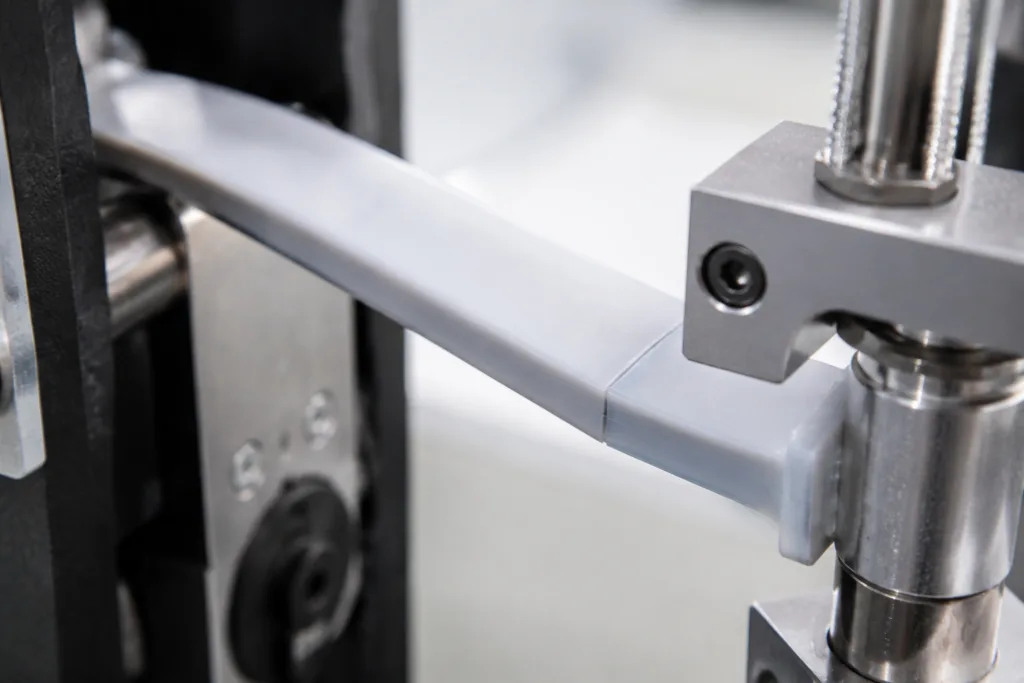
Start with the substrate pair, then map the actual movement, then eliminate adhesive families that are too rigid or poorly matched to the surface chemistry. After that, compare curing method, viscosity, environmental resistance, and production fit. Finally, validate with cyclic and environmental testing that reflects the real part, not just a simplified coupon.
For adhesive for TPE bonding and TPU assemblies, the safest approach is usually not to ask which adhesive is strongest, but which one can maintain adhesion and flexibility together throughout the life of the part. That question leads to better design decisions, more reliable supplier discussions, and fewer field failures.
FAQ
What is the biggest mistake when selecting an adhesive for TPE bonding?
The most common mistake is choosing based only on initial bond strength without checking flexibility, peel resistance, and fatigue performance under real movement.
Does TPU usually bond more easily than TPE?
Often yes, but not always, because both TPU and TPE vary by grade, additives, hardness, and surface condition, so testing the exact material combination is still necessary.
Can epoxy be used on flexible plastic parts?
It can in some limited-motion designs, but many epoxies are too rigid for parts that bend repeatedly, so they are usually not the first choice for highly dynamic joints.
Do TPE and TPU always need surface treatment before bonding?
No, but cleaning is usually essential, and some grades may also need plasma, corona, flame treatment, or a primer if wetting or long-term durability is poor.
Why do flexible plastic bonds often fail at the edge first?
Bond edges experience concentrated peel stress during bending and twisting, so cracks or lifting often start there before spreading across the rest of the joint.
What tests are most useful for flexible adhesive joints?
Peel testing, cyclic bend testing, environmental aging, and failure analysis are especially useful because they show how the bond behaves under movement and service exposure rather than only static load.
Related Reading
- Rubber Bonding Adhesive Guide for Metal, Glass, and Plastic Applications
- Plastic to Metal Adhesive: Best Options, Bonding Challenges, and How to Choose the Right Glue
- How to Choose a Strong Adhesive for Plastic by Plastic Type
- Adhesive Strength Simplified: Peel, Shear, & Tensile Performance Decoded
- adhesive selection technical support