
Choosing the right silicone adhesive for LED assemblies is rarely just a bonding decision. In lighting products, the adhesive or sealant often has to tolerate heat from drivers and chips, movement from thermal expansion, outdoor moisture, UV exposure, and in some cases the added demand of optical clarity around lenses or covers. A material that bonds well on day one can still become the weak point if it yellows, hardens, loses adhesion at edges, or allows water ingress after thermal cycling.
For teams comparing options, it helps to explore silicone adhesive solutions for lighting assemblies in terms of sealing role, substrate compatibility, curing behavior, and long-term durability rather than looking at bond strength alone.
Why lighting assemblies need heat- and weather-aware adhesive selection
LED fixtures operate in conditions that expose hidden weaknesses in many bonding materials. Even when LED systems are more energy efficient than older lighting formats, localized heat around chips, boards, heat sinks, and enclosed housings still matters. That heat is then combined with outdoor rain, condensation, UV, dust, and repeated expansion and contraction of dissimilar materials such as aluminum, glass, polycarbonate, acrylic, and coated metals.
Silicone is often selected because it can remain flexible across a wide service range and can better absorb movement than more rigid chemistries. For housing seals, lens bonding, gasket replacement, potting, and moisture barriers, that flexibility can be more important than maximum hardness. In practice, lighting manufacturers usually need a balanced material rather than the strongest or fastest-curing one.
Where silicone adhesives are used in LED and lighting assemblies
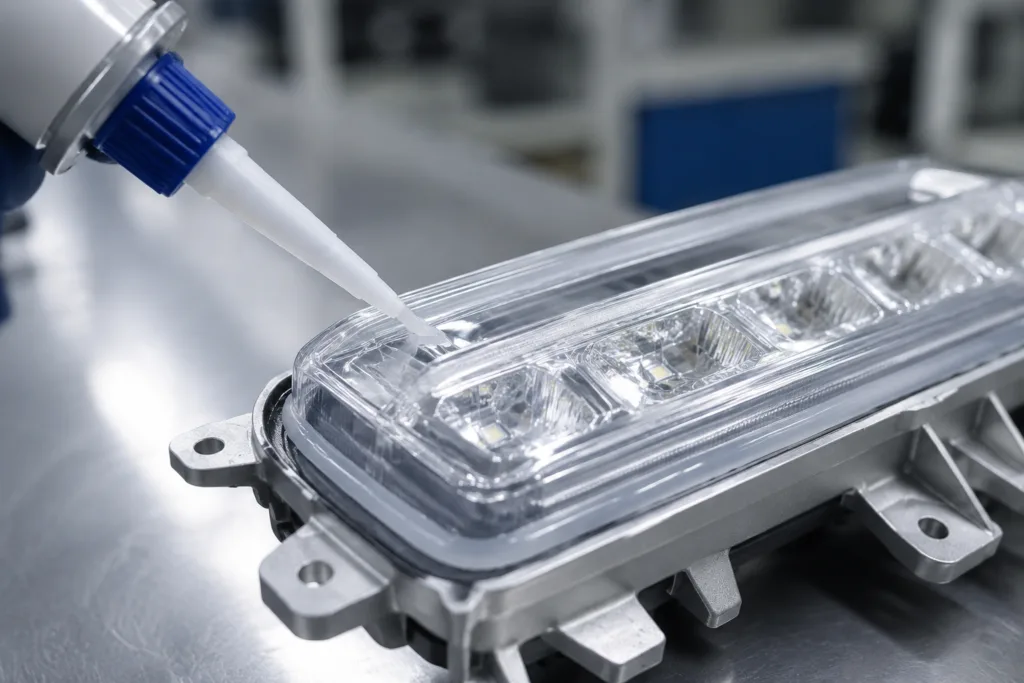
Silicone materials appear in many different lighting build points, and each location creates a different performance requirement. A lens bond line may prioritize optical stability and non-corrosive cure behavior, while a housing perimeter seal may prioritize water resistance and adhesion retention after thermal shock.
- Sealing LED housing joints and enclosure seams
- Bonding or sealing covers, diffusers, and protective lenses
- Potting drivers, connectors, and exposed electronics
- Creating moisture barriers around cable exits and fastener points
- Supplementing or replacing formed gaskets in compact designs
- Sealing outdoor fixtures, landscape lights, and underwater lighting assemblies
For fully sealed or potted outdoor products, a material such as ZDS-2680 silicone potting adhesive for outdoor lighting may fit assemblies that need environmental protection alongside stress relief around internal components.
Key performance requirements that matter most
Heat resistance
An LED adhesive does not need to be the hottest-running component to fail from heat. Long-term exposure to moderate elevated temperature can still cause shrinkage, embrittlement, adhesion loss, or color change. The real question is whether the material stays stable over time at the fixture’s actual operating temperature, including hot spots near drivers, heat sinks, or enclosed cavities.
Optical clarity
Where adhesive is visible near a lens, cover, or light path, clarity is not only about how the material looks when freshly dispensed. Engineers should also consider haze, yellowing tendency, bubble control, cure byproducts, and whether the bond line remains visually acceptable after UV and heat aging.
Flexibility and movement tolerance
Lighting assemblies often combine plastics and metals with different coefficients of thermal expansion. A flexible silicone can reduce stress at the interface during heating and cooling cycles. This is one reason silicone is frequently preferred over rigid materials in outdoor luminaires and sealed modules.
Environmental stability
Moisture, UV, cleaning exposure, and airborne contaminants can all degrade a bond line. Good environmental stability means the material maintains adhesion, elasticity, and sealing function instead of only surviving a short laboratory cure check.
Main durability risks in real lighting service
The biggest field failures are usually not dramatic adhesive breakages. More often, performance declines gradually until a fixture fails an IP requirement, develops fogging, shows lens edge defects, or experiences intermittent electrical issues from moisture ingress.
Heat aging
Long-term thermal exposure can harden some materials, reduce elongation, and weaken the seal at corners or thin edges. Assemblies that look fine after initial production may open micro-gaps later if the sealant loses elasticity.
UV exposure and yellowing
Outdoor lighting and sun-exposed lenses need careful review of color stability. Even clear materials can shift over time, and any yellowing becomes more noticeable in decorative, architectural, and consumer-facing luminaires. Where the adhesive is close to the visible light path, accelerated weathering checks are especially important.
Moisture and condensation
Outdoor fixtures rarely fail only from direct rain. Condensation, vapor ingress, standing water in design traps, and cyclic humidity are often more damaging because they act repeatedly over time. For harsher wet environments, teams may evaluate solutions such as ZDS-999 silicone waterproof adhesive for outdoor undersea exposure when a standard perimeter seal may not provide enough durability margin.
When silicone is better than rigid adhesives in lighting applications
Rigid adhesives can work well in some lamp or housing assemblies, especially where structural fixation and tight dimensional control are the main priorities. But in many LED products, the joint is exposed to movement, heat, and weather simultaneously. That is where silicone often gains an advantage.
| Application condition | Why silicone may be preferred |
|---|---|
| Dissimilar substrates | Helps absorb expansion mismatch between metal and plastic |
| Outdoor exposure | Typically offers stronger resistance to moisture and UV-related aging |
| Sealed housings | Maintains flexible sealing over thermal cycling |
| Visible bond lines | Can provide better long-term appearance when clarity stability is needed |
| Potted electronics | Reduces stress on components compared with harder compounds |
That said, silicone is not automatically the right choice for every joint. If very rigid positioning, paintability, or specific lens-to-frame aesthetics are critical, another chemistry may fit better in selected subassemblies.
RTV silicone lighting adhesive vs other bonding options
In practice, engineers should compare materials by function rather than chemistry label alone. RTV silicone is commonly used for lighting because it is process-friendly and versatile, but the real decision should consider cure speed, line throughput, adhesion to the target substrates, rework expectations, and whether the material needs to seal, bond, pot, or all three.
Some assemblies require waterproof internal filling rather than only seam sealing. In those cases, ZDS-2682 silicone potting adhesive for waterproof lighting may be evaluated where electrical protection and cavity sealing are central to the design.
There are also cases where an acrylic option is considered for lampshade or transparent part bonding, especially if the joint design and substrate set favor that chemistry. A comparison against ZDS-3358 acrylic lampshade adhesive for high-temperature resistance can help teams distinguish when flexibility and weatherability matter more than a harder, different-feel bond line.
Common failure modes to watch for
Leakage and IP failure
Incomplete wet-out, poor corner coverage, voids, or contamination can create leak paths even if the sealant itself is water resistant. Joint design and application consistency are often just as important as the material choice.
Edge debonding
Debonding usually starts at edges, corners, or thin sections where stress is concentrated. This can result from poor surface preparation, incompatible coatings, excessive movement, or a cured material that becomes too hard over time.
Long-term hardening
A sealant that initially feels elastic can stiffen after prolonged heat aging. Once flexibility drops, the joint may no longer accommodate thermal expansion, increasing the chance of cracking or adhesive separation.
Optical degradation
Visible joints can develop haze, yellowing, bubbles, or contamination-related clouding. For clear covers and decorative fixtures, these issues can become product-quality failures long before total bond failure occurs.
How material compatibility affects plastics, metals, and coated surfaces
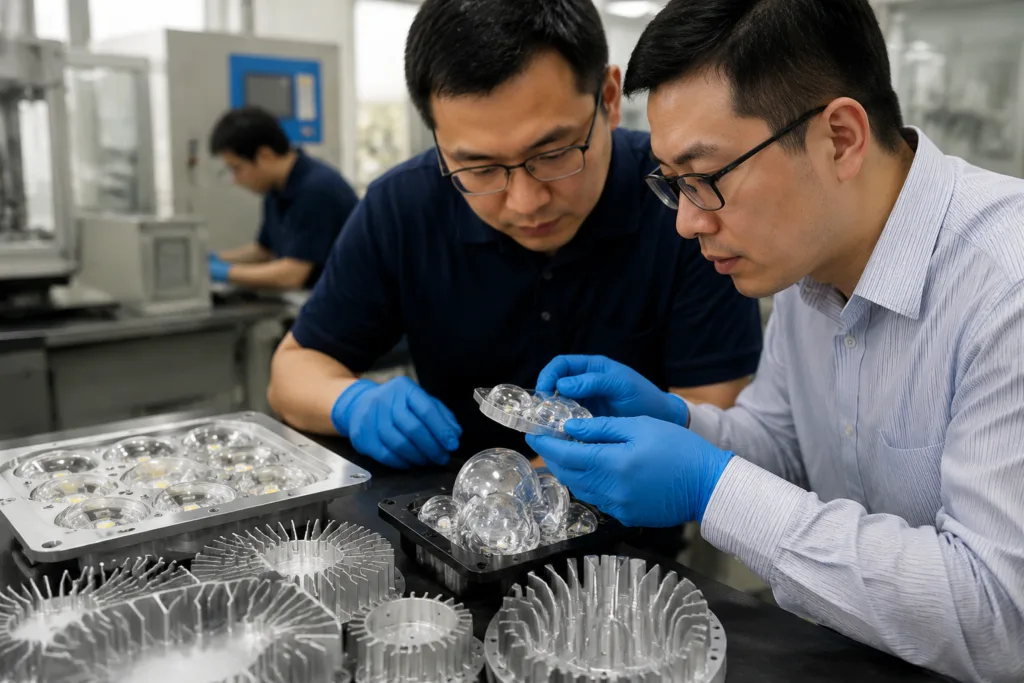
Material compatibility is one of the most overlooked parts of LED adhesive selection. A silicone that performs well on aluminum may behave differently on powder-coated steel, anodized parts, polycarbonate lenses, acrylic covers, or low-surface-energy plastics. Cure chemistry also matters because some sensitive electronic or optical environments require low-corrosion or low-outgassing behavior.
Teams should test on the exact production substrates, including coatings, surface treatments, release residues, and cleaning conditions. From a manufacturer perspective, ZDS typically treats substrate review as a core part of formulation matching because the real assembly surface is often different from the nominal material listed on the drawing.
- Check whether the lens is acrylic, polycarbonate, glass, or another transparent material
- Confirm whether metal parts are bare, anodized, plated, or powder coated
- Review process residues such as mold release, coolant, fingerprint oils, or cleaners
- Test adhesion after full cure, heat aging, and moisture exposure rather than only at room temperature
- Evaluate any risk of stress cracking or visual defects on clear plastics
What to validate before approval
Approval should be based on a validation plan that matches the actual service environment. A good bench result is useful, but lighting products usually need a broader check before the adhesive is released into production.
Adhesion testing
Test on real substrates, with real surface preparation, at realistic bond line thickness. Include initial adhesion and retention after aging.
Thermal cycling
Cycle the bonded assembly through expected temperature swings to reveal debonding, cracking, or seal shrinkage caused by expansion mismatch.
Weathering and UV exposure
Where the bond line is visible or outdoor-exposed, weathering tests help screen for yellowing, haze, and loss of elasticity.
IP protection checks
If the adhesive contributes to enclosure sealing, validate water and dust protection at the assembly level, not only the raw material level.
Aging and process review
Include cure consistency, dispensing behavior, tack-free timing, and any assembly bottlenecks. A technically suitable adhesive can still be a poor manufacturing fit if the process window is too narrow.
Selection checklist for choosing an LED housing sealant adhesive
- Define whether the material must bond, seal, pot, or combine those functions
- Map all substrates, including coatings and transparent parts
- Identify maximum sustained operating temperature and likely hot spots
- Decide whether optical clarity is required and how visible the bond line will be
- Review water exposure: splash, rain, condensation, immersion, or underwater use
- Check expected movement from thermal expansion and vibration
- Confirm cure speed and dispensing fit for production throughput
- Validate adhesion retention after heat, humidity, and UV aging
- Assess rework difficulty and field repair implications
- Balance performance margin against unnecessary over-specification
Conclusion
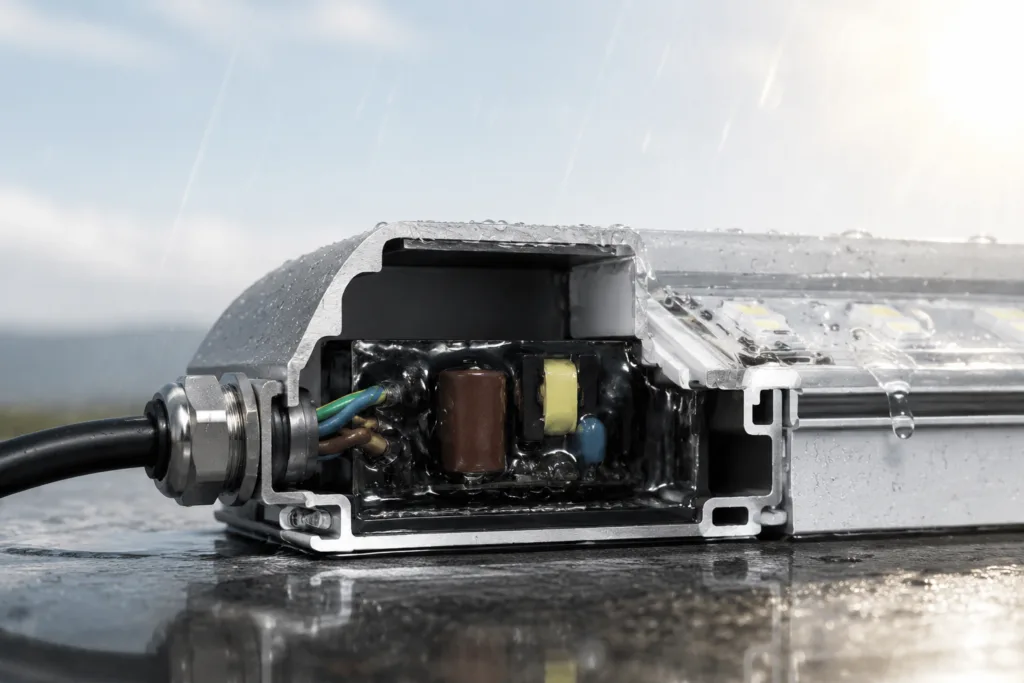
The right silicone adhesive for LED assemblies is usually the one that keeps doing its job after heat, moisture, UV, and material movement have acted on the joint for a long time. For lighting manufacturers, the key is to match the material to the exact function of the bond line, the real substrate set, and the expected environment instead of relying on generic silicone assumptions. A disciplined validation plan around adhesion, thermal cycling, optical stability, and sealing performance usually prevents the most expensive failures.
FAQ
Is silicone adhesive good for LED lighting assemblies?
Yes, silicone is often a strong fit for LED lighting because it can provide flexibility, heat resistance, and weatherability in assemblies that combine metals, plastics, and sealed housings.
Can silicone adhesive stay clear around LED lenses?
Some silicone formulations are suitable for clear or visible bond lines, but clarity should be checked after heat and UV aging because initial appearance alone does not predict long-term optical stability.
Why do LED housing seals fail over time?
Common causes include poor substrate preparation, thermal expansion mismatch, moisture ingress, UV exposure, incomplete cure, and materials that harden or lose adhesion after aging.
Is silicone better than rigid adhesive for outdoor lighting?
In many outdoor lighting joints, silicone performs better because it can stay flexible and maintain a seal during temperature changes and weather exposure, though rigid adhesives may still suit some structural applications.
What should be tested before approving a silicone adhesive for LED use?
At minimum, teams should test adhesion on real substrates, thermal cycling, moisture resistance, UV or weathering where relevant, and assembly-level sealing performance.
Can one adhesive handle bonding, sealing, and potting in the same lighting product?
Sometimes, but not always; many products use different materials for seam sealing, lens bonding, and internal potting because each function can require a different balance of viscosity, cure behavior, and durability.