
Choosing a rubber adhesive sounds simple until the bond has to survive movement, temperature change, moisture, and dissimilar materials. Rubber parts are flexible, many substrates are rigid, and different rubber compounds behave very differently in bonding. For engineers, buyers, and product developers, good adhesive selection starts with understanding why rubber bonding fails and which material combinations need special handling.
explore adhesive solutions by application when you need to compare bonding approaches across substrate combinations, environmental demands, and production processes rather than looking at adhesive chemistry in isolation.
Why rubber bonding is harder than it looks
Rubber is not just one material. Natural rubber, EPDM, nitrile, neoprene, silicone rubber, and thermoplastic elastomers each bring different surface characteristics, flexibility, oil resistance, and temperature behavior. The adhesive has to bond to the rubber itself while also handling the second substrate, which may be metal, glass, or plastic.
The challenge becomes greater when the two materials move differently. A steel bracket and a soft rubber gasket expand at different rates. Glass stays rigid while rubber compresses and rebounds. Some plastics are easy to bond, while others resist wetting and adhesion. That mismatch means a rubber adhesive must often provide both strong interfacial adhesion and enough flexibility to absorb stress over time.
What makes rubber adhesion complex
Elasticity creates repeated stress
Rubber stretches, compresses, and recovers. Even when the bonded part looks static, small cycles from vibration, assembly pressure, thermal expansion, or handling can continuously load the adhesive line. Brittle systems may hold initially but crack or peel after repeated movement.
Low surface energy can reduce wetting
Some rubber compounds and many plastics present low surface energy surfaces, which makes it harder for an adhesive to spread and form intimate contact. Poor wetting often leads to edge lift, low peel resistance, or early delamination, especially in humid conditions.
Substrate mismatch matters
Rubber-to-rigid bonding is a mismatch problem as much as a chemistry problem. Metals and glass are hard and dimensionally stable. Rubber is compliant. Plastics vary widely in stiffness and chemical makeup. The adhesive must bridge these differences without becoming the weak point in the assembly.
Understanding rubber types and why they bond differently
Before comparing adhesive families, it helps to identify the rubber compound. Two black rubber parts may look similar but require different surface treatment and bonding strategies.
| Rubber type | Typical bonding behavior | Selection implication |
|---|---|---|
| Natural rubber | Often bonds reasonably well but can age and oxidize | Check long-term durability and environmental exposure |
| Nitrile rubber | Common in oil-resistant parts, moderate bonding variability | Consider chemical exposure and flexibility needs |
| EPDM | Weather resistant but can be harder to bond reliably | Surface preparation and primer use may become important |
| Neoprene | Often manageable with flexible adhesive systems | Balance heat, moisture, and process needs |
| Silicone rubber | Especially challenging because of low surface energy | Often needs silicone-compatible chemistry or treatment |
| TPE/TPR | Behavior depends heavily on formulation | Validate with actual molded parts, not generic assumptions |
At ZDS, substrate pairing is usually the starting point because rubber type alone does not decide success. The actual bond line has to reflect the rubber compound, the mating material, the process, and the end-use environment together.
Natural rubber, synthetic rubber, and silicone rubber
Natural rubber
Natural rubber is valued for elasticity and resilience, but durability can depend on environmental exposure. For indoor or protected applications, many flexible adhesive systems can work well. For outdoor or chemically exposed parts, aging resistance becomes more important than initial strength alone.
Synthetic rubber
This category covers a wide range of materials such as nitrile, EPDM, neoprene, and others. Each was designed for a property set such as weatherability, oil resistance, or heat tolerance. The more performance-driven the rubber, the more likely its surface chemistry may complicate bonding.
Silicone rubber
Silicone rubber is a special case. It handles temperature well and remains flexible, but its surface is notoriously difficult for many conventional systems. In applications that need long-term flexibility and moisture resistance, silicone adhesives for flexible, waterproof bonding are often evaluated because chemistry compatibility can matter as much as nominal bond strength.
Rubber-to-metal bonding
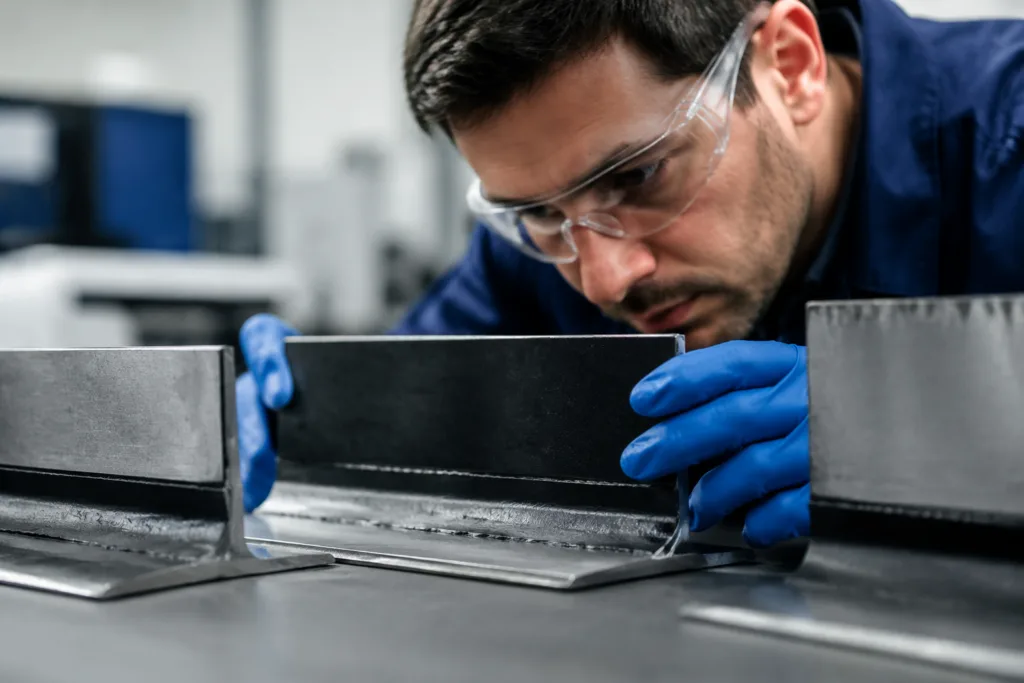
Rubber-to-metal assemblies are common in seals, vibration isolators, appliance parts, automotive components, and industrial mounts. Metal provides structure, while rubber provides damping, sealing, or cushioning. The main challenge is that the interface sees both stress concentration and environmental exposure.
Typical issues include oily contamination, corrosion risk, mismatch in thermal expansion, and localized peel forces at edges. A bond that looks strong in lap shear may still fail if the actual part experiences peel or flexing during service.
Main challenges with metal substrates
- Residual oil, cutting fluid, or release agents blocking adhesion
- Smooth surfaces limiting mechanical interlock
- Corrosion at the interface under moisture exposure
- High stiffness of metal concentrating stress at bond edges
- Heat cycling that repeatedly loads the adhesive line
Surface preparation for metal substrates
For rubber-to-metal bonding, preparation often determines whether the project succeeds in production. Cleaning is the first step, but not the only step. Grease, oxide, dust, and handling residue can all reduce wetting. Roughening may improve anchorage, while primers can improve compatibility or long-term durability depending on the system.
For assemblies where metal and glass are involved and moisture resistance matters, some teams review products such as ZDS-695 for metal and glass bonding to understand how single-component, flexible systems may fit sealing or bonding conditions that combine rigidity with movement.
Practical preparation sequence
- Remove oils, mold release, dust, and oxidation
- Use controlled abrasion only if the substrate and appearance allow it
- Keep prepared parts clean before adhesive application
- Evaluate primer use where the rubber or metal is difficult to bond
- Match cure schedule to part thickness, fixture method, and throughput
Curing logic also matters. If the adhesive cures too fast, assembly time may be too short. If it cures too slowly, parts may shift or contamination may occur before full property development. The right balance depends on line speed, fixture strategy, and part geometry.
Rubber-to-glass adhesive applications
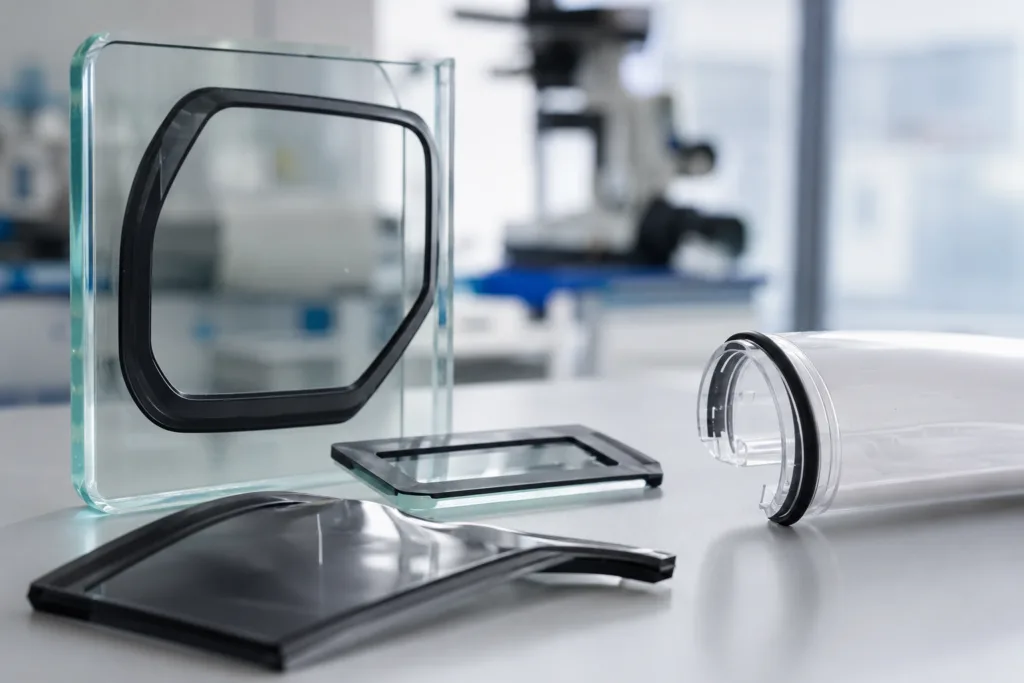
Rubber bonded to glass appears in seals, edge protection, flexible mountings, and some transparent assemblies. Glass is smooth, rigid, and dimensionally stable, but it is also brittle. The adhesive must avoid creating stress patterns that increase crack risk or visible defects.
Moisture resistance is usually a key concern in glass applications. If the assembly also needs flexibility, the adhesive should maintain adhesion while accommodating differential movement. In some designs, the bond line also acts as a seal, so waterproofing and aging resistance become as important as initial adhesion.
What matters most in rubber-to-glass bonding
- Clean, residue-free glass surfaces
- Adhesive flexibility to reduce stress concentration
- Moisture resistance for long-term edge integrity
- Compatible cure profile for the production process
- Appearance control if the bond line is visible
When the assembly includes transparent materials and visual clarity matters, a different evaluation path may be needed than for hidden industrial joints. In those cases, teams may compare options such as ZDS-3311F for clear glass-to-plastic assemblies to understand how transparency, cure method, and bond-line appearance affect material selection.
Rubber-to-plastic adhesive applications
Rubber-to-plastic bonding is often the most variable category because plastics differ so widely. ABS, PVC, and polycarbonate are usually easier to approach than polyolefins such as PP and PE. Even within one plastic family, additives, surface texture, and molding conditions can change bonding behavior.
ABS, PVC, and polycarbonate
These plastics are often more adhesive-friendly than low-surface-energy plastics, but that does not guarantee success. Stress cracking, solvent sensitivity, and rigidity mismatch still need attention. A formulation that bonds well to the rubber may still damage or stress the plastic if the chemistry is not compatible.
PP and PE
PP and PE are difficult because they resist wetting and bonding. Surface treatment, primers, or alternative joint design may be required. In some cases, adhesive bonding alone may be less reliable than a hybrid approach using mechanical retention plus adhesive sealing.
For demanding metal-to-plastic interfaces within rubber-containing assemblies, some developers also benchmark materials like ZDS-3355H metal-to-plastic bonding adhesive to compare toughness, process behavior, and compatibility where dissimilar materials must share load.
Common failure modes in rubber bonding projects
Understanding failure mode is more useful than looking at bond strength alone. A strong adhesive applied to the wrong surface can still fail quickly.
Peel failure
Rubber parts often flex at the edge of the bond line. If the design creates peel stress, even a strong adhesive can detach progressively from one edge. Flexible systems and better joint geometry usually help more than simply choosing a harder adhesive.
Shear overload
Some joints are designed for shear, but service loads may exceed what the bond line can sustain, especially after aging or temperature exposure. Testing under realistic conditions is essential.
Delamination
Delamination often points to poor surface preparation, poor wetting, incompatible chemistry, or contamination. If failure is clean at one interface, the problem may be adhesion. If residue remains on both sides, cohesive weakness or environmental breakdown may be involved.
Environmental breakdown
Heat, moisture, oils, UV exposure, and cleaning chemicals can degrade either the adhesive or the substrate interface. A bond that passes room-temperature testing may fail in real use if environmental conditions were not part of the validation plan.
Performance requirements that matter most
Selection should be driven by the properties that matter in service, not by a generic claim of high strength.
- Flexibility: Critical when the rubber moves or the joint sees vibration.
- Waterproofing: Important when the bond line also acts as a seal.
- Heat resistance: Needed for appliances, automotive zones, and outdoor exposure.
- Chemical resistance: Relevant for oils, cleaners, fuels, or process fluids.
- Aging resistance: Important for long service life and outdoor durability.
- Process fit: Open time, cure speed, and application method affect production reliability.
How to choose the right rubber adhesive
A practical selection framework starts with four questions: what is the rubber type, what is the mating substrate, what environment will the joint see, and what process constraints exist? Once those are clear, it becomes easier to narrow the chemistry range.
Step one: identify the actual substrates
Do not stop at “rubber” or “plastic.” Ask for the exact compound or resin if possible. Surface treatments, fillers, and additives may change bonding behavior.
Step two: define the operating environment
Consider temperature range, water exposure, oil or chemical contact, UV exposure, and movement. If the joint will be flexed repeatedly, flexibility and fatigue resistance may matter more than static strength.
Step three: map process requirements
Check viscosity, dispensing method, working time, fixture time, cure conditions, and production speed. The right adhesive on paper can still fail operationally if it does not fit the line.
Step four: test the real design
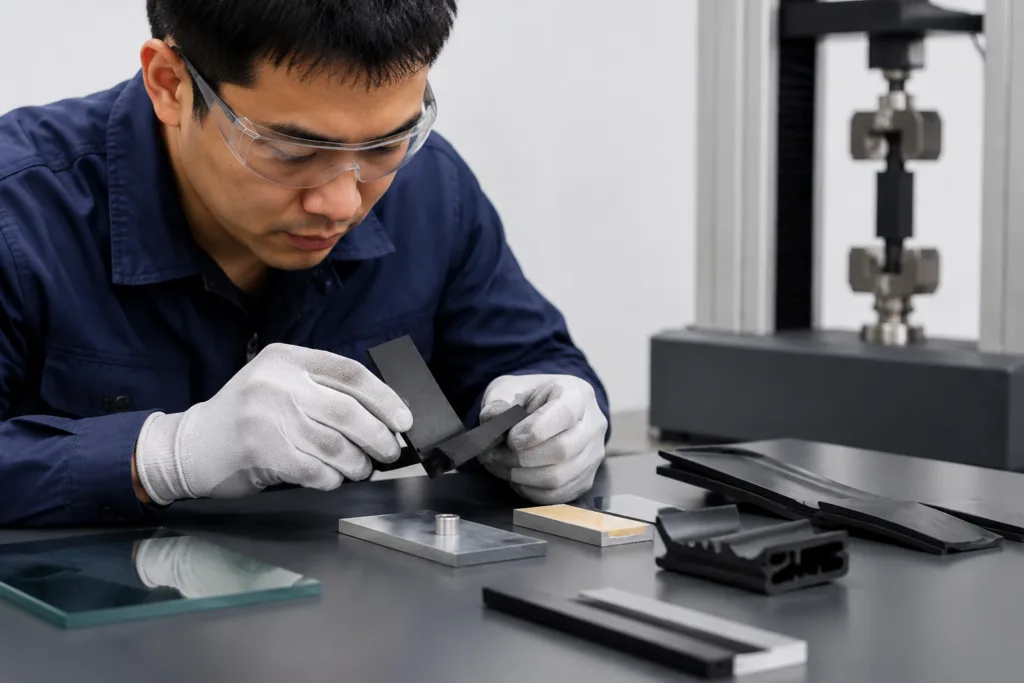
Test with actual substrates, actual surface preparation, and realistic environmental conditioning. Lab coupons are useful for screening, but production-like assemblies reveal edge effects, tolerance stack-up, and geometry-driven stress.
Matching adhesive chemistry to substrate and environment
No single chemistry fits every rubber bonding task. Flexible systems are often preferred where movement and sealing dominate. Tough structural systems may fit where load-bearing performance matters more and substrate compatibility supports it. UV-curing materials can be attractive for transparent assemblies, but only when light access and geometry allow it.
The decision should weigh three things together: compatibility with the rubber, compatibility with the second substrate, and durability under service conditions. If one of those is weak, the whole bond can become unreliable.
When to use primers, surface treatment, or mechanical design support
Primers and surface treatments are not just rescue tools for failed projects. They are often part of a robust process when bonding difficult rubbers or low-surface-energy plastics. Corona, plasma, flame treatment, or chemical primers may improve wetting and adhesion depending on the substrate.
Mechanical design support is also worth considering. Grooves, compression features, overmold-style retention, or geometry that reduces peel can improve reliability without forcing the adhesive to carry all stress alone. This is especially helpful when bonding to PP, PE, or highly dynamic rubber parts.
Testing and validation checklist before production use
Before scaling a rubber adhesive into production, validate the full bonding system rather than the adhesive alone.
- Confirm exact rubber compound and mating substrate grade
- Document cleaning and preparation steps
- Test multiple surface conditions, not just ideal samples
- Check adhesion after full cure, not only green strength
- Run peel, shear, and environmental conditioning as relevant
- Evaluate heat, humidity, water, and chemical exposure
- Inspect edge lift, cracking, and substrate damage
- Verify process repeatability across operators or production shifts
A short qualification cycle may save time upfront, but a broader validation plan usually reduces field failures, scrap, and redesign work later.
Application-specific guidance
Industrial equipment
Focus on oil resistance, vibration, temperature swings, and maintenance conditions. Hidden contamination on metal surfaces is a common reason for inconsistent results.
Automotive components
Consider heat cycling, fluids, dynamic stress, and long-term aging. Edge geometry and peel resistance are often just as important as nominal strength.
Appliances
Look at moisture, detergent exposure, thermal cycling, and appearance. Quiet operation may also favor adhesives that help damp vibration between rigid and flexible parts.
Consumer products
Pay attention to plastics compatibility, visible bond lines, handling abuse, and process speed. A fast-curing option may improve throughput, but not if it reduces assembly control or creates cosmetic issues.
Conclusion
The right rubber adhesive is rarely chosen by strength alone. Successful bonding depends on rubber type, mating substrate, surface preparation, joint design, curing behavior, and the real environment the assembly will face. When metal, glass, or plastic is involved, the best selection process is practical: define the substrates clearly, understand the service conditions, compare flexibility and durability needs, and validate with production-like testing before committing to scale.
Frequently asked questions about rubber bonding
Can one rubber adhesive bond all rubber types?
No. Different rubber compounds have different surface properties and environmental performance, so an adhesive that works on one rubber may perform poorly on another.
Is rubber-to-metal bonding usually stronger than rubber-to-plastic bonding?
Not always. Metal can be easier to prepare consistently, but bond strength depends on contamination control, joint design, adhesive flexibility, and the rubber compound itself.
Why does a rubber bond pass initial testing but fail later?
Delayed failures often come from moisture, heat, oils, repeated movement, or poor surface preparation that was not obvious during short-term room-temperature testing.
Do glass applications always need a clear adhesive?
No. Clear adhesive is mainly important when the bond line is visible or optical appearance matters; hidden glass assemblies may prioritize flexibility and moisture resistance instead.
Are PP and PE difficult to bond to rubber?
Yes. PP and PE have low surface energy, so they often need surface treatment, primer support, or a joint design that adds mechanical retention.
When should primers be considered in rubber bonding?
Primers are worth evaluating when the rubber or mating substrate is difficult to wet, when environmental durability is critical, or when early testing shows inconsistent adhesion.