
A polyurethane based adhesive is often chosen when a bond needs more than simple strength. It is valued for combining adhesion, flexibility, toughness, and durability in one system, which makes it useful across transportation, construction, wood assembly, electronics, and general manufacturing. Compared with more rigid adhesive chemistries, polyurethane can better absorb movement, vibration, and impact while still maintaining a reliable bond line.
For readers comparing chemistries across different substrates and process needs, it helps to explore the full adhesive lineup before narrowing the choice to one adhesive family.
What a polyurethane based adhesive is and how it performs
Polyurethane adhesive is a reactive adhesive system designed to bond and seal while keeping a degree of flexibility after cure. Depending on the formulation, it may be supplied as a one-component moisture-curing material or as a two-component system that cures after mixing. In both cases, the cured adhesive typically forms a tough polymer network with good elongation and useful load-bearing capability.
This balance is what gives polyurethane its distinct place in industrial bonding. It can bridge small differences in thermal expansion, tolerate movement between unlike materials, and reduce stress concentration that might crack a more brittle bond line. That makes it especially relevant when engineers are working with metal, plastic, wood, composites, coated surfaces, or mixed-material assemblies.
From a manufacturer perspective, ZDS usually sees polyurethane selected when the application needs a practical mix of bond strength, flexibility, moisture resistance, and process adaptability rather than extreme rigidity alone.
Core characteristics of polyurethane adhesive
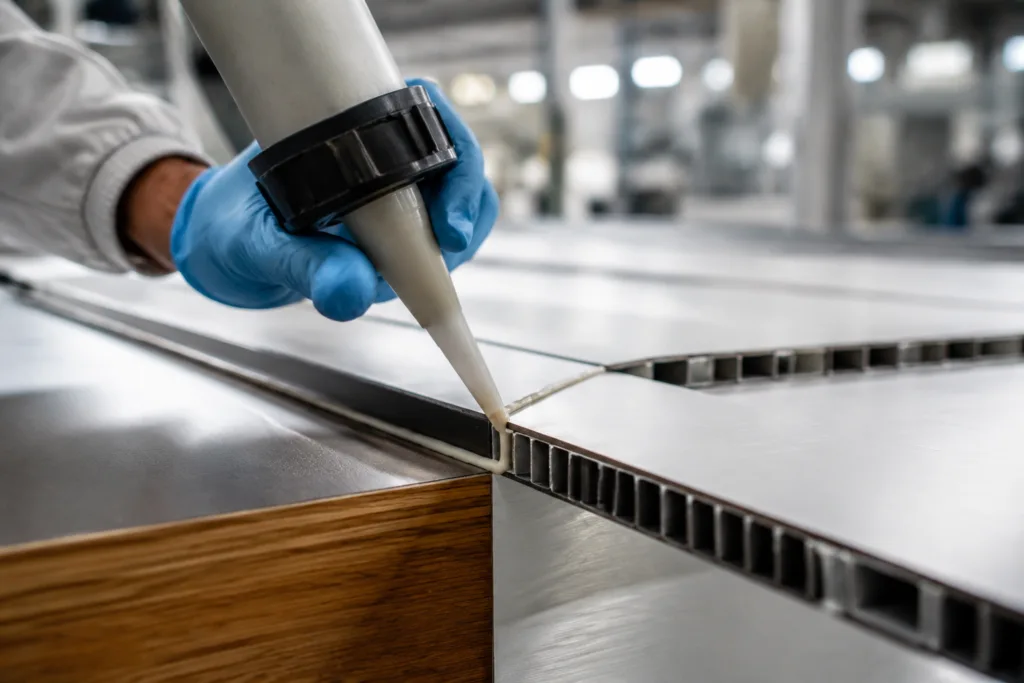
How it bonds
Polyurethane based adhesive can bond to a broad range of substrates, but actual performance depends on surface energy, cleanliness, porosity, and whether the adhesive is structural, flexible, foaming, transparent, or formulated for potting rather than bonding. It commonly performs well on wood, many metals, composites, foams, fabrics, ceramics, and selected plastics, though low-surface-energy plastics may still require pretreatment or a different chemistry.
How it cures
Cure behavior varies by system. Moisture-curing grades react with ambient humidity or substrate moisture, while two-component products depend on resin-hardener mixing ratio and pot life. This matters because assembly speed, bead size, fixture time, and final cure depth can all change based on temperature and humidity. Thick sections may cure more slowly in some systems, while some formulations are designed specifically for gap filling or encapsulation.
How it performs after cure
Once cured, polyurethane usually offers a useful combination of adhesion, flexibility, abrasion tolerance, and fatigue resistance. It often performs well where bonded parts experience repeated stress rather than only static load. For many industrial teams, that practical toughness is the main reason to consider polyurethane adhesive solutions for industrial bonding instead of relying on a single rigid adhesive family for every assembly.
Why polyurethane works well as a flexible adhesive
Flexibility is not just about softness. In industrial bonding, it often means the adhesive can stretch slightly, recover from movement, and prevent crack initiation at the bond line. A polyurethane based adhesive usually performs well here because it can distribute stress instead of concentrating it sharply at one point.
This matters in applications exposed to:
- Vibration from motors, vehicles, or rotating equipment
- Impact during transport, installation, or service
- Thermal expansion mismatch between bonded materials
- Small dimensional movement in wood, panels, or composite parts
- Repeated loading and unloading cycles
In those conditions, a rigid adhesive may provide high initial strength yet fail early if the joint design or service environment forces too much movement into the bond line. Polyurethane often reduces that risk by acting as both an adhesive and a stress-management layer.
Environmental resistance and long-term durability
A polyurethane based adhesive is often selected for real-world durability rather than laboratory strength numbers alone. In many applications, bond survival depends on moisture, temperature swings, and service conditions over time.
Moisture resistance
Many polyurethane systems provide good moisture resistance after full cure, which supports use in outdoor, washdown, and condensation-prone environments. That said, moisture resistance is not identical across all PU formulations. Some are optimized for bonding, some for sealing, and others for encapsulation or potting.
Temperature tolerance
Polyurethane adhesives can handle moderate temperature cycling well, especially where flexibility helps absorb expansion and contraction. However, they are not automatically the first choice for every high-heat environment. If continuous elevated temperature is a major requirement, teams should compare the exact service range against epoxy, silicone, or other specialized systems.
Durability under movement
Where joints are exposed to shock, vibration, and repeated mechanical stress, polyurethane often outperforms brittle alternatives because it maintains adhesion while accommodating movement. This is especially important in transportation panels, appliance housings, floor systems, and mixed-material assemblies.
Best use cases for polyurethane based adhesive
Polyurethane performs best when a joint needs a combination of bond strength, toughness, flexibility, and environmental resistance. It is especially useful when the assembly includes dissimilar materials or when service conditions are less than ideal.
| Application need | Why polyurethane may fit |
|---|---|
| Bonding dissimilar materials | Helps absorb stress from different expansion rates |
| Vibration-prone assembly | Flexible bond line improves fatigue resistance |
| Outdoor or damp service | Many formulations offer solid moisture durability |
| Gap filling | Can handle uneven surfaces better than thin rigid adhesives |
| Visible flexible bond or coating area | Transparent and flexible grades are available for selected uses |
Automotive and transportation bonding applications
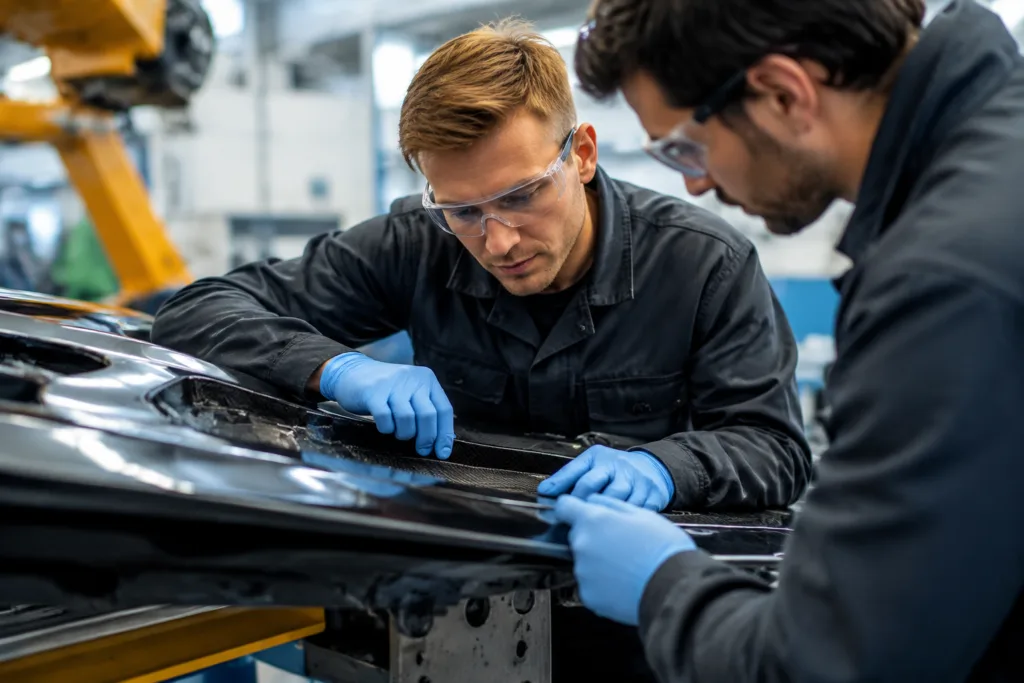
Transportation assemblies regularly involve vibration, dynamic loading, thermal cycling, and mixed substrates. That is where polyurethane often earns its place. It can be used in interior trim bonding, panel attachment, insulation assembly, weather-exposed joints, and component fixation where flexibility is important.
For more demanding structural-style joints, a product such as ZDS-PU929 high-strength structural PU adhesive reflects the type of formulation often considered when higher strength must be paired with toughness instead of brittleness.
Typical selection logic in transportation includes whether the joint must handle peel, shock, vibration, or material movement over time. If yes, polyurethane usually deserves serious consideration.
Construction and building materials bonding applications
In construction, bond lines are rarely static. Building materials expand and contract, outdoor humidity changes, and surface flatness is not always perfect. Polyurethane based adhesive is often suitable for panel bonding, insulation attachment, flooring-related assembly, facade elements, and other applications where movement tolerance matters.
It can also help where porous and non-porous materials meet. Wood to metal, composite to masonry-adjacent components, and coated building panels are examples where flexibility and gap accommodation can improve practical bond reliability. Surface preparation still matters, especially where dust, release agents, oil, or unstable coatings are present.
Woodworking, furniture, and panel assembly applications
Wood and engineered boards naturally change dimension with moisture and temperature. A rigid bond line can therefore become a stress point over time. Polyurethane often performs well in furniture, decorative assemblies, panel lamination support tasks, and wood-to-mixed-material bonding because it can move with the substrate more effectively.
Flexible and visually clean formulations can also be useful in decorative small-part assembly. For example, ZDS-8300AB transparent flexible PU glue represents the kind of polyurethane system used where appearance, elasticity, and bonding stability need to work together.
Electronics, appliances, and general industrial assembly
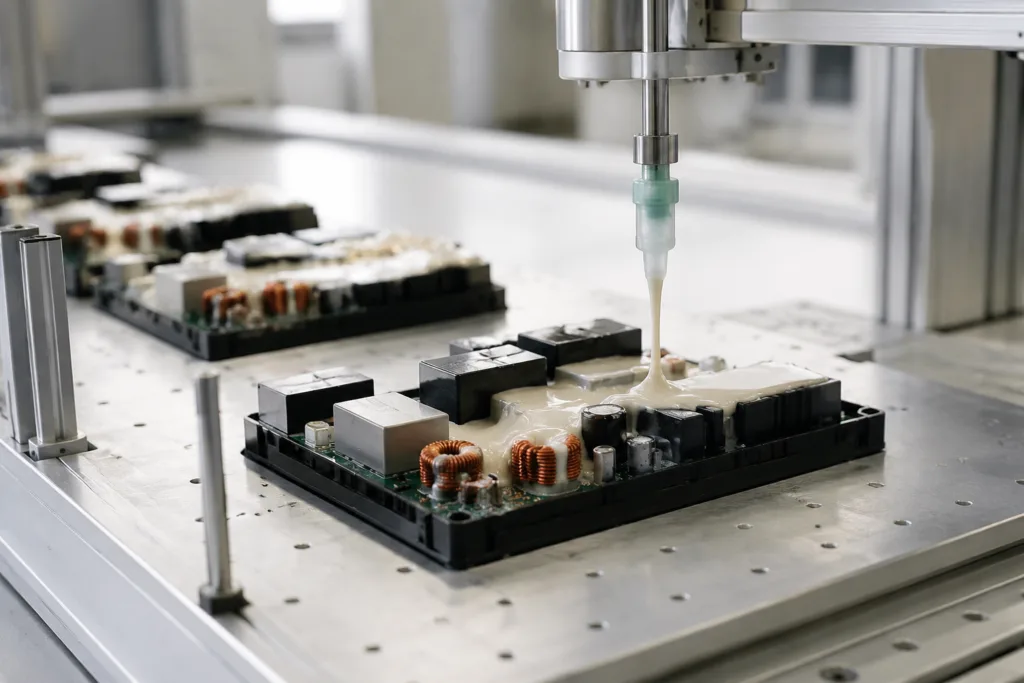
Not every polyurethane product is intended only for bonding flat parts together. In electronics and appliance manufacturing, PU materials are also used for potting, encapsulation, vibration damping, and environmental protection. When components need mechanical support plus resistance to moisture or movement, a polyurethane system may do more than a simple rigid adhesive.
For example, a formulation such as ZDS-PU951 waterproof PU potting compound shows how the same chemistry family can support protection of sensitive assemblies where shock absorption and sealing behavior are important alongside adhesion.
This is why adhesive selection should begin with function, not only chemistry name. The right polyurethane for bonding metal panels is not automatically the right polyurethane for encapsulating an electronic module.
Advantages and limitations of polyurethane adhesive
Where it is the right choice
- Assemblies requiring flexibility and toughness together
- Joints exposed to vibration, impact, or thermal movement
- Mixed-material bonding where expansion rates differ
- Applications needing moisture resistance and practical durability
- Situations where gap filling is more important than ultra-thin bond lines
Where it may not be the first choice
- Very high continuous heat exposure
- Applications demanding maximum rigidity with minimal movement
- Very fast fixture requirements better suited to acrylic systems
- Chemical environments that require a more specialized formulation
- Substrates that are difficult for PU to wet without primer or pretreatment
In other words, polyurethane is not a universal replacement for every adhesive. It is strongest as a problem-solving option where stress, movement, and real-world service conditions matter as much as basic lap shear strength.
Polyurethane adhesive vs epoxy
Epoxy and polyurethane can both provide strong bonds, but they solve different problems. Epoxy is often chosen for rigidity, dimensional stability, and high-strength structural performance where joint movement is limited. Polyurethane is often chosen when flexibility, peel resistance, and vibration tolerance are more important.
| Selection factor | Polyurethane | Epoxy |
|---|---|---|
| Flexibility | Usually higher | Usually lower |
| Vibration tolerance | Often better | Can be more brittle depending on grade |
| Gap and movement tolerance | Often strong | Varies, often less movement-friendly |
| Rigidity | Moderate | Usually higher |
| High heat suitability | Moderate depending on grade | Often stronger candidate depending on system |
If the joint must stay stiff and resist creep under high load, epoxy may be preferable. If the joint must survive movement and fatigue, polyurethane may be the smarter choice.
Polyurethane adhesive vs acrylic
Acrylic adhesives are often valued for fast handling strength, good adhesion to certain metals and plastics, and efficient production flow. Polyurethane usually brings more flexibility and a different durability profile, especially where impact and vibration are ongoing concerns.
When comparing the two, teams typically review:
- Required fixture speed
- Need for flexibility versus stiffness
- Substrate type and surface condition
- Expected service moisture and temperature variation
- Odor, process, and mixing preferences
If line speed dominates the decision, acrylic may win. If long-term movement tolerance is critical, polyurethane often has the advantage.
How to choose the right industrial glue for your application
The most reliable way to choose a polyurethane based adhesive is to define the joint by function. Ask what the bond must survive, not only what materials are being joined.
- Substrates: Are they metal, plastic, wood, composite, coated, or porous?
- Joint design: Will the bond see peel, shear, cleavage, impact, or vibration?
- Environment: Is there moisture, outdoor exposure, heat cycling, or chemical contact?
- Process: Do you need fast handling, long open time, bead stability, or easy dispensing?
- Appearance: Does the adhesive need to be clear, paintable, sandable, or low-foaming?
- Rework: Is permanent bonding acceptable, or will disassembly matter later?
Once these answers are clear, adhesive selection becomes more disciplined and less trial-and-error.
Surface preparation, application, and curing considerations
Even a well-chosen polyurethane will underperform if the surface and process are poor. Consistent bond results usually depend on basic controls:
- Remove oil, dust, loose oxide, moisture, and release agents
- Check whether abrasion improves wetting and mechanical keying
- Confirm compatibility with coatings, paints, and primers
- Use the correct mix ratio for two-part systems
- Apply appropriate bead size for the gap and cure profile
- Allow enough time for fixture and full cure before stressing the joint
Moisture-curing systems deserve extra attention because ambient humidity can affect cure speed. Very dry environments may slow cure, while production teams must also avoid assuming skin formation means full internal cure.
Common mistakes to avoid
- Choosing polyurethane only because it is flexible, without checking actual load and heat requirements
- Bonding contaminated or unstable surfaces
- Ignoring cure depth and full cure time in thick sections
- Using the same PU grade for structural bonding, cosmetic assembly, and potting without checking fit
- Overlooking joint design and relying on adhesive strength alone
- Skipping small-scale validation on actual substrates and process conditions
Many adhesive failures are really selection or process failures. A better match between formulation, surface, and service environment usually matters more than broad claims about chemistry type.
Conclusion
Polyurethane based adhesive stands out when a bonded assembly needs strength with flexibility rather than strength with brittleness. It is especially useful in applications involving vibration, impact, thermal movement, moisture exposure, or mixed materials. That makes it a strong candidate for transportation, construction, woodworking, electronics protection, and many general industrial tasks.
It is not automatically the answer for every application, especially where extreme heat, very high rigidity, or ultra-fast line speed drive the decision. But when the real challenge is long-term bond survival under movement and demanding service conditions, polyurethane is often one of the most practical adhesive families to evaluate first.
FAQ
What is a polyurethane based adhesive used for?
A polyurethane based adhesive is used for bonding applications that need strength, flexibility, vibration resistance, and good durability, including transportation, construction, woodworking, electronics, and mixed-material assembly.
Is polyurethane adhesive better than epoxy?
It depends on the application, because polyurethane is often better for flexible, vibration-prone joints while epoxy is often better for rigid, high-strength bonds with less movement.
Does polyurethane adhesive work on metal and plastic?
Yes, many polyurethane adhesives can bond metal and selected plastics, but actual performance depends on surface condition, plastic type, and whether pretreatment is needed.
Is polyurethane adhesive waterproof?
Many cured polyurethane adhesives offer good water and moisture resistance, but the exact level depends on the specific formulation and the service conditions.
How long does polyurethane adhesive take to cure?
Cure time varies by one-part or two-part system, bead size, temperature, and humidity, so handling strength may develop relatively early while full cure can take much longer.
What is the biggest mistake when using polyurethane adhesive?
The most common mistake is assuming flexibility alone guarantees performance without checking surface preparation, cure conditions, substrate compatibility, and real service demands.