
In disposable and high-volume device manufacturing, every second added to bonding can limit output, increase work-in-process, and complicate line balancing. Yet moving faster is only useful if the joint still performs as required in packaging, transport, sterilization, and end use. This is why teams evaluating a fast cure medical adhesive are usually not looking for speed alone. They need a process that shortens fixture time without creating hidden reliability risks. For buyers and engineers planning capacity increases, medical adhesive manufacturing support for high-volume assembly should focus on chemistry fit, curing method, dispensing control, and validation strategy together rather than as separate decisions.
Medical device assembly is especially sensitive because bond quality is affected by many linked variables: substrate energy, part tolerances, adhesive viscosity, cure access, operator handling, contamination, and post-assembly processing. A rapid process can be stable and scalable, but only when the adhesive and the line are designed around the actual assembly. For that reason, final selection should be confirmed against the current technical data sheet, safety data sheet, and device-specific regulatory and validation requirements for the chosen product.
Why Throughput Matters in Disposable and High-Volume Medical Device Production
High-volume production environments often run under tight takt-time targets. A bonding step that requires long fixture time can force larger buffers, more fixturing stations, more labor handling, or longer conveyor lengths. In disposable devices and other repetitive assemblies, even small delays compound quickly across shifts.
However, throughput is not just about cycle speed. It also includes line uptime, rework rate, scrap, cure verification effort, and how easily the process can be standardized across operators and production cells. In practice, a slower adhesive with a wide process window may outperform an ultra-fast material that strings during dispensing, cures inconsistently, or traps stress in a delicate assembly.
Teams typically evaluate throughput impact through questions such as:
- How quickly does the bond reach handling strength or fixture strength?
- Can parts move to the next station before full cure?
- Does the cure method require shielding, indexing, or dwell time?
- How sensitive is the process to adhesive bead size and placement?
- Will cure speed change with part geometry, bondline thickness, or substrate transparency?
- Can the process be monitored in-line with practical quality controls?
For procurement managers, this means price per unit is only one part of the sourcing decision. The total process cost includes equipment compatibility, waste, maintenance, quality losses, and the burden of validating the assembly step.
Fast Fixture vs Full Cure in Assembly Planning
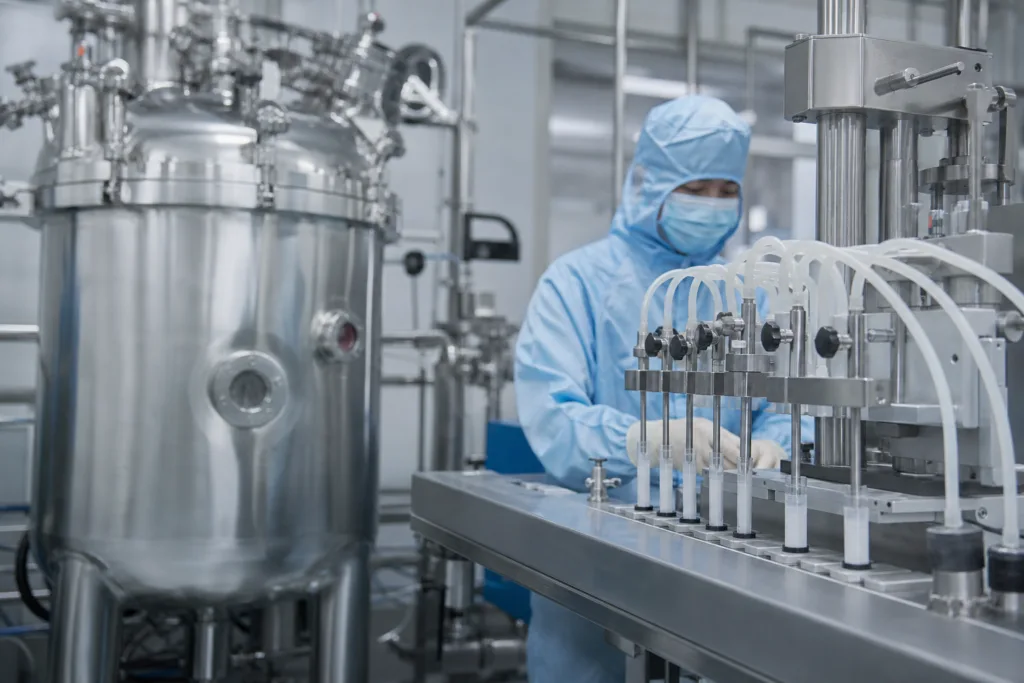
One of the most common planning mistakes is treating fixture time and full cure as if they are the same event. They are not. A joint may be strong enough to hold parts in place for the next operation long before it reaches its final mechanical or environmental performance.
Fast fixture matters when the line needs to release parts from nests or clamps quickly. Full cure matters when the assembly must survive later stresses such as leak testing, packaging compression, sterilization exposure, shipping vibration, or field use. If a production line is designed only around fixture speed, it may transfer parts too early or expose partially cured bonds to loads they were not ready to handle.
Engineers should map the full assembly sequence and identify what the bond must withstand at each stage:
- Immediate part retention after joining
- Transfer to the next station
- Inspection or leak testing
- Secondary assembly loads
- Sterilization or environmental conditioning
- Storage and shelf-life expectations of the finished device
Some applications benefit from a rapid initial cure plus additional time for property development. Others require near-complete cure before handling. The right choice depends on the bond design and downstream process, not on cure speed as an isolated specification.
How UV Cure, Viscosity, and Dispensing Precision Affect Line Design
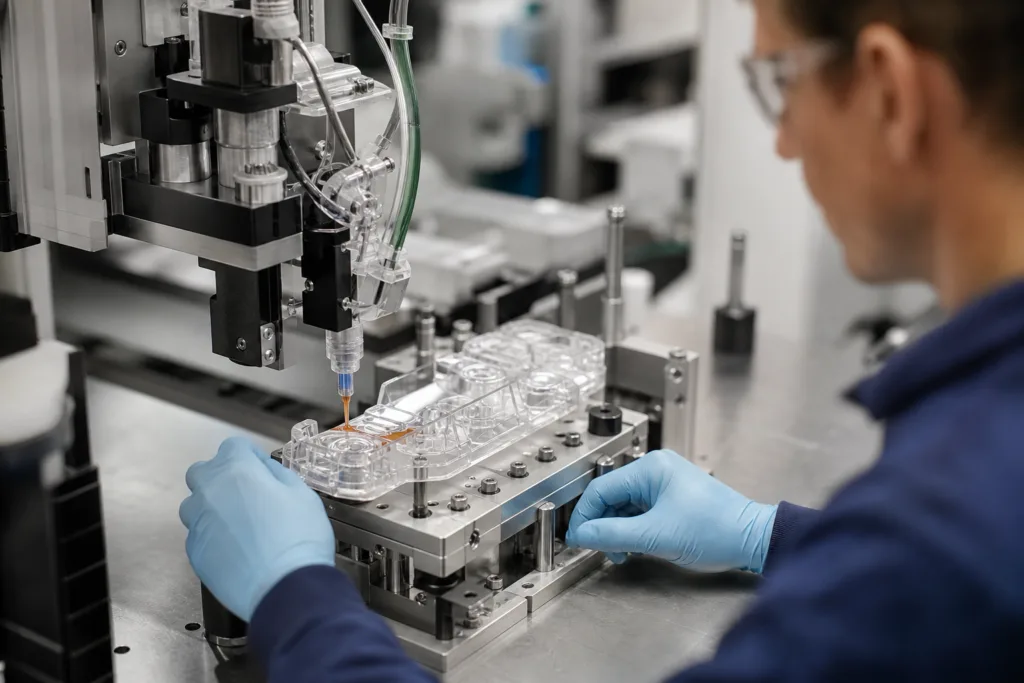
Fast-cure processes are heavily influenced by how the adhesive is applied and how energy reaches the bondline. UV-curing systems can offer very short fixture times in suitable assemblies, but they depend on light access, lamp consistency, and part geometry. Shadowed areas, opaque substrates, or irregular joint designs can lead to incomplete cure unless the formulation and process are designed for those realities. In applications where light access is favorable, a product such as ZDS-4018AB UV adhesive for fast-curing production lines may be evaluated for production fit, with final suitability confirmed through part-level trials and documentation review.
Viscosity also drives line behavior. Lower-viscosity materials may wet narrow features effectively, but they can migrate into unwanted zones, contaminate optics, or wick into channels. Higher-viscosity materials may hold a bead better and support positional accuracy, but they can demand higher dispensing pressure and may respond differently to narrow gaps or delicate components.
Dispensing precision becomes critical when the process is accelerated. As fixture time shortens, there is less opportunity for the adhesive to level or self-correct. This increases the importance of:
- Valve selection and shot-to-shot repeatability
- Needle size and bead geometry
- Part presentation and fixturing accuracy
- Control of adhesive temperature during dispensing
- Prevention of bubbles, tails, or stringing
- Consistency of cure exposure at the actual bondline
In high-throughput planning, the best adhesive is often the one that creates the most repeatable process, not the one with the shortest nominal cure statement in isolation.
When Faster Cure Helps and When It Creates New Risk
Faster cure can improve output, reduce fixture inventory, and simplify automation. It may also lower the chance of part movement before bond set, which can be valuable in assemblies with tight alignment tolerances.
But rapid curing introduces trade-offs. If the material sets too quickly relative to operator motion or robot travel, the process window may become too narrow. If cure occurs before the adhesive fully wets the surfaces, actual bond quality can decline even though the line appears faster. If shrinkage or modulus development happens too abruptly, stress can build at interfaces, especially in mismatched materials such as plastic-to-metal or glass-to-polymer bonds.
Faster cure can create risk when:
- The assembly needs more open time for alignment
- Bond gaps vary from part to part
- The adhesive must flow around inserts or into micro-features
- The substrate is sensitive to exotherm, light, or surface stress
- The operator or automation sequence is not yet tightly controlled
- Hidden areas cannot be fully cured or inspected easily
The lesson is straightforward: cure speed should support the assembly process, not dominate it.
Choosing the Right Adhesive Chemistry for Medical Device Assembly
No single chemistry is automatically correct for all medical device bonding. Selection depends on substrates, geometry, line speed, sterilization plan, and what “reliability” means for the finished device.
| Chemistry | General strengths | Typical trade-offs | Best reviewed for |
|---|---|---|---|
| Cyanoacrylate | Very fast fixture, simple one-part dispensing, useful for small-area assembly | May be sensitive to surface condition, gap, blooming, and brittleness depending on formulation | Rapid tack and small-part bonding |
| UV-curing adhesive | Fast on-demand cure, supports automation where light access is controlled | Requires cure access and exposure control; shadow zones need careful review | Transparent or accessible bondlines, indexed curing stations |
| Epoxy | Can offer strong structural bonding and chemical resistance depending on formulation | Often slower or more process-intensive; may require mixing or heat | Higher durability requirements and more demanding environments |
| Polyurethane | Can provide flexibility and stress absorption depending on formulation | Process control and cure conditions must match line needs | Assemblies needing toughness or lower stress transfer |
| Silicone | Can support flexibility and temperature tolerance depending on formulation | Usually not selected when maximum assembly speed is the only goal | Sensitive components and flexible sealing or bonding scenarios |
For very rapid fixture needs, teams may review materials such as ZDS-22401 medical-grade instant glue for rapid fixture steps where the assembly design supports that chemistry. But final recommendation should always be based on representative substrates, expected loads, cure environment, and finished-device requirements.
Adhesive chemistry must also align with the device’s biocompatibility requirements for adhesive systems. A fast-curing option may still need risk-based evaluation in its final processed state, especially if sterilization, cure conditions, or material interactions can affect extractables or leachables.
Substrate Compatibility: Plastics, Metals, Glass, and Sensitive Components
Substrate compatibility should be checked early because many speed-related failures are actually surface-related failures. The same adhesive can behave very differently on polycarbonate, ABS, PVC, stainless steel, aluminum, glass, or coated surfaces.
Key questions include:
- Is the substrate high or low surface energy?
- Are there mold-release residues, machining oils, or fingerprints present?
- Will the adhesive contact stress-sensitive plastics?
- Does the joint include transparent, translucent, or opaque sections?
- Are there metal inserts that create differential expansion or shadowing?
- Will the bond be exposed to sterilization, cleaning agents, or repeated flexing?
Sensitive components require additional review. Optical parts can be affected by haze or contamination. Thin-walled plastics can deform under clamp load or stress concentration. Electronics or sensor elements may be affected by unintended adhesive migration. In these cases, the bondline design, adhesive rheology, and dispensing path matter as much as the chemistry family.
What Bond Reliability Means in a Production Environment
Bond reliability is broader than initial strength. In production, a reliable bond is one that can be made repeatedly within process limits and still meet downstream and end-use requirements. That includes mechanical integrity, visual consistency, process traceability, and resistance to real service conditions.
Reliability should be discussed in at least four layers:
- Process reliability: the line can make the bond consistently shift after shift.
- Mechanical reliability: the joint resists the required loads and failure modes.
- Environmental reliability: the bond tolerates temperature, humidity, fluids, and sterilization relevant to the device.
- Quality-system reliability: the process can be validated, monitored, and controlled.
For mechanical assessment, comparative testing should use suitable methods rather than assumptions from cure speed. Depending on the joint, that may include tensile, shear, burst, leak, or peel testing. Standards-based references such as bond strength testing and qualification can help structure comparative peel evaluations where relevant.
Medical manufacturers should also treat adhesive bonding as a controlled manufacturing step subject to process validation and manufacturing controls, especially when the bond cannot be fully verified by simple end inspection alone.
Common Production Mistakes During Speed Optimization
Many line issues appear only after teams try to reduce cycle time. The most common mistakes are practical and preventable:
- Increasing line speed before confirming full wetting and bead placement
- Assuming a nominal cure claim applies equally to every substrate and geometry
- Using the wrong viscosity for the dispensing valve or joint design
- Ignoring adhesive temperature effects on shot size and flow behavior
- Overlooking UV shadow areas or lamp aging
- Moving parts after fixture but before sufficient property development
- Changing cleaning agents, release liners, or packaging materials without rechecking compatibility
- Relying only on visual appearance instead of mechanical and environmental validation
Another frequent mistake is under-defining the incoming RFQ or technical request. If the adhesive supplier receives only the application name, selection will be less precise than if the buyer provides substrates, part drawings, bond gap, process speed, sterilization method, and packaging format requirements.
What to Validate Before Scale-Up
Before full production release, the team should validate the adhesive as part of the assembly process, not as an isolated raw material. A structured pilot typically reviews:
- Dispensing repeatability across expected lot and temperature conditions
- Fixture time under real line timing and part handling
- Full cure development before downstream stress
- Strength on minimum and maximum tolerance parts
- Environmental durability after relevant aging or conditioning
- Sterilization impact where applicable
- Packaging and transport effects on the bonded assembly
- Operator instructions, in-process checks, and nonconformance criteria
This is also the stage to review packaging options, application method, and whether the project needs standard product matching or custom adhesive formulation support for medical device production. Some projects do not need a new formula; they need a better viscosity range, cure profile, or packaging format aligned with the dispensing system.
How to Balance Cure Speed, Open Time, and Process Window
An optimized medical bonding process balances three timing elements:
- Open time: how long the adhesive remains workable for placement and alignment
- Fixture time: when the assembly can move or release from tooling
- Full cure time: when final properties are sufficiently developed for later loads and conditions
If open time is too short, operators and robots can create variation. If fixture time is too long, throughput suffers. If full cure is too slow relative to downstream operations, hidden failures can enter the process.
The right balance depends on line architecture. Manual assembly often needs more forgiving open time. Fully automated cells may accept shorter process windows if shot placement and transfer timing are tightly controlled. Complex parts with multiple bond points may need staged curing or sequence changes rather than simply a faster adhesive.
Where the project requires a practical review of chemistry, process, and documentation together, buyers can discuss the assembly with adhesive selection technical support for process fit and reliability. That review should include substrate details, cure method, expected output, validation plan, and any biocompatibility or sterilization constraints.
Teams that are still comparing technologies may also benefit from broader medical adhesive manufacturing support for high-volume assembly before requesting a final quotation or sample program.
Testing for Strength, Durability, and Sterilization Resistance
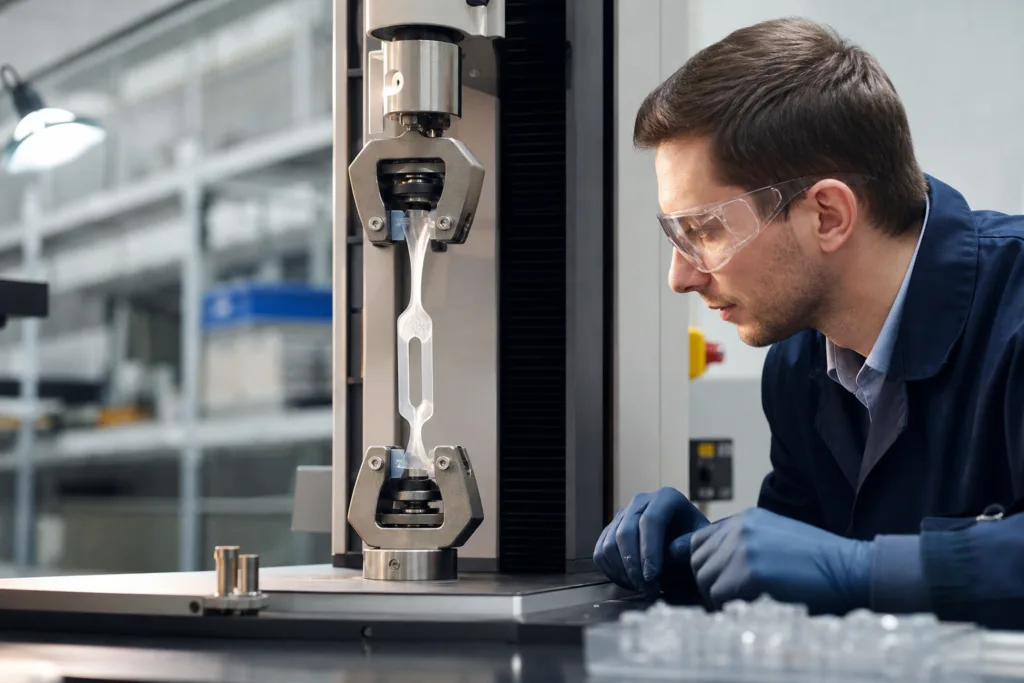
Scale-up testing should reflect how the device is actually used and processed. A bond that passes room-temperature lap shear on flat coupons may still fail on the real part after sterilization or environmental exposure.
A practical qualification plan often includes:
- Baseline mechanical testing on representative assemblies
- Testing after environmental aging such as humidity or temperature cycling where relevant
- Post-sterilization testing for the selected sterilization route
- Visual and dimensional checks for stress cracking, haze, voids, or movement
- Functional testing of the assembled device, not only standalone bond coupons
- Comparative testing after process changes such as lamp settings, dispense parameters, or cleaning method adjustments
For procurement teams, it is useful to request the current technical documents and define what the supplier should support during trials: sample quantity planning, lot traceability expectations, packaging format discussion, and what process information must be captured during the evaluation.
How ZDS Helps Customers Balance Throughput and Reliable Bonding
ZDS LTD works with industrial customers that need to align adhesive chemistry with the realities of production, not just with a theoretical bond requirement. For medical device assembly projects, that can include reviewing substrates and bond geometry, discussing whether instant, UV-curing, epoxy, polyurethane, or silicone systems are worth screening, and planning sample evaluation around actual line conditions.
Where appropriate to the project, ZDS LTD can support product matching, packaging-format discussion, technical-document review, and trial planning for OEM, ODM, or private-label programs. In cases where a standard material is close but not fully aligned with the process, the discussion may extend to formulation adjustment or broader supply planning. Final recommendations, however, should always be confirmed against the selected product documentation and the manufacturer’s own validation requirements.
If you are reviewing a fast-cure medical adhesive for a new line or a capacity expansion, the most useful starting package is usually simple: part materials, bond area, gap range, cure method, line speed target, sterilization route, handling loads, and the type of documentation needed for internal approval.
Frequently Asked Questions
How fast should a medical assembly adhesive cure?
It should cure fast enough to support the target takt time without narrowing the process window so much that wetting, alignment, or inspection become unstable. The right speed depends on the assembly sequence, substrate pair, bond geometry, and downstream handling loads.
Is UV adhesive always the best choice for high-throughput medical assembly?
No. UV systems can be very effective when light reaches the bondline consistently, but opaque parts, shadowed joints, or complex geometries may require other chemistries or a different process design. Selection should be based on the actual part and cure access.
Can a very fast fixture time replace full cure validation?
No. Fast fixture only shows that the parts can often be handled sooner. It does not prove final strength, durability, sterilization resistance, or long-term bond stability. Those properties still need representative testing and process validation.
What information should we provide when requesting samples or a recommendation?
Provide substrate names, drawings or bond dimensions, gap range, cure method, dispensing method, target cycle time, sterilization plan, expected service environment, and any documentation or compliance requirements relevant to the device. Better input usually leads to a more relevant screening recommendation.
Can an adhesive be selected based only on the device type?
No. The same device category can use different plastics, metals, tolerances, sterilization methods, and production speeds. Final selection depends on the full bonding condition, not just the application name.