
How Custom Adhesive Development Works from Lab to Production
Developing a custom adhesive solution that seamlessly transitions from laboratory research to reliable full-scale production is a highly structured, collaborative process. For industrial buyers, engineers, and sourcing teams, understanding this roadmap illuminates how partnering with a capable adhesive manufacturer ensures fit-to-function performance—and mitigates risks throughout the product lifecycle.
A useful next step is to review the custom adhesive development process with a professional manufacturer, which provides an in-depth look at ZDS’s solution capabilities, material expertise, and the technical approach used to turn application requirements into real-world production results. Readers evaluating adhesives for specialized projects or ongoing supply programs may find this resource helpful when aligning project scope with manufacturer support.
Understanding Custom Adhesive Development
The Core Drivers of Custom Adhesives
Standard adhesives often fall short for advanced manufacturing needs, unique substrates, or demanding operational environments. A custom adhesive addresses these gaps by tailoring formulation, application method, and performance profile around your specific project goals, regulatory requirements, and cost-performance targets.
Key Stakeholders in the Development Journey
Custom adhesive development brings together project engineers, buyers, chemists, application specialists, and quality assurance teams. Effective collaboration bridges technical priorities and practical challenges from the outset, ensuring that the final material works on the actual production line—not just on paper.
Needs Assessment & Project Input
Capturing Technical and Commercial Requirements
The process starts with a thorough needs assessment. This input phase gathers details on substrates, desired strengths, cure speeds, operating temperatures, chemical exposures, and assembly methods that the adhesive must support. Getting this foundation right prevents costly redesigns downstream.
Formulating a Clear Application Brief
A structured project brief summarizes all gathered technical, logistical, and commercial criteria. Common elements include environmental regulations, RoHS/REACH status, packaging format, anticipated production volume, and target pricing.
Material and Application Environment Analysis
Substrate Identification and Compatibility Research
Material analysis focuses on the surfaces, plastics, metals, or composites to be bonded. Compatibility assessment predicts potential surface energy, wetting issues, and the likelihood of requiring primers or pretreatment steps.
Operational and Environmental Stress Factors
Operational analysis models the real environment: will the adhesive face high vibration, chemical splash, fluctuating temperatures, or UV exposure? This step shapes initial formulation decisions and test design criteria to ensure robust performance.
Laboratory Sample Formulation
Translating Requirements Into Formulation Strategy
ZDS applies formulation expertise to select resin families (like epoxy, polyurethane, acrylic, or silicone) and modify additives, flexibility agents, or fillers to begin matching required properties. This stage is highly iterative, and formulators maintain close coordination with customer teams for feedback.
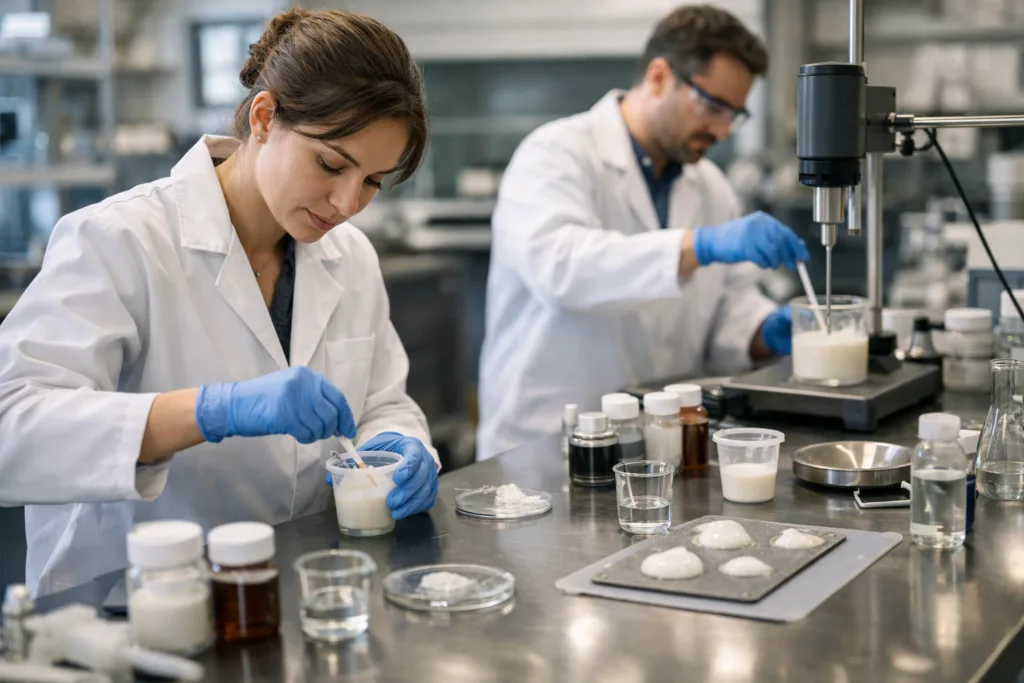
Small Batch Mixing and Initial Properties Testing
Typically, multiple initial variants are produced at lab scale. Key properties—such as open time, viscosity, and preliminary adhesion—are tested to narrow down promising candidates.
Testing, Validation, and Optimization Cycles
Application-Oriented Test Panels
Lab-prepared samples are applied to representative substrates and cured under real-world conditions. Mechanical, thermal, and chemical tests validate adhesion, flexibility, peel strength, and cure completeness.
Design of Experiments and Analytical Assessment
Formulation parameters are adjusted using design of experiment (DOE) methodologies. Variables like crosslink density, plasticizer ratios, or catalyst concentrations are systematically evaluated to optimize performance.
Customer-Driven Fit Testing
It’s common to send mini-batch samples for customer evaluation. Customer plant trials, backed by application engineers, validate processability and check for any edge cases not visible in the lab.
Pilot Batch (Scale-Up / Pre-Production) Trials
Transitioning from Beaker to Pilot Plant
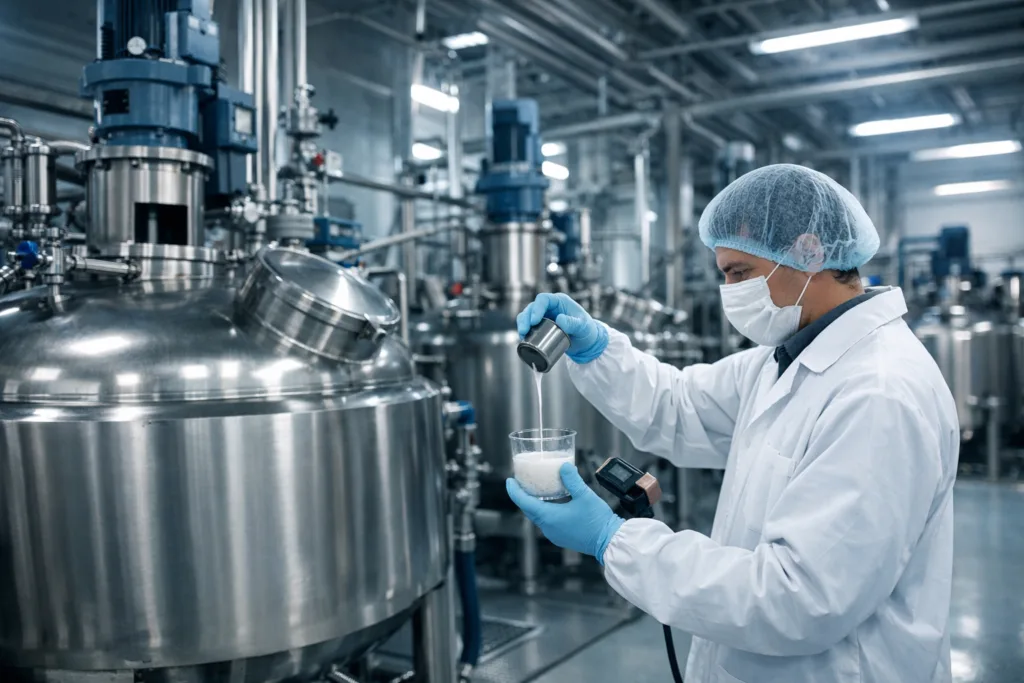
Next, promising formulations are manufactured in pilot-scale mixing equipment. Variables such as heat transfer, mixing homogeneity, viscosity drift, and raw material batch variability are tested here to ensure reproducible quality at higher volume.
Pilot-Scale Production Runs
These pilot runs enable extended end-user application simulation. It allows investigation into pot life stability, cure consistency, and scale-sensitive phenomena that only emerge above laboratory volumes.
Process Optimization for Full Production
Manufacturing Process Engineering
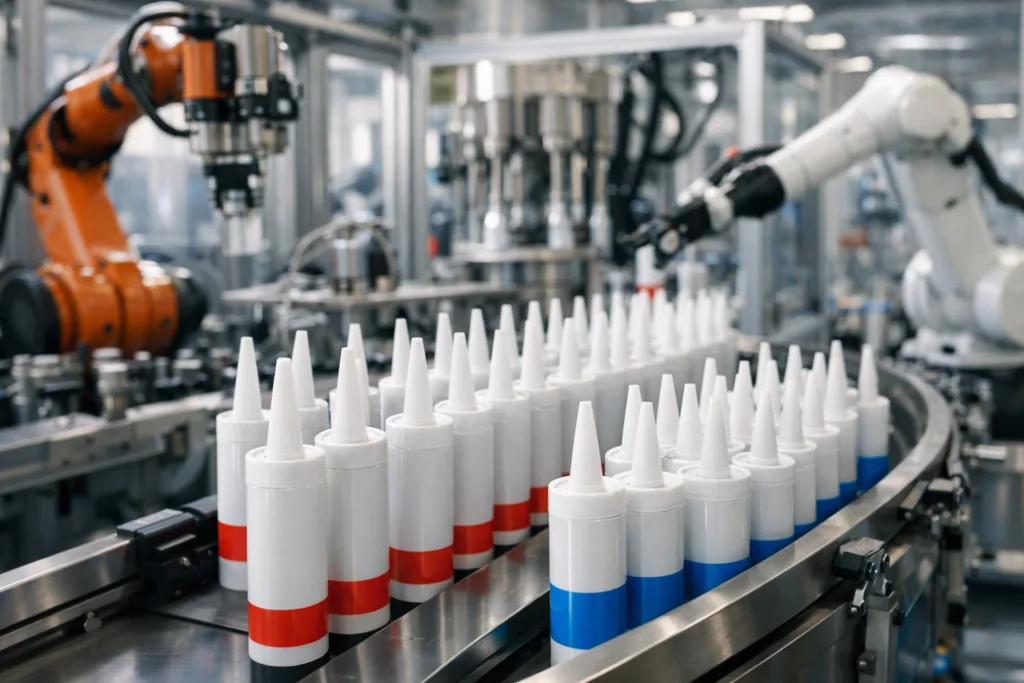
Production process engineers refine mixing, dispensing, and packaging protocols. They establish critical control points, in-line quality checks, and packaging validations to meet the requirements of automated filling or robotic dispensing in the field.
Quality Assurance Ramp-Up
QA teams scale up audit sampling, batch traceability, and reference retention protocols to match industry standards and regulatory frameworks.
Commercial Production Launch
Volume Manufacturing and Final Validation
Full-scale manufacturing begins following final customer approval. Early lots are monitored closely to confirm batch-to-batch consistency, physical properties, and compliance with previously agreed-upon benchmarks.
Packaging Formats and Logistic Labelling
Adhesive is packed into pails, cartridges, bulk tanks, or special formats as needed. Shipping logistics, labeling, and temperature control for transport are prepared for each destination market.
Long-Term Supply Partnership & Continuous Improvement
Performance Monitoring and Technical Support
Manufacturers like ZDS provide ongoing technical support, handling adjustments as customer production lines evolve or as fielded products reveal new performance demands.
Documentation, Regulatory, and Change Control
Process documentation supports compliance (i.e., RoHS, REACH, FDA if applicable). Any formulation changes for improved raw materials or regulatory shifts are managed via formal change-control protocols.
Lifecycle Management and Data Feedback Loops
Lifecycle support includes periodical performance reviews, supply chain risk monitoring, and reviewing actual usage data to spot improvement opportunities or necessary next-generation formula development. This closed feedback loop helps ZDS and our partners continuously raise reliability and efficiency benchmarks.
Case Study: A Typical Custom Adhesive Project
Stepwise Workflow in Practice
Consider a procurement team seeking an electronics potting compound: after submitting technical specifications, multiple lab samples are prepared, tested for flame resistance, and validated for compatibility with automated dispensers. Pilot runs identify a need for improved thixotropy. After adjusting the formulation, full scale-up meets the production and compliance criteria—ensuring reliable supply for the lifecycle of the electronics project.
Key Selection Criteria for Custom Adhesive Projects
Performance Metrics and Testing Protocols
Evaluation is driven by criteria such as shear strength, flexibility, low-temperature stability, chemical resistance, and application method fit. Selection is calibrated to application needs, not generic industry benchmarks.
Supplier Collaboration and Technical Strengths
Strong manufacturer collaboration ensures transparency during samples, scale-up, and ongoing improvement. Expertise in both formulation chemistry and real-world application supports smooth project flow and successful adoption.
Common Challenges and Practical Solutions
Scaling Lab Results to Production
Lab-perfect adhesives sometimes underperform during plant trials due to differences in raw material sources, batch sizes, or environmental conditions. Active communication and flexible formulation management are required to mitigate these risks.
Balancing Cost, Performance, and Compliance
Trade-offs are common—such as optimizing for cure speed vs. workability, or adjusting formulation to pass regional chemical compliance at the expense of some secondary characteristics. Experienced teams help customers prioritize and fine-tune these tradeoffs.
How ZDS Supports the Full Development Lifecycle
ZDS supports customers with an integrated workflow—from needs assessment and lab formulation through pilot runs, scale-up, and comprehensive lifecycle support. Our engineers and chemists help tailor critical properties while ensuring supply chain reliability, especially for long-life industrial programs.
Is Custom Always Better Than Standard Adhesives?
While a proven off-the-shelf adhesive can sometimes meet project targets, custom solutions are invaluable where specific application environments, unique substrates, special certifications, or distinctive dispensing methods demand a precise fit. The decision typically comes down to the complexity of requirements and the value of eliminating application risks.
When to Consider Custom Adhesive Development
If delays, failures, or continuous tweaks are common with catalog adhesives—or when assembling for new materials or market entries—it’s usually time to explore custom development. Early engagement often uncovers hidden risks and saves cost over the long lifecycle.
Conclusion: Unlocking Value From Custom Adhesive Development
Custom adhesive development is a multidimensional journey—combining technical research, practical validation, and scalable production expertise. By collaborating with an experienced manufacturer from the start, organizations gain control over critical bond properties, production efficiencies, and long-term reliability, ultimately reducing costs tied to failure and rework.
Frequently Asked Questions
What information does a manufacturer need to start custom adhesive development?
Manufacturers require detailed inputs such as bonded substrate types, desired mechanical properties, operational environment factors, regulatory preferences, and production constraints to tailor an adhesive effectively.
How long does a typical custom adhesive development project take?
Most projects run three to nine months from input to production handover, depending on complexity, required approvals, and the number of optimization/test cycles needed.
Is it more expensive to develop a custom adhesive than to use a standard one?
Upfront development costs are higher, but long-term savings from improved performance, reduced defects, and better fit can outweigh initial investments—especially for high-volume or critical projects.
What role do pilot-scale trials play in custom adhesive development?
Pilot trials bridge the gap between lab and full production, exposing scale-sensitive phenomena and ensuring that performance remains consistent as volume increases.
Can a custom adhesive be modified after production starts?
Yes, with robust change-control processes, iterative improvements or regulatory-driven modifications are possible, provided they are carefully validated and documented through the supply chain.
How do custom adhesives impact supply chain reliability?
Custom adhesives, when built with strong manufacturer partnership, enhance supply reliability by maintaining recipe control, documentation, and providing timely production continuity support.