
Pipeline repair rarely fails because a team recognized damage too late. More often, failure starts when a repair material is chosen for convenience rather than for the actual chemical, thermal, and mechanical conditions in service. In chemically exposed pipelines, the adhesive or repair compound has to do more than stick. It may need to resist immersion, vapor exposure, cyclic wetting, media permeation, thermal expansion, vibration, and surface contamination left behind by the operating environment. That is why selecting chemical resistant bonding materials for pipeline repair requires a structured evaluation of the line medium, substrate, leak mode, cure conditions, and durability target before any product is approved for field use.
If your maintenance team is comparing pipeline repair adhesive solutions for demanding service conditions, the key question is not only which adhesive can bond to steel or seal a crack today, but which formulation can keep performing when exposed to corrosive media, residual pressure, moisture, cleaning chemicals, and shutdown constraints. At ZDS, we support this kind of evaluation through formulation matching, viscosity and cure adjustment, substrate-specific recommendations, sample testing, and bulk production planning for OEM and industrial users that need reliable repair materials rather than generic bonding products.
Why chemical resistance matters in pipeline repair
In pipeline work, chemical resistance means the bonding material can retain essential performance after contact with the actual service environment. That environment may include acids, alkalis, saline water, hydrocarbons, refrigerants, process water, oils, cleaning agents, and mixed industrial media. A repair compound that shows strong initial adhesion in a dry workshop can soften, swell, embrittle, lose cohesion, or detach after exposure in real operating conditions.
From our manufacturing perspective, buyers often focus first on tensile strength or advertised bonding force. Those properties matter, but they are not enough. A pipeline repair material must be evaluated for chemical compatibility, not just room-temperature bond strength. The adhesive must also remain stable against diffusion, surface attack, and aging under the expected exposure profile. Short splashes, intermittent washdown, and full immersion create very different demands.
For teams building a repair standard, chemical resistance should be considered alongside corrosion control, surface condition, downtime limits, and whether the repair is temporary containment, medium-term maintenance, or part of a longer service-life restoration plan.
Common pipeline damage scenarios that change adhesive selection
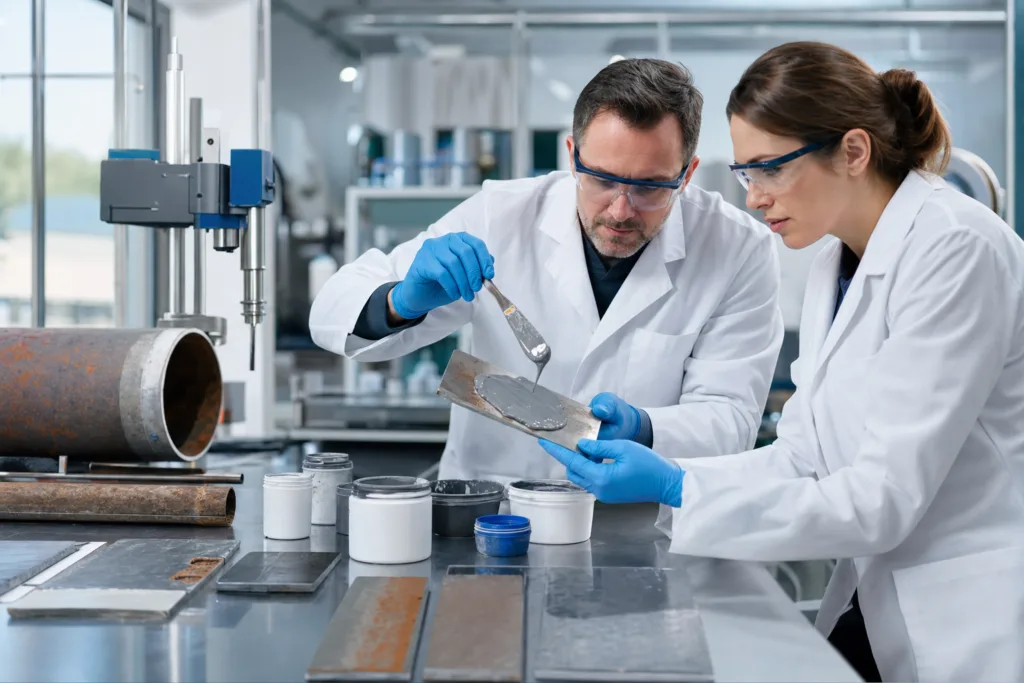
Not every defect calls for the same bonding approach. We usually break pipeline repair decisions into failure patterns, because the damage mode often determines whether a rigid, flexible, gap-filling, or sealing-focused system makes the most sense.
Leaks through pinholes or localized corrosion
These cases often need a material that can wet irregular metal, tolerate some surface roughness after proper preparation, and resist further attack from the conveyed medium. The repair may combine sealing and rebuilding functions. If the defect zone is chemically active or moisture-prone, the material must resist underfilm attack and edge degradation.
Cracks in non-pressurized or lightly stressed piping components
Cracks demand more than surface sealing. The adhesive must bridge the defect, bond strongly to the substrate, and manage stress concentration. Brittle systems can fail if the pipe sees thermal cycling or vibration.
Erosion, abrasion, and wall thinning
Where solids or fast-flow media wear away the pipe wall, the repair material may need good compressive strength and resistance to erosion in addition to chemical stability. Here, rebuild compounds and reinforced repair systems are often considered.
Joint leakage and threaded connection seepage
These applications may not need a heavy structural compound. Instead, they need controlled-flow sealing chemistry with media resistance and cure behavior matched to the assembly geometry. In such cases, ZDS-554 refrigerant pipe sealant for chemical resistance reflects the kind of targeted sealing approach buyers often evaluate when the problem is media-tightness rather than structural rebuild.
Types of chemical resistant bonding materials used for pipeline repair
The phrase chemical resistant bonding materials covers several families of repair products, and each has strengths and limitations. No single chemistry fits all lines, media, and maintenance conditions.
Epoxy systems
Epoxies are commonly chosen when structural strength, gap filling, corrosion resistance, and rebuild capability are important. They can be supplied as pastes, liquids, filled compounds, or repair putties. Many pipeline repairs rely on epoxies because they bond well to prepared metals and can be formulated for high hardness, good compressive properties, and useful resistance to water, oils, and many industrial chemicals.
For buyers screening structural repair systems, our experience is that epoxy adhesive options for structural repair bonding should be compared not only by strength claims, but by viscosity, cure profile, exotherm, chemical compatibility, and whether the formulation is intended for thin bondlines, rebuild layers, or sealing defects.
Polyurethane systems
Polyurethanes are generally selected where flexibility, impact resistance, and movement tolerance matter more than maximum rigidity. They can perform well on lines exposed to vibration or differential expansion, but chemical resistance varies widely by formulation. Some grades handle water and mild chemical exposure effectively, while others are not suitable for strong solvents or aggressive process chemicals.
Silicone systems
Silicones are valuable for flexible sealing, weather resistance, and thermal cycling. They are less suitable where high structural strength or abrasion resistance is required. In pipeline contexts, they are more often considered for gasketing, non-structural sealing, or external environmental protection than for heavy-duty defect rebuilding under aggressive media exposure.
Acrylic and hybrid systems
Acrylic adhesives can offer fast cure and good adhesion to some metals and plastics, but their chemical resistance profile must be checked carefully against the process fluid. Hybrid systems can balance flexibility and adhesion, especially for sealing applications, but they are not automatically interchangeable with epoxies in corrosion repair or long-term immersion environments.
That is why selection should begin with service conditions rather than product family preferences. In leak-focused applications, buyers often review chemical-resistant sealing solutions for leak-prone assemblies separately from structural rebuild compounds, because the performance targets are not the same.
How to match the material to the pipeline substrate and conveyed media
Substrate compatibility is a basic filter, but media compatibility is the deciding factor. Steel, stainless steel, cast iron, copper alloys, PVC, CPVC, FRP, and coated pipe surfaces all present different adhesion challenges. Surface oxide condition, roughness, contamination, and age of the line also influence bond reliability.
| Pipeline factor | What to evaluate | Why it matters |
|---|---|---|
| Substrate type | Carbon steel, stainless steel, plastic, composite, coated metal | Determines adhesion potential and surface prep method |
| Service media | Water, oil, acid, alkali, solvent, refrigerant, saline fluid | Drives chemical resistance requirements |
| Temperature | Ambient, elevated, cycling, cold service | Affects cure, flexibility, and aging stability |
| Pressure condition | Low, intermittent, residual, or shutdown-only repair | Influences structural demand and safety margin |
| Defect geometry | Pinhole, crack, thread leak, wall loss, seam seepage | Changes viscosity and gap-filling needs |
| Application method | Manual mix, cartridge, meter-mix, paste application | Must fit field handling realities |
For example, a repair material that adheres well to grit-blasted steel may not perform equally on oily stainless surfaces or low-surface-energy plastics. Likewise, a product rated broadly for chemical exposure may still be a poor fit if the medium includes mixed solvents at elevated temperature.
In our application review process, we ask buyers to define not only the primary fluid but also cleaning chemicals, line flushing conditions, and possible upset events. These secondary exposures often explain why otherwise acceptable repairs fail early.
Key selection criteria for chemical resistant bonding materials
Chemical exposure profile
Ask whether exposure is splash, intermittent immersion, continuous wetting, vapor, condensate, or full contact with the process medium. Concentration also matters. A mild acid wash is very different from continuous exposure to concentrated acid at temperature.
Operating and cure temperature
Low temperatures can slow cure, raise viscosity, and reduce wetting. High temperatures can accelerate cure during application but increase aging stress in service. Temperature cycling also creates movement at the bondline that may crack overly rigid materials.
Pressure and stress level
Adhesive repairs should never be treated as generic substitutes for an engineering decision on pressure integrity. Still, within a defined repair protocol, stress level determines whether you need mainly sealing, structural reinforcement, or a combination. Higher loads generally push selection toward tougher, more structurally capable systems.
Required service life
A shutdown patch, a maintenance repair until scheduled replacement, and a long-duration corrosion-restoration program do not need the same material. Procurement teams should align cost with service objective rather than overbuying or under-specifying.
Application practicality
Field crews need manageable pot life, predictable cure, workable viscosity, and tolerance for real maintenance conditions. If the material is too fast, crews waste product. If it is too slow, the line may not return to service on schedule.
Bond strength versus flexibility in pipeline repair
One common mistake is assuming the hardest material is always the safest choice. In reality, pipeline service often includes expansion, contraction, vibration, pulsation, and differential movement between the repair area and surrounding substrate. A very rigid material can perform well on static wall loss but crack on a vibrating connection. A highly flexible sealant may remain intact on a moving joint but lack the compressive or structural strength needed for rebuild work.
The selection question is not rigid or flexible in isolation. It is whether the bondline must carry load, absorb movement, maintain seal integrity, or resist both stress and chemical attack over time. Toughened epoxy systems are frequently useful because they can balance adhesion, chemical resistance, and some stress tolerance, but there are cases where a more elastic chemistry is the better engineering answer.
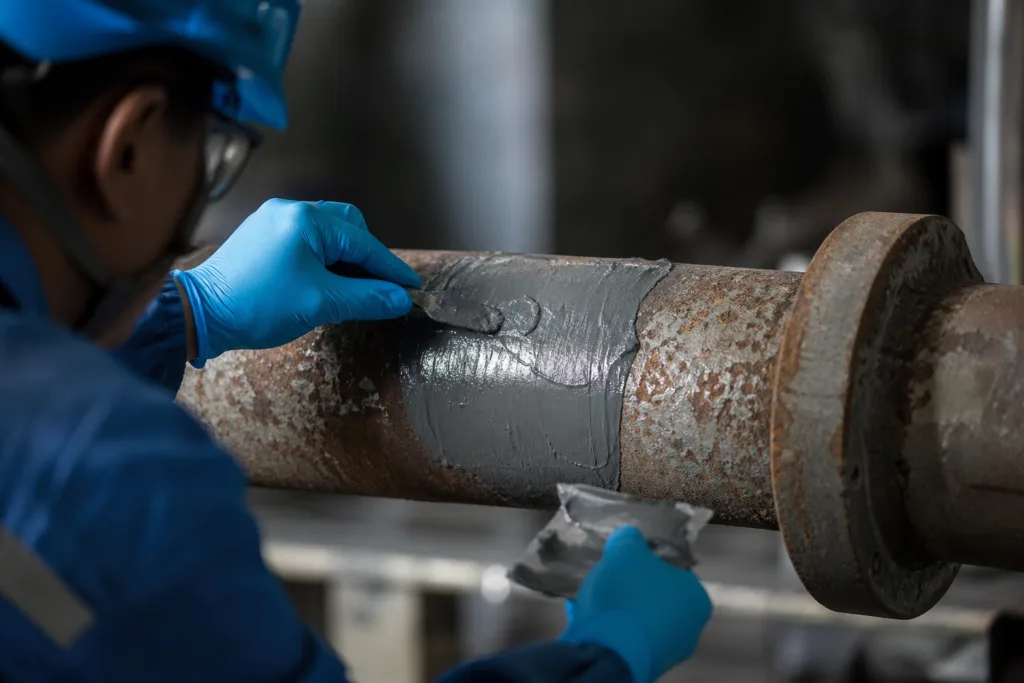
When buyers need help weighing these trade-offs across media, substrate, and process constraints, adhesive selection support for challenging repair environments is often more valuable than comparing product names alone, because the correct answer depends on how the repair will actually be applied and used.
Cure behavior and field application practicalities
For maintenance teams, cure behavior is often where theoretical suitability meets operational reality. Pot life, open time, fixture time, handling strength, and full cure all affect whether the repair can be applied consistently in the field.
- Pot life is the usable working time after mixing.
- Open time is the practical window to place and shape the material before surface skinning or viscosity rise affects application.
- Fixture time is the point at which the assembly or repair zone can hold position without disturbance.
- Full cure is when final performance is reached or close to it.
For vertical surfaces, overhead work, and irregular corrosion pits, non-sag or paste rheology is often more important than headline bond strength. For narrow leak paths or threaded assemblies, lower viscosity or capillary behavior may be preferred. Cure speed also has to match ambient conditions. A repair material that performs well in a warm plant may become difficult to use in cold field conditions without process adjustment.
At ZDS, we often discuss cure profile and packaging format as early as chemistry selection, because cartridge systems, dual-component packs, pails, and private-label repair kits create very different mixing control and field-use outcomes.
Surface preparation and contamination control before repair
Even highly capable repair compounds fail if they are applied over unstable corrosion products, oil film, moisture, incompatible old coatings, or process residue. Surface preparation is especially critical in pipeline environments because contamination is often not obvious. A dry-looking area may still contain salts, absorbed oil, or invisible chemical residue that undermines adhesion.
Good preparation generally aims to remove weak layers, create a sound surface profile where appropriate, and control contamination before application. Depending on the substrate and maintenance protocol, this may include abrasion, mechanical cleaning, degreasing, drying, and verification that the surface is stable enough to bond.
From a formulation perspective, some materials are more forgiving than others, but no serious repair program should assume contamination tolerance without validation. The more aggressive the service media, the more important edge integrity and complete substrate wetting become.
Evaluating resistance to acids, alkalis, oils, solvents, water, and salt exposure
Buyers should be cautious with generic labels such as chemical resistant or solvent resistant. Resistance is always conditional. The right evaluation asks: resistant to which chemical, at what concentration, temperature, exposure duration, and mechanical stress level?
Epoxies often perform well against water, oils, saline exposure, and many industrial chemicals, but not every epoxy handles strong acids or specific solvents equally well. Polyurethanes may be strong in moisture tolerance and flexibility, yet less suitable for some solvent-rich environments. Silicones can excel in weathering and thermal cycling but may not provide the cohesive strength needed under some immersion and abrasion conditions.
For qualification work, we encourage customers to define the actual media matrix and test accordingly rather than relying on broad marketing categories. Standards-based screening can help frame this process. For example, Chemical resistance testing for pipeline coatings and repair materials provides a useful reference point when teams need to compare behavior under specific reagents, temperatures, and exposure durations instead of making assumptions from generic compatibility language.
Corrosion protection and long-term durability considerations
Pipeline repair materials are part of a broader corrosion-management strategy, not a standalone fix. If the root cause includes external corrosion, under-deposit corrosion, trapped moisture, galvanic effects, or coating breakdown, the repair chemistry should be selected with those mechanisms in mind.
Long-term durability depends on more than initial adhesion. It depends on whether the repair resists edge lifting, moisture ingress, chemical permeation, thermal fatigue, and progressive corrosion at the bond interface. In external repairs, adhesion to the prepared substrate and compatibility with surrounding coatings or wraps can be just as important as bulk chemical resistance.
Corrosion risk remains central to pipeline integrity planning, and broader corrosion management considerations for pipeline repairs reinforce why repair materials should be chosen as part of inspection, coating, and maintenance logic rather than as isolated consumables.
When custom-formulated or OEM repair materials make sense
Off-the-shelf materials are useful when service conditions are common and performance requirements are clear. But custom formulation becomes more attractive when the project involves unusual chemical exposure, mixed substrates, difficult cure windows, specialized dispensing, private-label programs, or bulk supply requirements across multiple facilities.
We commonly see custom development requested when buyers need one or more of the following:
- Adjusted viscosity for vertical or overhead application
- Longer or shorter pot life for field workflow
- Improved adhesion to a specific coated or low-energy surface
- Modified hardness or toughness balance
- Packaging matched to maintenance kits, cartridges, or production packs
- Stable repeatability for distributor or OEM supply programs
From our adhesive manufacturing perspective, customization is not only about changing chemistry. It is often about making a repair system easier to apply consistently, easier to procure at scale, and easier to validate across recurring service conditions.
How to validate repair materials through testing and sample trials
Sample evaluation should simulate the real use case as closely as practical. That means testing on the actual or representative substrate, with realistic surface preparation, bondline thickness, cure conditions, and chemical exposure. A simple lab coupon can be misleading if the field condition includes corrosion pitting, heat, vibration, or contaminated shutdown surfaces.
| Validation step | What to check | Common lesson |
|---|---|---|
| Bench adhesion trial | Wetting, handling, cure, initial bond | Confirms basic suitability only |
| Chemical exposure test | Softening, swelling, discoloration, bond loss | Often reveals media incompatibility early |
| Thermal cycle trial | Cracking, edge lift, flexibility retention | Shows stress management capability |
| Mock field application | Mixing ease, sag control, cure speed | Identifies application problems before rollout |
| Production consistency review | Batch repeatability, packaging, shelf life | Important for multi-site procurement |
For procurement teams, testing should also cover practical issues: batch labeling, storage conditions, shelf life, packaging integrity, and whether technical support is responsive when application variables change.
Common selection mistakes that lead to repair failure
- Choosing by generic chemistry alone. Not all epoxies, polyurethanes, or sealants behave the same in chemical service.
- Ignoring secondary chemical exposure. Cleaning agents, condensate, and process upsets can be more damaging than the main line fluid.
- Underestimating surface contamination. Oils, salts, corrosion residues, and moisture often defeat otherwise suitable materials.
- Prioritizing fast cure over complete fit. A quick return to service can be expensive if the repair lacks long-term resistance.
- Using rigid materials on moving joints. High hardness is not a substitute for toughness or flexibility.
- Skipping field-realistic sample trials. Lab success without process simulation often leads to rework.
Supplier evaluation for maintenance buyers and engineers
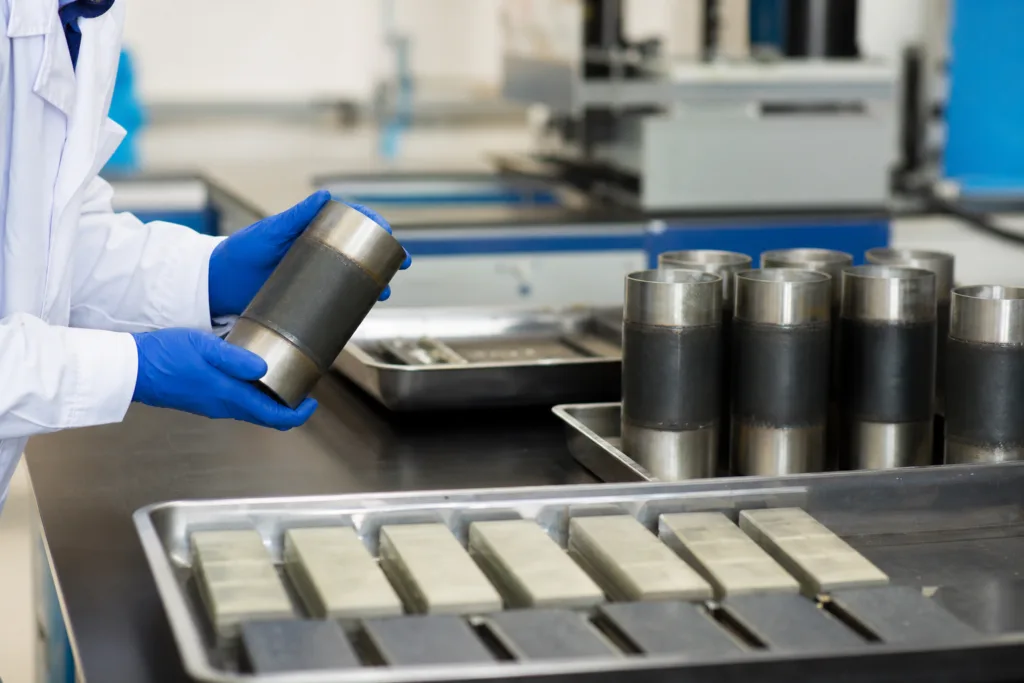
When evaluating an adhesive manufacturer, buyers should ask practical questions that go beyond a product sheet:
- What specific media has the formulation been evaluated against?
- Can the supplier explain limits, not just strengths?
- What is the recommended surface preparation for the target substrate?
- How do viscosity and cure change with ambient temperature?
- Is customization available for packaging, pot life, or rheology?
- Can the supplier support samples, trial feedback, and formulation adjustment if needed?
- How is batch consistency controlled for repeat orders?
These questions matter because pipeline repair procurement is not only a materials purchase. It is a risk decision tied to maintenance reliability, shutdown efficiency, and service continuity.
A practical decision framework
For most industrial teams, the best path is to narrow candidates in this order: define the substrate, define the exact media and exposure pattern, define movement and pressure conditions, define cure constraints, then validate with realistic trials. That sequence helps prevent the common mistake of selecting a product for headline strength while overlooking chemical attack, field handling, or long-term durability.
Chemical resistant bonding materials can be highly effective in pipeline repair when they are matched to the actual failure mode and service environment. In our experience, the right adhesive is rarely the one with the broadest generic claim. It is the one whose chemistry, cure behavior, mechanical balance, and application method fit the line, the defect, and the maintenance objective. For engineers, maintenance managers, and sourcing teams, that practical fit is what turns a repair material from a short-term patch into a dependable solution.
FAQs
How do I know if a pipeline repair adhesive is chemically resistant enough for my application?
Start by defining the exact process media, concentration, operating temperature, exposure duration, and whether contact is splash, vapor, intermittent, or continuous. Then compare candidate materials against those conditions and validate with sample testing on the real substrate whenever possible, because a general chemical resistance claim is not enough for a reliable pipeline decision.
Are epoxy materials always the best choice for pipeline corrosion repair?
Epoxy materials are often strong candidates because they can combine adhesion, gap filling, hardness, and broad industrial chemical resistance, but they are not automatically the right answer in every case. If the pipeline sees significant movement, vibration, unusual solvent exposure, or special cure constraints, another chemistry or a modified epoxy may be a better fit.
What surface preparation is most important before applying a repair material?
Removing unstable corrosion, oils, moisture, salts, and any weak coating layer is usually the most important step. The goal is to expose a sound, clean surface that the repair compound can wet and anchor to consistently, because even a high-performance adhesive can fail early if contamination remains at the bond interface.
Can a chemical-resistant sealant replace a structural repair compound?
Not usually. A sealant is typically designed to stop leakage and maintain media tightness, while a structural repair compound is chosen to rebuild, reinforce, or carry greater mechanical demand. Some repairs need both functions, so the defect type and service stress should determine whether sealing alone is enough.
When should a buyer request a custom formulation instead of using a standard product?
If the project involves unusual media, difficult substrates, tight application windows, specific viscosity needs, private-label packaging, or recurring multi-site procurement, a custom formulation can make sense. Customization is especially useful when small changes in pot life, flow, toughness, or cure speed can improve field reliability and reduce rework.
What should procurement teams ask an adhesive manufacturer before approving a pipeline repair material?
Procurement should ask what substrates and chemicals the material has been evaluated against, what cure conditions are required, how shelf life and packaging are managed, whether samples and trial support are available, and how batch consistency is controlled. Those answers help determine whether the supplier can support repeatable performance instead of just supplying a product code.