
Choosing the right adhesive for stretch fabric is less about achieving the highest static bond number and more about preserving how the textile behaves in real use. In performance apparel, compression products, intimate wear, and stretch laminates, the bonded area has to elongate, recover, flex, and remain comfortable against the body. If the adhesive film is too rigid, too thick, or cured under the wrong conditions, the fabric may lose stretch, show edge lift, feel boardy, or crack after repeated movement and laundering. From our manufacturing perspective, the real target is balanced performance: enough adhesion for durability, but enough flexibility and softness to protect elasticity, recovery, hand feel, and wearer comfort.
Stretch textile projects often require a supplier that can tune softness, viscosity, coating behavior, and cure profile around fabric construction rather than forcing the fabric to adapt to a generic adhesive. Even without a specific product page linked here, buyers evaluating bonded apparel components can use this guide to define what they need from formulation support, pilot sampling, process matching, and production consistency when working with a manufacturer on flexible textile bonding.
Why stretch fabrics require adhesives that move with the substrate
Stretch fabrics are mechanically dynamic materials. A nylon/spandex jersey, polyester/spandex knit, power mesh, or coated elastic fabric can extend repeatedly during wear, then return toward its original dimensions. The adhesive layer sits inside that movement cycle. If it cannot elongate with the fabric, stress builds at the bond line, especially near edges, transitions, perforations, or thicker coated areas.
In practical terms, a suitable adhesive system for stretch textiles needs to do more than stick. It should support strain distribution, resist embrittlement, and maintain bond integrity after cyclical movement. This is why many buyers shift away from rigid attachment concepts and evaluate flexible film, web, or liquid systems when seam appearance, low bulk, and comfort matter.
We usually advise customers to define the movement profile first: Is the fabric stretched lightly and frequently, as in everyday leggings? Is it stretched more aggressively, as in shapewear or compression panels? Is the bonded area narrow and localized, or broad and laminated? Those answers affect chemistry choice, coating weight, adhesive modulus, and curing strategy.
How elasticity, modulus, recovery, and hand feel affect bonded textile performance

Elasticity retention is only one part of the decision. A bonded stretch textile also has to recover well, resist growth, and maintain acceptable hand feel. Buyers often focus on peel strength, but end users notice stiffness, drag, skin feel, and edge comfort first.
Elasticity and modulus
Low to medium modulus flexible systems are often preferred because they let the fabric extend without creating a hard hinge line. An adhesive with a very high modulus may hold firmly at rest but still restrict extension enough to change garment fit or create visible strain whitening in the bonded zone.
Recovery behavior
Recovery describes how well the bonded assembly returns after stretching. Some bond lines elongate but do not fully recover, which can create permanent growth, seam distortion, waviness, or a bagged-out appearance. For that reason, buyers should test the finished bonded construction, not only the fabric. Standards-based thinking is helpful here, and stretch, growth, and recovery testing for bonded stretch fabrics can be framed with reference to stretch, growth, and recovery testing for bonded stretch fabrics.
Hand feel and comfort
A technically durable bond may still fail commercially if the area feels plasticky, tacky, scratchy, or overly dense. In activewear and intimate apparel, hand feel influences perceived quality as much as bond durability. Adhesive selection therefore needs to consider softness after cure, film continuity, add-on weight, and whether the bond creates a noticeable comfort boundary under pressure or movement.
Why over-rigid adhesives cause cracking, edge lift, stiffness, and comfort loss
Over-rigid systems typically fail in predictable ways on stretch substrates. First, they restrict extension, causing the fabric to deform around the bond instead of through it. Second, because strain cannot distribute evenly, stress concentrates at the bond perimeter. Third, repeated movement and laundering amplify that stress until the bonded area starts to crack, curl, tunnel, or lift.
This is one reason buyers comparing flexible versus general-purpose bonding materials should be careful with broad claims around “high strength.” In textiles, excessive hardness can be a disadvantage. A strong but stiff bond can reduce drape, create visible read-through, and compromise wearer comfort long before it fully delaminates.
We often see four avoidable issues during evaluation:
- Adhesive films that are too thick for lightweight knits
- Cure schedules that over-harden the bonded area
- Adhesive modulus that is mismatched to high-extension fabrics
- Bond layouts with sharp corners or abrupt stress points
For buyers reviewing process alternatives, material choice should be discussed alongside geometry, coating pattern, and expected elongation in service.
Best-fit use cases for stretch textile bonding
Flexible bonding is especially relevant when stitching adds bulk, creates pressure lines, reduces waterproofing, or limits design freedom. Typical use cases include:
- Activewear hems, waist details, and reinforcement zones
- Lingerie and intimate apparel where softness and low profile matter
- Sportswear panels that need smooth seams and dynamic stretch
- Compression garments that must maintain close body contact without harsh edges
- Performance base layers and laminated constructions where reduced seam bulk improves comfort
In these applications, a flexible laminating adhesive for spandex fabric may outperform mechanical joining where flatness, softness, and recoverable stretch are required simultaneously. However, not every area of a garment needs the same adhesive behavior. Hem bonds, logo transfers, panel laminations, elastic tape attachment, and reinforcement patches can each require different viscosity, activation temperature, or softness targets.
Material and substrate considerations for spandex blends and coated textiles
Stretch textile bonding starts with substrate reality, not generic chemistry selection. A nylon/spandex tricot behaves differently from a brushed polyester/spandex knit, and both differ from coated elastic fabrics or power mesh. Fiber type, knit density, finish chemistry, and heat sensitivity all influence bond quality.
| Substrate type | Typical challenge | Adhesive selection concern | Process note |
|---|---|---|---|
| Nylon/spandex | Smooth surface, high stretch, heat sensitivity | Needs flexible bond with good recovery | Control lamination temperature and fabric tension |
| Polyester/spandex | Variable surface energy depending on finish | Needs durable adhesion after wash cycles | Check finish compatibility and laundering resistance |
| Power mesh | Open structure and stress concentration | Needs controlled add-on and soft hand | Avoid excess strike-through or stiff edges |
| Coated stretch textile | Coating chemistry may dominate adhesion behavior | Needs compatibility with coated face, not just base fabric | Run face-side and back-side trials separately |
| Brushed or plush stretch fabric | Loose surface fibers reduce effective contact | Needs wetting and mechanical anchoring balance | Consider pre-treatment or pressure adjustment |
Surface finishes deserve special attention. Durable water repellents, softeners, release additives, and dyeing auxiliaries can all interfere with wetting or cure. In sourcing discussions, buyers should ask whether the adhesive was screened against the actual finished fabric, not only a nominal fiber composition.
When customers approach ZDS for flexible textile bonding development, we usually request exact substrate references, GSM range, stretch direction, face/back identification, target wash conditions, and the intended bonding method before we recommend a formulation path.
Choosing the right adhesive chemistry for stretch applications
There is no single universal adhesive for stretch fabrics. The right chemistry depends on stretch level, softness requirement, process temperature, wash expectation, and whether the adhesive is applied as a film, web, dispersion, reactive system, or specialty coating.
Polyurethane systems
Polyurethane-based flexible adhesives are often considered for stretch fabrics because they can offer a useful balance of elasticity, toughness, and soft hand. They are commonly evaluated for laminating and textile bonding where repeated flexing matters. Formulation details still matter: too high a hardness or too aggressive a cure profile can reduce softness and recovery.
Acrylic systems
Flexible acrylic systems may be useful when processing needs, substrate compatibility, or specific durability targets align with their strengths. Some acrylics offer good softness and handling, while others may trend firmer. They need careful review for elongation, wash durability, and long-term flexibility on highly elastic fabrics.
Silicone systems
Silicone-based flexible systems can be relevant where exceptional softness, flexibility, or temperature tolerance is needed, especially on difficult stretch constructions. However, they are not automatically the right answer for every apparel assembly because processing, surface compatibility, and downstream handling can differ significantly from polyurethane or acrylic options.
Other flexible systems
Some specialty elastomeric chemistries, hot melts, or hybrid systems may fit niche textile applications, especially where low-temperature bonding, low add-on, or unusual substrate compatibility is required. Selection should always be based on full assembly behavior rather than chemistry name alone.
Key performance targets for an adhesive for stretch fabric
For industrial buyers, the most useful specification approach is a performance matrix tied to the end use. The following properties usually matter more than a single bond number:
| Property | Why it matters | What to watch for |
|---|---|---|
| Elongation capacity | Allows bond line to stretch with fabric | Premature cracking or stress whitening |
| Recovery after strain | Helps garment return to shape | Permanent growth or wavy seam line |
| Peel resistance | Indicates resistance to edge lift and delamination | Peel loss after washing or sweat exposure |
| Flex fatigue resistance | Critical under repeated movement | Microcracks or edge opening after cycles |
| Softness and drape | Affects comfort and appearance | Boardy hand or visible patch outline |
| Heat sensitivity | Protects elastic fibers during processing | Fabric distortion, gloss change, or shrinkage |
Because performance apparel often faces body heat, perspiration, laundering, and repeated extension, a specification should include both initial and aged performance. A bond that passes a bench peel test on day one may still fail after wash, drying, or repeated body movement.
How cure behavior, open time, and processing temperature affect stretch retention
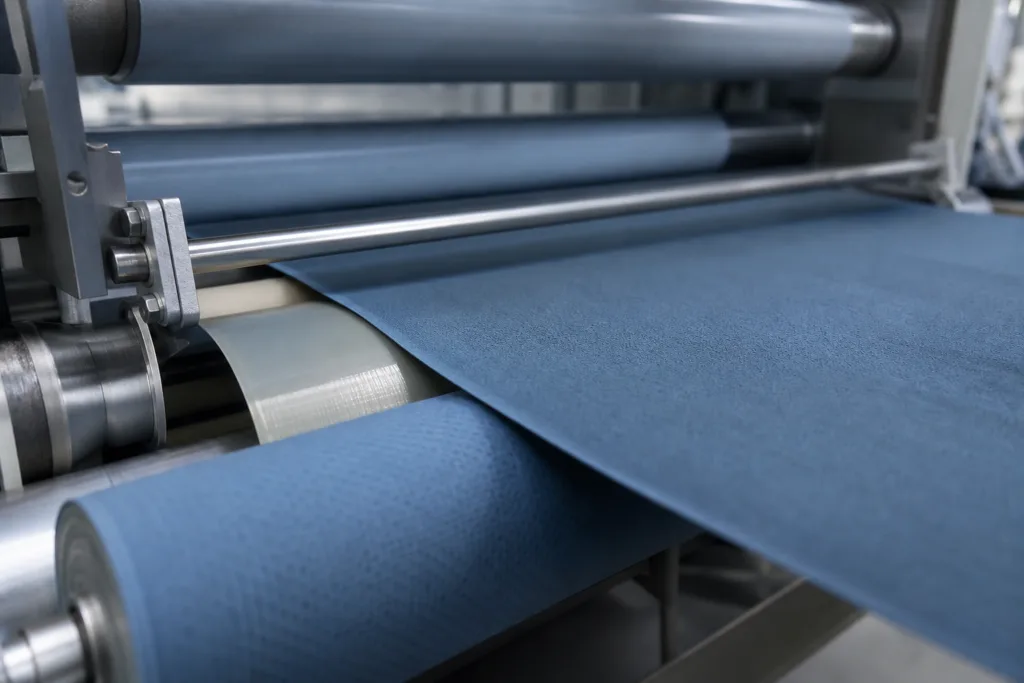
Processing can preserve or destroy stretch performance even when the chemistry is fundamentally suitable. Open time affects alignment and wet-out. Cure speed affects throughput and bond development. Processing temperature affects both adhesive flow and fabric integrity.
For heat-sensitive spandex blends, lower-temperature processing can be important. Buyers evaluating lamination conditions should remember that excess heat, excess dwell, or stretch under tension during bonding may reduce recovery and alter garment dimensions. Practical low-temperature lamination conditions for stretch fabrics are discussed in this low-temperature lamination conditions for stretch fabrics reference, which aligns with the broader point that controlled heat and tension are essential for elastic substrates.
From a manufacturing standpoint, we typically review:
- Application temperature window
- Whether the substrate is under tension during coating or lamination
- Pressure and dwell time
- Cooling and post-cure handling
- Whether the bonded part is folded, stacked, or stretched before full cure
These variables often explain why a lab sample behaves well but scaled production does not.
Common failure modes after stretching, washing, sweat exposure, and wear
Stretch textile failures rarely appear as one simple defect. They usually emerge as a combination of mechanical, chemical, and process-related symptoms.
Cracking and crazing
Usually linked to excessive adhesive rigidity, over-cure, or insufficient elongation capacity for the actual movement profile.
Edge lift and corner peel
Often associated with stress concentration, insufficient wetting, low peel resistance, contamination, or poor bond design.
Seam telegraphing and stiffness
Common when the add-on is too high, the adhesive layer is too continuous for the garment zone, or the cured film is too firm.
Wash-related delamination
May result from weak initial bonding, finish interference, hydrolytic sensitivity, or poor compatibility with detergent and heat exposure. Buyers should include wash durability and post-launder appearance testing in validation plans, especially for activewear and comfort garments.
Sweat and body movement deterioration
Body chemistry, humidity, heat, and repeated local strain can gradually reduce bond quality. The risk is often highest in high-motion zones such as underarm, waistband, bust, knee, and side seam areas.
Surface preparation and fabric construction factors that influence bond quality
Even a well-designed adhesive cannot compensate for poor substrate readiness. Textile bonding is especially sensitive because knit structures are compressible, finishes vary by mill, and cut edges can distort under handling.
Important checks include:
- Whether the fabric surface carries softeners, repellents, or finishing residues
- Whether the fabric face and back respond differently to the adhesive
- Whether the knit opens under tension and changes contact area
- Whether pressure causes strike-through or visible show-through
- Whether the cut edge curls before bonding
In some projects, a lighter coating weight or modified viscosity solves more problems than switching chemistry entirely. In others, pre-cleaning, adjusted nip pressure, or a different bond pattern is enough to stabilize the result.
What to validate in dynamic textile testing
For bonded stretch fabrics, dynamic testing matters more than isolated static values. We encourage customers to validate the whole assembly under conditions that resemble use, laundering, and handling.
- Cyclic stretch testing across the expected extension range
- Recovery observation after repeated extension
- Peel testing before and after aging or washing
- Flex fatigue in targeted garment zones
- Hand feel assessment by technical and product teams
- Visual assessment for edge lift, curling, grin-through, and distortion
For washable garments, appearance retention after laundering should not be treated as a cosmetic afterthought. It directly affects perceived quality and return risk. Buyers who need a standards-based framework can review wash durability and post-launder appearance testing concepts when building textile validation plans.
How to balance bond strength with softness, drape, breathability, and comfort
This balance is where many stretch textile programs succeed or fail. More adhesive is not automatically better. A heavier coat weight may improve initial bond confidence yet make the textile stiffer, hotter, and more noticeable on the body. A very soft adhesive may feel excellent but underperform if the bond area is narrow or the substrate finish is difficult.
In development work, we usually adjust multiple variables together rather than chasing one metric. These may include adhesive solids, viscosity, coating thickness, activation range, cure profile, and pattern design. The right balance depends on whether the user prioritizes compression response, invisible seam appearance, wash life, or low-noise comfort during wear.
Teams exploring alternatives to sewn assembly may also benefit from comparing bonding strategies with adjacent flexible material joining approaches, especially when the product includes elastic trims, coated panels, or soft-touch overlays.
Custom formulation factors for textile bonding development
Custom development becomes valuable when standard grades almost work but still miss one critical requirement. For stretch textiles, common tuning factors include:
- Viscosity: to match knife coating, screen application, slot die, spray, or transfer methods
- Cure profile: to reduce thermal stress on elastic fibers
- Softness after cure: to improve hand feel in body-contact zones
- Initial tack or green strength: to stabilize handling before full bond development
- Add-on control: to minimize strike-through and stiffness
- Package format: to align with pilot, OEM, or high-volume production
From our formulation and production work, this is often where the manufacturer relationship matters most. A supplier should be able to discuss not only chemistry type but also rheology, coating behavior, line conditions, and scale-up consistency. That is especially important when fabric lots vary or private label programs need repeatable output.
Production and sourcing checks before scale-up
Technical fit and supply fit should be reviewed together. A suitable stretch fabric adhesive still needs to be manufacturable, stable in packaging, and consistent from batch to batch.
| Checkpoint | Why buyers should review it |
|---|---|
| Sample-to-production correlation | Confirms pilot success is repeatable at scale |
| Batch consistency | Reduces variation in softness, cure, and adhesion |
| MOQ and packaging options | Supports both development and production economics |
| Shelf life and storage conditions | Prevents viscosity drift or performance loss |
| Technical communication speed | Helps resolve process deviations quickly |
| Lead time planning | Protects launch timing and replenishment reliability |
We recommend asking for a trial plan that includes fabric references, process settings, acceptance criteria, and post-wash checks before full procurement approval. This reduces the common risk of approving a chemistry on simple peel data alone.
How we help preserve stretch performance in bonded fabrics
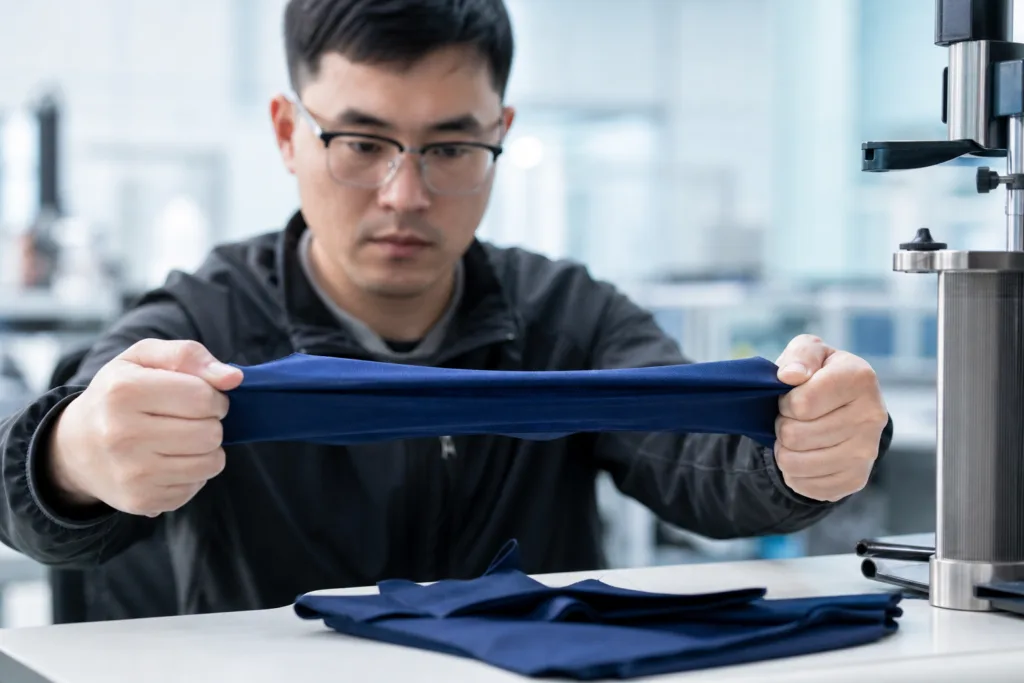
At ZDS, we approach stretch textile bonding as a performance-matching problem rather than a catalog selection exercise. Our role as a manufacturer is to help customers align adhesive behavior with substrate movement, processing limits, and end-use expectations. That may involve adjusting viscosity for the chosen application method, tuning the cure profile for heat-sensitive spandex blends, or balancing softness and peel performance for comfort-critical garment zones.
In practical projects, we support sample evaluation against real fabrics, discuss failure patterns after cycling or laundering, and review whether the bond line is too rigid, too heavy, or not recovering well enough. For OEM and ODM programs, this same logic helps reduce scale-up risk by linking formulation decisions with packaging, storage, and production consistency targets.
Conclusion
The right adhesive for stretch fabric should preserve movement, support recovery, and stay comfortable through wear, washing, and repeated flexing. Buyers should evaluate the bonded construction as a dynamic system, not just the adhesive in isolation. Substrate finish, coating weight, cure temperature, bond geometry, and laundering profile all influence whether the final product feels soft and performs reliably. When these factors are addressed early, flexible bonding can improve appearance, reduce bulk, and maintain the elastic behavior that stretch garments are designed to deliver.
FAQs
What is the most important property to evaluate in an adhesive for stretch fabric?
The most important property is not maximum strength alone but balanced elongation and recovery within the bonded assembly. A useful adhesive should allow the fabric to stretch and return without cracking, edge lifting, or creating a stiff hand, so buyers should review dynamic stretch behavior together with peel resistance, softness, and wash durability.
Can a strong adhesive still be wrong for performance apparel?
Yes. An adhesive can show high initial bond strength and still be unsuitable if it is too rigid, too thick, or too heat-aggressive for the fabric. In stretch garments, that often leads to reduced elasticity, visible seam read-through, discomfort against the skin, and early cracking during repeated movement or laundering.
How should buyers test bonded spandex or elastane fabrics?
Testing should include the finished bonded construction rather than only the base textile. A practical plan usually includes cyclic stretch, recovery observation, peel testing before and after washing, visual checks for edge lift or curling, and hand feel assessment after processing so the team can see whether elasticity and comfort were preserved together.
Why does a bonded sample sometimes pass in the lab but fail in production?
Production failures often come from process differences rather than chemistry alone. Fabric tension, coating weight, heat exposure, pressure, dwell time, cooling conditions, and the time allowed before handling can all change bond behavior, so pilot trials should closely reflect real line conditions before approval.
When is custom formulation worth considering for stretch textile bonding?
Custom formulation is worth considering when standard grades bond adequately but still miss a key requirement such as softness, lower processing temperature, better recovery, different viscosity, or improved wash resistance. It is especially valuable when the textile has a difficult finish, the garment zone is comfort-sensitive, or the application method requires tighter rheology control.
What should sourcing teams ask a supplier before approval?
Sourcing teams should ask about substrate compatibility, recommended process window, sample validation method, batch consistency, packaging formats, shelf life, MOQ, and whether the supplier can support troubleshooting if scale-up changes the bond result. Those questions help determine whether the adhesive program is robust enough for ongoing production rather than just initial sampling.