
Choosing the right plastic to glass adhesive is rarely just a question of “bonding two materials together.” In transparent, decorative, and precision assemblies, the adhesive has to support appearance, process speed, and long-term reliability at the same time. If the bond line is visible, any haze, bubbles, edge lift, or yellowing can become a product issue. If the parts move differently with heat or vibration, the bond can fail even when the first sample looks acceptable.
For buyers and engineers, the best starting point is to define the job clearly: which plastic, which glass, what the bond must look like, and what the assembly must survive in service. If you are still mapping the chemistry options, ZDS LTD can review the application early alongside its plastic bonding solutions for demanding transparent assemblies so the project team can narrow the shortlist before trials begin.
This guide explains the main selection factors for clear and decorative plastic-to-glass structures, including optical risks, thermal expansion mismatch, curing method, and scale-up validation. It is written for industrial buyers who need a practical decision framework rather than a generic product description.
Why plastic-to-glass bonding is a special industrial challenge
Plastic and glass behave very differently. Glass is rigid and dimensionally stable, while many plastics flex more, expand more with heat, and may have surface treatments or lower surface energy that affect wetting. That difference matters because the adhesive must hold the joint together while accommodating movement that the substrates do not absorb in the same way.
The other challenge is visual. In many assemblies, the bond is not hidden inside a housing. It may be part of a light guide, a display frame, a decorative panel, a lens cover, or a precision enclosure. In those cases, the adhesive is part of the product’s appearance, not just its structure.
That is why a plastic to glass adhesive should be chosen by balancing three questions:
- Will the adhesive create the required optical appearance?
- Will it maintain integrity under temperature, moisture, handling, or vibration?
- Can it be processed reliably on the intended production line?
Some projects also need selective curing, short cycle time, or reworkability. Others need a flexible bond that tolerates movement. The right answer depends on the substrates, geometry, and service conditions, not chemistry name alone.
Optical and mechanical requirements must be considered together
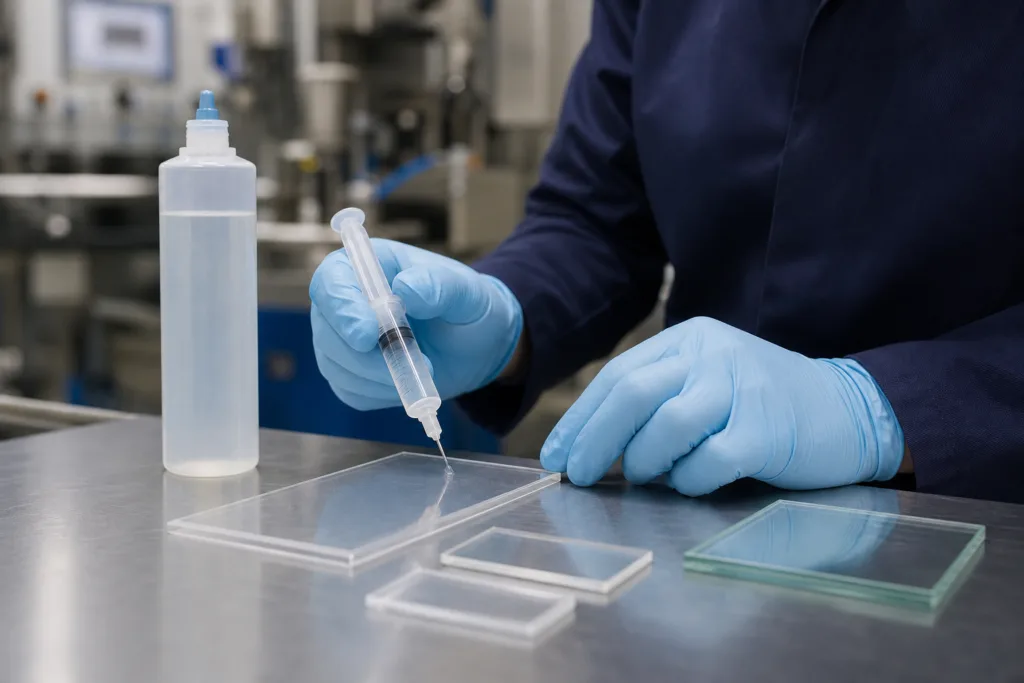
In transparent assemblies, buyers often focus on clarity first. That is reasonable, but clarity alone is not enough. A bond line that looks good on day one can still fail if the adhesive is too brittle, too soft, or too sensitive to heat and moisture.
For example, a decorative glass panel on a plastic frame may need a neat visible edge and a stable bond line. A precision cover may need both low visual distortion and controlled positioning during assembly. A light-transmitting part may need an adhesive that cures cleanly without leaving trapped air or obvious haze.
General performance questions to ask include:
- Does the adhesive wet both substrates consistently?
- Does it stay clear after cure and after aging?
- Does the bond tolerate the difference in thermal movement between glass and plastic?
- Is the joint designed to carry peel, shear, or mainly locate parts?
For light-cured systems used in clear bonding, buyers should still verify the current technical data sheet and sample performance for the exact substrate pair. Product behavior can vary with thickness, surface treatment, and cure access. For a practical product example, review ZDS-3311F UV adhesive for transparent glass-plastic bonding and compare its documented scope with your own assembly needs.
Thermal expansion and rigidity differences between plastic and glass
One of the most important design issues in plastic-to-glass bonding is mismatch in thermal expansion. When temperature changes, plastic usually moves more than glass. If the adhesive layer is too rigid, the stress can concentrate at the edge of the bond. If the adhesive is too soft, the assembly may lose positioning accuracy or visible alignment.
This is why bond geometry matters. A narrow adhesive line may look clean, but it can also concentrate stress. A slightly larger bond area may improve robustness if the design allows it. However, no geometry should be assumed to be safe without testing.
As a rule, buyers should discuss:
- Part size and thickness
- Expected temperature range in processing and end use
- Whether the assembly will see thermal cycling or only stable room conditions
- Whether the plastic is rigid or slightly flexible
- Whether the joint must remain optically invisible or only visually neat
Where the design needs both clarity and stress relief, a carefully selected UV adhesive, acrylic, silicone, epoxy, or hybrid formulation may be considered. The final choice depends on the balance between appearance and mechanical freedom.
Appearance risks: bubbles, haze, yellowing, visible bond lines, and edge defects
Appearance defects are often the main reason a transparent project is delayed. Common risks include bubbles trapped during dispensing, haze caused by poor wetting or contamination, yellowing after exposure to heat or light, and edge defects where the adhesive pulls back from the substrate.
These issues are not always caused by the adhesive alone. They can also come from part design, cleaning method, dispensing pattern, cure speed, or operator handling. Still, the chemistry must be suitable for the visual target.
Buyers should be prepared to evaluate:
- Initial clarity after cure
- Bond line uniformity
- Resistance to visible bubbling during fill or cure
- Risk of edge wet-out issues on curved or slightly uneven parts
- Longer-term appearance after heat or UV exposure
For optically demanding projects, it is useful to compare TDS claims carefully. A datasheet should clearly state the cure method, substrate scope, and the type of optical bonding it supports. ZDS LTD can help review whether a candidate product matches the assembly plan, including options such as ZDS-3309X6 UV adhesive for plastic and glass bonding where a UV-curable approach is under consideration.
Adhesive options for transparent and nontransparent assemblies
Not every plastic-to-glass project requires the same visual outcome. Some are fully transparent, others are hidden inside a frame, and some need only a neat edge at the visible perimeter. The adhesive family should match that requirement.
| Adhesive family | Typical selection strength | Typical watch-outs |
|---|---|---|
| UV-curing adhesives | Often chosen where fast cure and clear appearance are important | Need light access and confirmation of substrate compatibility |
| Acrylic adhesives | Useful where speed and broader production tolerance matter | Appearance and odor management may need evaluation |
| Epoxies | Often considered for structural needs and broader chemical resistance goals | May be less suitable when flexibility or ultra-clear appearance is critical |
| Silicone systems | Useful where flexibility and stress relief are priorities | May not suit rigid positioning or very crisp visual edges in every design |
| Hybrid formulations | Can help when a project needs a balance of cure, flexibility, and handling | Must be validated for the exact assembly and process |
These are general selection patterns, not guarantees. The same chemistry family can perform very differently depending on the formulation. Buyers should ask for the current technical data sheet, sample condition, and recommended use window before committing to a pilot run.
How substrate type changes the selection
Plastic-to-glass bonding is usually not one material problem but several. Acrylic, polycarbonate, PET, ABS, and PMMA can each create different wetting and stress behavior. Surface treatment, molding residue, and part stiffness also affect results.
As a practical example, a rigid plastic frame may support a more dimensionally stable bond line, while a flexible plastic cover can place more dynamic stress on the adhesive. A clear PMMA part may have different optical and surface requirements than a matte ABS housing. The glass side may also vary, depending on thickness, edge finish, and coating.
Before choosing an adhesive, prepare a substrate matrix:
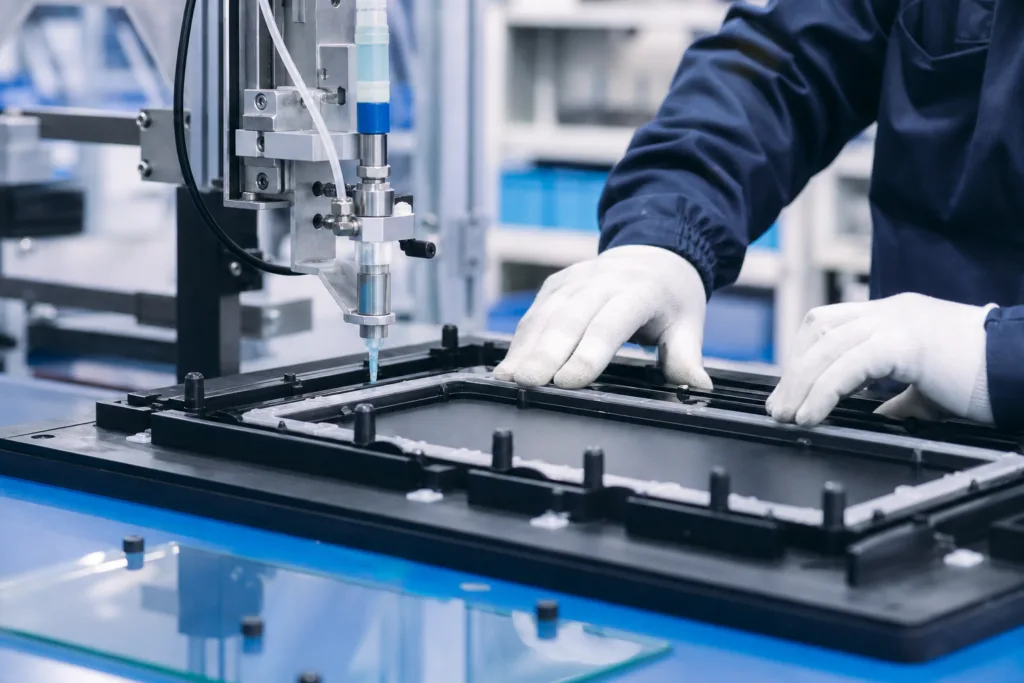
- Plastic resin type and grade
- Glass type and any coating or treatment
- Surface finish and edge quality
- Part rigidity and wall thickness
- Whether the joint is load-bearing or mainly cosmetic
If the project includes mixed-material assembly with multiple performance goals, ZDS LTD can provide adhesive selection technical support for mixed-material assemblies to help organize the shortlist and trial plan.
Surface preparation and cleaning requirements for reliable bonding
Many bond failures begin before the adhesive is applied. Dust, mold release, fingerprints, polishing residues, and moisture can all reduce wetting or create visible defects. In transparent assemblies, contamination may also show as a permanent visual flaw.
Surface preparation should therefore be treated as part of the process, not an optional step. The exact cleaning method depends on the materials and the approved process, but the production team should confirm:
- Which cleaning agent is permitted for each substrate
- Whether surface activation or priming is needed
- How long cleaned parts can wait before bonding
- Whether handling gloves and packaging reduce contamination risk
- Whether the process can be repeated consistently on the line
Do not assume that a visually clean part is bond-ready. For precision and decorative parts, the smallest contamination can affect clarity, adhesion, or both. ZDS LTD can review the substrate condition and propose a trial sequence, but the final cleaning window must be confirmed for the selected adhesive and process.
Process fit: cure speed, open time, and production line compatibility
The best adhesive on paper can still be a poor fit for a production line. Some lines need immediate fixture release. Others need time for alignment. Some assemblies can tolerate batch processing, while others require inline speed and short takt time.
When comparing candidates, buyers should ask how the cure method fits the assembly flow:
- Will the adhesive cure through the available light access?
- Does the process allow enough time for alignment before cure?
- Is the dispensing pattern compatible with the part geometry?
- Can operators inspect the bond before full cure?
- Does the system support manual, semi-automatic, or automated dispensing?
If your project is moving toward an industrial assembly program, it can help to compare a product-specific approach with broader bonding adhesive solutions for industrial assembly projects so that the selected chemistry and equipment approach match the line concept.
What to validate before scale-up
Representative-part testing is essential before approving a plastic-to-glass adhesive for production. A small coupon test may show basic adhesion, but it may not reveal optical distortion, trapped bubbles, or stress behavior in the real part geometry.
A practical validation plan should include:
- Representative plastic and glass parts
- Actual surface preparation steps
- Expected bond line thickness and dispensing pattern
- Real cure equipment and fixture setup
- Visual inspection under production lighting
After initial bonding, the sample set should be checked for appearance, handling stability, and repeatability. Where peel resistance is relevant, buyers can align trial design with recognized test methods such as ASTM D1876 for peel resistance of adhesives, while remembering that the exact test plan still needs to match the project geometry and load case.
For optical assemblies, reference technical data carefully. A datasheet such as technical data sheet criteria for optical bonding adhesives is useful as an example of the kind of information buyers should compare: cure type, substrate fit, gap behavior, and optical intent.
Common mistakes in plastic-to-glass bonding and how to avoid them
Several problems recur across projects. One common mistake is choosing only for transparency and ignoring stress management. Another is selecting a chemistry without confirming whether the plastic surface and part geometry can support it. A third is moving to scale-up before confirming the process window.
Watch for these failure points:
- Using a bond line that is too thin for wetting or stress relief
- Ignoring cleaning consistency between lab trials and production
- Assuming UV cure will be sufficient without checking shadow areas
- Assuming a clear adhesive will stay clear under all service conditions
- Skipping aging tests because the first sample looked acceptable
The safest approach is to define the visual target, the mechanical target, and the production target together. Then test the exact part combination under realistic conditions. That is usually the fastest way to reduce sourcing risk.
How to compare suppliers and request the right samples, TDS data, and custom support
When you contact a supplier, do not ask only for “a clear adhesive for plastic and glass.” That request is too broad to support a meaningful recommendation. A better request includes the substrate names, bond geometry, expected appearance, cure equipment, and target production method.
Useful information to provide includes:
- Plastic resin type and thickness
- Glass type, size, and edge condition
- Whether the joint is decorative, optical, or structural
- Required cure method and available equipment
- Expected temperature, moisture, vibration, or cleaning exposure
- Whether the part must remain reworkable or fully permanent
- Expected annual or monthly demand and packaging preference
ZDS LTD can use that information to review chemistry fit, suggest a sample plan, and discuss whether an off-the-shelf option is sufficient or whether the project needs a tailored formulation. If the target performance is unusual, you can also review whether signals that point to custom adhesive formulation are present before moving further.
How ZDS helps customers select adhesives for plastic-glass structures
ZDS LTD works with industrial buyers, engineers, and production teams as a manufacturer and technical supply partner. For plastic-to-glass assemblies, that usually means reviewing the substrates, visual target, production method, and operating environment before recommending a suitable chemistry path.
Depending on the project, support may include:
- Application and substrate review
- Adhesive chemistry shortlisting
- Sample planning and evaluation feedback
- Packaging-format discussion for the production line
- Technical document review for the selected product
- OEM, ODM, or private-label discussion where relevant
If the project needs a standard UV option, a broader bonding formulation, or a custom formulation review, ZDS LTD can help assess the requirements without assuming the answer in advance. Buyers should still confirm current documentation, test results, and suitability for the exact assembly before release to production.
Frequently Asked Questions
What information should I prepare before asking for a plastic to glass adhesive recommendation?
Prepare the plastic type, glass type, bond geometry, visual requirement, cure method, line speed, and service conditions. The more complete the input, the more useful the recommendation will be.
Are UV adhesives always the first choice for transparent plastic-to-glass bonding?
Not always. UV-curing adhesives are often considered for clear and fast processes, but the final choice depends on light access, substrate compatibility, bond design, and the required mechanical or environmental performance.
How do I check whether a sample is suitable for scale-up?
Use representative parts, real cleaning steps, and the intended cure setup. Then check appearance, handling stability, and aging behavior under the conditions that matter for production and service.
What technical documents should I request from a supplier?
Request the current technical data sheet, safety data sheet, and any project-relevant guidance on substrate compatibility, cure method, and validation notes. Confirm any specific performance or compliance requirement for the exact product.
Can ZDS LTD help if my project needs a special adhesive formulation?
Yes, ZDS LTD can review the application and determine whether a standard product is suitable or whether a custom formulation discussion is warranted. Final feasibility depends on the full project brief and the required performance window.