
Battery packs are built from conductive metals, plastics, foams, boards, and protective layers that sit very close to each other. In that environment, an insulation adhesive for battery pack assembly is not only a bonding medium; it can also help maintain electrical separation, hold parts in position, and reduce movement that can wear insulation surfaces over time. For a broader view of ZDS LTD’s application scope, start with battery electrical insulation adhesive solutions.
For engineers and procurement teams, the buying question is rarely whether an adhesive can stick. The real question is whether the selected material can support electrical safety, fit the pack design, survive the service environment, and still work inside the planned manufacturing process. That makes supplier evaluation a project-specific task rather than a chemistry shortcut.
Why battery systems need electrical protection beyond mechanical assembly
Mechanical fasteners keep parts together, but they do not automatically control electrical spacing, surface contamination, or movement between neighboring components. In compact battery systems, even small shifts can create abrasion points, stress on cable jackets, or unintended contact between conductive surfaces. An adhesive layer can contribute to fixation and can also support insulation when it is used as part of a wider electrical design.
That electrical design still needs to be framed by the pack architecture and the applicable insulation rules. Engineers often discuss these topics using the language of creepage, clearance, and solid insulation. For background, see Standards that define creepage, clearance, and solid insulation requirements and Small-gap creepage and surface insulation behavior. These references do not define a product choice by themselves, but they help explain why material selection matters in dense battery layouts.
It is useful to think of the adhesive as one layer in a system. Covers, barriers, spacers, coatings, and enclosure design still matter. If a project needs a non conductive adhesive for cells and modules, the material should be judged on how it works with the full assembly, not on chemistry name alone.
Where insulation adhesives are used in cells, modules, sensor areas, and control units

In EV packs and energy-storage modules, insulation adhesives may be used in several zones. Teams often start by reviewing battery-pack-specific sourcing context such as battery adhesives for EV pack assembly, then narrow the material choice by joint type and service requirement.
- Between or around cells where fixation and electrical separation must be maintained.
- At busbar covers, terminal areas, and insulating barriers where movement control is also needed.
- Around sensors, wiring, and board-level components that should remain stable under vibration.
- At module frames, end plates, foam supports, and spacer interfaces where gap control is important.
- In control units or interface zones where dust, moisture, and handling stress may be present.
These locations can behave differently even inside the same pack. A cell edge may need one balance of flexibility and retention, while a sensor area may need a different balance of flow, cure behavior, and inspection visibility. This is why one universal adhesive choice is rarely the right answer for an entire battery system.
What an insulation adhesive for battery pack must cover
For battery use, the performance discussion should be broader than bond strength. Buyers should ask how the material supports electrical isolation, how it handles movement, and how it behaves in the actual production line. The table below gives a practical review framework.
| Selection area | What it means in battery work | What to confirm with the supplier |
|---|---|---|
| Electrical insulation | The adhesive should support separation between conductive parts and reduce the risk of unintended surface contact. | Ask for the current technical data sheet, the test method used, and any project-specific insulation guidance. |
| Fixation | The material should keep parts stable under handling, vibration, and assembly stress. | Confirm the bonded substrates, the joint geometry, and any surface preparation needed for reliable hold. |
| Flexibility | Some battery structures expand and contract at different rates, so the adhesive may need to absorb movement. | Check whether the formulation is intended to be rigid, semi-rigid, or flexible, and whether that matches the joint. |
| Environmental resistance | Heat, humidity, condensation, dust, and aging can all change adhesive behavior over time. | Request project-specific compatibility confirmation rather than assuming the chemistry name is enough. |
| Processability | The material must fit the planned dispense, cure, inspection, and rework flow. | Review flow behavior, cure route, and whether the material can be used in the intended line setup. |
In practice, this means the buyer should not start with a generic statement such as “we need an insulating glue.” The better brief is more precise: what must be insulated, what must be held, what movement must be tolerated, and what production constraint must be respected.
How battery operating conditions affect adhesive requirements
Battery systems see a combination of vibration, temperature change, heat generation, moisture exposure, and aging. These conditions can interact. A material that looks acceptable in a short bench check may behave differently after repeated thermal cycling or in the presence of humidity and contamination.
Moisture deserves special attention because small gaps and surface films are sensitive to contamination and water uptake. For this reason, engineers often examine small-gap insulation behavior with references such as the IEC guidance above before they finalize material and geometry decisions. The key point is simple: if a battery pack is compact, the adhesive interface may be part of the insulation strategy, so its behavior under realistic service conditions matters.
- Vibration: Can loosen poorly designed joints or create abrasion where parts move against each other.
- Thermal cycling: Can stress the interface if the bonded substrates expand at different rates.
- Heat: Can change cure behavior, stiffness, or long-term stability depending on the formulation.
- Moisture and condensation: Can affect surface insulation and may influence adhesion to contaminated parts.
- Aging: Can reveal whether the adhesive remains stable after long exposure to the operating environment.
If the project includes coolant contact, electrolyte exposure, cleaning fluids, or outdoor storage, those conditions must be disclosed early. A supplier cannot responsibly confirm suitability without the actual exposure profile.
Key substrate and process factors: metals, plastics, foams, PCBs, and application method compatibility
The same adhesive can behave very differently on aluminum, copper, plated metals, engineering plastics, foams, and printed circuit boards. Surface energy, oxide layers, release agents, molding residues, and prior handling can affect adhesion more than buyers expect. This is one reason a battery project should include a substrate review before any final recommendation.
When evaluating a non conductive adhesive for cells and modules, ask the supplier to review the actual build, not a simplified material list. The following questions are especially useful:
- Which metals, plastics, coatings, and board materials are present in the real assembly?
- Are the surfaces bare, painted, plated, primed, anodized, or otherwise treated?
- Is there a cleaning, plasma, or priming step in the process?
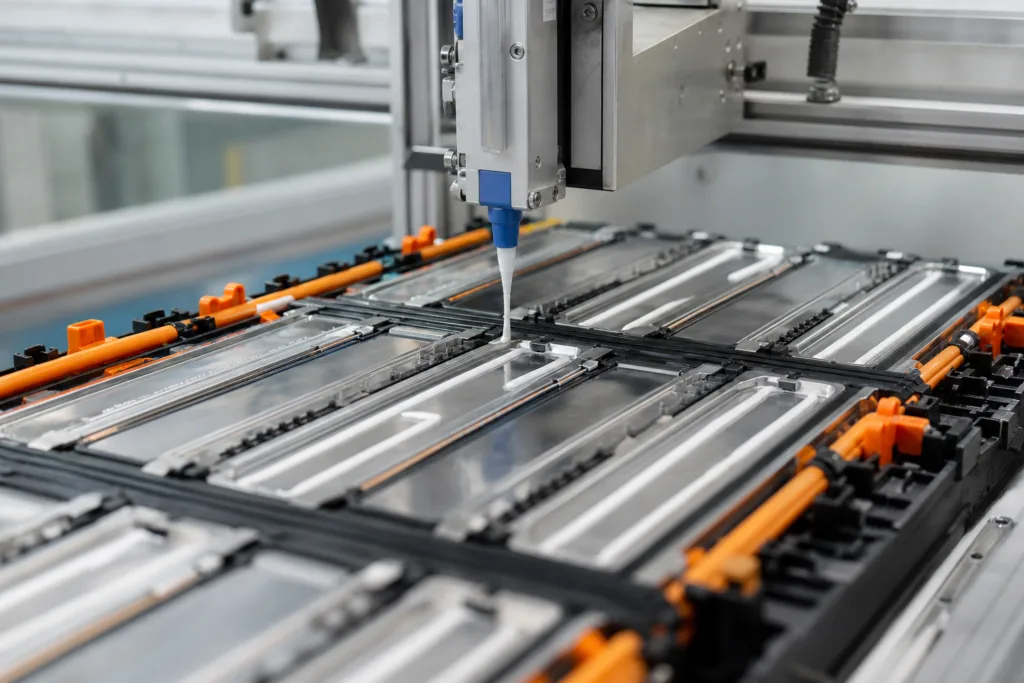
- Will the material be dispensed as a bead, dot, film, fill, or potting volume?
- Does the joint need gap fill, edge sealing, tack fixation, or a combination of functions?
Application method matters as much as chemistry. A material that performs well as a manual bead may behave differently in an automated dispense path. Likewise, an adhesive that is comfortable for prototype work may be too slow or too variable for a high-volume line. Packaging format should therefore be discussed together with substrate compatibility.
Common chemistry options and when a non conductive adhesive for cells and modules may be preferred
Not every battery zone needs the same material family. The right selection depends on whether the main goal is rigid fixation, flexible support, encapsulation, or fast line throughput. For projects that need insulation plus encapsulation, teams may review a product example such as ZDS-168ab-T electronic potting adhesive for insulation and waterproofing as part of the discussion. That review should still be tied to the real assembly, because a potting approach is not the same as a bonding-only approach.
| Chemistry family | General selection tendency | Trade-off to review |
|---|---|---|
| Epoxy | Often considered when strong fixation, gap control, and stable structure are important. | Check how rigid the cured material becomes and whether the joint needs to absorb movement. |
| Polyurethane | Often used when some flexibility is useful and the assembly may see movement or expansion. | Confirm environmental behavior and compatibility with the actual substrates and cure process. |
| Silicone | Often selected when flexibility and movement tolerance are priorities in insulating areas. | Review adhesion to the exact metals or plastics in the pack and confirm process fit. |
| Acrylic or UV-curing | Can support fast processing on suitable joints where light access or rapid handling is needed. | Check shadowed areas, cure depth, and whether the joint geometry suits this route. |
| Potting compounds | Useful when the design needs more complete encapsulation around protected parts. | Review inspection access, rework needs, and any effect on heat flow or serviceability. |
There is no universal winner among these families. If the main requirement is insulation plus fixation in a compact battery area, a non conductive adhesive for cells and modules may be preferred. If the assembly also needs full encapsulation or stronger moisture shielding, a different format may be more appropriate. The final decision should follow the project geometry, the service environment, and the line design.
Mistakes buyers make when selecting generic adhesives for battery environments
Many sourcing problems start when the buyer treats an adhesive as a commodity rather than as a design element. The label may sound suitable, but the actual assembly can expose hidden weaknesses. Common mistakes include the following:
- Selecting by chemistry name alone without checking the substrate stack or joint function.
- Using one material across every zone in the pack, even though the zones face different loads.
- Assuming electrical insulation comes automatically with good adhesion.
- Skipping representative testing on actual parts and actual surfaces.
- Ignoring the impact of surface contamination, cleaning residue, or coating variation.
- Reviewing lab performance without confirming line speed, dispense control, and cure availability.
- Forgetting that vibration, heat, and moisture can act together rather than separately.
In battery work, these errors can cause schedule delays, requalification work, or avoidable design changes. A disciplined technical review at the sourcing stage usually costs less than correcting a mismatch after pilot production has started.
What to confirm before qualification
Before a material is approved for battery use, the qualification package should connect the product data to the real application. When the short list narrows, it is sensible to review the broader battery electrical insulation adhesive solutions overview together with adhesive selection support for battery qualification so the discussion remains tied to the project brief.
Useful qualification questions include:
- What exact function is the material supposed to perform: insulation, fixation, sealing, potting, or a combination?
- Which substrates, coatings, and component surfaces are present in the final design?
- Which cure route is planned, and what equipment or line constraint does that create?
- What are the relevant electrical safety concerns in the target area of the pack?
- What thermal, moisture, and vibration conditions should be represented in testing?
- Is the material expected to be permanent, or does the design require rework or service access?
- Which documents are needed for approval, including the current technical data sheet and safety data sheet?
If a value, compliance point, or handling condition matters to the project, it should be checked on the current product documents for the exact formulation. The chemistry family can guide the discussion, but the final confirmation must come from the selected product data.
Sample validation and production considerations: dispensing, cure speed, batch consistency, and process stability
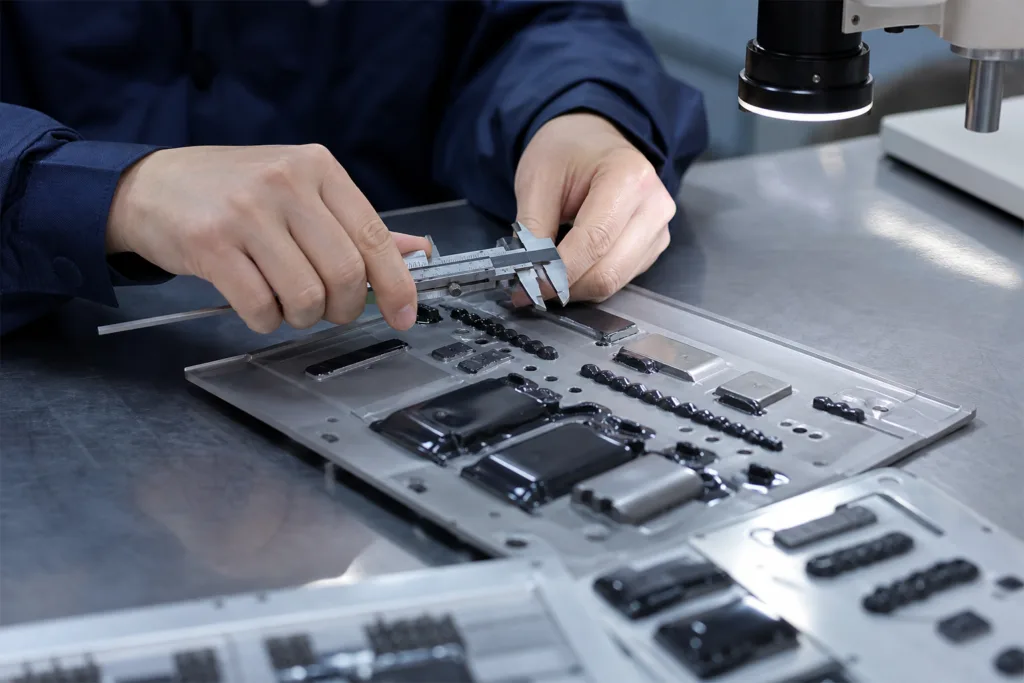
A bench sample is only a starting point. Real production needs the same substrate preparation, dispense equipment, bead size, cure route, and inspection method that will be used on the line. For teams planning scale-up, battery adhesive dispensing in EV production is a useful process topic to review before pilot trials begin.
During sample validation, the team should focus on repeatability, not only on first-piece appearance. A material that looks fine on one part may behave differently after a shift change, a nozzle change, or a minor variation in surface cleanliness. The pilot should therefore use representative parts and a realistic process window.
- Verify how the material flows and where it lands on the actual substrate.
- Check whether it wets the intended zone without running into unintended areas.
- Observe how the cured material fits around connectors, fasteners, and sensor parts.
- Confirm that the inspection team can judge placement and coverage reliably.
- Compare batch-to-batch consistency during the pilot with the original sample behavior.
- Review whether the material can be handled, stored, and loaded in the intended production format.
If the application uses automated dispensing, the manufacturer and the integrator should discuss nozzle type, feed stability, and the tolerance for process drift. If the application is manual, the buyer should still test the same control points that will matter on the line. Stability in battery assembly is about more than chemistry; it is also about process control.
How ZDS supports battery safety and process needs together through custom formulation and application-specific development
ZDS LTD works as a manufacturer, technical supplier, and project partner, so the support conversation can include substrate review, chemistry screening, sample planning, packaging-format discussion, and technical-document review. For battery projects, that approach is useful because insulation, fixation, and production fit have to be considered together rather than in isolation.
When a customer needs to balance electrical separation with stable fixation, ZDS LTD can review the part map, the process route, and the environmental profile to help narrow the options. If the project requires a different balance of rigidity, flexibility, flow, or encapsulation, custom adhesive formulation may be discussed after the assembly details are clear. The same principle applies to OEM, ODM, and private-label discussions: the material should be matched to the actual battery design and manufacturing plan.
To prepare a useful first discussion, share the substrates, coatings, bond geometry, target insulation function, operating temperature profile, vibration level, moisture exposure, application method, line speed, and expected order profile. That information makes it easier to compare candidate materials, plan samples, and reduce sourcing risk before qualification starts.
Frequently Asked Questions
When is a non conductive adhesive for cells and modules preferable to a standard structural adhesive?
It is usually considered when the assembly needs both fixation and electrical separation. Final choice still depends on substrate, gap, cure process, and operating environment.
What TDS details should I request first?
Ask for the cure method, approved substrates, electrical insulation guidance, mechanical performance window, environmental limits, and any storage or handling notes that affect production. Confirm the latest document for the exact product.
Can one material bond metals, plastics, foams, and PCBs in the same pack?
Sometimes, but not automatically. Mixed-material packs often need surface review and representative testing because adhesion and compatibility can vary by coating, plastic grade, and cleanliness.
What should we test during qualification?
Use representative parts under thermal cycling, vibration, moisture exposure, and assembly-relevant cure conditions. Also check dispensing, inspection, rework, and batch-to-batch repeatability.
How can ZDS LTD support a project without locking the formulation too early?
ZDS LTD can review the assembly, suggest candidate chemistries, discuss packaging and application method, and help plan samples and documentation. Final selection remains tied to the confirmed project data and test results.