
Choosing a silicone adhesive for medical devices involves more than finding a flexible material that bonds two parts. Engineers and procurement teams must consider the intended contact environment, substrate combination, cure chemistry, cleanliness, sterilization exposure, production method, and the evidence needed for qualification. A useful starting point is to review silicone adhesive options for flexible bonding and sealing while keeping the final device design and validation plan in view.
Silicone adhesives are often considered when an assembly needs elastic movement, sealing, vibration tolerance, or compatibility with irregular surfaces. However, general silicone characteristics do not automatically confirm suitability for a particular healthcare application. The selected formulation, cured adhesive geometry, surface preparation, manufacturing process, and finished-device risk assessment must all be evaluated together.
Why Some Medical Device Assemblies Use Silicone Adhesives
Silicone materials are based on a flexible polymer structure that can remain elastomeric after cure. This distinguishes them from many rigid structural adhesives. In a medical or healthcare assembly, that flexibility may help accommodate differential movement between substrates, repeated handling, vibration, bending, or thermal changes.
Silicone adhesives can also serve more than one design function. They may bond a flexible component, close a seam, seal around an enclosure, or help protect a joint from moisture and contaminants. These functions are related but not identical. A formulation suitable for a low-stress seal may not provide the required adhesion for a load-bearing joint, and a material that bonds well to one plastic may require different preparation or a different formulation for another.
For this reason, the key question is not simply whether silicone is used in medical products. The question is whether a specific silicone adhesive can provide the required bond and sealing function throughout the device life cycle, including assembly, storage, use, cleaning, and any applicable sterilization process.
What Medical and Healthcare Applications Demand from a Silicone Adhesive
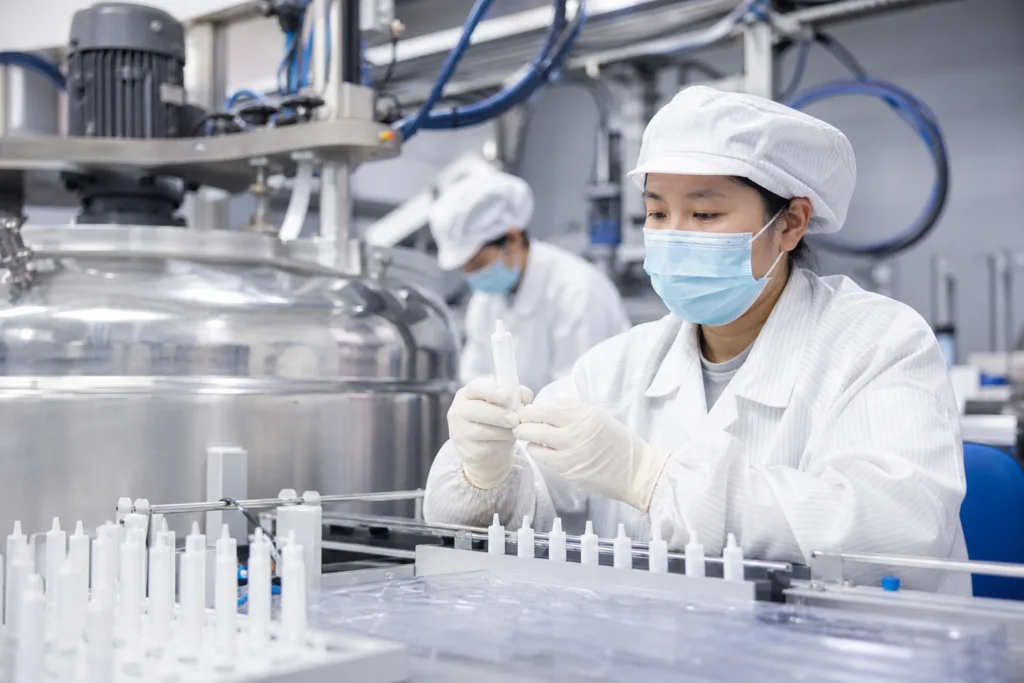
Medical and healthcare applications typically demand a controlled balance of performance and process evidence. Depending on the device, the adhesive may be near skin, bodily fluids, an air or fluid pathway, an electronic component, or an external housing. Each context changes the information that should be requested and the tests that may be appropriate.
Buyers should define the adhesive’s actual role before comparing supplier data. Important questions include:
- Is the adhesive used for bonding, sealing, strain relief, encapsulation, or several functions?
- Will the cured material contact skin, tissue, bodily fluids, process fluids, or only an external enclosure?
- Is the contact temporary, prolonged, or permanent within the intended use?
- Will the finished assembly be sterilized, disinfected, washed, or exposed to humidity?
- Does the joint need to remain flexible, or must it resist a defined mechanical load?
- Is the adhesive visible, and does transparency or color consistency affect inspection?
- Must the process support manual assembly, automated dispensing, two-part mixing, or a controlled bead application?
These inputs help separate a material-selection discussion from a regulatory conclusion. A supplier can help identify candidate formulations and provide available technical documentation, but the device manufacturer remains responsible for confirming whether the finished product meets its intended requirements.
Flexible Bonding, Sealing, and Skin- or Fluid-Adjacent Context
Flexibility is valuable when the joint must move without transferring excessive stress into a thin or delicate substrate. Low-modulus silicone can be useful in designs where a rigid bond could concentrate stress. Yet softness alone is not a qualification criterion. The joint still needs adequate adhesion, cohesive integrity, dimensional control, and resistance to the relevant environment.
Skin-adjacent and fluid-adjacent uses require especially careful boundary definition. An adhesive positioned outside a device housing may have a different risk profile from one located inside a fluid pathway. The same is true for a bond that is technically near the user but separated by a validated barrier. Engineers should map the adhesive location, exposure duration, possible migration routes, and consequences of bond failure.
For regulated products, biological safety cannot be inferred from the word silicone or from a generic statement that a material is suitable for healthcare. The FDA explains that biocompatibility assessment should consider the finished medical device, its materials, intended contact, and relevant exposure conditions. Buyers can consult FDA biocompatibility guidance for finished medical devices as part of planning, while confirming the applicable regulatory pathway for their product.
Silicone-to-Plastic, Silicone-to-Metal, and Silicone-to-Silicone Considerations
Substrate compatibility is one of the most common reasons that a promising adhesive fails during trials. Silicone rubber, thermoplastics, coated metals, glass, and painted surfaces present different chemical and physical bonding conditions. Even within one material family, additives, mold-release residues, surface texture, hardness, and manufacturing history can affect adhesion.
| Substrate combination | Primary evaluation questions | Potential process concerns |
|---|---|---|
| Silicone to silicone | Are both surfaces cured, contaminated, or treated? Is the joint intended to flex repeatedly? | Low surface energy, release agents, surface activation, and cohesive failure need review. |
| Silicone to plastic | What polymer, additive package, and surface finish are present? | Stress cracking, plasticizer migration, molding residues, and poor wetting may affect results. |
| Silicone to metal | Is the metal bare, anodized, plated, painted, or passivated? | Cleaning, corrosion considerations, surface energy, and coating adhesion require investigation. |
| Silicone to glass | How clean is the glass, and is the bond exposed to moisture or sterilization? | Residue control, edge stresses, optical requirements, and bead geometry may be important. |
Surface preparation should be documented rather than treated as an informal operator step. Cleaning chemistry, wipe material, drying time, plasma or corona treatment, primer use, and allowable time between preparation and bonding can all influence repeatability. Any primer or treatment must be assessed for its own residues and compatibility with the device.
Key Performance Factors: Flexibility, Low Modulus, Biostability, and Environmental Resistance
When engineers compare a silicone adhesive for medical devices, they should translate broad performance terms into measurable project requirements. “Flexible” may refer to elongation, peel behavior, movement accommodation, or resistance to repeated bending. “Biostable” may refer to retention of properties in a particular simulated environment over a defined period. Neither term is sufficiently precise without a test method and exposure condition.
Relevant factors may include adhesion to each substrate, cohesive strength, modulus, elongation, tear behavior, compression set, moisture resistance, temperature exposure, chemical exposure, and resistance to cleaning agents. Bond geometry also matters. A thin film, fillet, gasket-like bead, and gap-filling joint can experience very different stresses even when made from the same formulation.
Actual values depend on the selected product and formulation. They must be checked in the current technical data sheet and verified on representative parts. A supplier’s general silicone data cannot replace testing in the final assembly, particularly when the adhesive is exposed to sterilization, disinfectants, body-contact conditions, or repeated flexing.
Cure Chemistry Options and How They Affect Process Fit
Cure chemistry affects production timing, cleanliness, by-products, storage, equipment, and the condition of the assembled device during cure. One-part moisture-curing systems may simplify dispensing, but cure progression can depend on humidity, bead dimensions, access to atmospheric moisture, and packaging design. Two-part systems may provide a different process profile but require controlled metering and mixing.
Other silicone cure approaches may be considered where reduced by-products, controlled cure, or compatibility with sensitive components is important. The correct choice depends on the application and process rather than on chemistry names alone. Engineers should ask how the cure proceeds through the actual bead or joint, whether enclosed areas cure adequately, and whether uncured or volatile species could affect nearby components.
Curing is also different from drying. A surface that appears dry may not have reached the required internal cure state. The assembly should not be moved, sterilized, packaged, or placed into service based only on appearance. Cure conditions, handling time, fixture requirements, and any post-cure step must be confirmed for the selected formulation and validated on production-representative geometry.
For general process planning, buyers may also review adhesive curing vs drying in industrial applications.
Cleanliness, Extractables, Residues, and Supporting Data
Cleanliness is a system requirement, not simply a visual attribute of the cured adhesive. Uncured material, cure by-products, low-molecular-weight species, packaging residues, primers, cleaning agents, and particles may all affect the finished assembly. The relevance depends on the device construction and the adhesive’s location.
Procurement and engineering teams should ask what chemical characterization, extractables, leachables, or residue information is available for the candidate formulation. The useful question is not whether a supplier can provide a universal “medical safe” statement. It is whether the supplier can identify the available data, its scope, the tested formulation, and the limits of applying it to the customer’s finished device.
The FDA’s resource for chemical characterization and biocompatibility studies can help teams understand why material information and finished-device assessment must be considered together. ZDS LTD can review the intended adhesive location and available documentation with the buyer, while project-specific compliance evidence must be confirmed for the selected product and device.
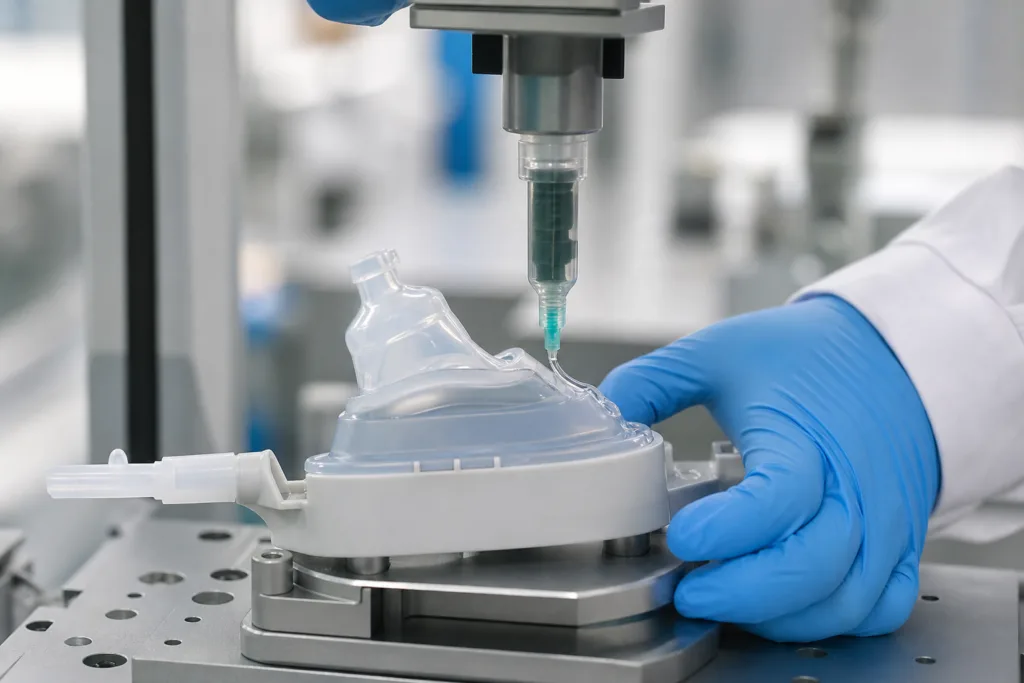
Surface Preparation and Compatibility Checks Before Bonding
Before ordering production quantities, create a controlled compatibility plan. Use the actual substrates where possible, including the same grade, coating, molding method, surface finish, and cleaning route. Test both prepared and intentionally varied surfaces to understand the process window.
- Record substrate identity, supplier, batch information, and surface finish.
- Define cleaning agents, wiping method, drying conditions, and time limits.
- Evaluate whether plasma, corona, abrasion, or primer is required.
- Control adhesive bead size, overlap, bond-line geometry, and fixture pressure.
- Document mixing, dispensing, cure, handling, and inspection conditions.
- Check whether the adhesive contacts sensitive electronics, optical surfaces, membranes, or fluid pathways.
- Retain representative samples for comparison when process changes occur.
A small coupon test can identify obvious incompatibility, but it is not a substitute for representative-part validation. Flexible assemblies may pass an initial pull test and still fail after bending, thermal cycling, humidity exposure, cleaning, or sterilization.
Common Misunderstandings in Medical Silicone Adhesive Selection
One misunderstanding is that every silicone adhesive is interchangeable because silicone is inherently flexible. Formulations differ in cure chemistry, adhesion promoters, hardness, modulus, transparency, processing behavior, and available documentation.
Another is that high initial adhesion proves long-term suitability. Medical assemblies can experience movement, moisture, chemicals, sterilization, and repeated handling. The relevant failure mode may be adhesive separation, substrate damage, cohesive tearing, cracking, residue formation, or loss of seal integrity.
A third misunderstanding is that a product described as transparent will remain optically acceptable in every geometry and environment. Color, haze, bubbles, surface contamination, cure conditions, and aging may affect appearance. Visual requirements should therefore be defined with inspection criteria.
Finally, a material label or intended industry does not replace a qualification strategy. “For medical devices” may indicate an application focus, but buyers still need to confirm the exact formulation, documentation scope, test conditions, and suitability for the intended finished product.
What to Validate Before Qualification
Validation should connect adhesive performance to the actual risk of the device. A practical program commonly begins with screening on representative substrates and then progresses to process repeatability, environmental exposure, aging, and finished-device assessment.
Depending on the application, teams may evaluate initial adhesion, peel or tensile behavior, seal integrity, dimensional stability, flexibility, visual quality, and failure mode. Aging studies may include humidity, temperature, cleaning agents, simulated fluids, or other service exposures. Sterilization must be included when relevant. The FDA describes multiple sterilization modalities used for medical devices, and the adhesive process must be considered alongside the device materials and packaging.
For sterilized assemblies, confirm the method, cycle conditions, number of exposures, packaging state, and inspection timing. EtO, radiation, steam, and other methods can create different chemical, thermal, or moisture stresses. Compatibility cannot be assumed from a generic product description.
Production repeatability deserves equal attention. Measure dispensing consistency, cure progression, operator handling, fixture removal, rework rate, inspection criteria, and lot-to-lot documentation. A candidate that performs well in a laboratory-style trial may still need process adjustment before it is appropriate for scaled assembly.
Documentation Buyers and Engineers Should Request
A supplier discussion becomes more productive when the documentation request is specific. Depending on the project stage, ask for the current technical data sheet, safety data sheet, packaging information, handling guidance, cure description, substrate recommendations, and available quality or compliance documents. Confirm which documents apply to the exact product code and formulation under review.
- Product identity, component structure, and revision-controlled technical data.
- Recommended storage, handling, dispensing, and cure conditions, subject to project confirmation.
- Available physical and mechanical data with test methods and conditions.
- Known limitations involving substrates, primers, contamination, gap size, or cure access.
- Available information on extractables, residues, chemical characterization, or biological evaluation support.
- Packaging formats and compatibility with the intended dispensing equipment.
- Batch identification, quality-control documentation, and change-notification expectations.
- Any applicable regulatory or customer-specific documents for the selected formulation.
When a product page is being considered, buyers can discuss the scope of available information for ZDS-795 transparent silicone adhesive for medical devices. The exact suitability, documentation package, and production conditions still require project review.
How to Frame Requirements for Custom Formulation or OEM Supply
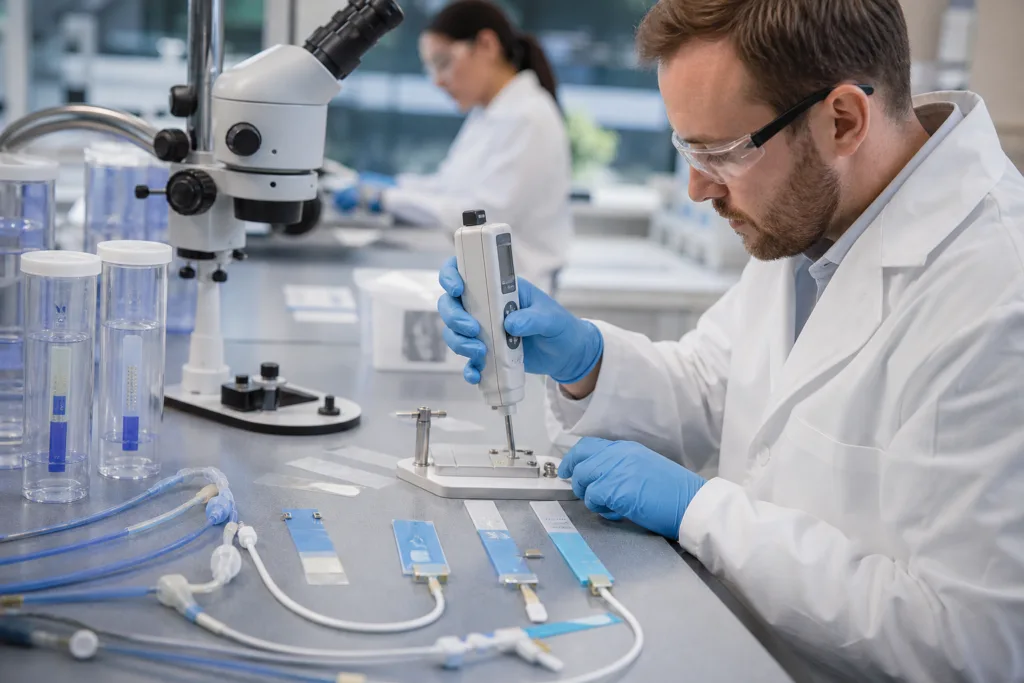
Custom formulation or OEM supply discussions should begin with a technical requirement sheet rather than a request for a generic medical silicone adhesive. Include the substrate drawings or samples, bond dimensions, target bead or film, application equipment, cure conditions, cycle time, packaging format, and expected inspection method.
Also describe the device’s operating environment and qualification pathway. State whether the adhesive is skin-adjacent, fluid-adjacent, internal, external, or isolated behind another material. Include sterilization method, cleaning exposure, temperature and humidity conditions, expected service life, mechanical movement, and any restrictions on primers or process chemicals.
Commercial details also matter. Provide the intended market, packaging preference, forecast assumptions, private-label or OEM requirements, quality documentation expectations, and delivery destination. These inputs allow a manufacturer to determine which questions require technical confirmation before samples, formulation work, or quotation discussions proceed.
ZDS LTD can support an application and substrate review, product matching, sample evaluation, technical-document discussion, and consideration of custom adhesive formulation for device-specific process fit. A recommendation or customized supply arrangement should be treated as subject to review of the complete project information.
How ZDS Helps Define Medical Silicone Adhesive Requirements
ZDS LTD approaches medical and healthcare adhesive projects as a manufacturer and technical supply partner. The most useful first step is to clarify the assembly function, substrates, cure process, exposure conditions, documentation needs, and order requirements. This prevents a chemistry discussion from becoming detached from the real device process.
For teams preparing qualification work, ZDS can review candidate requirements, discuss sample evaluation, and help organize the information needed for a supplier response. Its adhesive selection technical support for qualification planning can be considered alongside the customer’s own regulatory, quality, and engineering responsibilities.
Buyers should send substrate details, drawings or representative parts, adhesive location, joint geometry, cure and dispensing constraints, sterilization or cleaning exposure, intended contact context, validation tests, documentation expectations, packaging needs, and expected order profile. With that information, ZDS LTD can evaluate whether an existing formulation, product-matching discussion, sample plan, or custom development route is appropriate. Final approval should follow representative-part testing and the customer’s quality and regulatory procedures.
Frequently Asked Questions
Is every silicone adhesive suitable for medical device assembly?
No. Silicone chemistry alone does not establish suitability. The exact formulation must be assessed against substrates, adhesive location, cure process, exposure conditions, sterilization, cleanliness, and the finished device’s qualification requirements.
Can silicone adhesive be used for silicone-to-silicone bonding?
It can be considered, but cured silicone often presents a challenging bonding surface. Surface condition, contamination, release agents, treatment, primer use, joint movement, and the selected formulation should be evaluated on representative parts.
What information should be provided when requesting a supplier recommendation?
Provide substrate identities, drawings or samples, bond geometry, dispensing method, cure conditions, production cycle, operating environment, sterilization or cleaning exposure, contact context, documentation needs, packaging preferences, and expected order requirements.
Does a transparent silicone adhesive remain transparent after sterilization?
That cannot be assumed. Appearance may depend on formulation, cure, thickness, bubbles, substrate, sterilization method, and repeated exposure. Visual and functional acceptance criteria should be tested on the finished assembly.
Can ZDS LTD confirm biocompatibility for a finished medical device?
ZDS LTD can discuss available product information and support material-selection review, but finished-device biocompatibility and regulatory qualification remain project-specific responsibilities. The exact formulation, device construction, intended contact, and applicable test strategy must be confirmed.