
Choosing the right potting adhesive for transformers, coils, inductors, and other wound electrical components is not only about filling space around a part. It is a material-engineering decision that affects insulation reliability, thermal behavior, vibration resistance, moisture protection, process yield, and long-term field performance. In our adhesive manufacturing work, we see that many sourcing problems begin when buyers compare products only by chemistry name or price, instead of by penetration behavior, cure profile, dielectric performance, and fit with the real assembly process.
If your project involves tight winding gaps, moisture exposure, vibration, heat buildup, or insulation-sensitive assemblies, our potting adhesive options for transformer and coil protection are relevant because selection often depends on more than a generic epoxy or polyurethane label. At ZDS, we help manufacturers evaluate viscosity, wetting, cure speed, hardness, thermal management, sample performance, packaging format, and production consistency so the material fits both the electrical design and the dispensing process.
Why wound components need specialized protection
Transformers, coils, chokes, solenoids, and related wound components contain fine wire, layered insulation, bobbins, lead exits, and narrow internal voids. These features create several risks that standard general-purpose adhesives do not solve well. The material must enter narrow spaces, bond dissimilar surfaces, reduce air pockets, and maintain stable electrical insulation under thermal cycling.
In practical terms, potting or encapsulation can help by:
- Stabilizing windings against movement and vibration
- Reducing moisture ingress and contamination
- Supporting dielectric insulation around energized conductors
- Improving resistance to thermal shock and handling damage
- Filling cavities that would otherwise trap air
- Protecting lead exits and vulnerable edges from stress concentration
For wound assemblies, the challenge is usually not just adhesion. It is the combination of insulation, penetration, dimensional stability, and process control.
Typical failure modes in transformers, coils, and wound electrical components

Before selecting a material, it helps to define what failure you are trying to prevent. From our formulation and application perspective, the most common issues include incomplete impregnation, local air entrapment, resin cracking, poor adhesion to bobbins or housings, and stress transfer to fine magnet wire during cure or thermal cycling.
Common failure risks include:
- Moisture-related degradation: absorbed moisture can reduce insulation performance and encourage corrosion at leads or terminals.
- Vibration-induced winding movement: movement can lead to abrasion, noise, or long-term insulation wear.
- Voids and air pockets: these reduce encapsulation quality and may become electrical weak points.
- Excessive shrinkage: a rigid material that shrinks too much can stress wire enamel, ferrite, or plastic components.
- Poor heat management: trapped heat accelerates aging and can destabilize electrical performance.
- Incomplete cure: off-ratio mixing, poor temperature control, or excessive section depth can leave soft or undercured regions.
When buyers frame the problem this way, the choice of chemistry becomes much clearer.
Typical requirements for a potting adhesive for transformers
A potting adhesive for transformers is often expected to do several jobs at once. Some projects prioritize dielectric insulation first, while others are more constrained by heat, low-temperature shock, vibration, or deep impregnation in narrow winding spaces. The correct selection depends on the dominant risk.
| Requirement | Why It Matters | Selection Impact |
|---|---|---|
| Electrical insulation | Prevents leakage and breakdown between conductors and grounded parts | Check dielectric properties, cure completeness, and void control |
| Heat resistance | Supports stable performance during continuous or cyclic heating | Choose chemistry and glass transition behavior suited to the temperature profile |
| Penetration | Helps resin enter narrow winding gaps | Low viscosity and good wetting become critical |
| Void reduction | Improves electrical and environmental reliability | Consider degassing, filler level, and dispensing method |
| Stress management | Protects wire, ferrite, and plastic from cracking or pull stress | Balance hardness with flexibility and shrinkage control |
| Production practicality | Affects yield, takt time, and consistency | Review pot life, cure schedule, packaging, and mixing method |
Many sourcing teams ask for one material that is low viscosity, fast curing, highly thermal, highly flexible, and extremely heat resistant all at once. In reality, those targets may conflict. Good selection is about ranking priorities rather than expecting every property at its maximum.
How potting helps stabilize windings and reduce environmental damage
When correctly selected, potting compounds reduce movement inside the component and shield sensitive regions from moisture, dust, and chemicals. They also improve handling robustness during transport and downstream assembly. This is especially valuable where wound parts are mounted into power modules, chargers, lighting systems, industrial controls, or automotive electronics.
For projects where insulation performance is central, buyers often review electrical insulation adhesive solutions for wound components alongside potting materials, because the real question is not just whether a resin fills the cavity, but whether it maintains stable insulating performance throughout the product life cycle.
Common potting material types for electromagnetic components
The three most common chemistry families for this application are epoxy, polyurethane, and silicone. Each can work well, but each solves a different balance of mechanical, electrical, and process needs.
Epoxy potting compounds
Epoxy systems are widely used when strong adhesion, dimensional stability, chemical resistance, and durable electrical insulation are required. They are often selected for transformer housings, coil encapsulation, and electronics potting where a stable cured network is preferred. Depending on formulation, epoxy can be low viscosity for impregnation or highly filled for thermal management.
A low-viscosity system such as ZDS-168ab-1 low-viscosity insulating waterproof adhesive for electronics illustrates the kind of profile buyers often seek when they need deep penetration, electrical insulation, and moisture resistance in compact wound assemblies.
Polyurethane potting compounds
Polyurethane is often chosen when greater flexibility is needed. It can help absorb vibration, reduce stress transfer, and tolerate differential expansion between copper, ferrite, plastics, and housings. This makes it attractive for assemblies exposed to shock, thermal cycling, or substrate movement. The trade-off is that some polyurethane systems may have different moisture sensitivity or thermal limits than epoxies, so qualification should be application-specific.
Silicone potting compounds
Silicone is useful where flexibility across a broad temperature range is critical or where very soft stress relief is needed. It can be a strong option for temperature cycling and substrate sensitivity, especially when brittle failure must be avoided. However, silicone may not always be the first choice if very high cohesive strength, abrasion resistance, or certain downstream processing requirements are dominant.
Epoxy, polyurethane, and silicone: when each chemistry makes sense
| Chemistry | Typical Strengths | Typical Trade-Offs | Best Fit Examples |
|---|---|---|---|
| Epoxy | Strong adhesion, robust insulation, chemical resistance, stable cured body | Can be rigid, may create stress if shrinkage or hardness is too high | Power transformers, compact coils, industrial electronics |
| Polyurethane | Flexibility, vibration damping, stress absorption | Performance window depends heavily on formulation and moisture control | Shock-prone or movement-sensitive assemblies |
| Silicone | Thermal cycling tolerance, softness, broad service flexibility | May have lower structural strength or different adhesion profile | Sensitive substrates, high thermal expansion mismatch |
We usually advise engineers to start with the failure mode, then narrow chemistry. If the assembly runs hot and also needs heat dissipation, a filled epoxy may make sense. If stress relief is more important than rigidity, polyurethane or silicone may be the better route. For high-temperature designs, a material such as ZDS-368ab-hd high-temperature thermal potting epoxy represents the type of formulation category worth evaluating when thermal endurance and heat transfer matter together.
How to evaluate penetration, wetting, and deep void filling
For coils and wound transformers, low viscosity alone does not guarantee good impregnation. The material also needs suitable wetting behavior on copper, enamel-coated wire, ferrite, plastic bobbins, tape surfaces, and internal cavities. A resin that looks fluid in a cup may still bridge over narrow gaps or trap bubbles inside the winding pack.
In sample trials, we recommend checking:
- How quickly the material spreads over the winding surface
- Whether it reaches the bottom of the cavity without bridging
- Whether voids remain around lead exits, corners, and center areas
- Whether the resin separates or settles before cure
- Whether filler loading interferes with fine penetration
Sectioning cured samples is often more informative than visual inspection from the top. A part can appear fully filled externally while still containing internal dry zones.
Why air release and bubble control matter in coil potting
Air entrapment is one of the most overlooked issues in encapsulation of wound electrical parts. Bubbles are not just cosmetic defects. They can create weak regions for insulation, trap moisture, reduce thermal transfer, and interfere with bonding at critical interfaces. In high-reliability applications, low-void impregnation is especially important because filled gaps improve dielectric continuity; a technical review on dielectric systems also helps explain why void-free impregnation improves dielectric reliability in wound electrical structures.
Practical bubble-control measures include:
- Using suitable viscosity for the winding geometry
- Allowing time for self-leveling before gelation
- Applying vacuum degassing where the process permits
- Controlling dispensing speed to avoid turbulent entrainment
- Preheating components or resin when appropriate for flow improvement
- Designing fill points and vent paths into the housing
In production, bubble problems are often a combined result of material choice and fill method. A good formulation can still fail if the dispensing path is wrong.
What material properties matter most
Buyers often compare datasheets line by line, but not all properties have equal weight for wound components. The right interpretation depends on the component geometry, voltage environment, thermal load, and manufacturing method.
Viscosity
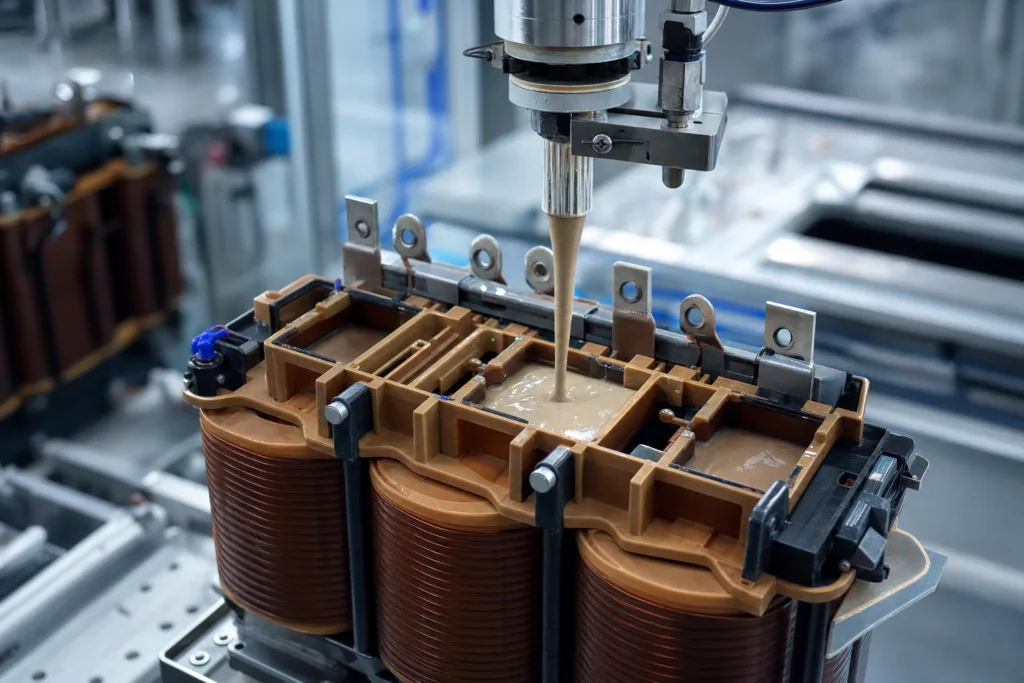
Viscosity drives penetration, wetting, and bubble release. Lower viscosity usually helps fine-gap filling, but if the resin is too thin for the housing or process, it may leak, settle, or expose sensitive surfaces unintentionally.
Cure profile
Pot life, gel time, fixture behavior, and full cure schedule determine whether the material fits your production line. A resin that performs well in the lab but cures too slowly for throughput may create hidden cost.
Hardness and flexibility
Harder materials give stable support, but overly rigid systems can stress copper windings, ferrite cores, or plastic bodies. Softer systems relieve stress better but may provide less mechanical reinforcement.
Dielectric performance
For electrical potting, buyers should verify dielectric performance with proper test methods rather than relying on vague insulation claims. Standards-based references such as dielectric strength testing for electrical potting materials are useful when defining qualification criteria for cured insulating systems.
Thermal resistance and thermal conductivity
These are not the same property. Thermal resistance refers to how the cured material tolerates elevated temperature over time. Thermal conductivity refers to how effectively heat passes through it. A material may survive heat well without actually moving heat efficiently.
Matching potting material to operating conditions and substrate sensitivity
Every wound component sits in a specific environment. That environment should drive your screening checklist.
| Operating Condition | Material Preference | Why |
|---|---|---|
| High continuous temperature | Heat-resistant epoxy or suitable silicone | Helps maintain cured stability and insulation under thermal load |
| Frequent thermal cycling | Flexible epoxy, polyurethane, or silicone | Reduces cracking from expansion mismatch |
| Moisture and splash exposure | Low-void moisture-resistant system | Limits ingress pathways and preserves insulation |
| Vibration or shock | Toughened epoxy or polyurethane | Supports windings while moderating stress transfer |
| Heat-dense compact power module | Thermally managed filled system | Improves heat flow away from the winding mass |
Substrate sensitivity also matters. Fine wire enamel, ferrite, thermoplastics, tape wraps, and housings do not respond the same way to rigid cure shrinkage or exotherm. This is why formulation matching should include real substrates, not just bulk resin testing.
Process considerations: mixing ratio, pot life, degassing, dispensing, and cure schedule
Many potting failures originate in the process rather than the chemistry itself. In our manufacturing and customer support experience, consistent results depend on controlling the full application window.
Important process questions include:
- Is the material supplied as one-part or two-part?
- How sensitive is it to off-ratio mixing?
- Can operators finish dispensing within the working time?
- Will vacuum degassing be used before or after fill?
- Is room-temperature cure acceptable, or is heat cure required?
- Does the cure schedule create excessive exotherm in larger mass sections?
For buyers evaluating multiple candidates, this is where adhesive selection technical support for demanding assemblies becomes valuable. The right recommendation depends on cavity volume, line speed, dispensing equipment, ambient conditions, and whether your process needs manual batching, cartridge dispensing, or meter-mix automation.
From a manufacturer perspective, ZDS typically reviews not only the target performance but also fill depth, cure temperature limits, package size, storage conditions, and batch-to-batch consistency requirements before finalizing a sample plan.
How to avoid common problems
Shrinkage and cracking
High shrinkage or overly rigid cure can create internal stress, especially around ferrite edges, wire exits, and plastic corners. To reduce risk, consider lower-stress chemistries, adjusted filler levels, slower cure ramps, or more flexible formulations.
Poor adhesion
Adhesion issues often come from contamination, release agents, oxidation, or poor substrate wetting. Test on actual production materials, not idealized lab coupons. Surface cleanliness and storage condition matter.
Incomplete cure
Two-part materials can underperform if the ratio is incorrect or mixing is insufficient. One-part heat-cure systems can remain uncured in thick sections if the thermal cycle is inadequate. Always verify cure through hardness checks, sectioning, and where relevant, electrical testing after full cure.
Excessive hardness
A very hard encapsulant may initially seem robust, but it can transfer stress into the winding system. If your assembly sees vibration or thermal cycling, toughness and controlled flexibility may matter more than maximum hardness.
How to validate a potting adhesive with samples and application testing
Sample qualification should replicate the real component as closely as possible. Bench tests on an open cup or flat plaque can help with first screening, but they are not enough for final approval.
We recommend a staged validation approach:
- Stage 1: confirm mixability, flow, wetting, and basic cure behavior
- Stage 2: pot actual components and section them for void inspection
- Stage 3: test after moisture, heat, or thermal cycling exposure
- Stage 4: evaluate electrical performance, insulation stability, and mechanical integrity
- Stage 5: run a pilot production trial with actual dispensing conditions
Procurement teams should also ask whether the supplier can support formula adjustment if the first sample is close but not ideal. In many real projects, viscosity, pot life, hardness, or cure speed needs tuning before scale-up.
Specification checklist for sourcing a potting adhesive for transformers and coils
When comparing suppliers, a clear specification checklist reduces sourcing risk and makes sample feedback more useful.
| Checklist Item | Questions to Ask |
|---|---|
| Chemistry type | Why is epoxy, polyurethane, or silicone recommended for this design? |
| Viscosity range | Can it penetrate the winding geometry without excessive leakage? |
| Pot life and cure | Does it fit the line speed and available cure temperature? |
| Electrical properties | What test method is used, and is the data based on fully cured material? |
| Thermal performance | Is the need thermal endurance, heat transfer, or both? |
| Mechanical profile | How hard, tough, or flexible is the cured system? |
| Void control | Has the supplier reviewed your cavity shape and dispensing method? |
| Packaging | Drum, pail, cartridge, kit, or custom packaging for your line? |
| Shelf life and storage | Can your plant manage the required storage conditions? |
| Scale-up support | Can the supplier support pilot runs, QC alignment, and batch consistency? |
This is also where OEM and private label buyers should ask deeper questions about formula stability, raw material control, and change management. A technically suitable resin still needs stable production execution.
How we support custom selection and formulation for electromagnetic components
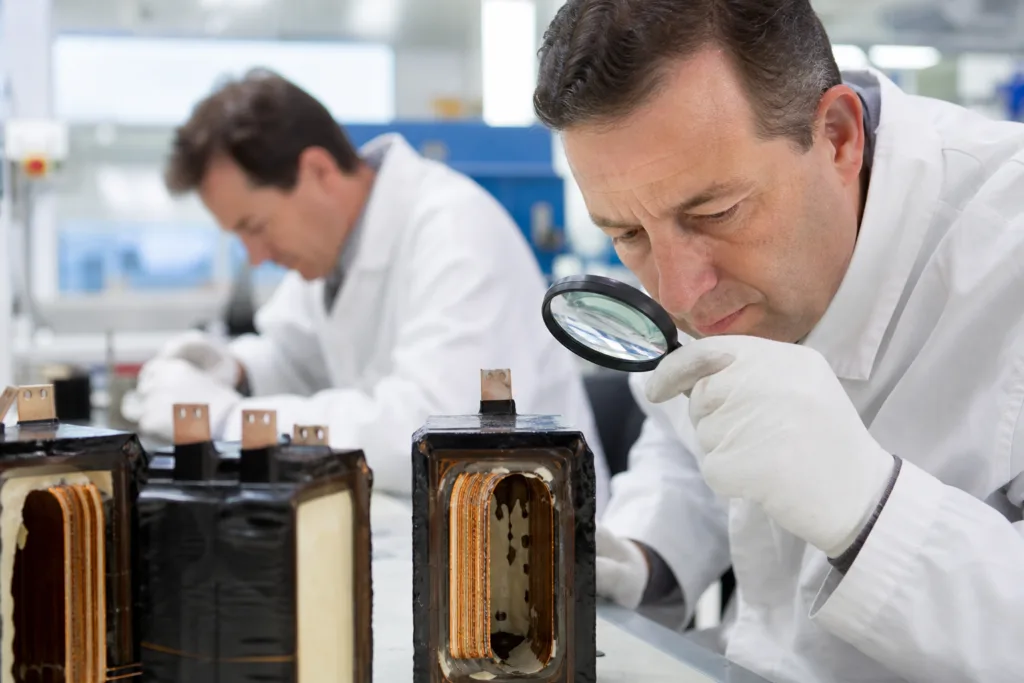
At ZDS, we approach wound-component potting as a balance of insulation, flow, stress management, and manufacturing practicality. Some customers need deeper penetration into tight coil structures. Others need higher heat resistance, better thermal conductivity, or lower cure stress on delicate bobbins and ferrites. In those cases, custom formulation work may involve adjusting viscosity, filler content, cure speed, hardness, or package format for the target process.
The key point for buyers is simple: the right material is the one that performs in the actual component and on the actual line. A generic product category is only the starting point.
Conclusion
The right potting adhesive for transformers should be selected by failure mode, operating environment, component geometry, and production method rather than by chemistry name alone. For transformers, coils, and wound electrical assemblies, the decision usually depends on electrical insulation, penetration, void reduction, heat behavior, and stress control after cure. When buyers combine real sample trials with a supplier review of viscosity, cure profile, packaging, QC, and scale-up support, they reduce both technical risk and sourcing risk.
For most projects, the most reliable path is to start with a shortlist, test on actual components, section the samples, and compare not just datasheet claims but cured results under realistic conditions.
FAQs
What is the most important property in a potting adhesive for transformers?
The most important property depends on the application, but for many transformer and coil designs the key combination is electrical insulation, low-void filling, and manageable cure stress. A material with high nominal strength is not automatically the right choice if it cannot penetrate winding gaps or if it shrinks enough to stress wire and ferrite during cure.
Should I choose epoxy, polyurethane, or silicone for coil potting?
Epoxy is often chosen for strong adhesion, stable insulation, and durable encapsulation, polyurethane for flexibility and vibration damping, and silicone for soft stress relief and broad temperature flexibility. The right choice depends on whether your design is driven more by heat, vibration, substrate sensitivity, or deep impregnation needs.
How can I tell if a potting material really fills internal winding voids?
The most practical method is to pot real samples and then cut cross-sections to inspect the internal fill quality. Top-surface appearance can be misleading, so sectioning, void inspection, and post-cure electrical checks give a much better picture of actual penetration and bubble control.
Can a low-viscosity potting compound create problems as well as benefits?
Yes. Lower viscosity can improve wetting and penetration, but it can also increase leakage, filler settling, or uncontrolled flow into unwanted areas if the part design or process is not ready for it. The target is not the lowest possible viscosity, but the viscosity that fits the geometry and dispensing method.
What should buyers ask a supplier before approving a potting adhesive?
Buyers should ask about viscosity range, pot life, cure schedule, dielectric test method, hardness, shrinkage behavior, thermal resistance, packaging format, shelf life, and batch consistency. It is also important to ask whether the supplier can review real component drawings or samples and support pilot-scale validation before full production.
Is sample testing necessary if the datasheet already looks suitable?
Yes. Datasheets are useful for screening, but they cannot fully predict flow behavior, void formation, adhesion on your actual substrates, or stress effects in your exact geometry. Sample trials on real parts are the most reliable way to confirm whether the material fits both the component and the production process.